

Periodization in plain English
Macro, meso, and microcycles: a practical way to organize training goals, blocks, and weeks without a spreadsheet.
Inside Kinoku
The app surfaces behind this story
 Open full-size image ↗
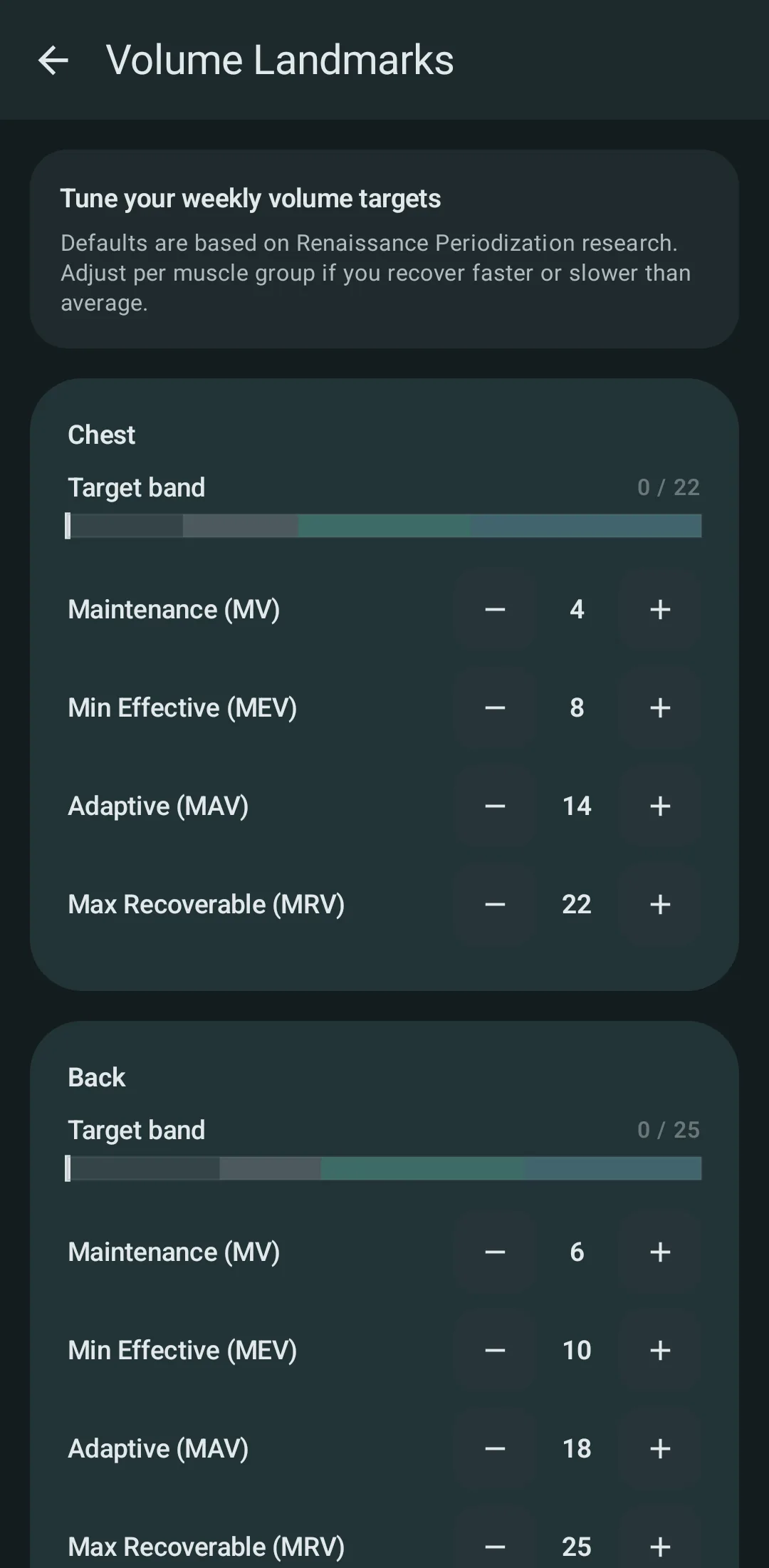
Periodization made visible
Volume landmarks and weekly guidance turn the plan into a concrete, inspectable training target.
Periodization is a family of ways to organize training over time, so the hard weeks and the easy weeks land on purpose rather than by chance. Macro, meso, and microcycles are one common set of names for it: the larger goal, the blocks that support it, and the week in front of you. This is the walk-through in plain words, with no spreadsheet and one squat example carried all the way through.
The big idea
Training creates both a stimulus (the push that makes the body adapt) and tiredness. Repeating the same hard week for months can make it harder to recover, while keeping every week equally easy may not give a goal the push it needs. Periodization varies volume, effort, and rest on purpose rather than treating every week alike.
Macro, meso, and micro describe those time scales, from the whole goal down to the week you are in.
The labels are a planning aid, not a promise
The common mix-up is treating the three words as a method that promises progress or keeps injury away. They are planning labels, so a plan written in them still stands or falls on the work inside it and on how you respond to that work. A block with the right name and the wrong load is still the wrong load.
Macrocycle: the story arc
A macrocycle is the full path toward one big goal, such as twelve weeks to peak for a powerlifting meet, sixteen weeks to train for a half marathon, or twenty-four weeks to add muscle. The goal at the end shapes it, whether that goal is a test day, a race, or a deadline.
Think of it like a movie, which has a start (where you are now), a middle (the work), and an end (the goal). All of it serves that arc, so a random muscle-building block does not land in the middle of marathon prep because you were bored. The comparison stops there, because a film plays the same way every time and a training block gets adjusted as you go.
Many goal-focused macrocycles run 8 to 24 weeks, but there is no one right length. The goal, your training age, the meet calendar, and the time you have decide the useful time frame.
Mesocycle: the training blocks
Mesocycles are shorter blocks, often several weeks long, with one main focus each. Common block types:
- Build phase (more volume, medium effort): lay the base and do the work.
- Push phase (less volume, higher effort): lift heavier and cash in the gains from the build phase.
- Peak phase (low volume, very high effort): sharpen up, shed tiredness, and arrive fresh.
- Deload (less volume and effort, 1 week): an easy week so your body can rest.
A 12-week strength plan might use 4 weeks to build, 1 easier week, 4 weeks of heavier work closer to the test, another easier week, and 2 weeks to peak. Other goals and other athletes mix the blocks in other ways, because the labels are a planning aid and the changes they aim for overlap in practice.
Blocks help keep the main variable clear: more volume for a period, heavier and more test-like work later, and less tiredness near the test. They do not remove the work of adjusting for how the athlete responds.
Microcycle: the week you’re in
A microcycle is the shortest repeating planning unit, often a week but sometimes longer or shorter. It describes the day-by-day exercises, load, volume, and rest inside the current block.
A build week might use more training days and more total reps, while a peak week might use fewer sessions and heavier, more test-like work. How often and how hard depend on the athlete and the goal. So the same person with the same goal can have a very different week, because the block is asking for something else.
A worked example
Here is an outline to show the idea, not a plan written for you. Say you currently squat 100 kg and want to prepare for a possible 120 kg attempt in 12 weeks.
Weeks 1 to 4: Build. You squat three times a week at medium effort (70 to 75% of your max) and higher reps, around 4 to 6 sets of 6 to 8, with extra work for quads, hamstrings, and core. The goal is to get used to squatting often and feeling fine.
Week 5: Deload. Same lifts, half the sets, and 60% effort, so you arrive at the next block fresh.
Weeks 6 to 9: Push. You squat twice a week at higher effort (80 to 90%) and lower reps, around 5 sets of 3 to 5, with a bit less extra work. The goal is to teach your body to handle heavy weight.
Week 10: Deload. The same easy week again, for the same reason.
Weeks 11 to 12: Peak. You squat heavy once a week and light once a week, working up to single reps at 90 to 95%, while all else just ticks over. The goal is to show up to the personal record (PR) attempt fresh and sharp.
Test day: the attempt makes sense only if the training before it and the warm-ups that day support it, because the plan cannot promise 120 kg.
Each block has one job, and each week inside it serves that block. You never try to do it all at once, and you always know why this week looks the way it does.
Where people get it wrong
The first mistake is treating the plan as untouchable. A hard session is expected in a heavy block, but pain, illness, odd tiredness, or a clear breakdown in form are reasons to adjust. One hard day neither proves nor breaks the block.
The second mistake is treating deloads as magic or as weakness. A lighter week is one rest tool, so some athletes do well with a scheduled one while others adjust when tiredness and performance call for it.
The third mistake is losing sight of the goal. A test day or race can sharpen the plan, but general training with no meet date is valid too. What matters is a time frame clear enough to review and change.
Where Kinoku fits
Kinoku’s Periodization feature is built around this three-cycle model. You pick a macrocycle, set the blocks inside it, and the calendar fills in weeks from your plan. The current app ships 15 program templates, among them general strength, hypertrophy (muscle growth), named progression, balance/flow, and longevity options. So you can start from a structure and map your own routines onto it instead of staring at a blank spreadsheet.
As of version 1.2, the builder, all 15 templates, named programs, the custom model, and unlimited active programs are free. Pro adds volume landmarks, auto set adjustment from your reps in reserve (RIR), and optional Health-signal Readiness Adaptation. The separate Pro Analytics Readiness score is a reporting surface with a different input mix, and it is not the score that writes program adjustments. Kinoku is Android only, and it has no cloud sync between devices, so the plan sits on the one phone until you move a backup file yourself.
What holds in this post is the order: a goal, then a time frame, then blocks and weeks that serve it, with room left to adjust. What changes is all that sits inside the blocks, because your response to a heavy week decides the next one and no template knows that in advance. The planning ideas above stay useful whether or not you use Kinoku.
Related features
A 4-phase planning stack. The builder, all 15 templates, named programs with auto-progression, the custom model, and unlimited active programs are free. Pro adds volume targets, readiness tuning, and auto set changes.
Plan workouts on one calendar, with no limit on how many plans you keep or how far ahead you plan. Pro adds repeating schedules (weekly, custom days, or every few weeks), drag-to-move, bring-to-today, repeat-day, and day copy.
Unlimited routines, Smart Sync, Starter Packs, and follow-along links are free. Pro adds managed Rotation Groups that cycle through several routines.
Try Kinoku
Core tracking works offline. No mandatory account. No Kinoku-hosted training-history cloud.
Get on Google Play →