

Reference calculator
FFMI Calculator
Fat-free mass index scores how much lean mass you carry for your height, so taller and shorter lifters land on the same scale. Kouri's 1995 study used it to mark a drug-free ceiling near FFMI 25.
The formula
FFMI is your lean mass in kg divided by your height in meters, squared:
fat_free_mass_kg = weight_kg × (1 − bodyFatPercent / 100)
FFMI = fat_free_mass_kg / (height_m)²
The height-adjusted FFMI corrects for lifters taller or shorter than 1.80 m, which is the version Kouri used:
adjusted_FFMI = FFMI + 6.1 × (1.80 − height_m)There is one wrinkle about that 6.1, because Kouri's abstract prints 6.3 while the paper body uses 6.1. Almost every calculator went with 6.1, so we do too, and your score stays comparable to other people's, with a gap between the two of at most 0.08.
How to read your score
These bands come from 157 male athletes, and Kouri's paper has no female data at all. Published female values run 3 to 4 points lower, so the ladder below reads a woman low.
| Adjusted FFMI | Interpretation |
|---|---|
| < 18 | Low lean mass: most untrained people sit here |
| 18 – 20 | Average lean mass |
| 20 – 22 | Above-average, typical of a consistent lifter |
| 22 – 24 | Advanced natural lifter, years of consistent training |
| 24 – 25 | Elite natural: at or near the natural ceiling |
| 25 – 26 | Edge of the natural distribution (Kouri cutoff was ~25) |
| > 26 | Beyond Kouri's upper natural limit; statistically rare without enhancement |
About the natural-limit reading
Kouri (1995) measured 157 male athletes, 83 who used anabolic steroids and 74 who did not. The 74 gave urine samples that came back clean, though they were a gym sample rather than a screened elite group. The height-adjusted FFMI of the clean group topped out at 25.0, and the paper's own words for that were "must be regarded as preliminary".
So 25 is where one small group stopped rather than a law of the body, though it gets quoted as one a lot.
Body-fat methods vary a lot too, so a DEXA scan (the clinical body-composition x-ray) reads tight while a tape estimate reads loose. A 5-point miss on body fat moves FFMI by about a point, which is why your number reads best as a range.
FFMI vs DOTS (bodyweight-adjusted strength)
DOTS scores how much you lift for your bodyweight, while FFMI scores how much muscle you carry for your height, so the two ask different questions. A wiry lifter can be strong with a modest FFMI, and a big, muscular person can post a middling DOTS without meet training.
Common questions
What is a good FFMI (fat-free mass index)?
Most untrained adults sit below 18, while a lifter who trains steadily usually lands between 20 and 22. Advanced natural lifters reach 22 to 24 after years of work, and above 25 is the edge of the natural range. These numbers all refer to the height-adjusted version.
What is the highest natural FFMI?
Kouri's 1995 study found drug-free lifters topped out near an adjusted FFMI of 25. Later work put the real range closer to 25 to 26, with a rare few reaching 26 to 27. The real range reads best as a fuzzy band rather than a hard ceiling.
What is adjusted FFMI?
Plain FFMI slightly favours shorter people, because lean mass does not scale with height squared as neatly as the formula assumes. The adjusted version corrects back to a reference height of 1.80 m, and it is the version the natural-limit numbers refer to.
How accurate is an FFMI calculator?
The result is only as accurate as your body-fat number, so a DEXA scan (a clinical body-composition x-ray) reads close while calipers sit within a few points and a smart scale moves with how hydrated you are. A 5-point miss on body fat shifts FFMI by more than a point, so yours reads best as a range.
Privacy
Your height, weight, and body-fat number never leave the page, because the maths runs in your browser and nothing is stored between visits. The calculator makes no network requests at all, so nobody can intercept or log what you type.
Full story
The FFMI explainer in the Learn section covers the height adjustment, where the natural-ceiling number came from, and how far off your score can be.
Track this in Kinoku
The Strength Standards feature scores FFMI next to DOTS and Wilks, and it reads the body-fat number from your profile and rescores when you change it. Strength Standards sits inside Pro Analytics, which costs money, while this page does not.
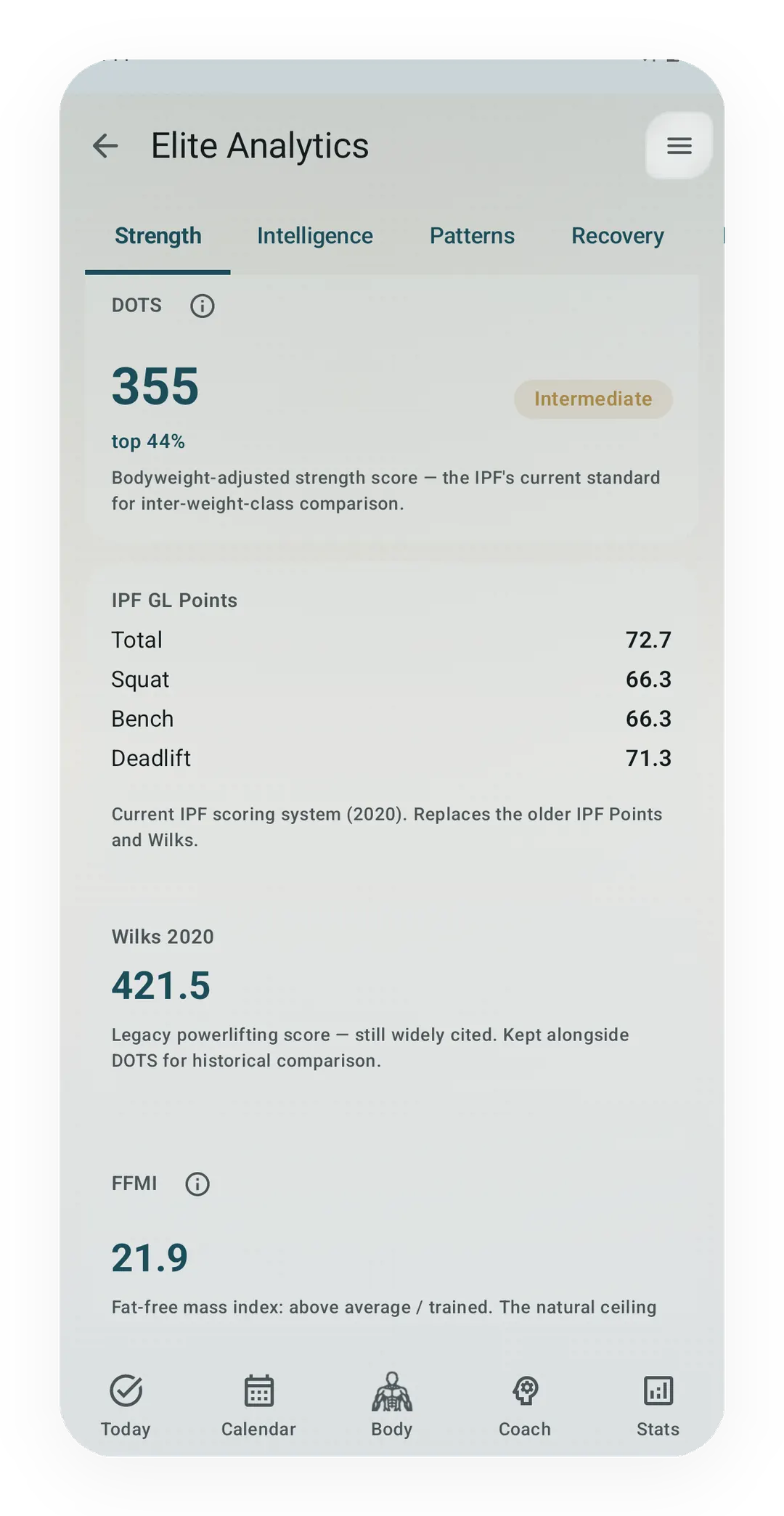
Pro Analytics → Strength tab
Type your body fat once into your profile and the app keeps the FFMI current, instead of you retyping it here every few weeks.
ProPart of Pro. The free tier still records the training it reads from.
Track this in the app
Strength Standards
DOTS, IPF GoodLift, Wilks 2, and FFMI with offline percentile tables. Published tools widely used in strength sport.