

Strength Standards
DOTS, IPF GoodLift, Wilks 2, and FFMI scores that compare lifters across body weights. Worked out on your phone, fully offline.
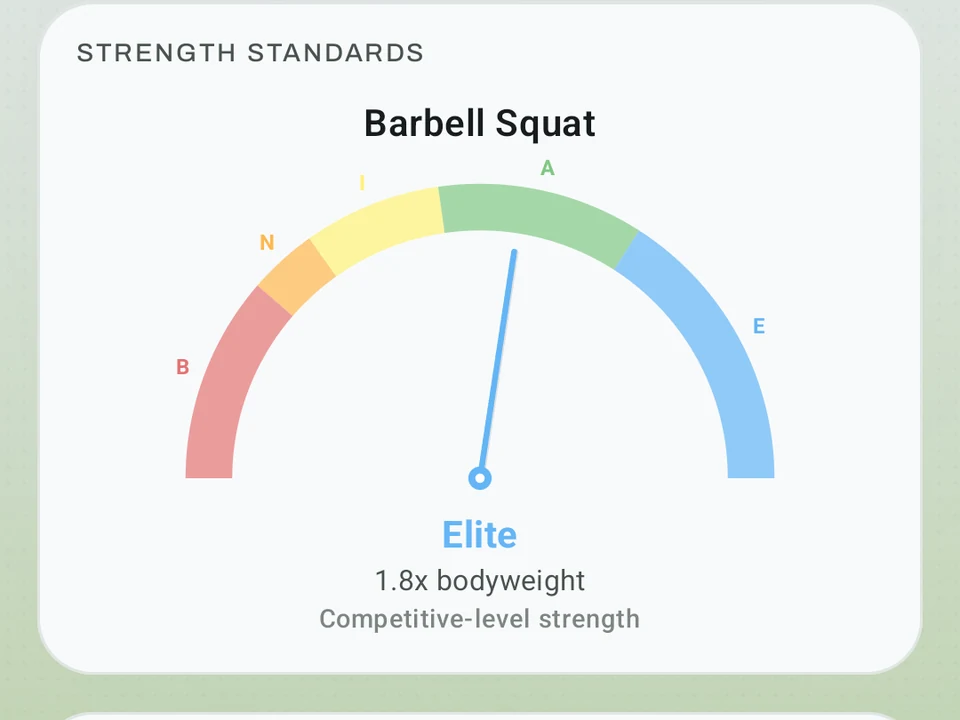
Real app capture
What this feature looks like with data
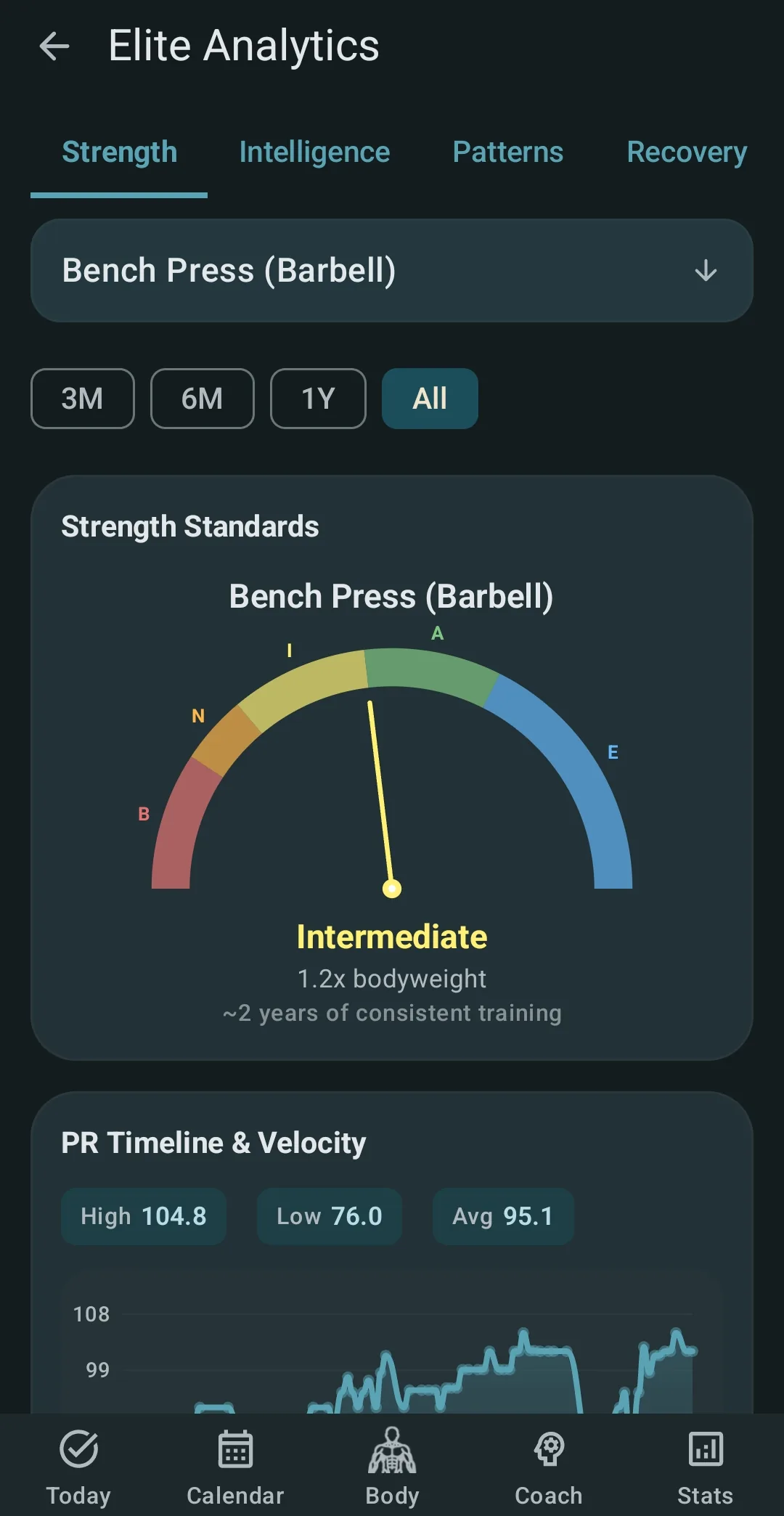 Open full-size image ↗
Standards with the inputs visible
The Strength Standards surface shows the selected lift, bodyweight-relative context, and populated comparison rather than a mystery rank.
What it is
Strength Standards are scores that let you compare lifters who weigh different amounts. A 60 kg lifter and a 100 kg lifter can both bench a big number, and the raw total says nothing about which of them is stronger for their size. Kinoku works out four of these scores from the lifts you have already logged.
- DOTS (a total scored against body weight) is the score most powerlifting federations use now, and it took over from Wilks around 2019 and 2020.
- IPF GoodLift (GL) is the score the International Powerlifting Federation uses to rank lifters at its own meets.
- Wilks 2 is a 2020 update of the older Wilks formula, and plenty of federations still post records in it.
- Fat-free mass index (FFMI) rates how much muscle you carry for your height, which is worth watching when you train for size.
All four run on your phone, with no internet connection and no account involved, so you supply your total and your body weight and the score comes back. The math never leaves your device.
One lift, scored four ways
One lift shows why the four differ: a 140 kg bench at 82 kg body weight. The weight on its own tells you very little, while the same lift measured against your body weight lands in the top 8% for your age and becomes something you can place. Each formula puts that bench in a slightly different spot, because they were built in different years from different pools of results.
The percentile chip
When your score lands in the top half, Kinoku adds a small chip that reads “top X%” beside it. A bare score is a number you have to learn to read, while a chip naming your place in the field is a line anyone gets.
The percentiles come from public meet results, and they are honest about who those results cover. The pool is trained lifters who compete, not everyone who trains, so the bar here is a harder one.
Strength ratios
The Strength tab also shows how your lifts balance against one another, and every ratio carries a target range.
- Hamstring to quad: often 0.6 to 0.8.
- Bench to overhead press: often 1.5 to 1.7.
- Push to pull: close to even, with some room on either side.
- Deadlift to squat: often 1.1 to 1.3.
A ratio that drifts well outside its band can flag an imbalance worth checking against your training history and how you feel. Ratios are context rather than a guess about any one person’s injury risk.
A trend line with its margin
Kinoku fits a trend line through your last 12 weeks of estimated one-rep maxes on each lift, and it hands you three readings. You get the smoothed path your recent work has taken, plus a margin of error showing how much the data bounces around. The third is a days-to-goal figure, always a range rather than a fixed date, such as a three-plate bench roughly 47 days out.
When the data is too noisy to read, Kinoku says “not enough to project yet” instead of making up a date for you. Twelve weeks of scattered sessions produce a wide margin, and a wide margin is the honest answer.
Why four scores and not one
Nobody agrees on a single right score, and each of these carries its own history.
- DOTS (2019) is the standard across federations for classic powerlifting, and it smooths out some Wilks quirks at very light and very heavy body weights.
- IPF GoodLift (2020) is the federation’s own score for its own meets, so a lift at one of those meets goes on record with this number.
- Wilks 2 (2020) updates the first Wilks formula from 1994, which Vanderburgh and Batterham tested on top lifters in 1999. Some federations still post their records in it.
The same lift gives a different value under each one, so Kinoku shows them together with their percentile chips and lets you follow whichever fits your goal. For the original 1994 Wilks score, useful only for matching records set before 2020, there is a web Wilks calculator.
Where the numbers come from
The formulas are written up on the methodology page, covering the DOTS curve, the IPF GoodLift parameters, the Wilks 2 values, and the height fix inside FFMI. The sources are the federation’s own published rules and Kouri and colleagues in 1995 for the fat-free mass index.
For reading the scores rather than doing the math, the DOTS pillar article goes deeper, and Wilks vs DOTS vs IPF GL helps you choose which one to follow.
Privacy
The scoring needs no network call, because the percentile tables ship inside the app as files and load when it starts. Results are not uploaded to a Kinoku server, though eligible main-app data may still enter Android system backup.
Part of Pro
The four scores sit in Pro. Every lift and every record they are worked out from is tracked for free, so the data underneath them is yours at any tier. Pro adds the comparison across body weights and the trend line with its margin.
Related surfaces
A Pro hub with five core tabs, plus a Cycle tab when cycle tracking is on. Its 20+ features include strength scores like DOTS, IPF GL, Wilks, and FFMI, the Banister Form Band, plateau alerts, ACWR, muscle balance, and cycle links.
Charts per exercise, PRs, your best one-rep estimate, volume trends, and date filters. Every exercise type gets a chart that fits it: Best, Total, and Avg Time for holds, Best and Total Reps for rep work, and Best and Total Distance for distance work, not just weight charts.
132 achievements across 13 groups. The whole ladder stays visible; 24 of them and the Achievement Timeline require Pro.