

Reference calculator
Wilks Calculator
Wilks scores how strong you are for your bodyweight on one scale, and this page runs two versions: the first Wilks from 1994, and the Wilks 2 redo from 2020. Many federations still list records in Wilks, even after the International Powerlifting Federation (IPF) moved on to DOTS (the cross-federation score) and then to IPF GL (GoodLift).
The formula
Wilks runs your bodyweight (in kg) through a fifth-degree polynomial, a long math curve, then multiplies the result by your total. The numbers in the curve change with the version and your sex, and so does the number on top:
Wilks 1 (1994):  coefficient = 500 / (A + B·x + C·x² + D·x³ + E·x⁴ + F·x⁵)
Wilks 2 (2020):  coefficient = 600 / (A + B·x + C·x² + D·x³ + E·x⁴ + F·x⁵)
Wilks = total × coefficient
The 500 against 600 is the part most calculators get wrong, including this one until August 2026. Using 500 for both makes every Wilks 2 score exactly five sixths of its true value.
Wilks 1 (1994), male lifters, six coefficients in ascending powers:
-216.0475144, 16.2606339, -0.002388645, -0.00113732, 7.01863e-6, -1.291e-8Wilks 1 (1994), female lifters, the same six positions:
594.31747775582, -27.23842536447, 0.82112226871, -0.00930733913, 4.731582e-5, -9.054e-8Wilks 2 (2020), male lifters, the six that came out of the refit:
47.4617885411949, 8.47206137941125, 0.073694103462609, -0.00139583381094385, 7.07665973070743e-6, -1.20804336482315e-8Wilks 2 (2020), female lifters, the last of the four sets:
-125.425539779509, 13.7121941940668, -0.0330725063103405, -0.0010504000506583, 9.38773881462799e-6, -2.3334613884954e-8Bodyweight is capped at the edge of each version's fitted range before the curve runs: 40 to 201.9 kg for Wilks 1 men, 26.51 to 154.53 for Wilks 1 women, 40 to 200.95 and 40 to 150.95 for Wilks 2. Past those edges the polynomial turns over and the score starts climbing with bodyweight instead of falling.
Wilks 1 vs Wilks 2
The first Wilks from 1994 read a bit off, so Robert Wilks refit it in 2020 on a bigger and newer pool of lifters. Most federations now post both, plus DOTS or IPF GL for new rankings.
The two are not interchangeable and they are not close. Because of the 600 numerator, a Wilks 2 score runs about 18 to 22% above a Wilks 1 score for the same lifter, right across normal bodyweights, which is why this page carries a separate band ladder for each version.
Why this still matters
Federation records from the 1990s through the mid-2010s are in Wilks 1 points, so Wilks 1 is the one you want when you are matching an old record or ranking. A 2021 or later record may be Wilks 2, DOTS, or IPF GL, depending on the federation.
Common questions
What is a good Wilks score?
On the Wilks 1 scale, 300 is a solid intermediate score, 400 is advanced and 500 is elite at regional or national level. Wilks 2 sits about 20% higher for the same lifter, so the matching rungs there are 360, 480 and 600. The women's curve is scaled so the same bands mean the same thing.
What is the difference between Wilks 1 and Wilks 2?
Wilks 1 is the original 1994 curve, while Wilks 2 is the 2020 refit on a larger and newer pool of results. They also use different numbers on top of the fraction, 500 against 600, so a Wilks 2 score runs roughly 18 to 22% above a Wilks 1 score for the same lifter, and the two are not interchangeable at any bodyweight.
Is Wilks still used?
Less than it was, because most federations moved to DOTS (the cross-federation score) or IPF GoodLift, from the International Powerlifting Federation, around 2020. Wilks still matters for reading records set between 1994 and about 2020, since those were stored in Wilks 1 points, and some organisations still post Wilks 2 next to newer scores.
Why does my Wilks differ from another site?
Usually because the two sites are running different versions. A Wilks 1 score and a Wilks 2 score for the same total differ by about 20%, and many calculators do not say which one they use. Switch the version toggle here and you can see the gap for your own numbers.
Privacy
Nothing you type here leaves the page, because the maths runs in your browser and nothing is stored between visits. The calculator makes no network requests at all, so there is nothing to intercept and nothing to log.
Full story
The Wilks explainer in the Learn section covers what the 2020 refit changed, what a good score looks like, and when the 1994 version is still the one you want.
Track this in Kinoku
The Strength Standards feature scores Wilks 2 next to DOTS, IPF GL, and fat-free mass index (FFMI) from your training record. Wilks 1 stays on this web page so you can look up old federation records that used the 1994 formula, while the app sticks to Wilks 2, the version federations rank in today. Strength Standards is a paid part of the app, and the DOTS calculator here costs nothing.
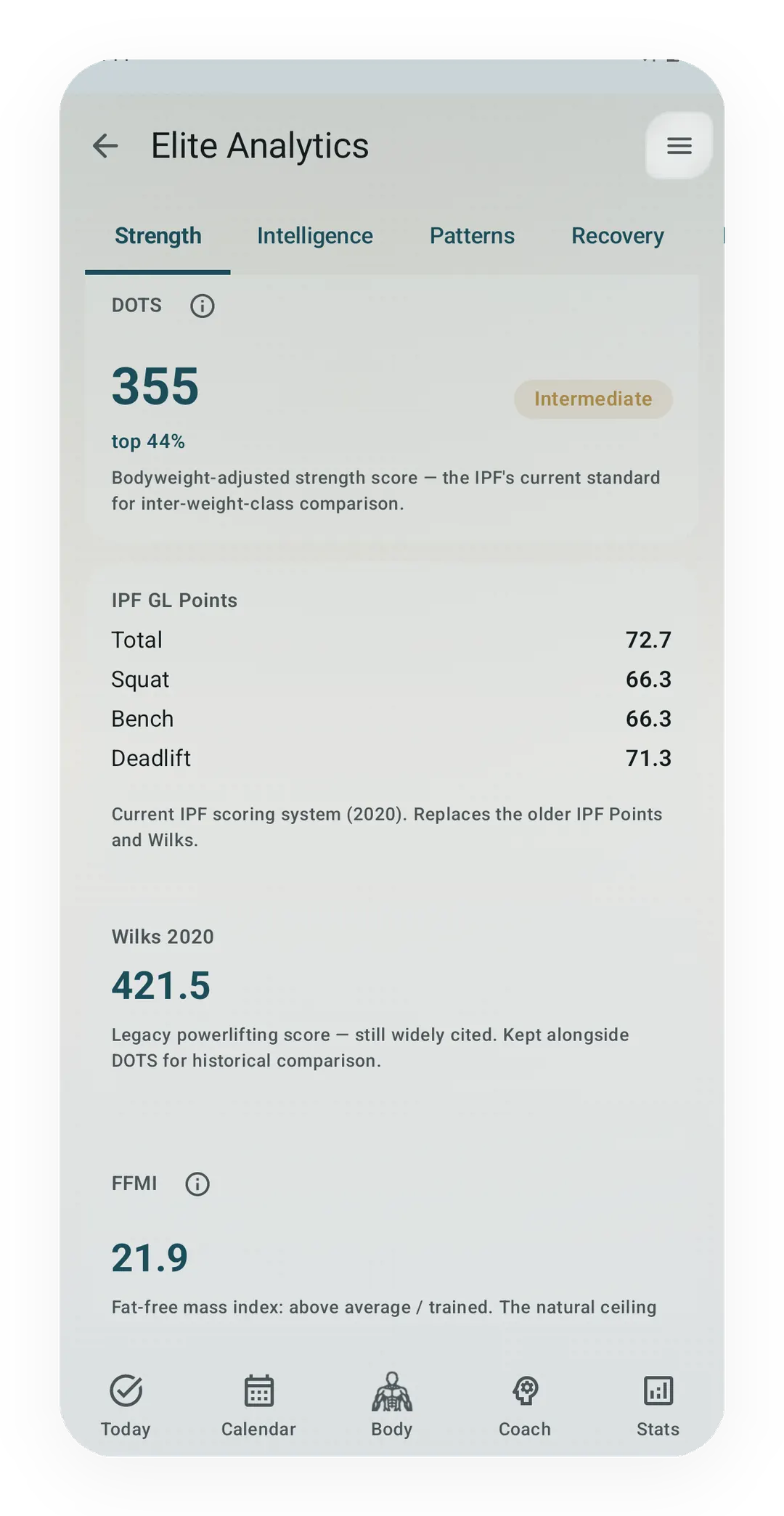
Pro Analytics → Strength tab
The card labelled Wilks 2020 is the same score this page calls Wilks 2, kept next to DOTS so you can read the old number and the current one together.
ProPart of Pro. The free tier still records the training it reads from.
Track this in the app
Strength Standards
DOTS, IPF GoodLift, Wilks 2, and FFMI with offline percentile tables. Published tools widely used in strength sport.