

Reference calculator
DOTS Score Calculator
DOTS (a bodyweight-adjusted strength score) rates how strong you are for your size, and it adjusts for sex too, so a 60 kg lifter and a 120 kg lifter land on one scale. Tim Konertz wrote it in 2019 for the German federation, and most federations outside the International Powerlifting Federation (IPF) now use it.
Compute
The formula
DOTS runs your bodyweight in kg through a curve to get a coefficient, and multiplying your total by that coefficient gives your DOTS. Men and women use different numbers in the curve.
coefficient = 500 / (A + B·x + C·x² + D·x³ + E·x⁴)
DOTS = total × coefficient

Bodyweight is capped to the fitted range first:
  men 40 to 210 kg, women 40 to 150 kg
Male lifters run through these five coefficients, listed from A to E:
A =  -307.75076
B =    24.0900756
C =    -0.1918759221
D =     0.0007391293
E =    -0.000001093
Female lifters run through a different five, in the same order:
A =  -57.96288
B =   13.6175032
C =   -0.1126655495
D =    0.0005158568
E =   -0.0000010706
The curve is set so that strong meet totals land between 300 and 600.
How to read your score
Nobody official publishes DOTS bands, not the IPF and not the people who wrote the formula, so these five are only a convention. They are the same five Kinoku uses in the app.
The percentiles beside them are real, though, and they come from OpenPowerlifting results, raw classic totals from 2020 to 2024 in tested federations, the same file the app scores against. One thing to keep in mind is that the group is people who enter meets, so against gym lifters any DOTS ranks higher than the table says. Every anchor row, for men and for women, is on the strength standards by body weight page.
| DOTS | Band | Percentile among competing men |
|---|---|---|
| Under 200 | Beginner | Below the 2nd |
| 200 to 300 | Novice | 2nd to 30th |
| 300 to 400 | Intermediate | 30th to 75th |
| 400 to 500 | Advanced | 75th to 96th |
| 500 and up | Elite | 96th and up |
The women's curve sits 20 points lower at every percentile, so a woman at DOTS 380 ranks where a man at DOTS 400 does. The calculator picks the right curve for you.
DOTS vs Wilks vs IPF GL (GoodLift)
DOTS took over from Wilks around 2019 and 2020, because Wilks read a bit off at the light and heavy ends. DOTS uses a cleaner pool of lifters and fixes most of that.
The IPF runs its own newer score for sanctioned meets called IPF GoodLift (GL), and it changes by event. It uses one set of numbers for raw lifting and another for geared lifting, and it splits three-lift totals from single-lift events. GL and DOTS do not line up one to one, but both ask the same thing: how strong are you for your size? If you are not sure which to watch, Wilks vs DOTS vs IPF GL makes the call in one page.
Kinoku shows DOTS, IPF GL, Wilks 2, and fat-free mass index (FFMI) in the app, so you can read one total four ways. The Wilks calculator on this site also runs the old Wilks 1 (1994) score, which is handy for checking old federation records. See "Reading the DOTS Score" in /learn for the full story.
Common questions
What is a good DOTS score (strength adjusted for bodyweight)?
Around 300 is solid, and most people who train steadily for a few years reach it. 400 is advanced, around the 75th percentile among competing men and the 82nd among competing women, while 500 is elite, around the 96th. Those percentiles come from tested meet results, so they are a harder bar than a gym crowd.
How is DOTS calculated?
Your bodyweight in kilograms runs through a fourth-degree curve, which gives you a coefficient. Multiply your three-lift total by that coefficient and you get your DOTS. Men and women use different numbers in the curve, so the scale means the same thing for both.
Is DOTS better than Wilks?
For most lifters, yes, because DOTS redrew the curve on a bigger and newer pool of results, so it reads fairer at the light and heavy ends. Wilks is still handy for checking older federation records.
Is anything I type here sent anywhere?
No, because the maths runs in your browser and the calculator makes no network requests at all, so there is nothing to intercept and nothing to log, and nothing is saved between visits either.
Privacy
This calculator runs in your browser, so scoring your lift takes no network call at all. Nothing you type is saved or logged, which means there is nothing to intercept and nothing to hand over.
Track this in Kinoku
The Strength Standards feature scores DOTS, IPF GL, Wilks, and FFMI from your training record, with percentiles from offline tables, and it is part of Pro Analytics, so it costs money while this page does not.
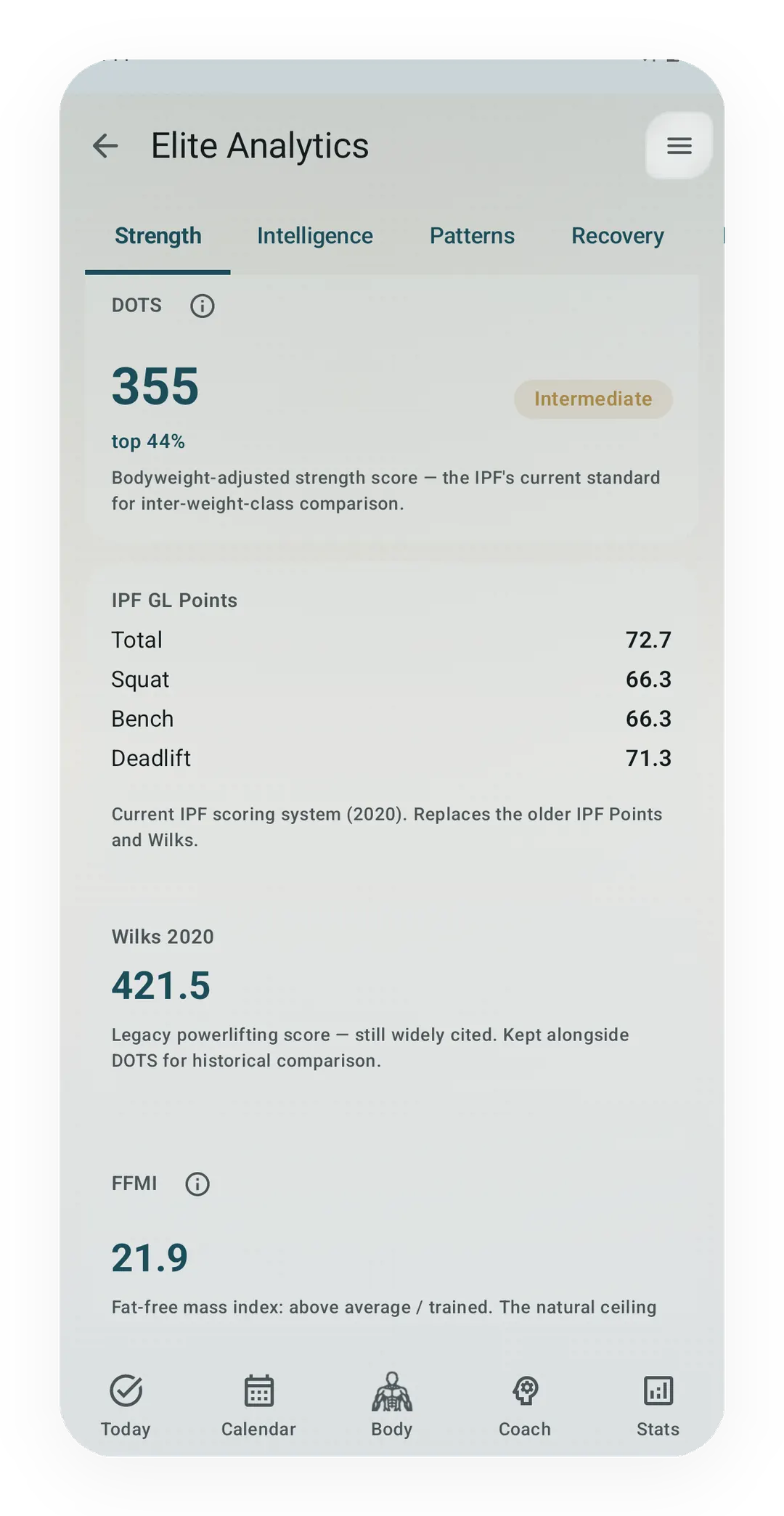
Pro Analytics → Strength tab
The DOTS you work out here from one total, the app works out from your logged lifts, and keeps rescoring it as they change.
ProPart of Pro. The free tier still records the training it reads from.
Track this in the app
Strength Standards
DOTS, IPF GoodLift, Wilks 2, and FFMI with offline percentile tables. Published tools widely used in strength sport.