

Reading the DOTS Score: Are You Actually Strong?
DOTS is the score that rates lifting strength fair across body weights. How it works, how to read yours, and how it stacks up to Wilks and IPF GL.
Kinoku in practice
Where this shows up in the app
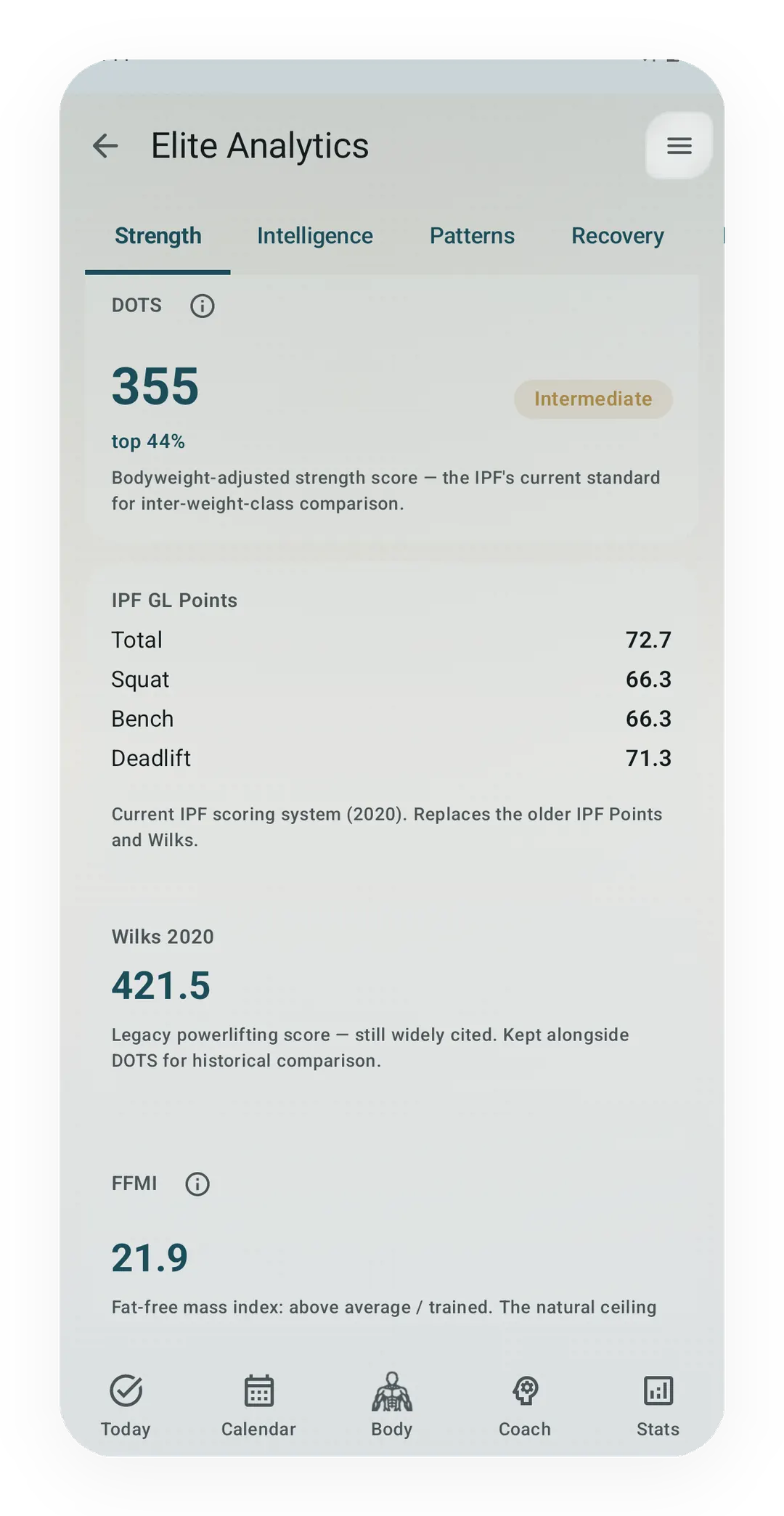 Open full-size image ↗
DOTS beside the other scores
The Strength Scores surface keeps DOTS, bodyweight, and lift inputs together so the result can be interpreted.
Quickstart
DOTS (a formula that scores lifting strength across body weights) answers one question: how strong are you for your body weight and sex? It puts a 60 kg lifter and a 120 kg lifter on the same scale, and it succeeded the old Wilks score around 2019 and 2020 across most federations. Wilks was unfair at the very light and very heavy ends, and DOTS fixes most of that.
Here are rough landmarks. They are for raw lifters with no drug testing and no gear:
- DOTS 300: solid. Most people who train for a few years reach this.
- DOTS 400: advanced. In Kinoku’s shipped reference table, it is about the 75th percentile for men and the 82nd for women among competing raw lifters.
- DOTS 500: elite. Strong at any body weight.
- DOTS 600+: world class. Rare, or drug-tested record turf.
DOTS is not a law of physics but a score with choices built in, and knowing how it works helps you read your own number with clear eyes.
What problem does DOTS solve?
Raw total is not fair when two lifters weigh different amounts. A 120 kg deadlift at 60 kg body weight is a 2.0x pull, and a 220 kg deadlift at 110 kg body weight is also 2.0x. Both are real strength, but you can’t lay one over the other and call it even.
What you want is a score that levels the field across body weights, so you can compare, and that is the whole job of a strength score.
A few have been used over the years:
- Wilks: from 1994, and the one that ruled the sport from the mid-90s to 2020. Schwartz and Malone predate it by about twenty years.
- Schwartz-Malone: seen in older US meets. Many GymRat scores were based on it.
- Glossbrenner: popular in some regions. Still seen at some state meets.
- DOTS: the 2019 successor to Wilks, written by Tim Konertz for the German federation. Most federations outside the IPF (International Powerlifting Federation) use it, and the IPF went its own way with GoodLift (GL) Points.
- IPF GoodLift (GL): the IPF’s own score. Adopted in 2020 for IPF meets. It splits by event and is more fine-grained than DOTS.
DOTS caught on for three reasons: it is open, so anyone can use the curve; it fixes the Wilks bias at very light and very heavy body weights; and its curve stays sensible at the edges.
How is DOTS calculated?
DOTS runs your body weight x (in kg) through a fourth-degree curve to get a coefficient, then multiplies your total by it. The values A through E differ for men and women, and they are published in the DOTS spec. Lighter lifters get a bigger bonus, heavier lifters a smaller one. The 500 on top is just a scaling choice.
coefficient = 500 / (A·x⁰ + B·x¹ + C·x² + D·x³ + E·x⁴)
DOTS = total · coefficient
The idea is plain: the curve sets a body-weight bonus for each weight, and past a point, more body weight does less to explain more strength. That 500 on top keeps most scores in the 100 to 700 range.
Is DOTS better than Wilks?
At the light and heavy ends, yes. Wilks uses a fifth-degree curve; DOTS uses a fourth-degree one. Wilks values were too kind at the very heavy end (over 140 kg) and too harsh at the very light end (under 53 kg). DOTS redrew the curve with a bigger, cleaner dataset, so it is fairer at the edges.
The second difference is age scaling, which neither Wilks nor DOTS does on its own. DOTS pairs cleanly with age charts like the IPF’s, while Wilks age-scaled scores were shaky for older lifters.
In real use, the two are close for a mid-weight lifter (80 to 100 kg). For a 60 kg or a 140 kg lifter, DOTS tracks the truth better.
What is the difference between DOTS and IPF GL?
The IPF went one step past DOTS, and for its own meets it started using IPF GoodLift (GL) in 2020, a score that splits by event: raw and equipped get separate values, and so do the classic 3-lift total and bench-only meets. The numbers come out on a different scale than DOTS, where a GL near 100 is about world-record class for that event.
Equipped means squat suits, bench shirts, and the like. The official IPF table does not define squat-only or deadlift-only coefficients.
If you compete in IPF meets, GL is the number that sets your world ranking. If you just track your gym lifts over time or against friends, DOTS is the score most apps and spreadsheets use. The full decision, with Wilks in the mix, is on the Wilks vs DOTS vs IPF GL page.
Kinoku shows DOTS, IPF GL, Wilks 2, and FFMI (Fat-Free Mass Index) in the app, so you can read the same total four ways. The web Wilks calculator also gives you the old Wilks 1 (1994) score, which is handy for matching old federation records that used it.
What does DOTS not tell you?
DOTS compares you with other lifters at your body weight, so three things it cannot see are worth keeping in mind:
DOTS compares; it does not track week-to-week progress
Your DOTS rises when any of your three lifts rise, and over months it shows whether you are getting stronger after any body-weight change. But it moves slowly, and two good weeks barely shift it, so for week-by-week progress watch your lifts one by one.
DOTS does not know about doping
The charts you are scored against mix tested and untested lifters. A 500 DOTS in an untested federation is strong, while a 500 DOTS in a strict tested IPF raw division is stronger still, and the number alone won’t tell you which crowd you stand in.
Kinoku uses charts built from an OpenPowerlifting composite of raw classic totals from 2020 to 2024, filtered to tested federations. That set leans toward the stricter, tested-raw end on purpose, which is a harder bar but a more honest one for most serious lifters.
DOTS does not know your body type
Two lifters at 90 kg with the same DOTS can be built very differently: one is 175 cm and lean, the other 185 cm with more mass to move. DOTS treats body weight as the only body number, which is fine for most use, but when it matters you can pair it with FFMI or a body-fat-aware score.
What is a good DOTS score?
DOTS 300 is solid, 400 is advanced, and 500 is elite. Nobody official publishes DOTS bands, not the IPF, OpenPowerlifting, or the people who wrote the formula, so every band chart you have seen, including this one, is somebody’s opinion.
What is not opinion is the percentile column, which comes from an OpenPowerlifting composite of raw classic totals from 2020 to 2024, filtered to tested federations, the same reference file the app scores against.
| DOTS | Band | Percentile among competing men |
|---|---|---|
| Under 200 | Beginner | Below the 2nd |
| 200 to 300 | Novice | 2nd to 30th |
| 300 to 400 | Intermediate | 30th to 75th |
| 400 to 500 | Advanced | 75th to 96th |
| 500 and up | Elite | 96th and up |
In Kinoku’s shipped reference table, the women’s anchors sit 20 DOTS points below the men’s anchors at the same percentile, which is a property of this app reference set rather than part of the DOTS formula itself. All 22 anchor rows, men and women, are printed on the strength standards by body weight page.
One thing worth saying plainly: the percentile depends on the reference group and sex. In Kinoku’s shipped table, DOTS 400 interpolates to about the 75th percentile for men and lands at the 82nd-percentile anchor for women. For men, the top 10 to 15% begins closer to DOTS 440 to 450 in this reference set.
And the reference group matters, because these are people who enter meets, so against everyone who trains, any given DOTS ranks higher than the table says.
A DOTS 400 at a real meet means a lot, while a DOTS 400 on a gym squat PR (personal record) day, with a spotter and a soft depth call, is a gym number. Both are yours, and it helps to know which is which.
Does DOTS adjust for age?
No. DOTS on its own does not adjust for age, and neither does Wilks. The IPF’s age classes add a second number that multiplies your DOTS or GL, which is how a 65-year-old with a DOTS of 350 can rank next to a 28-year-old at DOTS 400.
Kinoku does not do this, and Strength Standards shows the raw score only. Age factors are a reasonable thing to add, and they are not built yet.
What is the difference between DOTS and FFMI?
DOTS rates strength for your body weight, while FFMI (Fat-Free Mass Index) rates how much muscle you carry for your height. These ask different things, and both show on the Strength Standards tab, since most lifters want both when they size up where they stand. Drug-free lifters tend to land around FFMI 22 to 25.
FFMI = fat_free_mass / height² (kg and meters)The upper edge is near 25 to 26 (Kouri 1995 is the key paper). Serious enhanced lifters can reach 30 and up.
Track this in Kinoku
The Strength Standards feature works out DOTS, IPF GL, Wilks 2, and FFMI from your own logs, and it all runs on your device with charts that ship inside the app. The Pro Analytics Strength tab shows these scores next to your PR timeline, your strength forecast, and your compound lift ratios.
You can also try the DOTS calculator without the app. It runs the same coefficients, the same bodyweight clamp and the same five bands, and a shared test fixture holds both to published reference values.
References
Track this in the app
Strength Standards
DOTS, IPF GoodLift, Wilks 2, and FFMI with offline percentile tables. Published tools widely used in strength sport.
Core tracking works offline, with no mandatory account.
Related features
DOTS, IPF GoodLift, Wilks 2, and FFMI with offline percentile tables. Published tools widely used in strength sport.
A Pro hub with five core tabs, plus a Cycle tab when cycle tracking is on. Its 20+ features include strength scores like DOTS, IPF GL, Wilks, and FFMI, the Banister Form Band, plateau alerts, ACWR, muscle balance, and cycle links.
Charts per exercise, PRs, your best one-rep estimate, volume trends, and date filters. Every exercise type gets a chart that fits it: Best, Total, and Avg Time for holds, Best and Total Reps for rep work, and Best and Total Distance for distance work, not just weight charts.