

Polarized 80/20 training, explained
What polarized 80/20 training means, what the research does and does not show, and how to use it as one possible intensity-distribution model.
Inside Kinoku
The app surfaces behind this story
 Open full-size image ↗
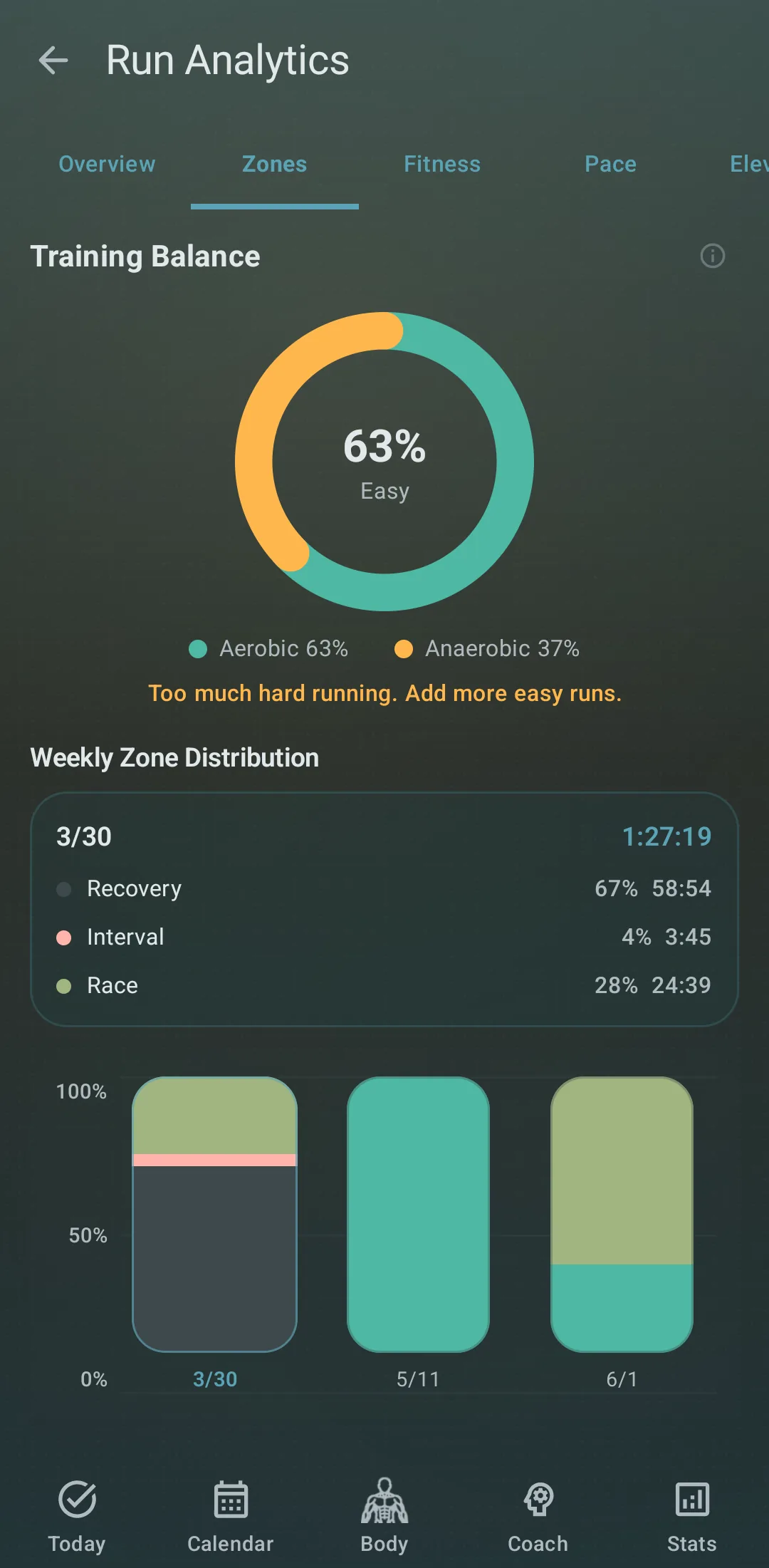
The 80/20 split in the app
Zone Training shows easy and hard work across the week so polarized balance is readable at a glance.
Polarized training puts most of your running at a low effort, a smaller share at a high effort, and little in between. Research on how elite endurance athletes train made the model well known. It is also one of the splits Kinoku’s Zone Training feature can help you inspect. If your running has stalled, the way your time splits between easy and hard is one place worth a look. It is not the only possible cause, though, and no single split fits each runner or each phase of a season.
The five-zone model
Kinoku shows run effort in five zones based on heart rate or pace. Research papers often group those into three broader bands, so a five-zone label in the app does not map one-to-one onto each study.
| Zone | How hard | What it feels like |
|---|---|---|
| 1, Recovery | Very easy | Could chat all day |
| 2, Easy | Easy | Full sentences, nose breathing is fine |
| 3, Tempo | Medium-hard | Short sentences, breath picks up |
| 4, Threshold | Hard | One word at a time |
| 5, Interval | Very hard | Can’t talk |
Many endurance programs put most of the miles at an easy effort and use smaller doses of threshold or interval work. The exact split varies by sport, athlete, season, and how the effort is counted.
Why too much moderate work can become a problem
Zone 3 is the tempo range, which is real work but harder to recover from than an easy run. Tempo and threshold sessions can be worth doing, so the concern is not that the zone is wasted. The concern is that doing most sessions medium-hard can leave too little easy volume and too little freshness for the sessions meant to be hard.
Take a runner whose weekly chart shows most of the time in zone 3. Two things tend to follow:
- Medium-hard work adds tiredness that changes the next day’s plan.
- When each run drifts there, easy days stop serving as easy volume and hard days may lose quality.
That pattern can be worth fixing, but it does not prove why a given runner is tired or stalled.
The 80/20 heuristic
“80/20” is a rule of thumb, not a law. For the runner above it would mean roughly 80% of running time in zones 1 and 2 and roughly 20% in zones 4 and 5, with zone 3 used on purpose rather than by drift. A recent systematic review and meta-analysis (a study that pools the results of earlier trials) found a small edge for polarized training on VO2 peak (the top rate of oxygen use measured in a test). Time-trial results and other outcomes were much the same as with other splits. Studies that watched what elite athletes did also show other splits across sports and phases of a season.
The test you can run yourself is simple. Easy runs stay easy enough to recover from, and harder work goes in on purpose. The split then gets judged by how you respond rather than by hitting an exact percent.
How Kinoku scores it
Supported runs with enough pace or heart-rate data feed the weekly zone chart. As the record builds up, the chart shows how much time landed in each zone and how that split changes. That is where the runner above would watch zone 3 shrink week by week, though the chart does not say why performance stalled.
Kinoku also computes a Training Effect score from 0.0 to 5.0 from your pace or heart-rate zone split. It is a steady estimate for comparing your own runs, not a lab test or a promise of gains.
Two limits here are Kinoku’s own. Kinoku is Android only, and the chart needs pace or heart-rate data, so a run recorded with neither does not feed it.
The takeaway
Polarized training is one way to arrange effort with some research behind it, not a sure speed gain. What holds is the idea: when too many runs drift into the same medium-hard effort, splitting easy and hard days is a fair test. What the research does not settle is the exact split for a given runner. So total load, past injuries, goals, and rest stay in the call too.
Zone Training is part of Kinoku Pro, and you’ll find it on the Run Analytics dashboard.
Related features
Pace zones, easy-versus-hard balance, and a training effect score built into your runs.
Live pace, splits, a route map, and audio cues. Your run record is not uploaded to Kinoku; map tiles load when you view maps, and weather is a clear opt-in.
Offline run breakdown with splits, a fitness score from your runs, a pacing score, best efforts, race forecasts, and a compare card that stacks each run against your similar past runs.
Try Kinoku
Core tracking works offline. No mandatory account. No Kinoku-hosted training-history cloud.
Get on Google Play →