

Reference calculator
IPF GoodLift (GL) Calculator
The International Powerlifting Federation (IPF) has used this scoring formula for raw classic powerlifting since May 2020, and its GL Points compare lifters across body weights on one scale. This page uses the IPF's own coefficients and its own rounding, so a score here matches an official score sheet, and there is no account and no tracking.
The formula
GL scales your total against your body weight, with one set of numbers for men and another for women. The curve is a different shape from the one DOTS (the cross-federation strength score) uses.
GL Points = 100 × total / (A − B × e^(−C × bodyweight_kg))

Classic (raw) 3-lift total, IPF 2020 table:
  Men    A = 1199.72839   B = 1025.18162   C = 0.00921
  Women  A =  610.32796   B = 1045.59282   C = 0.03048
The IPF rounds the coefficient to six decimals, then rounds the product to six decimals. The calculator does the same, so a score here matches an official score sheet.
The calculator covers the classic raw 3-lift event, and the IPF has separate numbers for equipped lifting and for bench-only meets. Squat-only and deadlift-only have no numbers at all, because the IPF holds no such meets.
What the number means
The formula puts 100 near the top of the sport, and real records run past it. Agata Sitko scored 124.40 with a 600 kg total at 68.9 kg, and Gustav Hedlund scored 117.27 with 895 kg at 92.7 kg.
The bands below are our reading rather than an IPF publication, because the IPF publishes coefficients and not classifications.
| GL Points | Band |
|---|---|
| 110 and up | World-record territory |
| 100 to 110 | World class |
| 85 to 100 | Elite international |
| 70 to 85 | National level |
| 55 to 70 | Regional or strong club |
| 40 to 55 | Intermediate |
| Under 40 | Novice |
GL vs DOTS
DOTS is the cross-federation standard, written by Tim Konertz for the German federation in 2019, while IPF GL is the IPF's own score and has been used since May 2020. For gym use people reach for DOTS, and for IPF rankings GL is the number that counts, so Kinoku ships both.
How it matches the app
This page and Kinoku's Strength Standards feature run the same coefficients from the same IPF table, and one shared test checks both against the IPF's own worked examples, so the build fails if they ever drift apart.
Common questions
What is a good IPF GL (GoodLift) score?
For the raw classic total, 55 to 70 is regional and 70 to 85 is national level, while elite international sits 85 to 100. Real world records run past 100, because Agata Sitko scored 124.40 and Gustav Hedlund 117.27. The IPF publishes coefficients, not bands, so any ladder including ours is a reading rather than a rule.
What is the difference between IPF GL and DOTS (the cross-federation score)?
They answer the same question with different math, because DOTS uses one polynomial curve for all raw lifting and runs roughly 300 to 600. GL uses an exponential curve, splits raw from equipped and totals from single lifts, and centres on 100, so neither score converts cleanly into the other.
Does this work for a bench-only meet?
No, because this calculator uses the parameters for the raw classic three-lift total. The IPF publishes separate numbers for bench-only events, so entering a bench-only result here scores it against the wrong event.
Does the web score match the Kinoku app?
Yes, and it is checked rather than promised, because both read the same classic raw coefficients from the IPF's 2020 table. A shared test fixture holds both to the IPF's own published worked examples, so neither can drift without a build failing.
Privacy
The maths runs in your browser, so your bodyweight and total are never sent anywhere and nothing is saved between visits. The calculator makes no network requests at all, which means there is nothing to intercept and nothing to log.
Full story
The IPF GoodLift explainer in the Learn section covers where the formula came from, how to read your number, and where GL and DOTS part ways.
Track this in Kinoku
The Strength Standards feature tracks IPF GL Points from your training record, and it sits next to DOTS, Wilks, and fat-free mass index (FFMI), with percentile chips from offline tables. Kinoku ships it inside Pro Analytics, which is paid, while this page stays free.
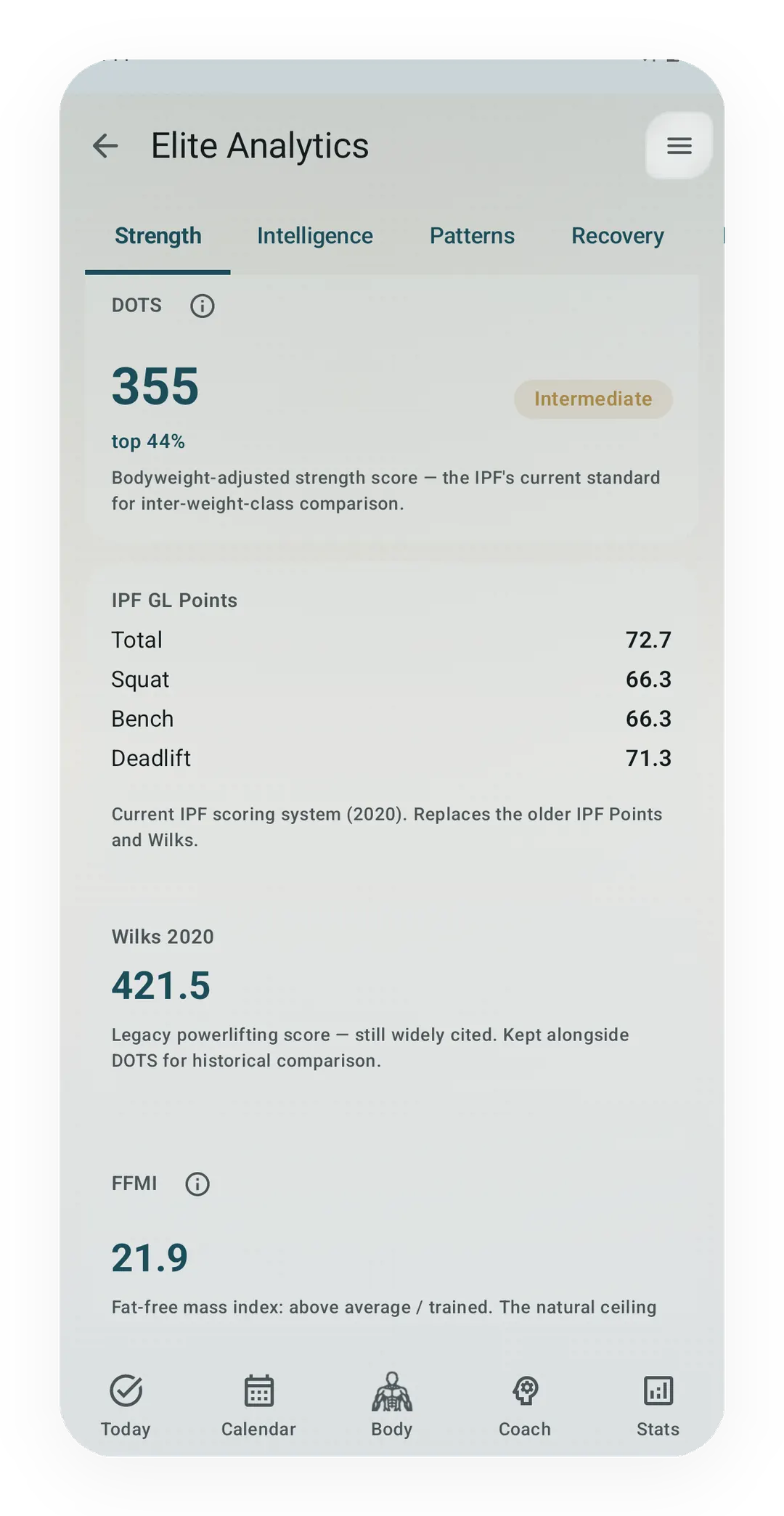
Pro Analytics → Strength tab
The app uses the official IPF rows for the three-lift total and bench-only result. Its Strength Standards card also shows internal squat and deadlift comparison proxies; the IPF publishes no official coefficients for those two single-lift rows.
ProPart of Pro. The free tier still records the training it reads from.
Track this in the app
Strength Standards
DOTS, IPF GoodLift, Wilks 2, and FFMI with offline percentile tables. Published tools widely used in strength sport.