

Reference calculator
Volume Landmarks Calculator (MEV, MAV, MRV)
Weekly set counts are the clearest lever for muscle growth. Pick a muscle group and enter your sets from this week to see where you land across MV (maintenance volume), MEV (minimum effective volume), MAV (maximum adaptive volume), and MRV (maximum recoverable volume). The tool uses the same band rules and weekly set ramp that Kinoku runs on your phone.
The four volume landmarks
Weekly set landmarks split muscle-growth planning into four steps. Instead of guessing whether a split has too few or too many sets, you compare the working sets you logged over seven days against four numbers for each muscle group.
- MV (maintenance volume): the lowest weekly set count that keeps the muscle you already built during a busy week or a deload.
- MEV (minimum effective volume): the weekly floor where new growth starts, because sets below this mark only hold your size.
- MAV (maximum adaptive volume): the weekly zone where added sets bring strong gains without outrunning your rest between gym days.
- MRV (maximum recoverable volume): the highest weekly set count you can recover from before fatigue stalls your lifts.
How Kinoku classifies your week
Effective sets (S) = completed WORKING + REST_PAUSE + FAILURE sets
Raw sets           = Effective sets + DROP sets (warmups excluded)

S < MV          -> Under Maintenance
MV <= S < MEV   -> Maintaining
MEV <= S < MAV  -> Productive Growth
MAV <= S <= MRV -> Peak Adaptive (MRV itself is inside Peak)
S > MRV         -> Over MRV
Across a block of four to eight weeks, Kinoku steps your weekly target sets up from MEV in week one to MRV in the second-to-last week. The final week drops to MV for a planned deload so you shed fatigue before the next block. If a muscle group stays above MRV for two weeks in a row, the planner flags an early deload right away.
Default weekly landmarks by muscle group
Kinoku seeds six muscle groups with default weekly targets based on Brad Schoenfeld's 2017 study review and standard volume guidelines. You can keep the defaults or tune any number up to 35 sets per week.
| Muscle group | MV | MEV | MAV | MRV | Beginner / Advanced MEV–MRV |
|---|---|---|---|---|---|
| Chest | 4 | 8 | 14 | 22 | 6–18 / 10–26 |
| Back | 6 | 10 | 18 | 25 | 8–20 / 12–30 |
| Shoulders | 6 | 8 | 16 | 26 | 6–18 / 10–26 |
| Arms | 4 | 8 | 14 | 22 | 4–16 / 8–24 |
| Legs | 6 | 10 | 16 | 22 | 6–18 / 10–28 |
| Core | 0 | 6 | 16 | 25 | 2–16 / 4–24 |
How compound lifts credit muscle groups
One lift often works more than one muscle group, so Kinoku uses a 30 percent cutoff from its exercise list. Any muscle group worked at 30 percent or more gets one set of credit when you finish a lift set. Smaller parts merge into their main group, so a bench press set credits Chest once rather than counting flat and upper chest twice.
In the separate volume check on the stats screen, sets logged below RPE (rate of perceived exertion) 6, which means more than 4 RIR (reps in reserve), are also flagged as too light to count toward growth.
Where landmarks help and where they mislead
Landmarks give you a starting map rather than a fixed law, because sleep, food, lift choice, and how close you train to failure all shift your personal ceiling. A lifter doing heavy barbell squats and deadlifts will hit leg MRV in fewer sets than a lifter doing leg extensions and leg curls. Treat the bands as a prompt to check how you feel rather than a quota you must force.
Common questions
What do MV, MEV, MAV, and MRV mean?
They are four weekly set landmarks for muscle growth, shared by Mike Israetel. MV (maintenance volume) is the lowest weekly set count that keeps the muscle you already have. MEV (minimum effective volume) is the floor that starts new growth, while MAV (maximum adaptive volume) is the weekly range where most lifters make their best gains. MRV (maximum recoverable volume) is the ceiling where fatigue outruns rest.
How many sets per week should I do for each muscle group?
A 2017 study review by Brad Schoenfeld found a clear trend where 10 or more weekly sets per muscle group grew more muscle than fewer sets. In Kinoku's default landmarks, good weekly volume starts at 8 to 10 sets for chest, back, and legs. It climbs through 14 to 18 sets in the sweet spot before reaching a 22 to 25 set ceiling.
Do warmup sets and drop sets count toward MEV and MRV?
Warmup sets do not count toward weekly landmarks because the weight is too light to drive growth. In Kinoku's Volume Landmarks tracker, finished working sets, failure sets, and rest-pause sets count as effective sets. Drop sets stay in your raw set total and get a 0.8 weight in tonnage views, while set landmarks count your main working sets.
Does one compound lift count for more than one muscle group?
Yes, when a helper muscle works hard enough during the lift. Kinoku credits a muscle group once per finished set whenever a move works a muscle in that group at 30 percent or more. It also merges parts of the same group, so a bench press set credits Chest once instead of counting flat and upper chest twice.
Privacy
This calculator runs in your browser, so the set counts and landmarks you enter are never sent to a server and nothing is stored between visits. It makes no network requests at all, which leaves nothing to track and nothing to log.
Track this in Kinoku
Kinoku's Periodization planner and Coach screen count your weekly sets per muscle group after every workout, compare them against your MV, MEV, MAV, and MRV targets, and step planned sets up across your block. You can also check muscle credit on the free Muscle Map and the Exercise Galaxy. Volume Landmarks is part of Pro, and all math runs on your phone with no Kinoku account.
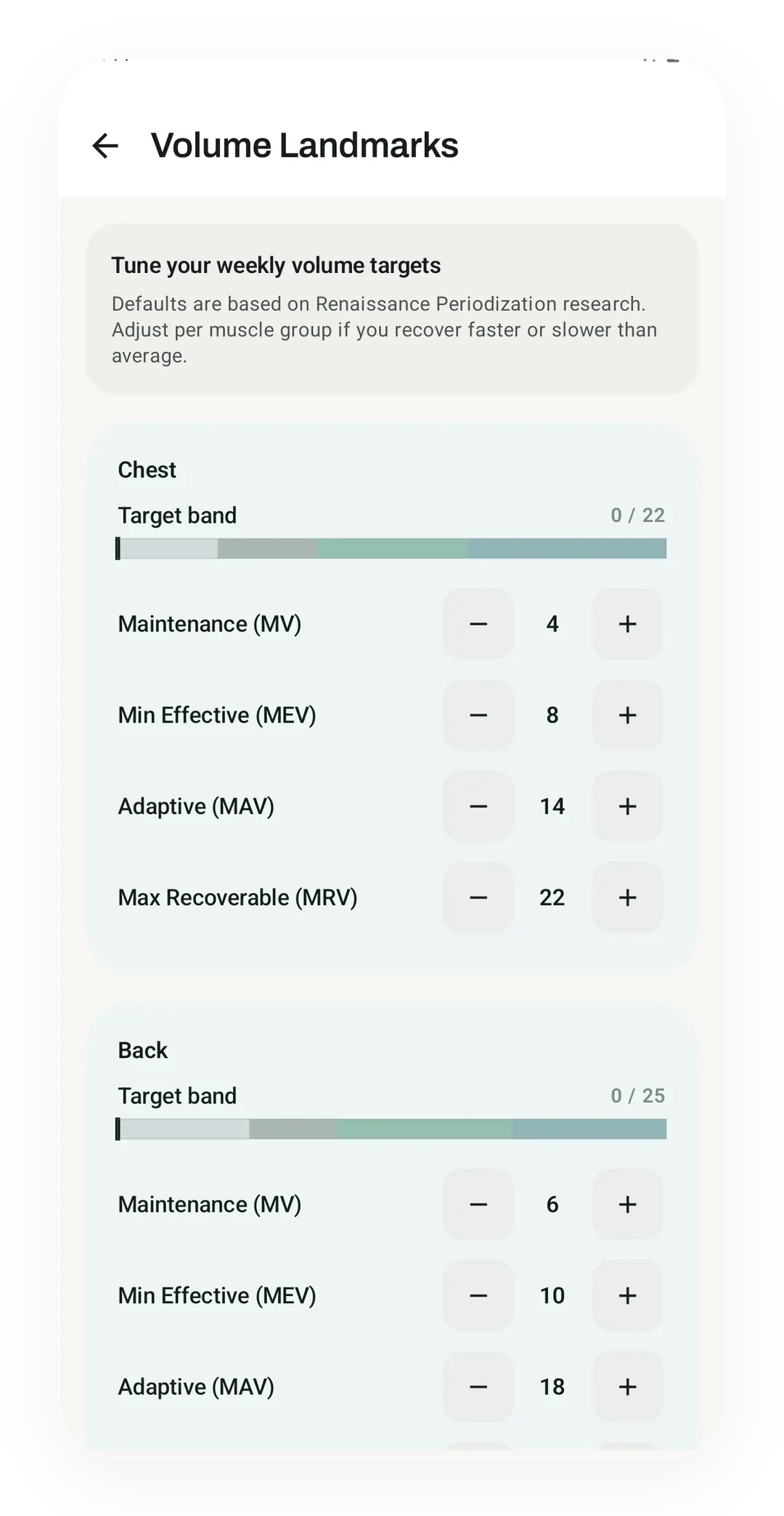
Settings → Training → Volume Landmarks
Counting sets by muscle group across a week takes work by hand, so Kinoku reads the sets you already logged on the free tier and places each muscle group on its band for you.
ProPart of Pro. The free tier still records the training it reads from.
Track this in the app
Periodization
A 4-phase planning stack. The builder, all 25 templates, named programs with auto-progression, the custom model, and unlimited active programs are free. Pro adds volume targets, readiness tuning, and auto set changes.
Get it free on Google Play