

How do you know if you are actually in zone 2?
The definitions disagree and a heart rate strap is a shaky judge. Here is how Kinoku works your zones out from your own runs instead, and where that fails.
Inside Kinoku
The app surfaces behind this story
 Open full-size image ↗
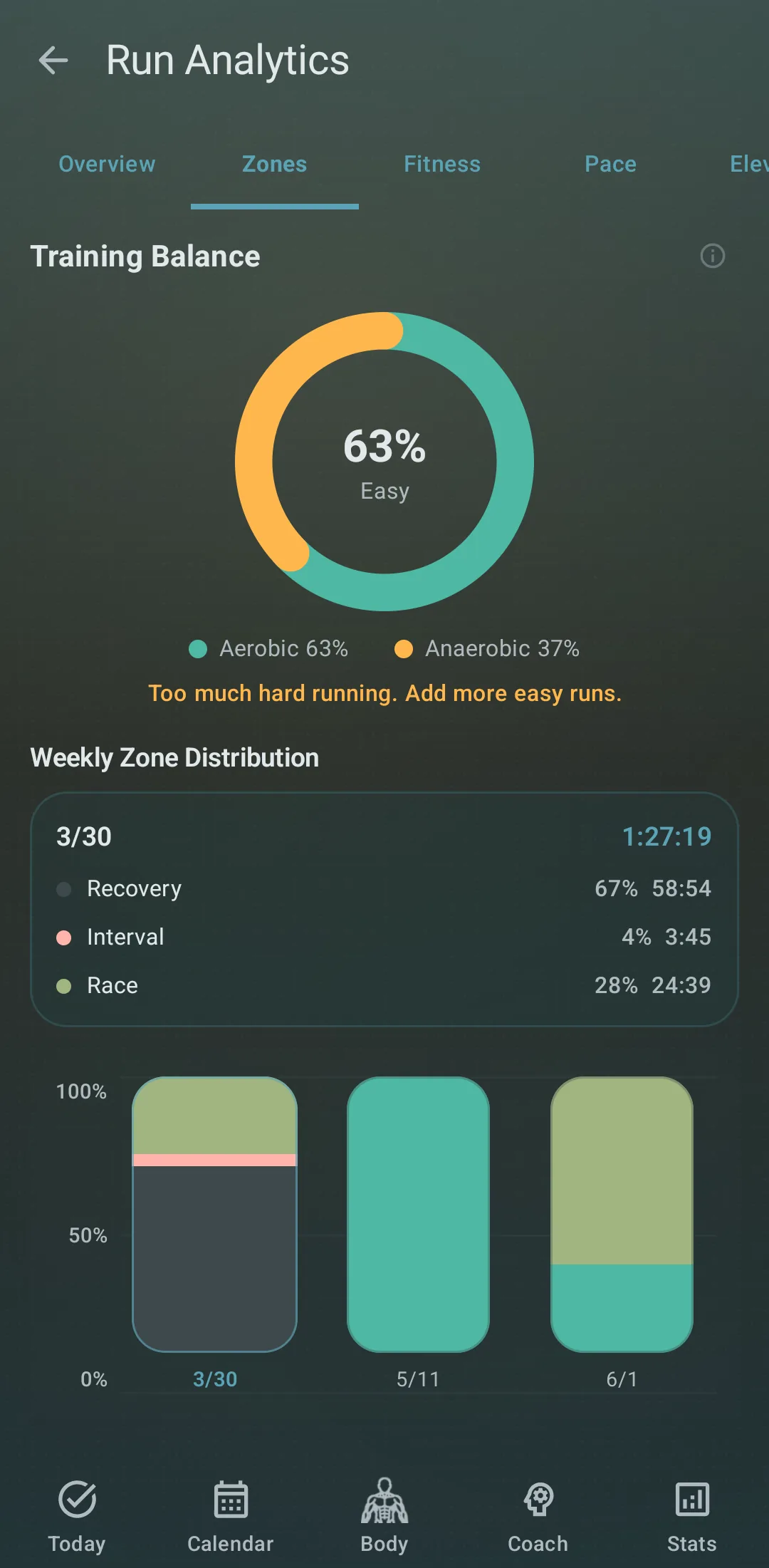
Time in each zone, from pace
Zone Training splits a week by pace zone, so the easy-hard balance is readable without a heart rate strap.
Zone 2 is the most talked-about pace in running, and it is also the one most people are not actually running.
The advice is everywhere and the definitions do not agree. One version puts zone 2 at 60 to 70 percent of your maximum heart rate. Another uses a five-zone model where zone 2 sits between two lactate markers, which is a different band. A popular rule of thumb says the top of zone 2 is where you can still hold a conversation. Another says 180 minus your age. These produce different paces for the same runner on the same day, and none of them is obviously wrong.
That leaves a real practical question underneath the trend, which is how you would know.
Heart rate is a shakier judge than it looks
Most zone 2 advice leans on a heart rate number, and heart rate is a noisy tool for this job.
Heart rate drifts upward through a run at a constant effort, so the same pace that started in zone 2 can finish above it without you changing anything. Heat pushes it up, and so do caffeine, poor sleep, a cold coming on, or a stressful morning. It also lags behind changes in effort by a minute or two, so on rolling terrain the reading describes the hill you just finished. Wrist sensors add their own errors, and chest straps add different ones.
None of that makes heart rate useless. It does mean “stay under 140” is a shakier rule than it sounds, and that a runner strict enough to obey it is often obeying a measurement error.
The maximum heart rate underneath the percentage is usually a guess too. Most people have never measured theirs and are using a formula, and the common formulas are often ten or twelve beats out. Build a zone on a number that wrong and the zone is wrong with it.
What Kinoku does instead
Kinoku works your pace zones out from your own runs, and it needs no heart rate monitor to do it.
The method is simple on purpose. Once you have three runs long enough to count, the app sorts them and takes the middle pace. That pace becomes your easy zone, and every other zone is set as a step from it. Recovery is 20 percent slower than your easy pace. Tempo begins 10 percent faster, threshold 15 percent faster, and interval 25 percent faster, with anything beyond that counted as race pace.
The screen then shows how your week split across those zones, which is the number that matters if you are trying to run most of your miles easy.
If you do wear a strap, the app saves your heart rate zones for each run too, so you get both views. Pace is the one it leans on, because you can control pace directly and it holds still while you do.
The flaw in our own method, since it is a real one
Working the zones out from your own runs can fail in one obvious way, and it would be dishonest to describe the feature without saying so.
If every run you do is slightly too hard, the middle of those runs is also slightly too hard, and the app will happily label that pace “easy”. The zones describe your habits and not your body, so they inherit whatever you have been doing. A runner who has spent two years in the middle gets zones built around the middle.
Two things reduce it. The zones move as your runs move, so a genuine shift toward easier running drags the baseline with it within a few weeks. And the weekly split shows the pattern even when the labels flatter you, because a week spent mostly at tempo is easy to see on the chart whatever it is called.
Pace has its own limits too. Pace is a poor guide on hills, where effort and speed part company, and it flatters you in cool weather while punishing you in heat. Neither pace nor heart rate measures the thing you care about, which happens in your muscles. Measuring that directly means a lactate meter and a finger prick.
What we would actually suggest
Run most of your easy runs slower than feels natural, and check the weekly split rather than any single number.
If you want a rough test that needs no kit, the talking one is still decent: if you cannot say a full sentence in comfort, you are above zone 2, whatever your watch says. The test is rough, and it is honest about being rough. That puts it ahead of a share of a top heart rate you have never measured.
The part nobody can settle for you is how much of this matters. The research on how hard to run is good, and most of it was done on trained athletes. How well it carries over to somebody running four times a week around a job is an open question. Treat any firm answer about the exact split, ours included, as a place to start and not a target.
Related features
Pace zones, easy-versus-hard balance, and a training effect score built into your runs.
Live pace, splits, a route map, and audio cues. Your run record is not uploaded to Kinoku; map tiles load when you view maps, and weather is a clear opt-in.
Offline run breakdown with splits, a fitness score from your runs, a pacing score, best efforts, race forecasts, and a compare card that stacks each run against your similar past runs.
Try Kinoku
Core tracking works offline. No mandatory account. No Kinoku-hosted training-history cloud.
Get on Google Play →