

Longevity Mode
An opt-in layer that frames your training around health for life, not just your next personal best. Swaps PR goals for age-graded fitness marks.
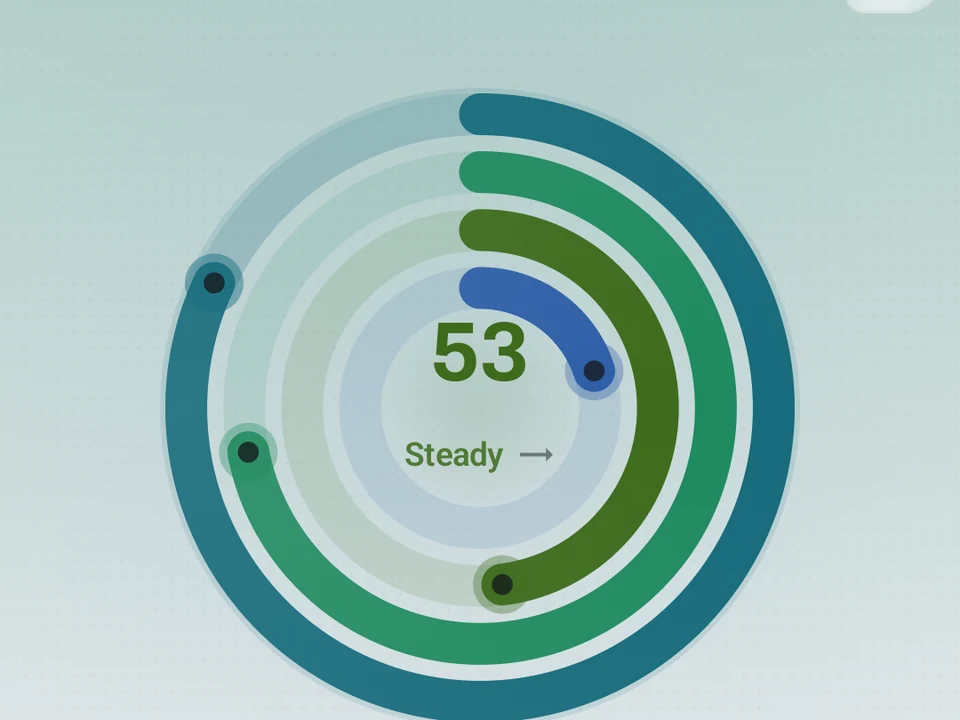
Real app capture
What this feature looks like with data
 Open full-size image ↗
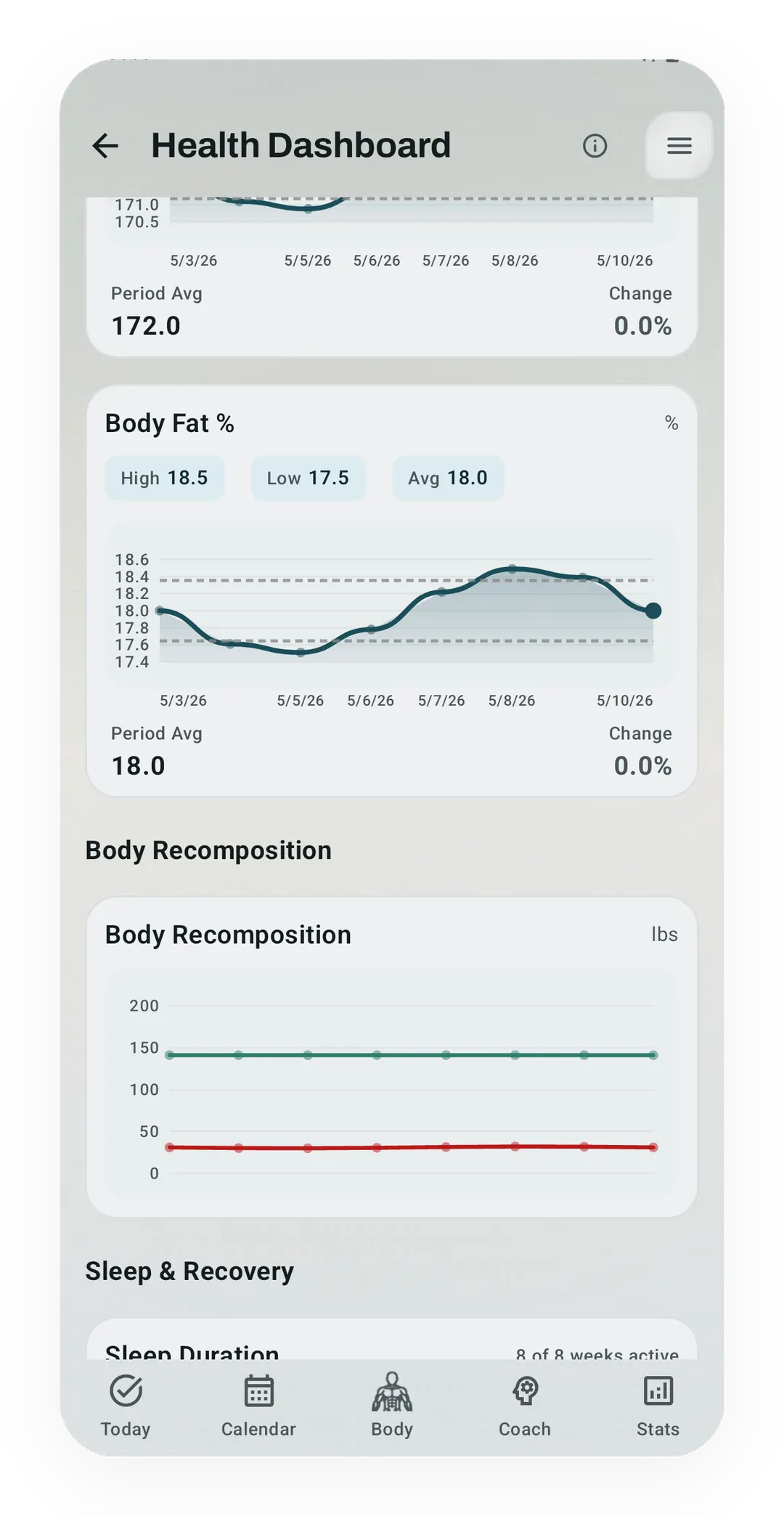
Recovery and healthspan context
Longer-term health signals are readable together in the Health Dashboard instead of being scattered across isolated tiles.
What it is
Longevity Mode is a setting that frames Kinoku around health for the long run, not your next personal best. The math and the tracking stay the same. What shifts is the language, the goals, and the tips, all of them tilted toward training you can keep up for decades.
What it changes
- Healthspan Goal Card: a coach card that tracks your weekly brisk walking and easy cardio. The goal is 150 minutes a week, the mark the World Health Organization sets for adults.
- Fitness graded by age: VO2 max (your body’s top rate of oxygen use) normally shows as a raw number. Here you get a word matched to your age and sex, so a 60-year-old might read “Excellent” where the number says 35.
- Softer Coach copy: Tomorrow’s Focus trades hard-driving labels for calmer ones like “Rest”, “Heart day”, and “Strong day”.
- Calmer state labels: your Pulse states read Strong, Resilient, Steady, and At risk in place of Strong, Building, Steady, and Drifting.
Why a graded band beats a raw number
A raw fitness estimate quietly rewards being young, which is the reason the graded band exists. The 60-year-old reading “Excellent” at 35 is measured against people their own age, not against a 25-year-old. Mandsager and colleagues tracked 122,007 adults through treadmill testing in 2018. The fitter ones lived longer, and no ceiling turned up where the benefit ran out. Kinoku leans on that by pointing at fitness you can hold for years, not a peak you touch once.
The Longevity Foundations template
The free program gallery includes Longevity Foundations, an eight-week template pairing strength and bone-loading work with easy cardio, balance, and mobility. Pro can layer adaptive analysis on top, and none of it is needed to browse or start the template.
Who it’s for
Longevity Mode switches on by default at age 40 and up, once your date of birth is set. You can turn it on or off at any age. The mode suits people training for the next four decades, not the next four weeks.
What it does not change
One limit deserves saying plainly: the mode changes words, goals, and framing, and it changes no number under them. Your score and your charts read the same either way.
The free layer
The toggle, the calmer labels, the age-graded fitness bands, and the Longevity Foundations template are all free. Pro can add deeper analysis on top, though the mode itself never depends on paying. The bands and labels above are how it reads today, and they can still shift as we tune them.
Try it for yourself.
Available on Google Play. Core access starts on the free tier.
Get on Google PlayRelated surfaces
Once Kinoku has enough data, the Kinoku Score sums up your recent training, recovery, and health signals. Until then, it shows a learning state instead of a made-up number.
Coaching screens that run on your phone and explain what changed in your training and why it matters.
Track anything with toggle, scale, value, duration, time-range, and combined metrics. Every type is free, and there is no limit on how many you keep active.