

Kinoku Score
Once enough evidence exists, one recent composite that blends training, recovery, and health into a simple read.
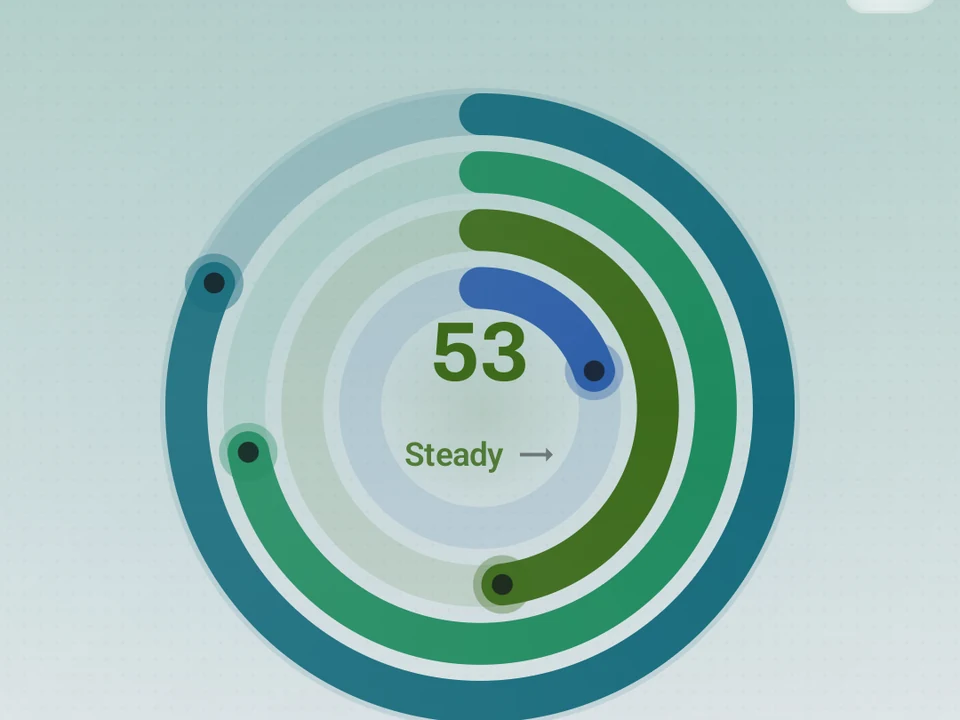
Real app capture
What this feature looks like with data
 Open full-size image ↗
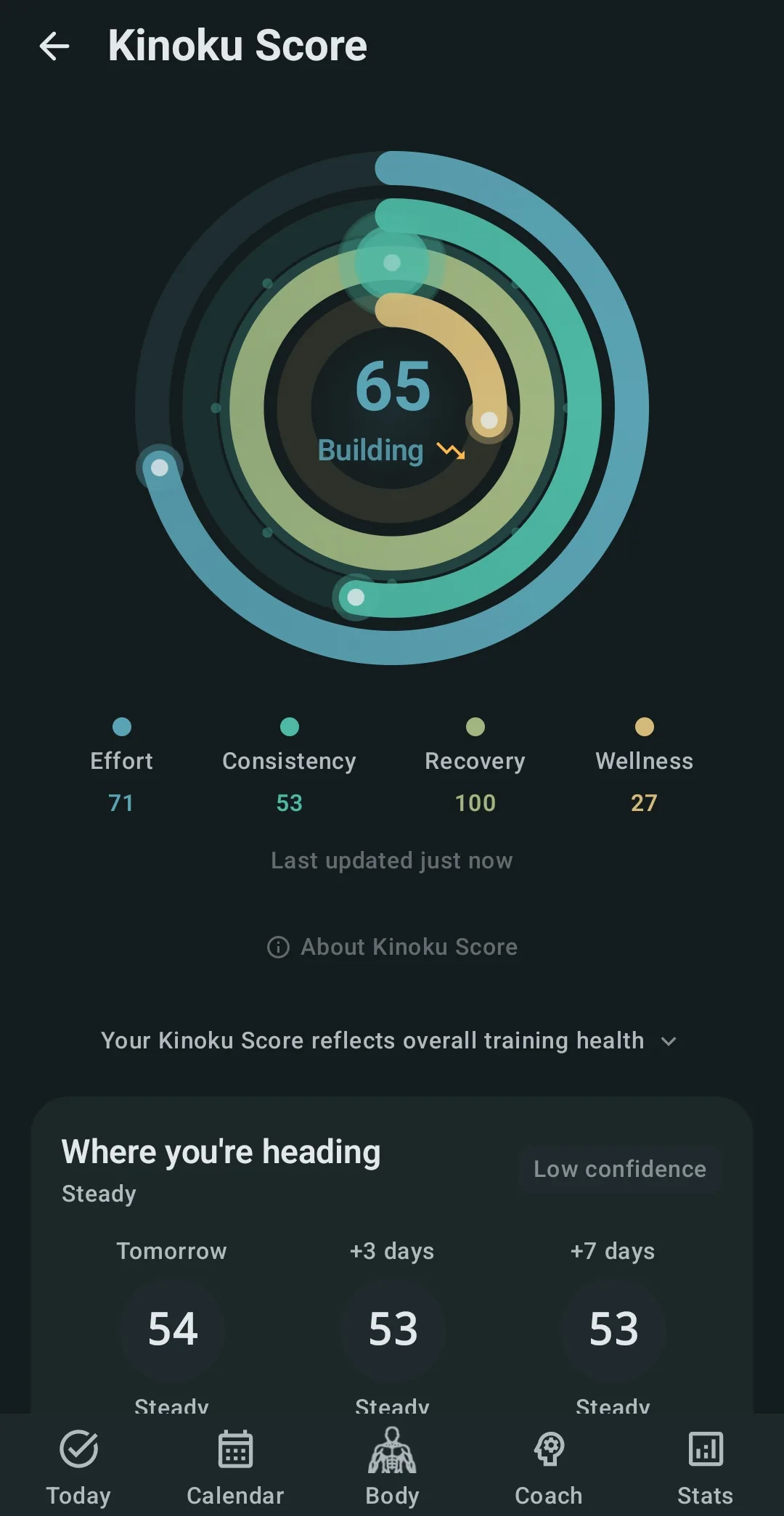
Kinoku Score detail
Captured from the real app using representative training data. A 65 Building state, four parts, and a forecast band.
 Open full-size image ↗
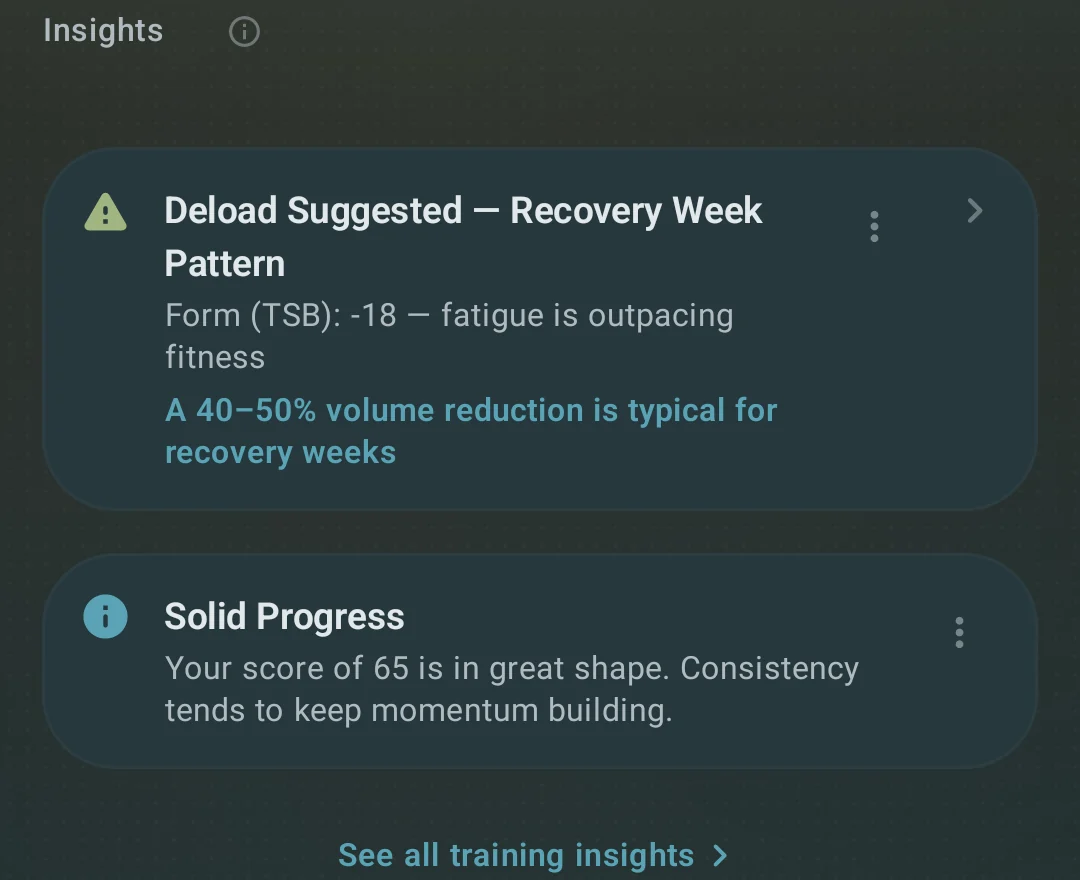
Training insights from your score
Real capture. Notes from your score, like a deload tip when fatigue runs high.
Tier shape
How access changes by tier
The Pulse ring plus 2 insights a day.
Five insights a day, extra insight types that spot links in your data, and more linked screens.
What it is
The Kinoku Score is one number from 0 to 100 that sums up your recent training, recovery, and health, once Kinoku has enough evidence to work it out. Before that point the screen shows a learning state and names the inputs it still wants, rather than a placeholder that looks real. Once it settles, the score blends three parts of your data:
- Training, at 45%: how much you lift and run, how hard, and how often.
- Wellness, at 30%: sleep, heart rate variability (HRV), soreness, mood, and stress, whatever you log.
- Health, at 25%: signals from Health Connect such as weight, body fat, and resting heart rate.
HRV is the small gap between heartbeats, and it can hint at how rested you are.
The capture on this page shows a 65, so take that score as the worked example. With all three parts tracked it reads Building, and the weights behind it are Training at 45%, Wellness at 30%, and Health at 25%. Skip HRV, and once the evidence bar is met the missing part hands its weight to the parts you do track, so a 65 like that leans harder on Training and Wellness, and the screen says so.
How to read it
| Range | State | What it means |
|---|---|---|
| 85–100 | Thriving | Your body looks fresh and ready. |
| 55–84 | Building | A solid baseline, trending up. |
| 35–54 | Steady | You are holding your ground. |
| 0–34 | Drifting | Your body may be asking for a rest. |
You choose what to do with each state, because the score is a read rather than an order. Today answers what to do now, the Kinoku Score sums up recent evidence, Coach explains patterns, Stats keeps the long record, and the specialist screens are there for a deeper look.
Why it’s different
The first difference is that the math is visible. Many fitness apps hand you a readiness number and hide the formula, while Kinoku shows the parts, the weights, and the reason for each state. Tap any part to see which inputs moved it, so that 65 Building never has to be taken on trust.
The second difference is where the score is worked out. Like the rest of the app, the score runs on your phone, and your wellness data never goes to a Kinoku server.
The limit sits in the inputs. The Health part only knows what reaches Health Connect, so a phone with no sleep or heart data leaves that part empty and the score leaning on the rest.
Daily insights
Next to the score sits a short note about your day, and one of them might read: “Your HRV has dropped 12% over the last 3 days. An easy session could help.”
- Free: 2 insights a day.
- Pro: 5 insights a day, plus extra types such as Wellness Correlation and Plateau Signal.
A deeper readiness score blends sleep, muscle recovery, training load, and HRV, and it comes with Pro.
The free layer
The score ring and two insights a day are free, and Pro raises that to five a day, links more screens into it, and adds ways to spot patterns across your data. The three weights above are the current mix and can shift as we tune them, while the score itself stays free at every tier.
Try it for yourself.
Available on Google Play. The core here is free. Pro adds optional extras.
Get on Google PlayRelated surfaces
Coaching screens that run on your phone and explain what changed in your training and why it matters.
Pulse, Coach, and Tomorrow's Focus shift toward long-term health markers instead of peak output. It turns on at age 40, can be changed anytime, and includes the free 8-week Longevity Foundations template.
Full cycle, fertility, and pregnancy tracking, with phase context and training links. Dedicated raw records and generated cycle state are excluded from future Android automatic cloud backup, standard exports, share cards, and Kinoku servers. Your Cycle Tracking configuration lives in that same excluded database, while user-created metrics remain eligible for Android system backup in your Google account. A manual ZIP or user-initiated device transfer can carry the dedicated database.