

VO2 Max From a Run Test, Explained
What VO2 max measures, how Cooper and 1.5-mile run estimates work, and why a field test can differ from a watch or lab.
Kinoku in practice
Where this shows up in the app
 Open full-size image ↗
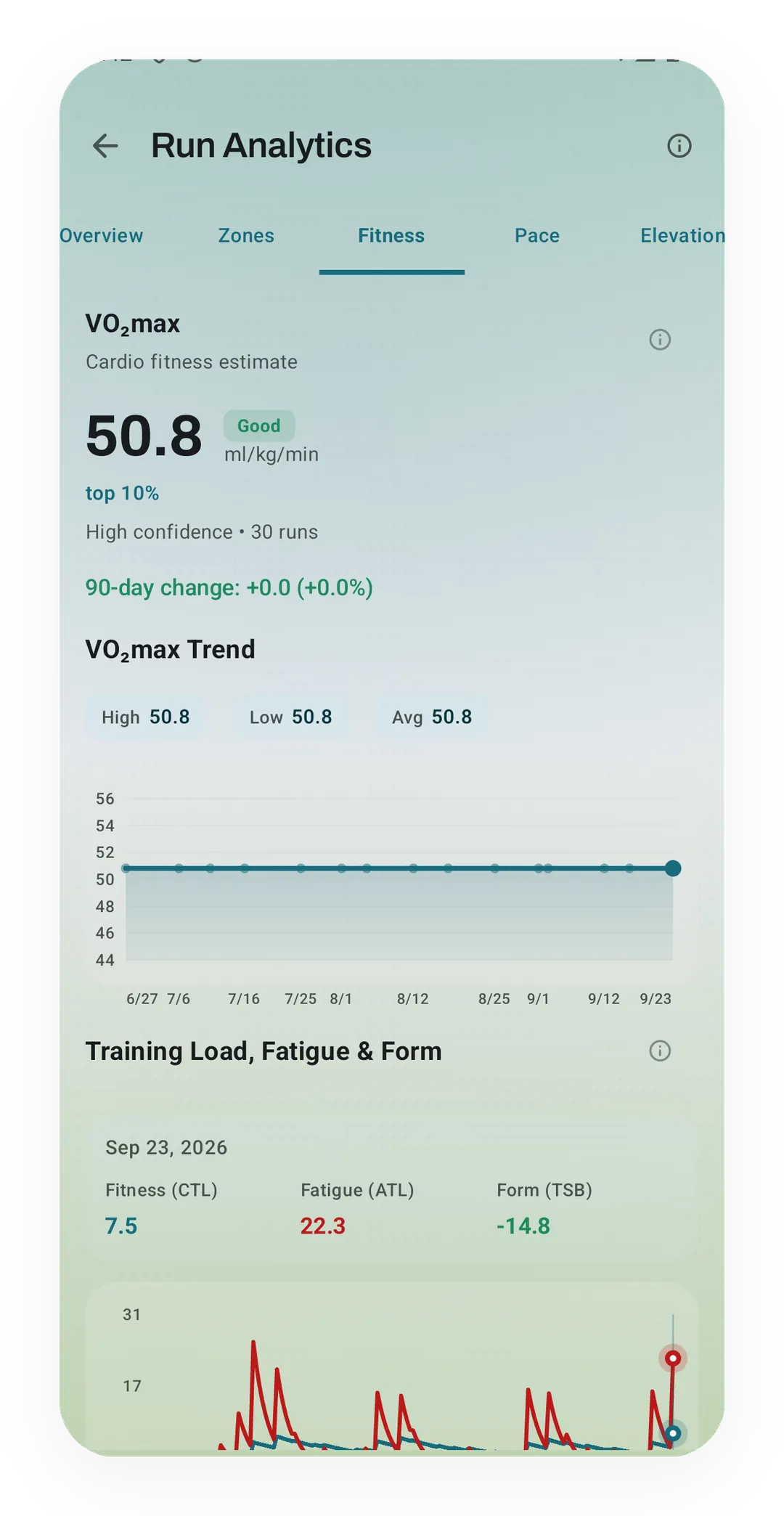
A fitness trend in Pro Run Analytics
Fictional sample data shows 50.8, high confidence from 30 runs, and a flat ninety-day trend with a 0.0 change. The Good and top 10 percent labels belong to the app; the web calculator assigns no ranks and uses different formulas.
VO2 max (your body’s top rate of oxygen use) describes how much oxygen you can use during a hard effort. A run test estimates that rate from distance or time, while a lab measures it from your breath. The formula and test conditions shape the estimate, so one number can differ from another.
The VO2 max calculator offers Kenneth Cooper’s twelve-minute distance test and a timed 1.5-mile test, with each source beside its result. This article follows a distance of 2.6 km in twelve minutes, which gives a rounded estimate of 47 ml/kg/min.
What does ml/kg/min mean?
The unit ml/kg/min means millilitres of oxygen per kilogram of body weight per minute, so the value includes body size. An estimate of 47 describes about 47 millilitres per kilogram each minute at the top rate of oxygen use. It does not describe the oxygen used throughout every minute of an ordinary run.
A field test cannot measure that rate directly because distance and time carry no record of the breath itself. The formula links run performance with oxygen use from earlier testing, then applies that link to the input you enter.
The number is an estimate from a specific method, and this calculator leaves comparisons with other people out of the result. It asks for neither age nor sex and gives no percentile, fitness age or health rank.
How does the Cooper distance test work?
Kenneth Cooper’s test uses the distance covered in twelve minutes, with as much ground covered as possible during that fixed time. The Cooper Institute’s guide describes a flat, measured course in mild weather, because the result depends on those conditions.
The calculator uses the equation printed in Amit Bandyopadhyay’s 2015 paper, keeping all the printed digits:
Estimated VO2 max = 22.351 × distance in km − 11.288For the 2.6 km example, multiplying by 22.351 and subtracting 11.288 gives 46.8246, displayed as about 47 ml/kg/min. That worked example shows the arithmetic; it is not a test result copied from a study or a claim about your likely error.
The calculator converts miles to kilometres before doing the maths, so changing units keeps the same estimate from the same distance. A longer distance raises the estimate because the formula treats more ground in the same time as stronger test performance.
How is the 1.5-mile test different?
The 1.5-mile test fixes the distance and uses your elapsed finish time, reversing which part of the run becomes the input. The Cooper Institute gives its formula as 483 divided by time in minutes, plus 3.5.
Estimated VO2 max = 483 / time in minutes + 3.5A 12:00 finish gives 483 divided by twelve, plus 3.5, which is 43.75 or about 44 ml/kg/min. That timed example is separate from the 2.6 km Cooper example, so their gap is not an error range.
| Test | Fixed part | Your input | Formula |
|---|---|---|---|
| Cooper distance test | Twelve minutes. | Distance in km or miles. | 22.351 × km − 11.288. |
| 1.5-mile time test | Exactly 1.5 miles. | Elapsed finish time. | 483 / minutes + 3.5. |
Exactly 1.5 miles is 2.414016 km, while six laps on a 400-metre track total only 2.4 km. Those extra fourteen metres matter to the test’s definition, even though the two distances look close when rounded.
The tool reads 12:30 as twelve minutes and thirty seconds, which becomes 12.5 minutes inside the formula. A colon keeps that time clear, and the calculator also accepts an hours:minutes:seconds format when hours are present.
Why is there no plus-or-minus range?
The cited sources leave a gap in the numerical error for these equations, so the calculator states that gap beside the result. A 2022 study by Rowley and colleagues notes that Cooper did not report an error for the original equation. The Institute’s guide also gives no error range for its timed equation.
Cooper’s original study compared field and treadmill tests in 115 United States Air Force men, reporting a correlation of 0.897. Correlation describes how two sets of results move together, so subtracting it from one cannot give a personal percentage error.
Bandyopadhyay tested the old equation in a study group of 58 sedentary Indian men and found it read high by about 3 ml/kg/min on average. That result shows a limit in that group, rather than a margin that fits every person using this page.
The paper then built a different equation for the group, so its new equation’s reported error belongs to that other method. Putting that error beside the old formula would mix two results and make the calculator look more exact than its sources allow.
Why might a watch or lab give another number?
A watch, field test and lab can differ because they use different inputs and methods to describe oxygen use. A lab can measure gases from your breath, while these formulas infer a value from how far or how fast you ran.
A field-test estimate also carries the course and conditions of the test, as well as the effort behind the input. An easy run’s distance can go through the same formula, but it lacks the test effort the equation assumes.
A changed result can therefore reflect a changed test, and the number alone cannot tell you how much fitness has changed. Comparisons are easier to read when the method and test conditions remain similar, with the limits kept beside the values.
How does Kinoku show a fitness trend?
Kinoku’s paid Pro Run Analytics dashboard has a Fitness tab that shows an estimate and a trend from saved runs. The app prefers a heart-rate estimate when usable data is present, with a pace-based estimate as its fallback. Both methods differ from this page’s run-test equations, so the app’s value can differ from the web result.
The screenshot uses fictional data: 50.8 with a high-confidence label based on 30 runs, beside a flat ninety-day trend showing a 0.0 change. Good and top 10 percent are labels in the app’s own view, and the web calculator assigns neither one.
Kinoku is on Android, with free GPS run recording and the Fitness dashboard as part of paid Pro. No Kinoku server stores your run history, though Android system backup may copy eligible app data to your Google account. The web calculator remains useful on its own for a single field-test estimate.
Track this in the app
Run Analytics
Offline run breakdown with splits, a fitness score from your runs, a pacing score, best efforts, race forecasts, and a compare card that stacks each run against your similar past runs.
Core tracking works offline, with no mandatory account.
Related features
Offline run breakdown with splits, a fitness score from your runs, a pacing score, best efforts, race forecasts, and a compare card that stacks each run against your similar past runs.
Your run records and whether you are getting faster, over time. It reads your best efforts and a fitness estimate, never plain average pace, and only claims progress when the trend is sure.
Live pace, splits, a route map, and audio cues. Your run record is not uploaded to Kinoku; map tiles load when you view maps, and weather is a clear opt-in.