

Why Kinoku is offline-first
Why Kinoku keeps core tracking on-device, works without a mandatory account, and names the few features that reach the network.
Inside Kinoku
The app surfaces behind this story
 Open full-size image ↗
The offline-first controls
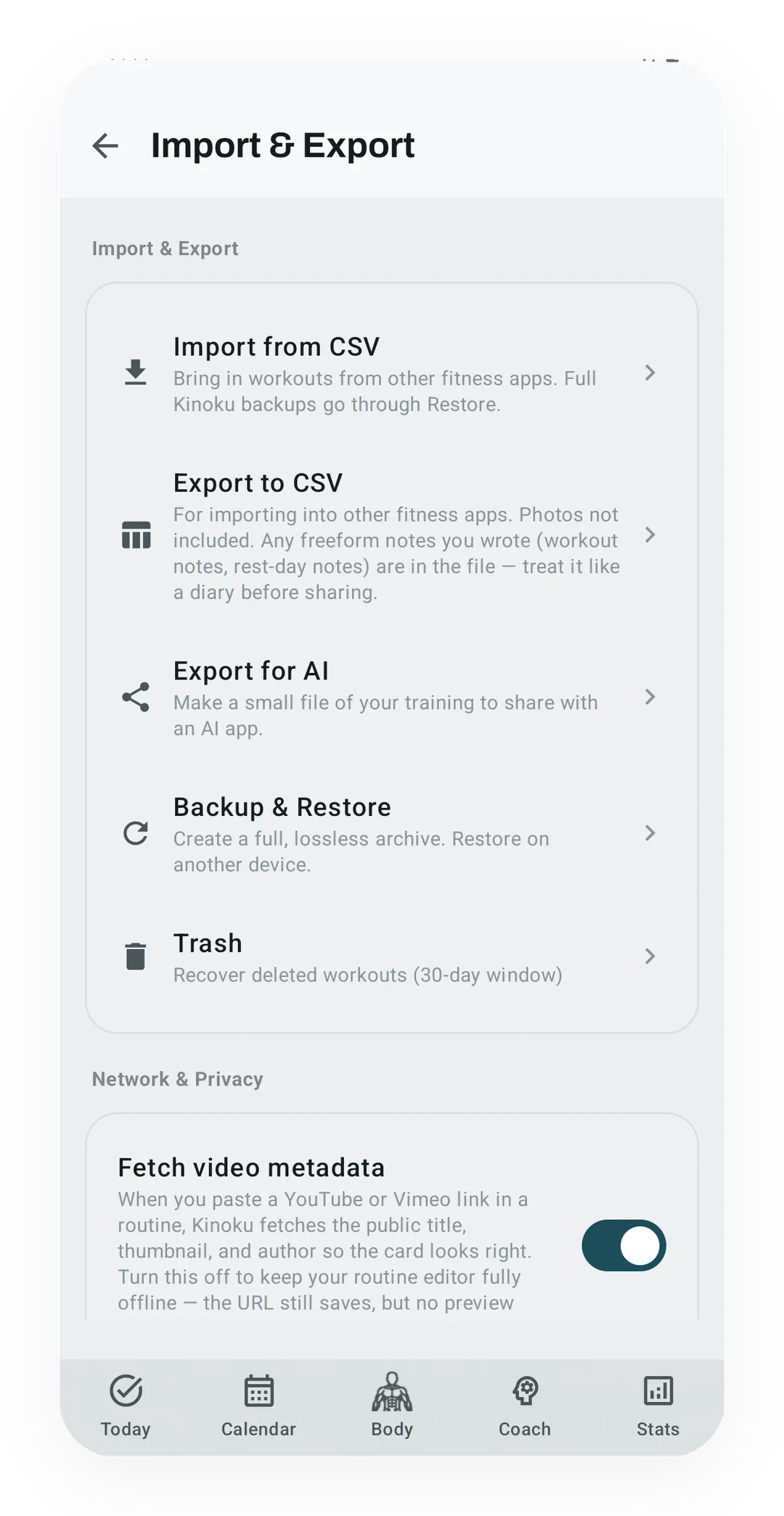
Kinoku's Data & Storage screen keeps backup, restore, import, export, and deletion in the user's hands.
Kinoku keeps your training record on your phone, and it never sends that record to a Kinoku server. You need no account to log a set, and the app keeps working in airplane mode. The promise is narrower than it sounds, so this post says what it covers and where it stops.
“Works offline” means several things
Plenty of apps say they work offline, and in some of them your data waits in a queue and goes to a hosted account once you have signal again. You can use the app on a plane, but a copy still lands on someone else’s server. Kinoku means the stricter kind, where the training record has no server to go to at all.
Why we chose it
A hosted copy adds one more party you have to trust. Your history sits on hardware you do not own, and the provider decides how long to keep it and how to delete it. We are not saying providers sell training data, only that a second copy exists in someone else’s care.
Writing down a set does not need a server. Sync makes that set easy to read on another device, but it is not what makes the log work. So sync is a choice here rather than the price of writing a set down.
What it costs you
Kinoku has no cloud sync between your devices, so your phone holds the one copy of the record. To move it, you make a backup file and carry it across yourself. If you want the same log live on two phones at once, Kinoku does not do that today.
The edges that do reach the network
Kinoku names each one rather than hiding it inside the word “offline”:
- Google Play handles billing.
- Maps need map tiles.
- Run weather context is opt-in.
- Speech can fall back to a cloud recognizer.
- Remote Config can fetch promo settings.
- Social Bets and gift codes are switched off right now, and their cloud paths stay documented because old data may still exist and they may return.
Where the line is drawn hardest
Kinoku works another way, because your training record never syncs to a Kinoku server. Eligible main-app data and files may enter Android system backup in your Google account, while dedicated raw Cycle Tracking records and generated cycle state are excluded from automatic cloud backup, and a manual ZIP or user-initiated device transfer can carry them. That gap is the clearest test of the rule, because the most private data gets the strictest handling, and you can check the claim in the settings rather than take our word for it.
Why “deep movement”
Kinoku (kih-NOH-koo) joins two words, since kinesis is Greek for movement and oku is Japanese for deep. The name is a small reminder that training is meant to be private, between you and your body.
What this does not promise
Offline-first is a default rather than a wall, and the list of edges above can grow as the app grows. What does not move is the training record, because no Kinoku server holds a copy of it. Android system backup can still copy eligible app data to your Google account, and that switch is yours. If that fits how you train, Kinoku is on Google Play, and the free tier is a full tracking app rather than a teaser.
Related features
Lossless backup, open CSV and JSON import, Strava import, and a scoped Export for AI handoff.
Full cycle, fertility, and pregnancy tracking, with phase context and training links. Dedicated raw records and generated cycle state are excluded from future Android automatic cloud backup, standard exports, share cards, and Kinoku servers. Your Cycle Tracking configuration lives in that same excluded database, while user-created metrics remain eligible for Android system backup in your Google account. A manual ZIP or user-initiated device transfer can carry the dedicated database.
Every set, one tap. Track how hard each set felt, your rest timers, set types, and notes.
Try Kinoku
Core tracking works offline. No mandatory account. No Kinoku-hosted training-history cloud.
Get on Google Play →