

Epley vs Brzycki: Which One-Rep Max Formula to Trust
Two formulas turn a set of reps into a one-rep max. They agree up to ten reps and drift after. Here is the choice, and the one Kinoku uses.
Kinoku in practice
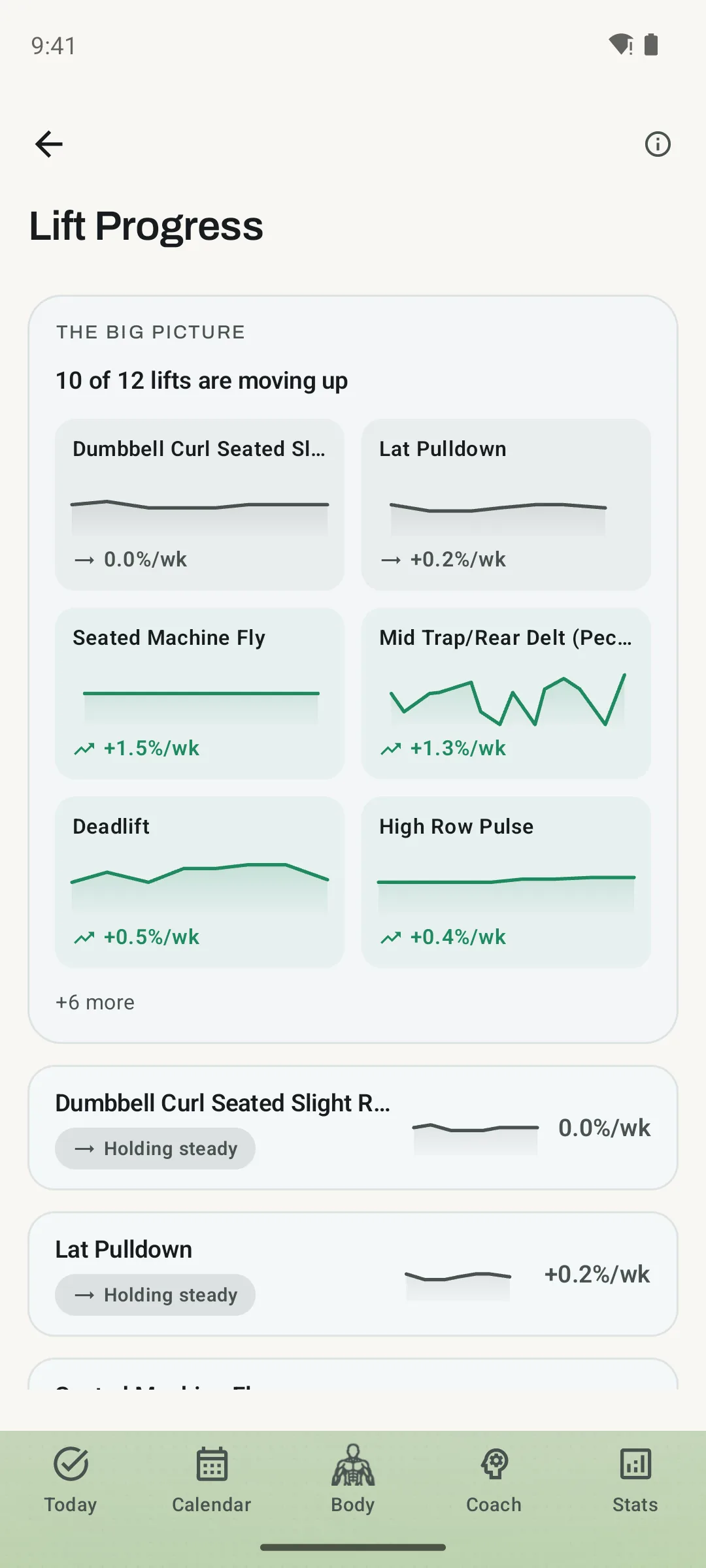
Where this shows up in the app
 Open full-size image ↗
One formula, one trend
The Lift Progress surface reads each session's best set through Epley, with sets above ten reps left out of the strength line so a high-rep day does not fake a jump.
Quickstart
Both formulas turn a set of several reps into a one-rep max (1RM) estimate, and below ten reps they agree within a few percent. Above ten reps they drift apart, and both get less reliable. Kinoku uses Epley only, which is weight times one plus reps over thirty. Its lift trends skip sets above ten reps, while the personal record (PR) banner still counts every set.
What each formula measures
Both answer the same question: you lifted this weight for this many reps, so what could you lift once? Neither formula measures anything, because each is a curve fitted to a group of lifters years ago. You put in a set, and the curve hands back a guess.
Epley is the older one, printed by Boyd Epley in 1985 as a poundage chart for the Nebraska football program. It is a straight line, where each rep adds one thirtieth of the weight, so ten reps add a third.
Brzycki came in 1993, fitted by Matt Brzycki for a physical education journal. It is a curve rather than a line, and the curve bends upward as reps climb, so a high-rep set reads heavier than Epley says.
Epley:    1RM = weight x (1 + reps / 30)
Brzycki:  1RM = weight x 36 / (37 - reps)
At ten reps the two give the same number, and below ten Brzycki reads a little lower. Above ten it runs away, returning 36 times the weight at 36 reps and dividing by zero at 37.
A true single is the odd case, because Epley reads a one-rep set as 3 percent more than you lifted, while Brzycki reads it as the weight itself.
Side by side
The same lift through both formulas, from the year each one was written to the point where each one fails.
| Epley | Brzycki | |
|---|---|---|
| Year | 1985 | 1993 |
| Shape | Straight line | Curve |
| Ten reps | Same answer | Same answer |
| Under ten reps | Reads slightly higher | Reads slightly lower |
| Over ten reps | Keeps climbing in a line | Climbs faster and faster |
| Breaks at | Never, but drifts | 37 reps |
| Common in | Most apps and spreadsheets | Many gym calculators |
Here is 100 kg through both formulas at four rep counts, which is arithmetic rather than a measurement, since nobody lifted these sets.
| Set | Epley | Brzycki | Gap |
|---|---|---|---|
| 100 kg x 5 | 116.7 kg | 112.5 kg | 4.2 kg |
| 100 kg x 8 | 126.7 kg | 124.1 kg | 2.5 kg |
| 100 kg x 10 | 133.3 kg | 133.3 kg | 0 kg |
| 100 kg x 15 | 150.0 kg | 163.6 kg | 13.6 kg |
Up to ten reps the gap stays under 5 kg on a 100 kg lift, and at fifteen reps it is more than a plate. Neither number is right. LeSuer and colleagues tested seven formulas against real maxes in 1997, and every formula tracked the real max well. Most still missed the bench or the squat by a set amount, and all of them read the deadlift low.
Which one Kinoku shows you, and where
Kinoku uses Epley and nothing else, and here is where the number goes, as of September 2026.
- The formula is weight times one plus reps over thirty, and it lives in one function that every record check runs through. A repeat of an old best therefore never reads as a new one. A Brzycki helper sits in the code base, and nothing calls it.
- The PR banner uses every completed working set. When a workout ends, the app takes the best Epley number per exercise and checks it against your history. There is no rep cap here, so a set of twenty can set the record.
- Lift Progress caps at ten reps. The per-lift state label, the Lift Progress dashboard, Routine Progress, the post-workout exercise standing, and the Progress widget’s strength line all read one best set per session. Only sets of ten reps or fewer can be that best set, and sets above ten still count toward the session’s volume.
- The Stats chart has no cap. The e1RM line on an exercise’s Stats page runs Epley on every completed working set, and so do the Pro Analytics five-lift strength view and the Pulse strength trend.
- Bodyweight lifts count your body. For a pull-up or a dip, the weight in the formula is the added load plus your body weight times a per-move factor. The app captures your body weight when the set is done.
- One rep reads two ways. The live set panel in a workout shows a single as the weight itself, while the record check reads it through Epley, 3 percent higher. Both are in the code today.
The ten-rep cap is our choice rather than a finding from a paper. Epley is a line, so it never bends and keeps climbing, and past ten reps the guess drifts from what people can lift. Ten is where the two formulas cross and where most of the test studies stop, so the trend surfaces stop there too.
When to use which
The set you log decides more than the formula does, and these are the four cases that come up most.
- If you log sets of ten or fewer, use either, because the two agree within a few percent there. Kinoku’s Epley is as good as any.
- If you log high-rep sets, trust neither, since a heavier set of three to six now and then gives the estimate something firmer to read.
- If you compare numbers with a friend’s app, check which formula it runs, because a 15-rep set reads 9 percent higher in Brzycki than in Epley. That gap is the app rather than the lifter.
- If you want to know your real max, an estimate will not give it to you. The usual way is to warm up, work up in singles, and log the top one.
Whichever formula you read, read it against your own past numbers. The formula’s error is the same each time, so the trend is honest even when the level is off.
Track this in Kinoku
The Stats charts draw the Epley estimate for every lift, free. Lift Progress reads the same sets with the ten-rep cap and puts a state label on each lift. That label is free, while the dashboard and the idea cards are part of Pro. The Pro Analytics strength tab reads your five main lifts without the cap.
What the app does not do is let you switch formulas, compute Brzycki, or mark the cap on the chart. If the ten-rep rule hides your progress, a heavier set now and then puts the trend back on the chart.
References
Track this in the app
Lift Progress
Open a lift in Stats and a plain label says if it is progressing, holding steady, or slipping, with a flat-zone band on the chart. The label is free. Pro adds ideas for a stuck lift (options, never orders), an all-lifts dashboard, and a Coach card. It stays quiet when the data is thin.
Core tracking works offline, with no mandatory account.
Related features
Open a lift in Stats and a plain label says if it is progressing, holding steady, or slipping, with a flat-zone band on the chart. The label is free. Pro adds ideas for a stuck lift (options, never orders), an all-lifts dashboard, and a Coach card. It stays quiet when the data is thin.
Charts per exercise, PRs, your best one-rep estimate, volume trends, and date filters. Every exercise type gets a chart that fits it: Best, Total, and Avg Time for holds, Best and Total Reps for rep work, and Best and Total Distance for distance work, not just weight charts.
A Pro hub with five core tabs, plus a Cycle tab when cycle tracking is on. Its 20+ features include strength scores like DOTS, IPF GL, Wilks, and FFMI, the Banister Form Band, plateau alerts, ACWR, muscle balance, and cycle links.