

Free Gym Apps With Progressive Overload Tracking (2026)
Which free gym apps track progressive overload? Ten Android apps compared from their own pages: records, one-rep max charts, next-weight tips and stall signals.
Five apps say on their own pages that personal records and an estimated one-rep max come free: Boostcamp, FitNotes, Hevy, Kinoku and StrengthLog; Kinoku's free plan also labels a lift that has stalled.
At a glance
| App | Best for | Better at | Main trade-off |
|---|---|---|---|
| Kinoku | Lifters who want a free label that says if each lift is still climbing | A free progressing, steady or slipping label, plus weeks since your last best | Next-weight tips in a free-form workout are Pro, and it is Android only for now |
| Boostcamp | Program followers who want free records and one-rep max curves | Five kinds of personal record tracked on its own | Advanced exercise analytics are part of Pro |
| FitNotes | Lifters who want one-rep max and rep-max graphs in a free, ad-free log | A trend line on each graph, in an app with no paid analytics | Android only, and its pages name no next-weight tips |
| Hevy | Lifters who want live record alerts and a projected one-rep max in a social log | A live alert the moment a set beats a record | Weight changes and a stall reminder come with Hevy Trainer, which is Pro |
| StrengthLog | Lifters who want free record tracking and one-rep max estimates | Records for every exercise and rep count | Advanced statistics are in the premium subscription |
| Alpha Progression | Lifters who want the exact weight and reps for the next set, with Pro | Next-set weight and rep tips drawn from past sessions | The free plan has no tips and no charts |
| JEFIT | Lifters who want suggested weights and reps plus a one-rep max for every exercise | Weight and rep suggestions named as a core feature | Its pages do not say which plan holds the suggestions |
| Liftosaur | Lifters who want to write their own rules for raising weight and reps | Built-in and scripted progression rules | Graphs are part of its Premium subscription |
| Setgraph | Lifters who want a live comparison with last session while they log each set | Percentage changes against last session, shown during the set | Its pages do not say which features are free |
| Strong | Lifters already on Strong who want record and one-rep max graphs | Records, one-rep max and total weight in one statistics view | Access to all charts is part of Strong PRO |
Publisher disclosure
Kinoku, made by Dreamsoft Works, writes and publishes this page, and Kinoku is one of the apps on it. Every fact about another app is quoted from a page that app's maker publishes, opened on October 4, 2026. We give no score. Where the list is ordered, the caption names the measure, and every label points at a quoted sentence.
Quickstart
Five apps say on their own pages that personal records and an estimated one-rep max come free: Boostcamp, FitNotes, Hevy, Kinoku and StrengthLog. Apps are ordered by what their own pages say, and inside the free group a free stalled-lift label comes first, as the caption explains.
Which gym apps track progressive overload for free?
Progressive overload means asking a little more of your muscles over time, so tracking it comes down to one question: is each lift still moving? Apps answer it in four ways, and the pages below say which ones each app offers for free.
- Records. A new best weight, rep count or volume, flagged when you set it; apps call these personal records, or PRs.
- An estimated one-rep max. A guess at your best single rep from a heavier set, drawn as a line over time; apps shorten it to 1RM, or e1RM for the estimate.
- Next-weight tips. The app names what to lift next, from your past sessions.
- A stall signal. The app says when a lift has stopped climbing.
Records and a one-rep max line are free in five apps here, by their own pages. Next-weight tips are rarer on a free plan: Alpha Progression and Hevy put them in Pro, and JEFIT (a workout tracker and gym log), Boostcamp and Liftosaur describe them without naming a plan. Hevy’s Pro plan also reminds you when progress stalls, and Kinoku is the one app here whose own pages put a stalled-lift label on the free plan.
Side by side
Each cell is backed by a quote from the app’s maker; where no page we opened covers a point, the cell reads “Not stated”.
| App | Records | One-rep max line | Next-weight tips | Stall signal |
|---|---|---|---|---|
| Kinoku | Free, as markers on your history | Free | Free in named programs; Pro in free-form workouts | Free label and weeks since your last best |
| Boostcamp | Free, five kinds | Free (“Personal records and e1RM”) | “Auto-progression sets your next weights”, plan not stated | Not stated |
| FitNotes | Free, at each rep count | Free | Not stated | Not stated; a trend line on each graph |
| Hevy | Free, with live alerts | A true or projected one-rep max | Pro, in Hevy Trainer; free shows previous values | Pro, in Hevy Trainer |
| StrengthLog | Free (“PR tracking”) | Free one-rep max estimates | Not stated | Not stated |
| Alpha Progression | Free | Charts are Pro | Pro | Not stated |
| JEFIT | Not stated | A one-rep max for every exercise | Named as a core feature, plan not stated | Not stated |
| Liftosaur | Not stated | Graphs are Premium | Rules you write | Not stated |
| Setgraph | Not stated | A formula you choose | A live comparison with last session | Its article says graphs alone do not diagnose a plateau |
| Strong | Shown in its statistics | Some charts are PRO | Not stated | Not stated |
Each app, in its own words
Kinoku
Best for: Lifters who want a free label that says if each lift is still climbing.
Kinoku is a free Android tracker for lifts and runs that keeps its whole record on the phone.
- What it does well. Open a lift in Stats and a small label says whether it is progressing, holding steady or slipping, beside a trend chart and a count of the weeks since your last best. The strength line uses the Epley one-rep estimate on sets of ten reps or fewer, and a quiet band on the chart marks the flat stretch while a lift holds.
- What else is free. Personal record markers stay on your history, and named programs such as GZCLP (Cody Lefever’s linear program) and 5/3/1 set their own weights by the program’s rules.
- What the paid plan adds. Pro adds an all-lifts dashboard, ideas for a stuck lift, a Coach card, the record timeline and next-weight tips in free-form workouts.
- What Kinoku does not do: It waits for a run of sessions before it labels a lift, so a lift you train once a month can stay unlabeled for a long while. Kinoku runs on Android only for now, and it keeps no cloud copy for a second phone to pick up.
Boostcamp
Best for: Program followers who want free records and one-rep max curves.
Boostcamp runs a library of training programs, more than 11,000 by its own listing.
- What it does well. Its features page says it “automatically tracks every type of PR: max weight per rep range, max volume per session, max reps at a given weight, lifetime bests, and an estimated 1RM (e1RM) curve calculated from your top sets.”
- What its pages say about the free plan. Its Pro page lists “Personal records and e1RM” in the free column, and its features page calls “basic personal record tracking” free. The listing adds “Auto-progression sets your next weights.” without naming a plan.
- Where it is the better pick. Lifters who follow one of its programs and want records tracked on their own.
- Where it differs. “Pro adds 20+ exclusive coach programs, the Strength Score (a single 0-100 number across the big lifts), the per-muscle volume heatmap, personalized programs, and advanced exercise analytics.”
FitNotes
Best for: Lifters who want one-rep max and rep-max graphs in a free, ad-free log.
FitNotes is a plain Android gym log with graphs built in.
- What it does well. Its progress page describes a graph that “Displays the highest Estimated 1RM calculated for a single set for the exercise in each workout,” another that “Displays the progression of your Personal Records” at each rep count, and “a trend line on the graph to show the general direction of progress over time.”
- What its pages say about the free plan. Its listing says “Free to use, and no ads - ever.”
- Where it is the better pick. Anyone who wants the graphs and nothing else, with nothing to pay.
- Where it differs. Its FAQ says “FitNotes is only available for Android devices”, and its pages name no next-weight tips.
Hevy
Best for: Lifters who want live record alerts and a projected one-rep max in a social log.
Hevy is a social gym tracker for iPhone and Android.
- What it does well. Its live record alert “instantly lets you know when you’ve achieved a new best 1RM, heaviest weight lifted for multiple reps, set volume, most reps, or duration.” Its exercise page shows “your true or projected 1RM” with your other records.
- What its pages say about the free plan. Its gym performance page says “Hevy’s free version provides access to all gym performance tracking features”, and its own roundup page lists live record notifications in the free version. Its listing adds that previous lift values show while you train, which “helps you with progressive overload training.”
- Where it is the better pick. Lifters who want a record alert mid-session and friends who see it.
- Where it differs. Weight adjustments and “Reminders to push hard if progression stalls” come with Hevy Trainer, and its page says “Trainer is a Pro feature”.
StrengthLog
Best for: Lifters who want free record tracking and one-rep max estimates.
StrengthLog is a lifting log whose free plan covers the basics and whose premium plan adds depth.
- What it does well. Its homepage promises “Personal Records (PR) for every exercise and rep count”.
- What its pages say about the free plan. Its listing puts “PR tracking” and “1RM estimates” among its free features.
- Where it is the better pick. Lifters who want records at every rep count on a free plan.
- Where it differs. A premium subscription adds “more advanced statistics” and “our full library of training programs”.
Alpha Progression
Best for: Lifters who want the exact weight and reps for the next set, with Pro.
Alpha Progression is a lifting app that builds plans and suggests your next set.
- What it does well. Its listing says “Our algorithm analyzes your past workout performances and recommends the exact weight and reps for your next set.”
- What its pages say about the free plan. Its homepage lists the free plan as “Free Basic access … No recommendations No charts”, and Pro as adding “Progression recommendations” and “Detailed progress charts”. Its blog marks personal records as included in both plans.
- Where it is the better pick. Lifters who want the app to pick the next weight, and pay for that.
- Where it differs. Both the tips and the charts are paid.
JEFIT
Best for: Lifters who want suggested weights and reps plus a one-rep max for every exercise.
JEFIT puts suggestions among the core features on its Android listing.
- What it does well. Its listing describes a “Built-in AI-powered progressive overload system” that analyzes past logs “to suggest exactly what weight and reps to lift next,” plus “automatic One Rep Max (1RM) calculation for every exercise”.
- What its pages say about plans. Its Elite page adds “Advanced analytics and tracking”, and no page we could open says which plan holds the suggestions.
- Where it is the better pick. Lifters who want suggestions and a one-rep max in the same log.
- Where it differs. The plan behind the suggestions is not stated.
Liftosaur
Best for: Lifters who want to write their own rules for raising weight and reps.
Liftosaur is a workout planner built around progression rules.
- What it does well. Its listing says it “automatically increases or decreases your weights and reps based on the logic you define,” and its homepage offers “Built-in Linear, Double, and Rep Sum progressions - or script any custom logic.”
- What its pages say about plans. Its features page shows “max weight, volume and estimated 1RM per exercise”, and its Premium sentence lists graphs among what the subscription adds.
- Where it is the better pick. Lifters who want exact control over how their weights climb.
- Where it differs. The graphs are paid, and the plan behind the rules is not stated.
Setgraph
Best for: Lifters who want a live comparison with last session while they log each set.
Setgraph is a strength log for iPhone and Android.
- What it does well. Its listing says that while you record a set, you “get a realtime comparison of your last session with percentage improvements in rep, weight/rep, volume, and sets”. It also lets you “Choose your preferred formula for calculating one-rep max (1RM).”
- What its pages say about plans. Its own article says “a free download does not mean every feature is free, and any trial depends on the offer shown.”
- Where it is the better pick. Lifters who want the comparison with last session in front of them during the set.
- Where it differs. Its pages do not say which features are free. The same article makes a fair point: “Graphs can help you notice a change, but they do not diagnose a plateau or decide the right training adjustment by themselves.”
Strong
Best for: Lifters already on Strong who want record and one-rep max graphs.
Strong is a set-by-set workout logger for iPhone and Android.
- What it does well. Its listing says “Advanced Statistics show your personal records and progression and even calculate your one rep max and total weight lifted”.
- What its pages say about plans. Its help centre lists “Access to all Charts” under Strong PRO, and says the free version of Strong will always be there to track your workouts.
- Where it is the better pick. People who already track their lifts in Strong.
- Where it differs. Some charts sit behind the paid plan, and its pages do not list which ones are free.
How this list was checked
Each column above rests on a sentence the app’s maker publishes.
- Sources. The feature pages, help articles and Play listings above were read on October 4, 2026, with every quote matched by script to its page.
- Left off. Gym Note Plus says it is iPhone only. Smaller Android apps such as POT (short for Progressive Overload Tracker), Overload and Gainflow describe progress tools too, and we kept the list to apps with a clear statement on each column.
- No sponsorship. No app paid for its spot. The caption under the table names the order, and ties sort alphabetically.
Frequently asked questions
Which free gym app tracks progressive overload?
Five apps here say on their own pages that personal records and an estimated one-rep max come free: Boostcamp, FitNotes, Hevy, Kinoku and StrengthLog. Kinoku’s free plan also labels each lift as progressing, holding steady or slipping. Alpha Progression keeps records free and puts its charts and next-set tips in Pro.
What is progressive overload?
It means asking a little more of a muscle over time, through more weight, more reps or more sets. A tracker helps by showing whether that is happening, with records, a one-rep max estimate and charts. The training itself stays your call.
What is an estimated one-rep max?
It is a guess at the heaviest single rep you could lift, worked out from a heavier set of a few reps. FitNotes graphs the highest estimate from each workout, and Kinoku draws its strength line from the Epley formula on sets of ten reps or fewer.
Which apps tell me what weight to lift next?
Alpha Progression recommends the weight and reps for your next set in Pro, Hevy’s Trainer adjusts your working weights as a Pro feature, and JEFIT’s listing describes suggestions without naming the plan. Boostcamp’s listing says auto-progression sets your next weights, and Liftosaur raises weights by rules you set. Kinoku’s named programs set weights on the free plan, and next-weight tips in free-form workouts are Pro.
How do I know if a lift has stalled?
The time since your last best on that lift says more than the shape of one chart. Kinoku’s free plan counts the weeks since your last best and labels the lift as holding steady or slipping. Setgraph’s own article adds a fair warning that graphs alone do not diagnose a plateau.
Does Hevy track progressive overload for free?
Hevy’s gym performance page says its free version includes all gym performance tracking features. Its exercise page shows records such as the heaviest weight and a true or projected one-rep max, and a live alert fires when a set beats a record. Its listing also shows your previous values while you lift, and its Trainer, which adjusts weights and flags a stalled lift, is a Pro feature.
Is Strong’s progress tracking free?
Strong’s listing describes statistics with personal records, progression and a one-rep max. Its help centre lists access to all charts as part of Strong PRO, and says the free version always tracks your workouts, so some charts sit behind the paid plan.
Do I need an app to track progressive overload?
No, a paper notebook works for many lifters. An app saves the arithmetic, though: it can flag a new record during the set, estimate your one-rep max and draw the trend, which a notebook leaves to you.
What does FitNotes show for progress?
Its progress page describes a graph of the highest estimated one-rep max in each workout, a graph of your personal records at each rep count, and a trend line for the general direction. Its listing says it is free to use with no ads, and its FAQ says it runs only on Android.
Which progress features are paid in Kinoku?
The per-lift label, the weeks since your last best, the trend charts and record markers on your history are free. Pro adds the all-lifts dashboard, ideas for a stuck lift, a Coach card, the record timeline and next-weight tips in free-form workouts.
What does Kinoku not do?
Kinoku will not label a lift until it has enough sessions, so a lift you train once a month can wait a long time. Next-weight tips outside a named program are Pro. It runs only on Android, and its record does not sync to a second phone.
Related pages
- Lift Progress in Kinoku: The free label, the Pro dashboard and how Kinoku decides a lift has stalled.
- Epley vs Brzycki: Which one-rep max formula to trust, and why Kinoku caps it at ten reps.
- Free muscle map workout trackers for Android: Which apps show the muscles you trained, and what is free.
- Best workout program apps: Apps that run named programs and set your weights.
- Best free workout tracker apps for Android: What each free plan leaves out, by the apps’ own pages.
- Kinoku vs Alpha Progression: A free log next to a plan builder.
- Kinoku vs FitNotes: Two account-free Android logs in detail.
- Best StrongLifts alternatives: Apps that add the weight for you on a 5x5, and the rule each one follows after a miss.
- Best Fitbod alternatives: Which apps tell you what weight to lift next, and which of them do it for free.
- Free workout trackers that log effort per set: Which apps log effort on each set for free, and which keep it paid.
- Best calisthenics workout tracker apps for Android: Progress on pull-ups and dips when the weight is you.
Which one fits you
- Choose Kinoku if you want each lift labeled as climbing, steady or slipping, with weeks since your last best, free and with no account.
- Choose Boostcamp if you follow a program from its library and want records and one-rep max curves at no cost.
- Choose FitNotes if you want a plain, ad-free Android log with one-rep max and rep-max graphs and nothing to pay.
- Choose Hevy if you want a record alert in the middle of a set and friends to share it with.
- Choose StrengthLog if you want free record tracking and one-rep max estimates, and may pay later for deeper statistics.
- Choose Alpha Progression if you want the app to name the next weight and reps for you, and Pro is fine.
- Choose JEFIT if you want suggested weights beside your workout log, and the plan behind them matters less.
- Choose Liftosaur if you want to define your own progression rules, and paying for graphs is fine.
- Choose Setgraph if you want to see the change against last session while the set is still in front of you.
- Choose Strong if you already log in Strong and want its record and one-rep max graphs.
How this page is checked. Every fact about another app on this page comes from a page that app publishes, which we could open and quote on October 4, 2026. The sources, with the exact sentence each fact rests on, are listed just above. Every Kinoku fact is tied to the shipping app's code. The page carries no score; the caption above names the measure the list is ordered by. If a fact here has gone stale, the support page is the fastest way to tell us.
Kinoku in practice
Where this shows up in the app
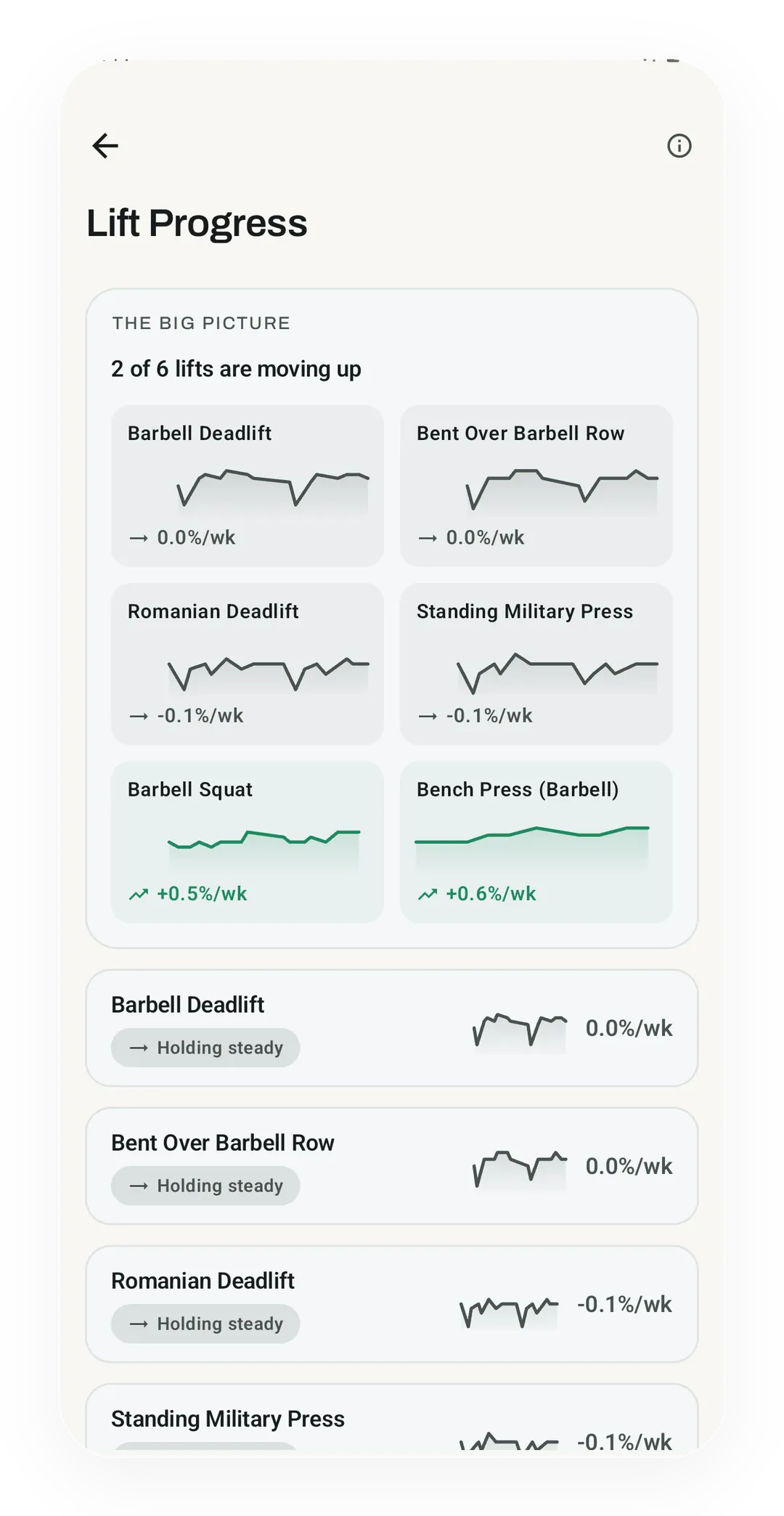 Open full-size image ↗
Kinoku's Lift Progress dashboard
The Pro dashboard ranks every lift with a trend line. The per-lift label it shows, progressing, holding steady or slipping, is free on each lift's own Stats page.
One of the apps on this page
Kinoku is free to install
Core tracking works offline, with no account. An export from the app you use today can come along.
Android only for now, with an iPhone version in the works. Some depth is paid, and the pricing page says which parts.
Related features
Open a lift in Stats and a plain label says if it is progressing, holding steady, or slipping, with a flat-zone band on the chart. The label is free. Pro adds ideas for a stuck lift (options, never orders), an all-lifts dashboard, and a Coach card. It stays quiet when the data is thin.
Charts per exercise, PRs, your best one-rep estimate, volume trends, and date filters. Every exercise type gets a chart that fits it: Best, Total, and Avg Time for holds, Best and Total Reps for rep work, and Best and Total Distance for distance work, not just weight charts.
A 4-phase planning stack. The builder, all 25 templates, named programs with auto-progression, the custom model, and unlimited active programs are free. Pro adds volume targets, readiness tuning, and auto set changes.