

Best calisthenics workout tracker apps for Android (2026)
Seven Android apps for logging pull-ups, dips, holds and skill progressions, with what each app's own pages say about counting your body weight as load.
To log your own sets, Calisthenics Memory, Hevy and Kinoku are trackers first, and Kinoku counts part of your body weight on every rep; Calistree, Caliverse, Thenics and Thenx lead with skill plans.
At a glance
| App | Best for | Better at | Main trade-off |
|---|---|---|---|
| Calisthenics Memory | People who follow their own method and want an open-source log that stays on the phone | Ten-level progressions you define, rep or hold tracking, and JSON or CSV export | Its page names no load math for body weight, and it ships on F-Droid |
| Calistree | People who want a plan built around their gear, with a skill tree to climb | Added weight, counterweight and bands on a set, plus generated programs | The free version limits custom exercises and Journeys |
| Caliverse | People who want ready-made plans and live group sessions with coaches | Live sessions with approved coaches, and a free library of 100+ workouts | Skill-focused plans are in Caliverse PRO |
| Hevy | Lifters who mix gym work and calisthenics and want friends in the same app | Friends, shared routines and a watch app, with no ads | Body weight counts only on full-bodyweight moves, and never on custom ones |
| Kinoku | Android users who want every push-up, dip and pull-up to count real load, with no account | A share of your body weight on every rep, plus seven free skill ladders | Android only for now, seven skill ladders, and no video lessons of its own |
| Thenics | People chasing named skills such as the planche or the front lever | Seven named skills free, each broken into step-by-step progressions | The coach and seven more skills need Thenics Pro |
| Thenx | People who want routines matched to their level and skill tutorials from one brand | Expert tutorials for muscle-ups, handstands and the planche | Its listing does not say which parts are free |
Publisher disclosure
Kinoku, made by Dreamsoft Works, writes and publishes this page, and Kinoku is one of the apps on it. Every fact about another app is quoted from a page that app's maker publishes, opened on October 12, 2026, or observed in a dated emulator test named in that source's note. We give no score. The apps are grouped by what their own pages lead with, and every label points at a quoted sentence.
Quickstart
For logging your own calisthenics sets on Android, Calisthenics Memory, Hevy and Kinoku are trackers first. Calistree, Caliverse, Thenics and Thenx lead with coach-built plans and skill progressions. The apps are grouped by what their own pages lead with and run A to Z inside each group, and nobody gets a score.
Which calisthenics apps track your own sets, and which build the plan?
A calisthenics log has two jobs. It records the reps, holds and added weight you did, and it shows whether a skill is getting closer. The seven apps here split by which job their own pages put first.
- Trackers you plan yourself: Calisthenics Memory, Hevy and Kinoku. Calisthenics Memory’s page calls it a “Bodyweight workout tracker”. Hevy’s listing says it suits “bodyweight workouts such as calisthenics”, and Kinoku logs each bodyweight rep with part of your body weight.
- Plans and skill progressions first: Calistree, Caliverse, Thenics and Thenx. Calistree says “It will create personalized programs based on your objectives, equipment and experience.” Thenics breaks each skill “into clear progressions”, Thenx teaches “elite moves like muscle-ups, handstands, planche, and more”, and Caliverse lists “10+ training plans” in its free version.
Most of these apps do some of both jobs, so the groups follow the lead claim on each page and not a full feature count.
Side by side
Each cell rests on the app maker’s own words or on Kinoku’s code. “Not stated” means no page we could open covers it.
| App | Reps and timed holds | Counts body weight as load | Added weight or assistance | Skill progressions | Free tier and ads |
|---|---|---|---|---|---|
| Calisthenics Memory | Reps or time per exercise | Not stated | Optional weight and assistance | 10 levels you define | Free open-source; F-Droid |
| Hevy | Reps; best time on planks | Full-bodyweight library moves only | Weighted and assisted types | Not stated | “No ads and free.” |
| Kinoku | Reps, time or both | Every bodyweight move, by its share | Belt or vest added; help subtracted | 7 free Skill Journeys | Free; no ads; Pro for deeper analysis |
| Calistree | Not stated | Not stated | Added weight, counterweight, bands | Skill tree | Unlimited free sessions; no ads |
| Caliverse | Not stated | Not stated | Not stated | Skill plans in PRO | 100+ free workouts |
| Thenics | Reps and progress | Not stated | Not stated | 7 free skills, 7 in Pro | Coach in Pro |
| Thenx | Reps, sets, personal bests | Not stated | Not stated | Skill tutorials | “In-app purchases” label |
Each app, in its own words
Calisthenics Memory
Best for: People who follow their own method and want an open-source log that stays on the phone.
Calisthenics Memory is a small open-source tracker on F-Droid, the free and open-source app store for Android. Its page calls it “A privacy-focused bodyweight training tracker.”
- What it does well: You “Choose rep-based (dynamic) or time-based (isometric) tracking” for each exercise you create, with “10-level progressions to match your method”. It offers “Optional distance, weight, and assistance tracking”, “Support for unilateral (one-sided) exercises”, and a workout mode with “Timer-assisted rep counting and isometric hold tracking”.
- What its pages say about data: “Your data stays on your device, no internet required”, and you can “Export/import in JSON/CSV format”. Its code is open source under a General Public License, so anyone can read it.
- Where it is the better pick: Someone who already runs a named method and wants the app to fit it. The page names “Convict Conditioning, StartBodyweight, RR (Recommended Routine), HIIT, circuit training”, where HIIT means high-intensity interval training.
- Where Calisthenics Memory differs: Its page does not say whether logged weight or assistance feeds a load or volume total, and it names no built-in exercise library or coach. Official listing: F-Droid.
Hevy
Best for: Lifters who mix gym work and calisthenics and want friends in the same app.
Hevy is a gym log, and its listing names calisthenics as one of the styles it suits.
- What it does well: The listing says “No ads and free.” You can “Follow your friend’s progress by following their lifts and copying their routines”, and its Wear OS app has “Helpful timers for duration exercises”.
- What its pages say about bodyweight load: When a move uses “100% of your bodyweight”, such as a pull-up or a dip, and you have logged your weight, Hevy counts body weight plus added weight. Then come the limits: “If an exercise only uses partial bodyweight (such as weighted sit-ups or push-ups), your bodyweight will not be included in total volume.” And “Custom weighted bodyweight exercises never include bodyweight in volume calculations.”
- What its pages say about records: For bodyweight and assisted moves, “the graph will have two metrics, Most Reps (Set) and Session Reps.” For a plank, the graph shows “your Best Time and this will be the only Personal Record available for these exercises.”
- Where it is the better pick: Someone who trains in a gym most days, does pull-ups and dips on the side, and wants to see friends’ sessions.
- Where Hevy differs: It needs an account, which we saw in an emulator test on September 6, 2026 for our Hevy versus page. Official listing: Google Play.
Kinoku
Best for: Android users who want every push-up, dip and pull-up to count real load, with no account.
Kinoku logs bodyweight work, gym sets and GPS runs in one record on an Android phone, and you never make an account.
- What it does well: Every bodyweight move counts a share of your body weight on each rep. A pull-up or chin-up counts all of it, a dip about 98%, a push-up about 64% and an inverted row about 55%. A belt or vest adds on top, and an assisted rep subtracts the help, so using less band reads as more load. Kinoku saves your body weight with each set, so the Total Load chart stays true through a cut or a bulk.
- Skills and holds: The seven free Skill Journeys are First Pull-Up, 10 Pull-Ups, First Muscle-Up, First Dip to 10 Dips, the 30-second wall handstand, the 30-second L-sit and the first pistol squat. Each rung lands on your calendar as a normal routine, and finishing the sets moves you up. Moves log reps, time or both, and the free Wear OS app logs sets from the wrist.
- What its pages say about limits: Most of the 538 load percentages are Kinoku’s own estimates, and only 11 repeat a lab figure, so every percentage is yours to edit. A custom move you mark as bodyweight takes a percentage from its name or a 70% default. Bodyweight-relative volume in the general Stats analysis is Pro, while the per-move Total Load chart is free.
- Where it is the better pick: Someone who wants weighted dips, harder push-up variants and lost kilos to show up as progress on one chart.
- What Kinoku does not do: There is no iPhone app yet, since Kinoku is built for Android first. It has no video lessons of its own, only a YouTube search on each move, and no live classes, coach chat or community feed. Its seven journeys leave out the planche, the front lever and the human flag, and it has no sync between two phones.
Calistree
Best for: People who want a plan built around their gear, with a skill tree to climb.
Calistree is a calisthenics coach app that writes programs and maps skills on a tree.
- What it does well: “It will create personalized programs based on your objectives, equipment and experience.” A set can carry “added weight, counterweight, elastic bands”, and you “Follow logical difficulty progressions with the Skill tree”.
- What its pages say about progress and price: You “Track your progress with Personal records, exercises Mastery and Experience points.” The listing says “the basic free version is unlimited in time and unlimited in number of workout Sessions” and calls the app “absolutely free of ads”. It adds: “The only restrictions are in the number of certain other objects that you can create, such as Journeys, Locations and Custom exercises.”
- Where it is the better pick: Someone who trains with bands or a counterweight and wants an app to write the program for the gear at hand.
- Where Calistree differs: Its listing names “Sync with Google Fit.” and “1300+ exercises with videos”, and it does not say how added weight or bands enter a load total. Official listing: Google Play.
Caliverse
Best for: People who want ready-made plans and live group sessions with coaches.
Caliverse is a calisthenics plan and video app with a free library and a paid PRO tier.
- What it does well: “Customize every aspect of your training - create custom exercises, workouts and training plans.” The listing says “The free version of the app contains 100+ bodyweight workouts and 300+ calisthenics exercises with professional videos and descriptions, 10+ training plans, monthly challenges with prizes and great community.”
- What its pages say about the paid tier: Caliverse PRO adds “More advanced and progressing workout plans that targets specific skills or movements”. The listing also says you can “Join live group sessions that are ran by Caliverse approved coaches.”
- Where it is the better pick: Someone who trains better with a coach on screen and a group around them.
- Where Caliverse differs: Its What’s new text says “your Pro access and workout history stay connected to your Caliverse account”, and the listing does not describe a set-by-set load total. Official listing: Google Play.
Thenics
Best for: People chasing named skills such as the planche or the front lever.
Thenics is built around a list of named skills, each with its own path.
- What it does well: “Free Skills: Muscle-Up, Planche, Front Lever, Back Lever, Pistol Squat, Handstand Push-Up, V-Sit”. “Each skill is broken into clear progressions with focused bodyweight training exercises and adaptive workouts.” You “Use the built-in workout tracker to log sets, reps and progress”.
- What its pages say about the paid tier: “Pro Skills*: One Arm Pull-Up, Human Flag, One Arm Push-Up, One Arm Handstand, Shrimp Squat, Hefesto, Dragon Flag”. The Thenics Coach, which “generates personalized plans based on your goals, suggests which skills to pair, and tells you when to rest”, is also marked “only available with Thenics Pro”.
- Where it is the better pick: Someone whose goal is one named skill, who wants the steps to it laid out in order.
- Where Thenics differs: Its listing describes reps and progress, and it does not mention body weight in a load total, added weight or an export. Official listing: Google Play.
Thenx
Best for: People who want routines matched to their level and skill tutorials from one brand.
Thenx is a calisthenics training app with routines matched to your level and video tutorials for big skills.
- What it does well: You “Get customized routines based on your fitness level and goals” and “Learn elite moves like muscle-ups, handstands, planche, and more with expert tutorials.” Its tracking lets you “Log your reps, sets, and personal bests.”
- What its pages say about progress: Its analytics “Track your strength gains, monitor muscle activation, and visualize progress.”
- Where it is the better pick: Someone who likes routines matched to their level and video lessons for the big skills.
- Where Thenx differs: The listing carries the “In-app purchases” label and does not say which parts are free. It does not mention body weight in a load total. Official listing: Google Play.
How does each app count a bodyweight rep?
A rep count tells you how many, and a load tells you how heavy. For a barbell the two come together, but a pull-up’s weight is you, and that changes as you cut, bulk or strap on a vest. Here is what each app’s pages say it does with your body weight.
- Kinoku counts a share on every bodyweight move. All of it on a pull-up, about 98% on a dip and about 64% on a push-up. The push-up figure repeats a 2011 force-plate study, and the pull-up and dip figures are Kinoku’s estimates. Body weight is saved with each set, and you can edit any percentage.
- Hevy counts all of it, on some moves. It adds your logged body weight on moves that use “100% of your bodyweight”, such as pull-ups and dips. Push-ups and other partial moves count only the added weight, and custom exercises never count body weight.
- The other five do not say. Calistree and Calisthenics Memory log added weight, and Calistree also logs counterweights and bands, but neither page says how those numbers enter a total. Caliverse, Thenics and Thenx describe reps, sets and progress.
You can try the Kinoku numbers without installing anything in the bodyweight load calculator, which lists every move and marks which figures come from a study.
Skill ladders compared
Five of the seven apps describe some way to climb toward a skill, and they differ in who writes the steps.
- Steps written for you: Thenics lists seven free skills and seven Pro ones. Thenx offers tutorials for the muscle-up, handstand and planche, Calistree has a skill tree, and Caliverse PRO adds plans for specific skills.
- Steps you write: Calisthenics Memory gives each exercise up to ten levels that you define to match your method.
- Steps that read your log: Kinoku’s Skill Journeys turn each rung into a routine on your calendar, and finished sets move you up. Training on Tuesday instead of Monday counts the same, and you can try the target skill whenever you like.
Kinoku’s catalog stops at seven journeys. You can still log a planche lean or a front lever tuck as an exercise, but no ladder guides you there yet.
For a full-body plan beside the journeys, Kinoku has the r/bodyweightfitness Recommended Routine as a free three-day template, where you choose when each move steps up to a harder version.
How this list was checked
Every fact about the other apps comes from a page that app’s maker publishes, opened on October 12, 2026, or from one dated emulator test.
- Other apps: Each fact is a sentence from a Google Play listing, the F-Droid page, or Hevy’s help centre. Hevy’s help centre refuses automated reads, so a person opened those two articles in a browser on the same day. Two facts, Hevy’s account wall and its export, come from our emulator test of September 6, 2026 for the Hevy versus page.
- Kinoku: We read the load percentage of each move, the Skill Journey list and every Pro gate in the app’s source code, then checked them against our feature pages.
- Left out: Calisteniapp and Madbarz came up in our search. Calisteniapp has no Google Play listing under that name that we could find, and Madbarz’s listing describes workouts and plans without a way to track progress on bodyweight sets.
- Order: The apps are grouped by what their pages lead with, trackers first and plan apps second, with each group in alphabetical order. No app paid for a place on this list.
Frequently asked questions
Is there an app that counts my body weight on pull-ups and push-ups?
Kinoku and Hevy both add body weight, in different ways. Hevy’s help centre says it counts your logged body weight on moves that use all of it, such as pull-ups, chin-ups and dips, but not on push-ups or other partial moves. Kinoku counts a share on every bodyweight move: all of it on a pull-up, about 98% on a dip and about 64% on a push-up.
Which calisthenics app works offline with no account?
Calisthenics Memory and Kinoku. The F-Droid page for Calisthenics Memory says it needs no internet, and Kinoku asks for no account and keeps no server copy of its own, while your Android system backup may hold eligible app data. Caliverse ties Pro access and workout history to a Caliverse account. The other listings here do not state an account rule in plain words.
Which app teaches skills like the planche or the front lever?
Thenics lists the planche, front lever, back lever and muscle-up among its free skills, each broken into progressions. Thenx offers expert tutorials for muscle-ups, handstands and the planche. Calistree has a skill tree, and Caliverse PRO adds plans aimed at specific skills. Kinoku’s seven Skill Journeys cover pull-ups, dips, the muscle-up, the wall handstand, the L-sit and the pistol squat, with no planche or lever journey yet.
Can I log timed holds like an L-sit or a plank?
Calisthenics Memory lets each exercise track reps or time, and its workout mode times isometric holds. Hevy’s help centre says a duration exercise such as a plank records your best time. Kinoku logs reps, time or both on a move, and two of its Skill Journeys, the 30-second L-sit and the 30-second wall handstand, are built on held seconds.
How do I track assisted pull-ups with a band?
Calistree’s listing names counterweights and elastic bands as set options, and Calisthenics Memory offers optional assistance tracking. Hevy logs assisted moves, and its help centre says their records are reps only. In Kinoku the help is stored as help, so the load is your body weight minus the assistance, and needing less help reads as more load.
Which app tracks weighted pull-ups and dips with a belt or vest?
Hevy adds the belt weight to your logged body weight on full-bodyweight moves from its own library. Kinoku adds the belt or vest to its share of your body weight on any bodyweight move, custom ones included. Calistree lists added weight as a set option, and Calisthenics Memory offers optional weight tracking, though neither page says how that weight enters a total.
Are these calisthenics apps free?
Most have a free way in. Calistree’s free version has unlimited sessions and no ads, with limits on custom exercises and Journeys. Caliverse’s free version holds 100+ workouts and 10+ plans. Thenics gives seven skills free and puts seven more and its coach in Pro. Hevy says no ads and free. Thenx lists in-app purchases without a free list. Calisthenics Memory is free open-source software, and Kinoku’s tracking is free.
Which app suits someone who also lifts weights in a gym?
Hevy and Kinoku both log barbell and machine work next to bodyweight sets, and Hevy’s listing calls the app perfect for calisthenics too. Kinoku adds GPS runs to the same record, and its free programs include barbell plans such as 5/3/1 next to the skill ladders.
Is there an app that plans calisthenics workouts for me?
Calistree generates programs from your gear, goals and level. Thenx offers routines matched to your level, and the Thenics Coach builds plans in Thenics Pro. Caliverse offers training plans and live group sessions. Calisthenics Memory and Kinoku leave the plan to you, though Kinoku’s Skill Journeys put each rung on your calendar as a routine you can edit.
Can I export my calisthenics history?
Calisthenics Memory exports and imports JSON and CSV files. Kinoku exports CSV files and a full ZIP backup that restores onto a new phone. Hevy’s in-app export makes a CSV that cannot be imported back into Hevy, which we saw in a September 2026 test for another page. The listings for Calistree, Caliverse, Thenics and Thenx do not mention an export.
Why does counting body weight change my progress chart?
Reps alone miss two kinds of progress. Ten pull-ups at 85 kg move more than ten at 70 kg, and a 10 kg vest adds work the rep count never shows. An app that counts body weight per set can show a rise when you gain weight at the same reps, or add a vest. Kinoku saves your body weight with each set, so a cut or a bulk does not rewrite old sets.
What does Kinoku not do that the calisthenics apps do?
Kinoku has no iPhone app yet, no video lessons of its own, no live classes and no coach to message. It has seven Skill Journeys, so skills such as the planche, front lever and human flag have no ladder yet. It has no community feed and no sync between two phones, and most of its load percentages are its own estimates rather than lab measurements.
Related pages
- Bodyweight load calculator: The load percentage for every bodyweight move Kinoku knows, and which ones come from a study.
- How much weight is a push-up, pull-up or dip?: Where the 64%, 98% and 100% figures come from.
- Relative strength and bodyweight exercise load: Why ten pull-ups at 70 kg and at 85 kg are not the same set.
- Bodyweight Total Load: How Kinoku saves your body weight with each set and charts the load.
- Skill Journeys: The seven free skill ladders, from the first pull-up to the first muscle-up.
- Military calisthenics workout: The US Army’s warm-up, conditioning and cool-down drills in order, and how to build them as routines in Kinoku.
- Kinoku vs Hevy: Accounts, routine limits and export, side by side.
- Best Hevy alternatives: Gym trackers for people leaving Hevy.
Which one fits you
- Choose Calisthenics Memory if you run your own method, such as Convict Conditioning or the Recommended Routine, and want open-source software with no internet.
- Choose Hevy if you split your week between the gym and the bar, your friends use Hevy, and an account is fine.
- Choose Kinoku if you want each rep to count a share of your body weight, a belt or vest on top, and no account.
- Choose Calistree if you want a program generated from your gear and level, with bands and counterweights logged on each set.
- Choose Caliverse if you want ready-made plans and the option of live group sessions with coaches.
- Choose Thenics if your goal is one named skill and you want its progression laid out for you.
- Choose Thenx if you want routines matched to your level and goals, and video tutorials for the big skills.
Test record
Tested September 6, 2026
- Environment
- Android Studio Pixel phone emulator, API 36, Android 16
- Hevy
- Version 3.1.12 (version code 3289233), installed from Google Play. Official listing
- Kinoku
- Version 1.2.0 (version code 30), test build. Official listing
How this page is checked. Every fact about another app on this page comes from a page that app publishes, which we could open and quote on October 12, 2026, or from a dated emulator test named in that source's note. The sources, with the exact sentence each fact rests on, are listed just above. Every Kinoku fact is tied to the shipping app's code. The page carries no score; the apps are grouped by what their own pages say. If a fact here has gone stale, the support page is the fastest way to tell us.
Test evidence
What the tested builds showed
 Open full-size image ↗
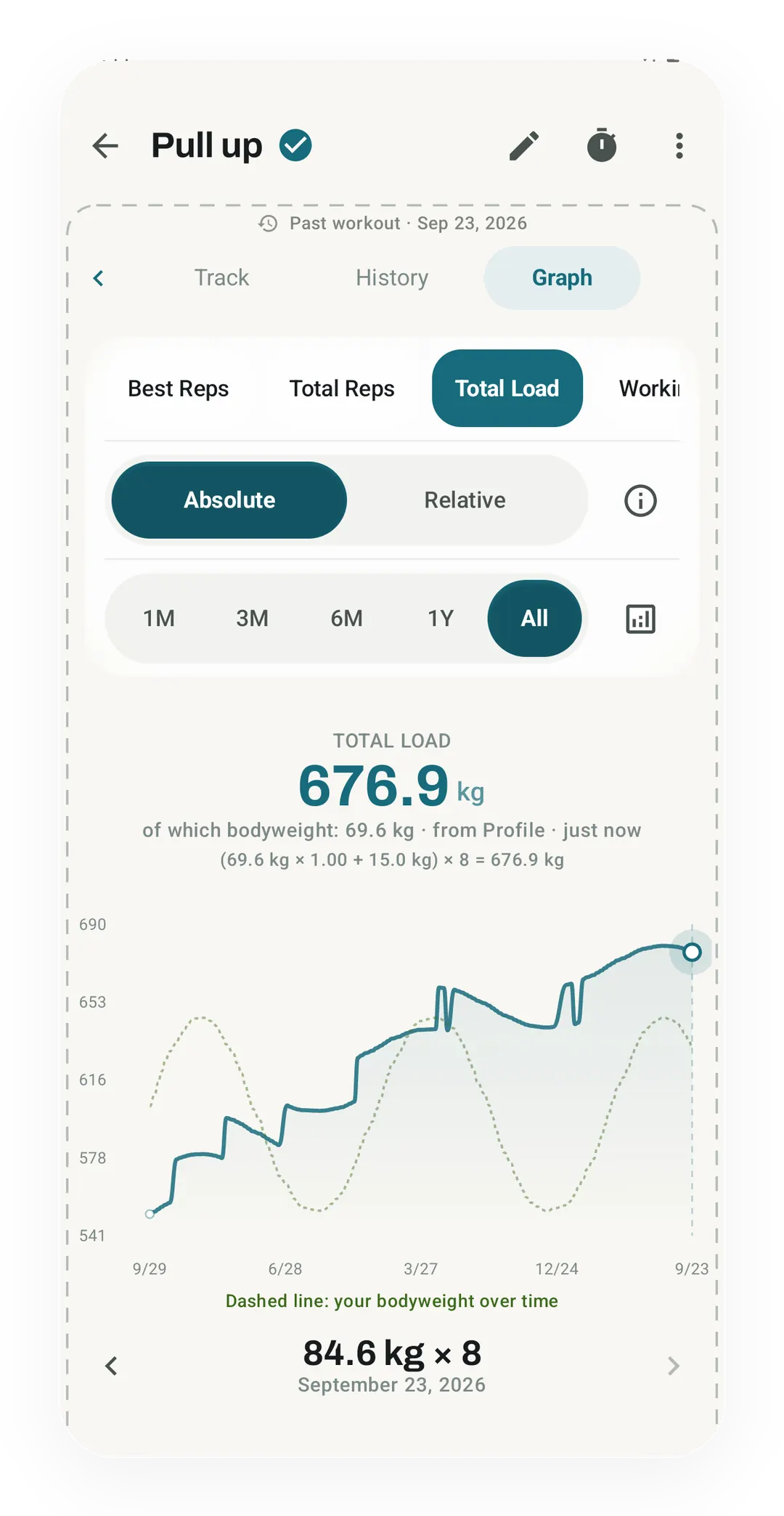
How Kinoku counts a bodyweight set
Real app capture, free tier. The Pull up Total Load counts 69.6 kg of body weight plus 15.0 kg added on each rep, so 8 reps come to 676.9 kg. A dashed line on the chart tracks body weight over time.
One of the apps on this page
Kinoku is free to install
Core tracking works offline, with no account. An export from the app you use today can come along.
Android only for now, with an iPhone version in the works. Some depth is paid, and the pricing page says which parts.
Related features
Pull-ups, push-ups, and dips get real per-rep load from body-movement math, not just reps times one. The load math, snapshots, and Total Load chart are free; Pro scales the volume charts in Stats Analysis to your body weight.
Seven free, offline-first paths to named bodyweight skills, with editable routines, evidence-based progress, graduation receipts, and no active-journey cap.
Every set, one tap. Track how hard each set felt, your rest timers, set types, and notes.
1,300+ built-in exercises with muscle data and unlimited custom moves are free. Pro adds custom form photos and assisted sorting.