

Calisthenics Workout Plan: The Recommended Routine
A free calisthenics workout plan for beginners: the r/bodyweightfitness Recommended Routine, with its progressions and pairings, tracked offline in Kinoku.
Weekly Training Schedule
These are the sessions the Kinoku template builds when you start it, and the same sessions sit in the file below. The rep counts are each routine's starting targets. The template sets no loads, so you choose how hard each set is.
- Pull up3 x 5
- Bodyweight Squat3 x 5
- Dips (Chest focus)3 x 5
- Single-Leg Romanian Deadlift3 x 5
- Inverted Row3 x 5
- Pushups3 x 5
- Plank3 x 30 s
- Hollow Body Hold3 x 30 s
- Pull up3 x 5
- Bodyweight Squat3 x 5
- Dips (Chest focus)3 x 5
- Single-Leg Romanian Deadlift3 x 5
- Inverted Row3 x 5
- Pushups3 x 5
- Plank3 x 30 s
- Hollow Body Hold3 x 30 s
- Pull up3 x 5
- Bodyweight Squat3 x 5
- Dips (Chest focus)3 x 5
- Single-Leg Romanian Deadlift3 x 5
- Inverted Row3 x 5
- Pushups3 x 5
- Plank3 x 30 s
- Hollow Body Hold3 x 30 s
Ready to lift?
Start Bodyweight RR in Kinoku
Bodyweight RR is a free template in the app. When you start it there, Kinoku builds the routine and puts 12 weeks on your calendar. It sets no loads, so you choose how hard each set is.
Any time, from the menu
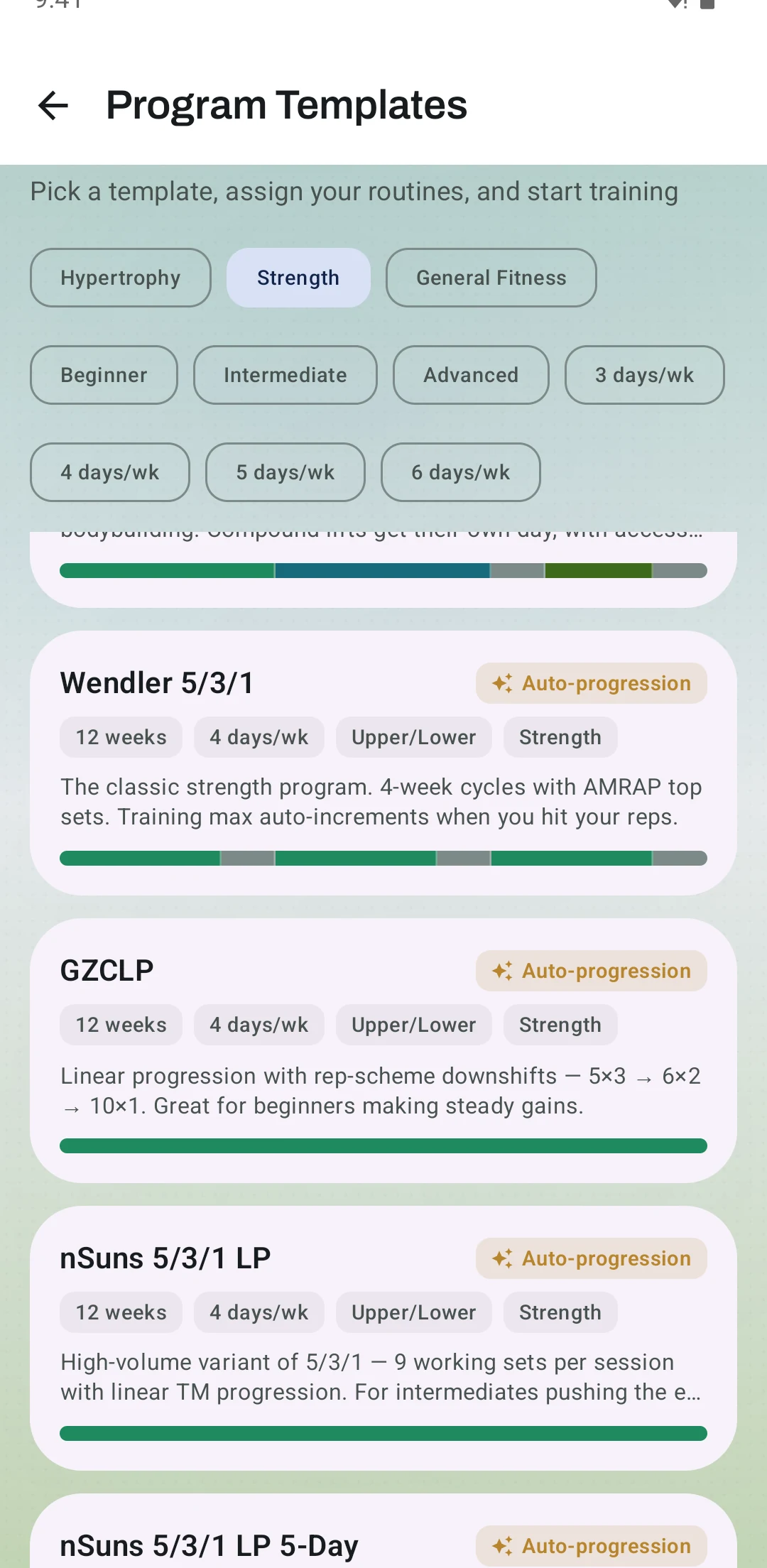
- Open the menu, tap Search Kinoku at the top, type templates and tap Program templates.
- Tap the General Fitness filter to shorten the list, then tap Bodyweight Recommended Routine and Start This Program.
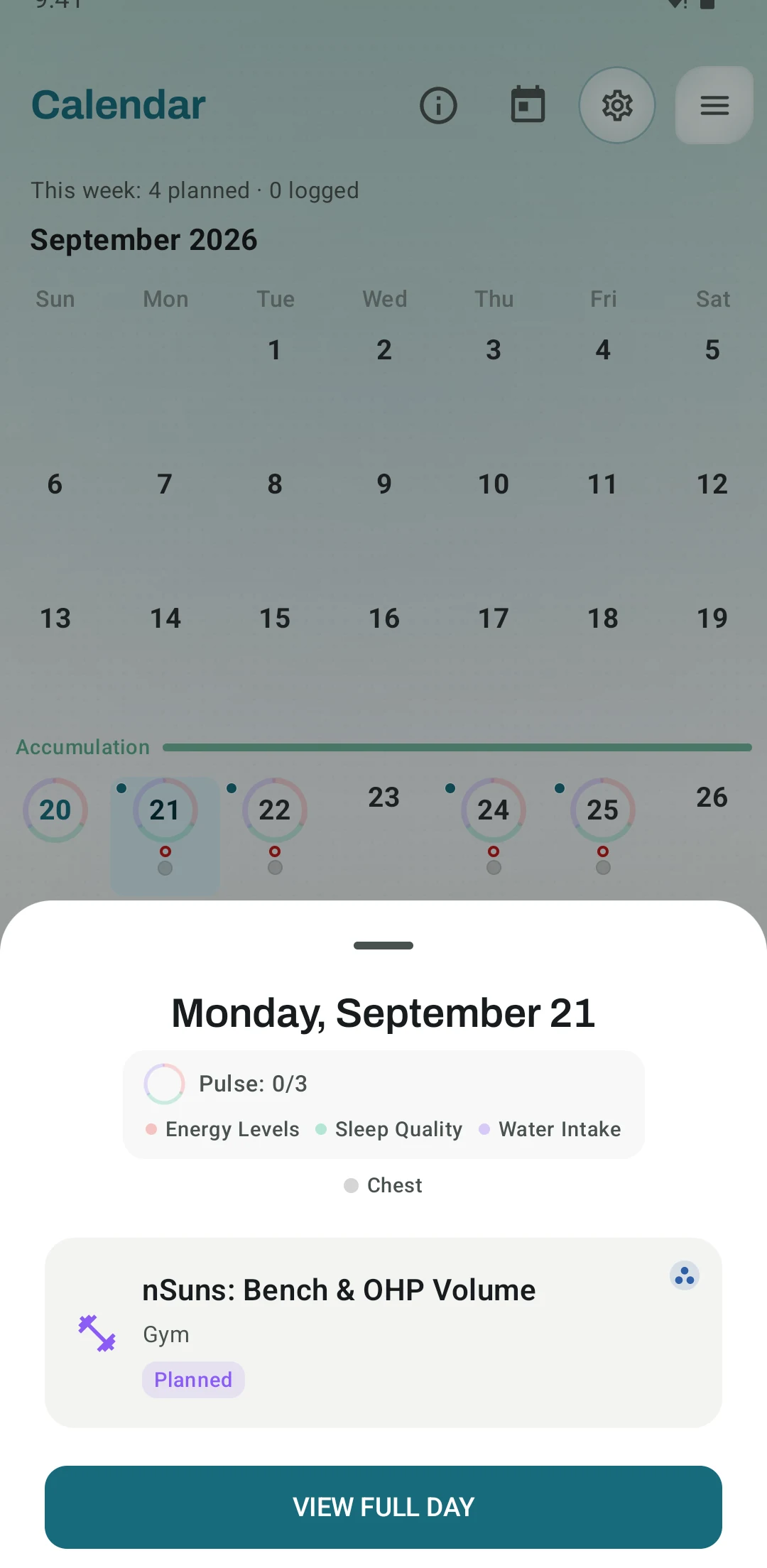
- Choose a start date, tap Next, and tap Create the program routines so Kinoku builds the routines for you.
- Tap Next, then Activate Program.
On your first launch, from the welcome screen
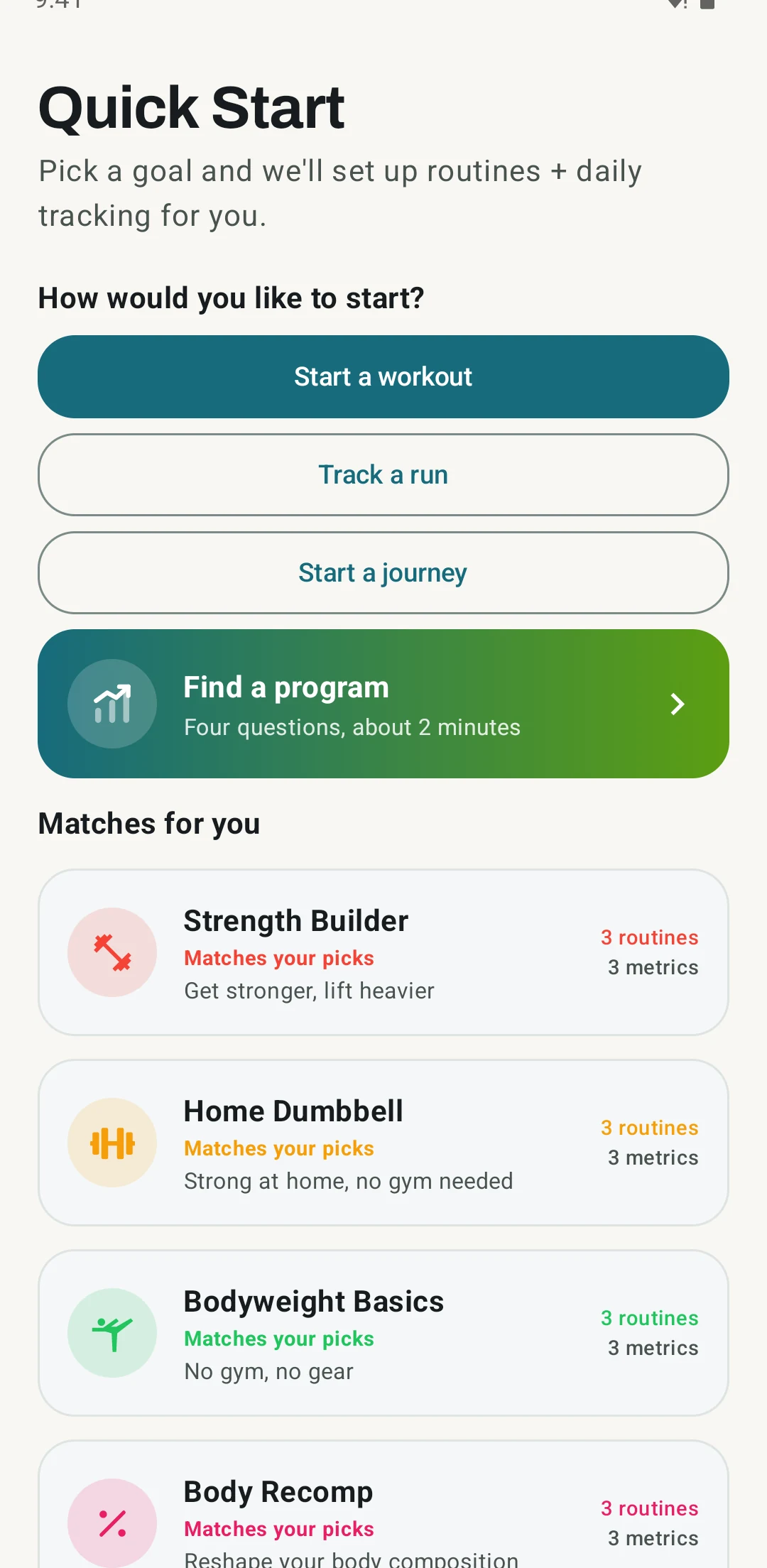
- Pick Strength as a focus, because the finder card only shows for people who lift.
- Tap Find a program on the welcome screen, right under the three start choices.
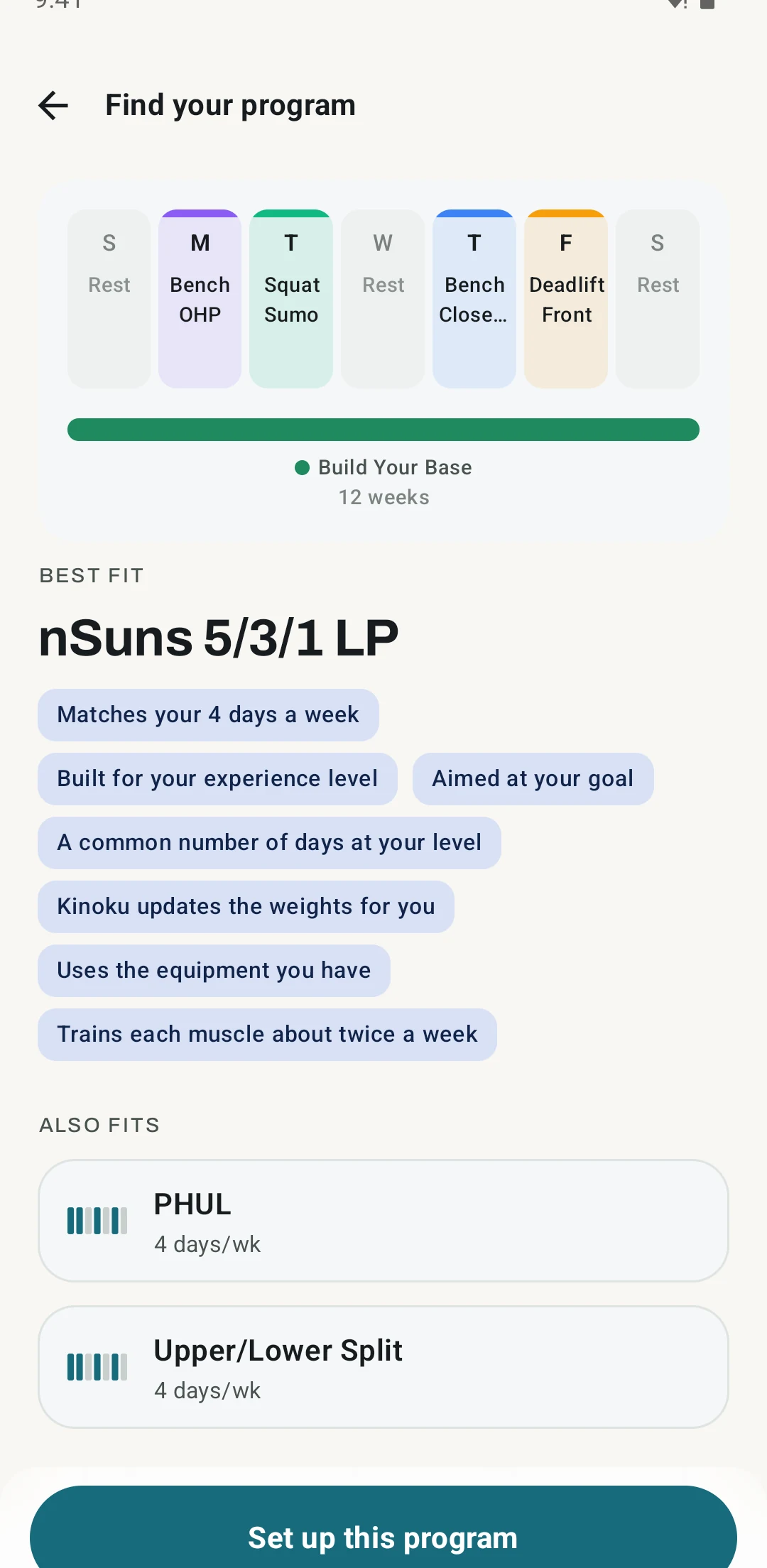
- Answer four questions about your week, and the finder sets up the match for you.
The finder picks the program that fits your answers, so it can suggest a different one, while the menu path above reaches Bodyweight RR every time.
Opens the template in the app when Kinoku is installed, and opens Google Play when it is not.
Prefer a file?
Save the file, then open it with Kinoku, and you get 1 routine and a 12-week calendar that starts on the Monday after you download it. No workouts are added to your history.
Kinoku in practice
Track this program on your phone
 Open full-size image ↗
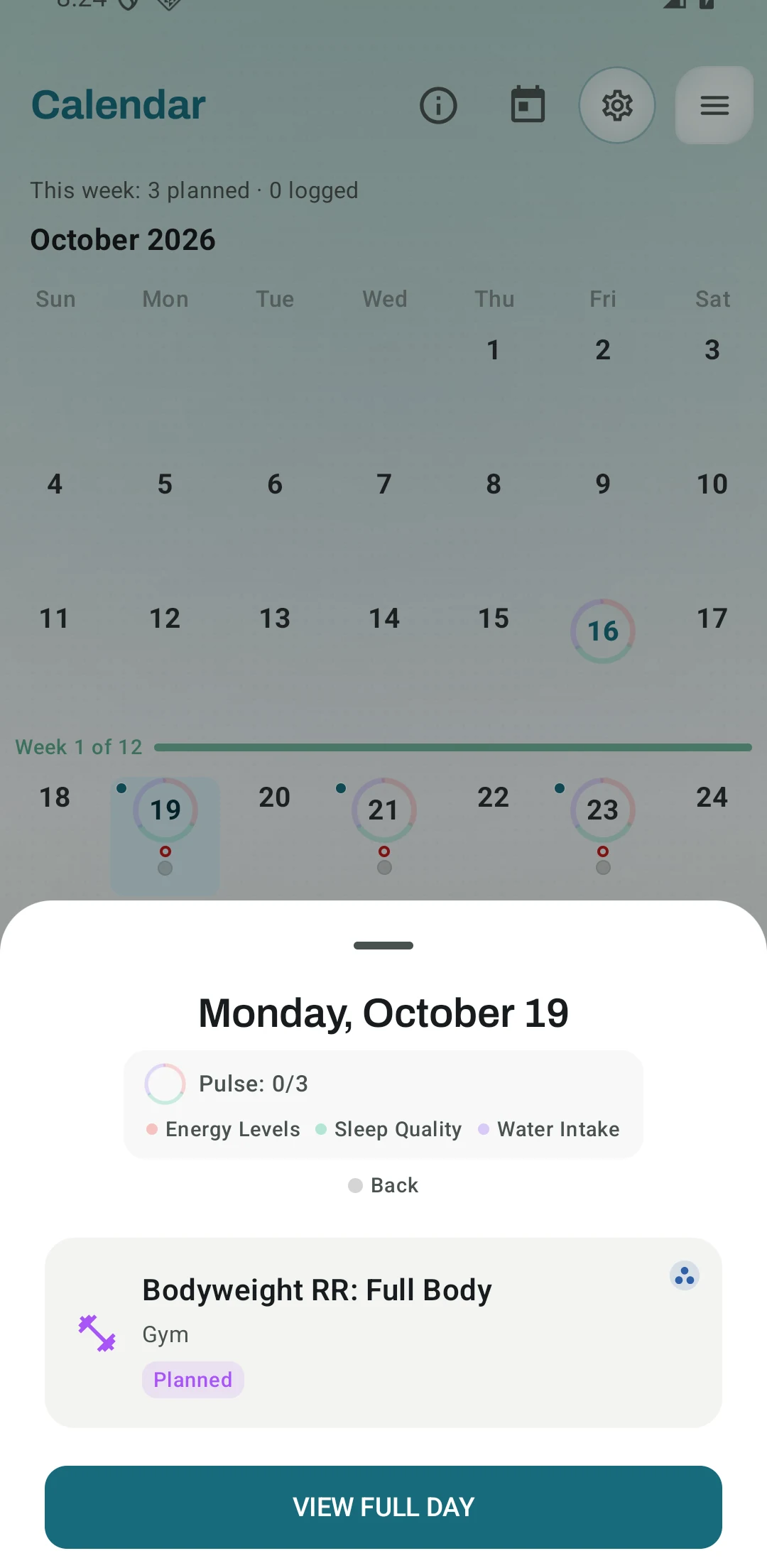
Your weeks land on the calendar
Real Android app capture of the Recommended Routine set to start on a Monday. The same session comes back on Monday, Wednesday and Friday, and the app calls it Bodyweight RR: Full Body.
 Open full-size image ↗
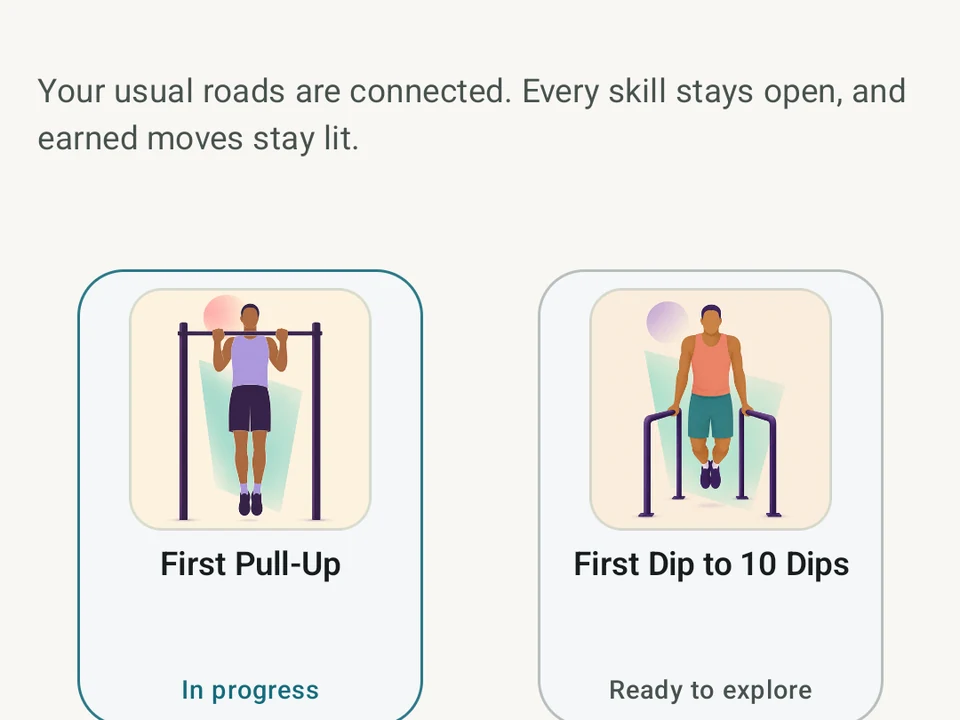
Skill Journeys beside the routine
Real Android app capture of the Skill Board. First Pull-Up and First Dip to 10 Dips are free journeys that can run alongside the Recommended Routine.
The Recommended Routine (RR) is a full-body bodyweight workout from the r/bodyweightfitness community on Reddit, kept on the community’s wiki. It runs three days a week with a rest day between sessions, and each session pairs six strength moves before a short block of core work.
How a session is built
A session opens with 5 to 10 minutes of warm-up, made of dynamic stretches and a few easy moves such as squat sky reaches and wrist prep. The strength work that follows takes 40 to 60 minutes, in three pairs at 3 sets of 5 to 8 reps each:
- First pair. A pull-up step and a squat step.
- Second pair. A dip step and a hinge step, a move that bends at the hips.
- Third pair. A row step and a push-up step.
A core triplet closes the session, with one anti-extension, one anti-rotation and one extension move for 3 sets of 8 to 12.
Pairs save time without cutting rest. You do a set of the first move, rest 90 seconds, then do a set of the second and rest 90 seconds again, which gives each move about three minutes between its own sets. The wiki treats rows as the one move nobody skips, and it suggests a low bar, rings, a sturdy table or even a knotted bedsheet in a door to row from.
How the ladders work
Every move in the routine is a ladder of versions, from easy to hard. Push-ups, for example, run from incline push-ups to full push-ups and on to harder forms such as decline or diamond push-ups.
The climb follows one rule on every ladder. You start on a step that fits your strength at 3 sets of 5 and add one rep per set each session. Once 3 sets of 8 are clean, you move to the next step at 3 sets of 5 again. Holds count seconds in place of reps, with sets of 10 to 30 seconds, and the next step comes once all three sets reach 30.
The wiki keeps barbells in view as well. Once the basic squat and hinge are solid, it suggests that people with a barbell and a squat rack learn those lifts in place of the bodyweight versions.
What Kinoku sets up
Kinoku’s template builds one routine and plans it on Monday, Wednesday and Friday for 12 weeks. Its eight moves follow the wiki’s pair order, starting with pull-ups, bodyweight squats, chest dips, single-leg Romanian deadlifts, inverted rows and push-ups at 3 sets of 5. A plank and a hollow body hold close it out at 3 sets of 30 seconds.
The template sets no weights and no rep climb, since progress here means a harder version of a move rather than more load. Starting it asks for no one-rep max, and your sets log the same way as any other workout.
The template is free to start and free to keep running, which fits the wiki’s own line on paid apps: “We do not endorse monetization of the RR.”
Where the app’s version differs
Each move in the template starts on one fixed version, while the wiki starts each ladder wherever your strength sits today. If a full pull-up or dip is out of reach, an easier step from the wiki’s list can take its place in the routine.
Kinoku also leaves the ladder climb to you. Its targets stay at 3 sets of 5 until you change them, and the step to a harder version happens when you edit the routine.
The routine is shorter than the wiki’s session in two places. It has no warm-up, and its core block holds two 30-second holds where the wiki has three moves, so the anti-rotation and extension work is yours to add. The moves also come as straight sets in pair order, and during a workout the Link as Superset option in an exercise’s menu pairs them the wiki’s way.
If a pull-up or a dip is your goal, Skill Journeys can run beside the routine. Its First Pull-Up and First Dip to 10 Dips journeys turn the steps toward each move into routines on your calendar, and every journey is free.
Frequently asked questions
What app can I use to follow the Bodyweight Fitness Recommended Routine?
Kinoku has a free template that builds the routine and plans it on Monday, Wednesday and Friday for 12 weeks, with the wiki's moves in pair order. It sets no weights and no rep climb, because progress here means a harder version of a move, which you choose by editing the routine. It asks for no one rep max and no account.
What equipment do you need for the Bodyweight Recommended Routine?
The wiki asks for a place to row, such as a low bar, gymnastics rings or a sturdy table, and it treats rows as the one part you cannot skip. A pull-up bar or rings comes in once you reach the pull-up steps. For dips, two sturdy chairs or the corner of a kitchen counter can stand in for parallel bars.
How does progression work without adding weight plates?
Each move has a ladder of harder versions. The wiki starts a step at 3 sets of 5 and adds a rep to each set every session. Three clean sets of 8 send you to the next step, back at 3 sets of 5. Holds work the same way with time, and the next step comes once all three sets reach 30 seconds.
Does Kinoku move me up the progressions?
No. The template has no progression rule, so its targets stay at 3 sets of 5 until you change them. When a move gets easy, you swap in the next version by editing the routine, and the reps you log above the target are kept as you logged them.
Can Kinoku guide me to my first pull-up?
Yes, through Skill Journeys, a free feature with seven paths to named bodyweight moves, including First Pull-Up and First Dip to 10 Dips. Each step of a journey lands on your calendar as a normal routine, and a journey runs beside the Recommended Routine instead of replacing it.
Calculators & tools
What a push-up, pull-up, dip or squat really lifts. Hundreds of exercises, each one labelled measured or estimated.
Every exercise in Kinoku's catalog as a star in 3D, placed by the muscles it works. Search a move to see its muscle map, or pick muscles to rank the moves that focus on them.
Track this in the app
Run Bodyweight RR in Kinoku
Kinoku plans every session and keeps your log offline on your phone.
100% free with no mandatory account and no cloud tracking.
Related app features
Seven free, offline-first paths to named bodyweight skills, with editable routines, evidence-based progress, graduation receipts, and no active-journey cap.
Unlimited routines, Smart Sync, Starter Packs, and follow-along links are free, and so are Rotation Groups that cycle through several routines for you.
Every set, one tap. Track how hard each set felt, your rest timers, set types, and notes.
A 4-phase planning stack. The builder, all 25 templates, named programs with auto-progression, the custom model, and unlimited active programs are free. Pro adds volume targets, readiness tuning, and auto set changes.