

Skill Journeys
Seven free, offline-first paths from your current ability to a named bodyweight skill, with editable training and evidence-based progress.
Real app capture
What this feature looks like with data
 Open full-size image ↗
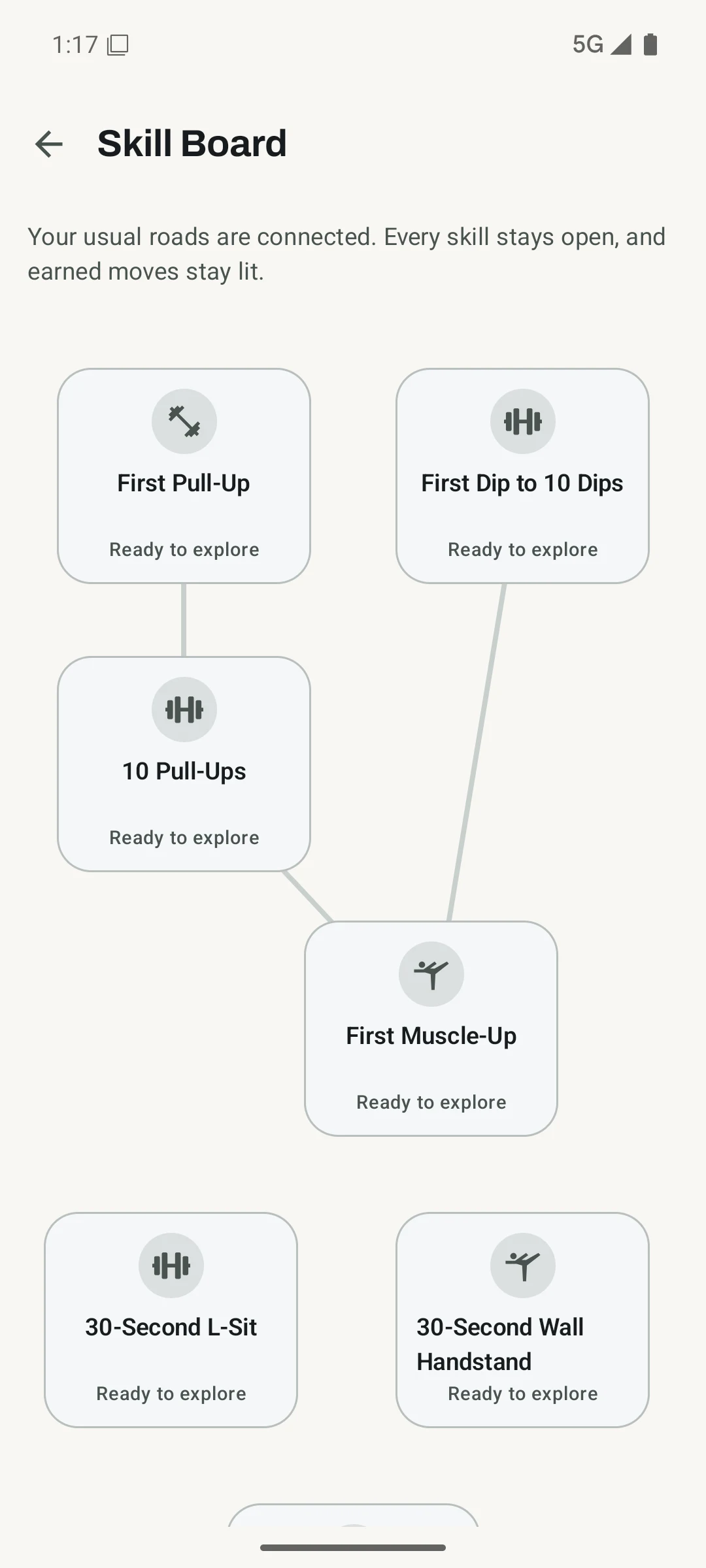
Seven skills, one honest board
Active, paused, earned, and available journeys stay together inside Challenges, with no subscription lock or one-at-a-time cap.
What it is
A Skill Journey is a path from what you can do today to a named bodyweight move you cannot do yet. Kinoku turns the steps between the two into real routines on your calendar. Reading the sets you finish is how it shows how much of the move is yours already.
The launch catalog has seven journeys:
- First Pull-Up
- First Muscle-Up
- 10 Pull-Ups
- First Dip to 10 Dips
- 30-Second Wall Handstand
- 30-Second L-Sit
- First Pistol Squat
Every journey is free. No cap limits how many you run at once, and a journey sits beside your normal training rather than replacing it.
One journey, start to finish
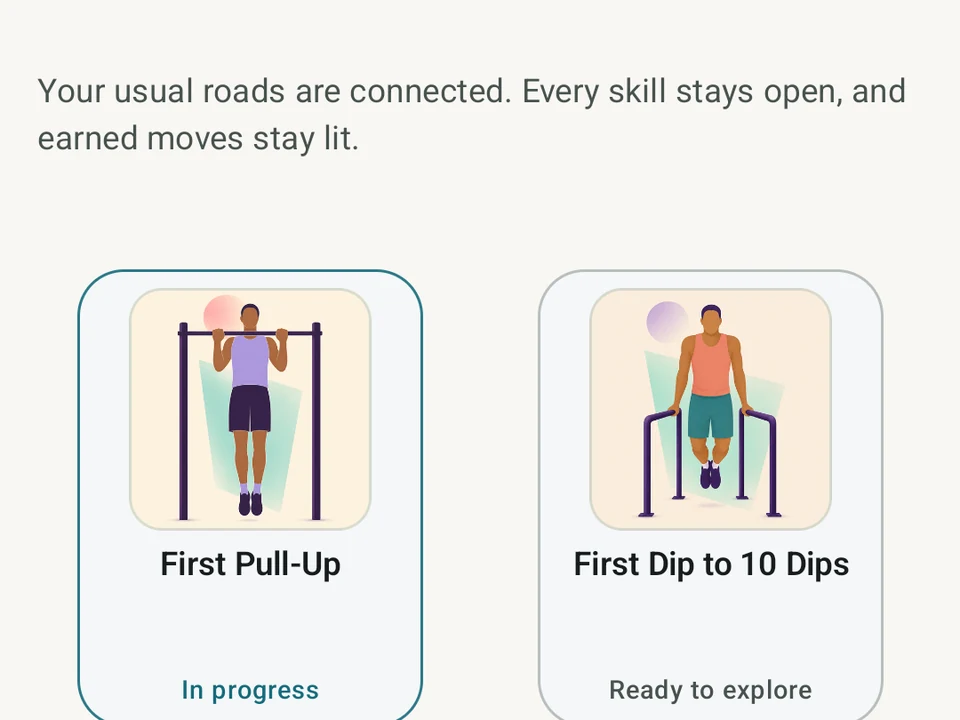
First Pull-Up shows the shape of the rest. The ladder starts with the holds and rows you can already do. Each rung lands on your calendar as a normal routine, and finishing those sets is what moves you up one. You can try the pull-up itself whenever you like, and landing it is judged on its own rather than on where the ladder says you are.
Why progress comes from finished sets
A ticked box on a plan says only that a day arrived. Kinoku reads the work in your log instead, so training on Tuesday rather than Monday counts the same.
Plans that punish a moved session are plans people quit. Editing a routine is allowed here, and a week that went sideways costs you the week and nothing more.
A missing movement reads as no signal rather than a failure. When a key exercise never turns up, Kinoku waits for it instead of marking you down for a session it cannot see.
Your plan stays yours
Skill routines are normal routines you can edit. Kinoku may offer to repeat a week, step back, or change the load. The plan changes only once you accept, so nothing rewrites the sets you finished.
The Skill Board lives inside Challenges, while an active journey also shows on Today, Log, Coach, and exercise details, and sets you log on the watch count toward it. Assisted work records the help as help, so using less of it reads as progress rather than as a heavier lift.
The day it lands
Earning a skill shows you the dated proof, the real time it took, and the climb that led there. Add a photo if you want one, make a share card on your phone, and find earned skills again in the Skill Board and Your Story.
Nothing posts by itself. The share image stays yours until you pick an app to send it to. Kinoku’s ZIP export and restore carries a journey with its routines, goals, plans, and photos onto a new phone.
What a journey does not promise
Timelines here are a guide rather than a promise, because your starting point, your recovery, your gear, and your past training all change the answer. The catalog holds seven moves as well, so a skill outside that list has no journey behind it yet.
Private and offline-first
Planning, progress, earning a skill, and sharing all happen on your phone. A Skill Journey needs no Kinoku account, and no Kinoku server holds your training history. Some main-app data may still reach your Google account through Android’s own backup.
Try it for yourself.
Available on Google Play. Core access starts on the free tier.
Get on Google PlayRelated surfaces
41 templates across many data sources, with deeper detail as your tier goes up.
Unlimited routines, Smart Sync, Starter Packs, and follow-along links are free. Pro adds managed Rotation Groups that cycle through several routines.
Plan workouts on one calendar, with no limit on how many plans you keep or how far ahead you plan. Pro adds repeating schedules (weekly, custom days, or every few weeks), drag-to-move, bring-to-today, repeat-day, and day copy.
The current-month and current-year training stories, including Skills landed, cards, saving, and sharing are free. Pro adds browsing earlier months and years.