

Bodyweight Exercise Load, Explained
How much of your body weight a push-up, pull-up, dip or squat lifts, which of those numbers are measured, and how we worked out the rest.
Kinoku in practice
Where this shows up in the app
 Open full-size image ↗
The estimate before it becomes volume
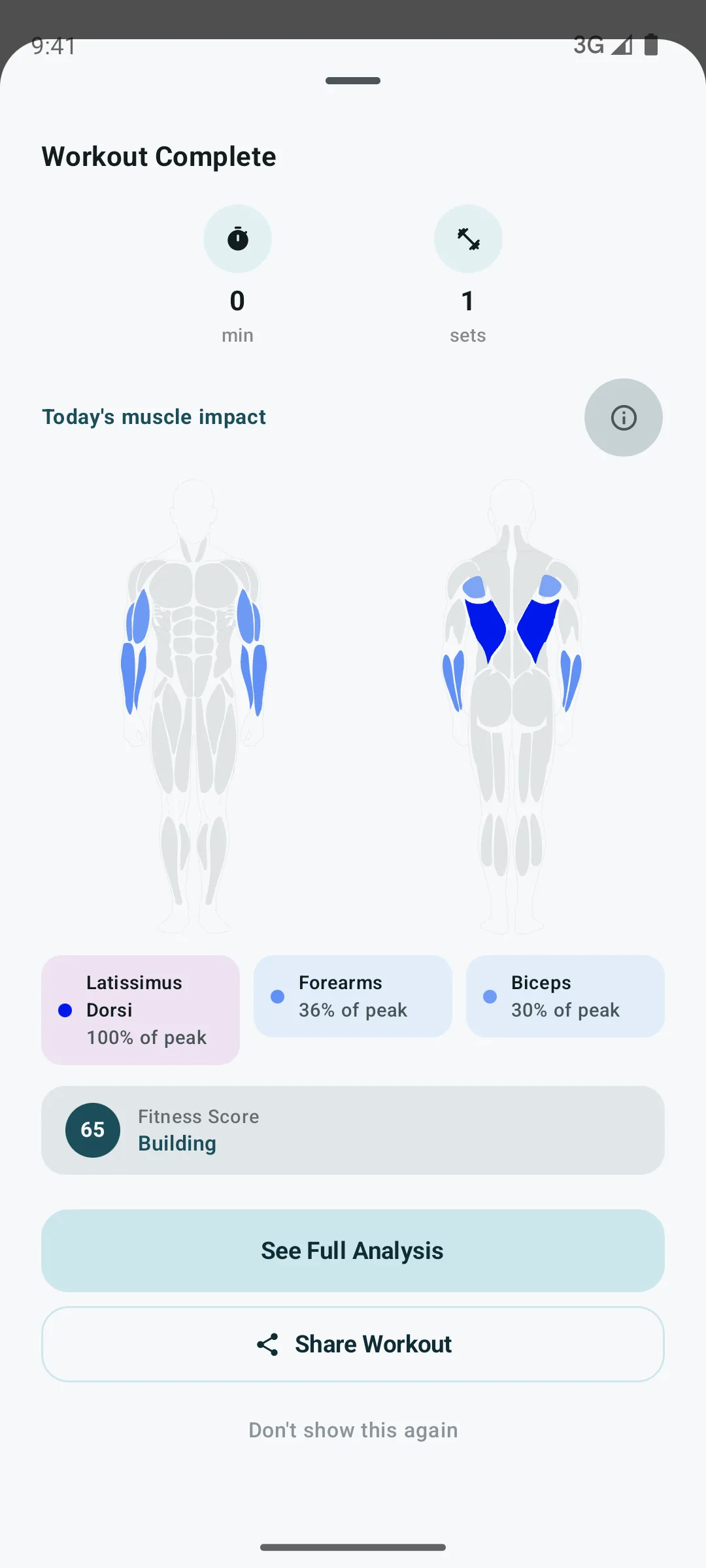
Muscle Impact shows how bodyweight movements receive a transparent external-load estimate.
Quickstart
A bodyweight exercise still has a weight, which is the share of your body the movement lifts times what you weigh.
- Push-up: about 64% of your body weight
- Pull-up: we use 100%
- Dip on parallel bars: we use 98%
- Bodyweight squat: we use 65%
- Bench dip with your heels on the floor: we use 65%
Only the push-up figure is measured, and the rest are our estimates, so this page explains how we got each one.
The bodyweight load calculator does the math and shows the label for every exercise we ship.
What a coefficient is
To see it, think about where your body pivots.
In a push-up your feet stay planted, so they hold part of you while your hands press the rest, and the share your hands press is the coefficient.
In a pull-up nothing touches the ground, so with your hands on the bar and all of you hanging below them, the coefficient is close to 1.00.
Written out:
load per rep = (body weight × coefficient) + added weightAdded weight is a belt, a vest, or a dumbbell between your feet, and it is never scaled by the coefficient, since ten kilos on a belt is ten kilos whatever the movement.
The one exercise with a real measurement
Ebben and colleagues published a study in 2011. They had 23 people do six kinds of push-up on a force plate, and they reported the peak force as a share of body mass, so this is their table:
| Push-up position | Share of body weight |
|---|---|
| Feet up on a 60.96 cm box | 0.74 ± 0.02 |
| Feet up on a 30.48 cm box | 0.70 ± 0.02 |
| Regular | 0.64 ± 0.04 |
| Hands up on a 30.48 cm box | 0.55 ± 0.05 |
| Bent knee | 0.49 ± 0.05 |
| Hands up on a 60.96 cm box | 0.41 ± 0.06 |
Four of those numbers are in Kinoku, under 11 rows. One movement can be spelled several ways, and the app matches on the name, so “push up”, “push ups”, “pushup” and “pushups” each get their own row with the same 0.64.
Gym language runs backwards from the paper here: an incline push-up raises your hands and is easier, while a decline push-up raises your feet and is harder. So Kinoku’s incline push-up carries Ebben’s hands-elevated 0.55, and its decline push-up carries the feet-elevated 0.70.
Even that measurement has edges
Three of them, and they all point the same way, so it is best to read 0.64 as a good middle rather than a fact about your body.
It is peak force, not average load, so the plate caught the hardest instant of the rep, and averaged over a whole rep the load is a little lower. A coefficient that says “share of body mass” and a study that reports “peak force” are answering slightly different questions.
A second study got different numbers: Gouvali and Boudolos (2005) found 66% for a regular push-up and 53% for the bent-knee one, two points off on the first and four on the second. Two careful studies gave two answers, and there is no way to call one wrong from here.
Hand position swings it more than either gap: the same 2005 study saw a range from 52.9% to 72.9% just from moving the hands, and your own push-up sits somewhere in there.
Suprak and colleagues (2011) took a third approach, holding people still in four push-up positions and measuring what the arms carried. That is a cleaner match for “share of body mass” than peak force is, but it describes a held position rather than a moving rep, so it does not settle the question either.
How we built the other 553
Nobody has run Ebben’s study for the pull-up, the pistol squat, or the dragon flag. If we waited for that, the app would have six numbers and a shrug.
So the other 553 rows are Kinoku’s own estimates. We label them that way in the app and on the calculator, because a number you cannot trace should say so. They are not guesses, though, and each one is built the same way:
- Start from the mechanics. Which parts of you leave the ground, and where does the body pivot? A pull-up hangs everything. A glute bridge lifts your hips and leaves your shoulders and feet down.
- Anchor to a movement that already has a number. A dip is close to a pull-up, so it sits at 0.98 rather than being invented from scratch. A bench dip with your heels on the floor is closer to an incline push-up, so it sits at 0.65.
- Keep the ladder in order. This is the part that matters most day to day. A full front lever has to score above a tucked one. A full pistol squat has to score above a pistol to a box. If the order is right, your progress chart rises when you get stronger even if the exact number is off.
- Be careful at the low end. A hamstring stretch is logged like a set, but it is not ten pull-ups. Stretches and held poses sit near 0.10 so a mobility session does not inflate your total load.
The honest read: these are directional heuristics, not measured percentages. They can make bodyweight work visible in a training chart, but accuracy varies with technique, limb lengths, range of motion, and the movement itself. Even the ordering between variations should be treated as a practical default that you can customize, not a biomechanical guarantee.
Why not just count reps
Because reps go flat exactly when your training is going well.
Log ten pull-ups at 75 kg, then log ten pull-ups at 90 kg six months later. A rep counter draws the same bar twice, yet the second session moved 150 kg more.
It cuts the other way on a cut: you drop 5 kg and hold your reps, so your log says nothing changed even though your pull-ups got easier and your log cannot see it.
Load-aware set totals catch both, and the relative view then divides the rep-adjusted set total by the bodyweight saved with that set.
Where we could be wrong
- Your build. These are averages from groups of 23 and 28 people. Limb lengths change the share and no published table adjusts for it.
- Peak against average. The measured rows lean slightly high for that reason.
- Hanging moves. We use 1.00 for a pull-up, but your hands and forearms are above the bar, so the true figure is a shade under. We round to 1.00 because the movement is the reference point everything else is anchored to.
- Tuck and straddle holds. A tucked front lever hangs the same mass as a full one. It is easier because your body is folded up short, not because it weighs less. Our table gives the tuck a lower number anyway, so the progression reads in order. That is a deliberate trade of strict physics for a useful chart, and it is worth knowing about.
Track this in Kinoku
Bodyweight Total Load is free, and it saves your body weight with each set, so old sets keep the body weight they were done at.
If you disagree with one of our numbers, change it. Every bodyweight exercise shows its own percentage in the app, and you can set your own between 5% and 100%. When a move falls back to the 70% default, the screen says so rather than hiding it. Your value applies to new sets, and sets you already logged keep the number they were saved with, so a correction today never rewrites last year’s chart.
The relative strength article covers what these numbers do to your training log over a cut or a bulk.
References
Track this in the app
Bodyweight Total Load
Pull-ups, push-ups, and dips get real per-rep load from body-movement math, not just reps times one. The load math, snapshots, and Total Load chart are free; Pro scales the volume charts in Stats Analysis to your body weight.
Core tracking works offline, with no mandatory account.
Related features
Pull-ups, push-ups, and dips get real per-rep load from body-movement math, not just reps times one. The load math, snapshots, and Total Load chart are free; Pro scales the volume charts in Stats Analysis to your body weight.
Charts per exercise, PRs, your best one-rep estimate, volume trends, and date filters. Every exercise type gets a chart that fits it: Best, Total, and Avg Time for holds, Best and Total Reps for rep work, and Best and Total Distance for distance work, not just weight charts.
132 achievements across 13 groups. The whole ladder stays visible; 24 of them and the Achievement Timeline require Pro.