

Kinoku vs JEFIT
JEFIT is a big cross-platform lifting app with an Elite plan. Kinoku is an Android app with no account, no ads, and free charts. Who fits which.
Publisher disclosure
Kinoku, made by Dreamsoft Works, writes and publishes this page. Every JEFIT product fact is quoted from a JEFIT page we opened on September 12, 2026, or observed in our own test of JEFIT 17.4.4 on an emulator on September 11, 2026. We say where JEFIT is the better pick, and we give no score and no winner.
Quickstart
JEFIT (a big lifting app on iOS, Android, and the web) has an Elite plan that removes ads and adds deeper analytics. Kinoku is Android only, with no account and no ads on any plan, and its routines and charts are free. So pick JEFIT for an iPhone or a browser, and pick Kinoku for a phone that keeps its own record.
What JEFIT does well
JEFIT covers more screens, because it runs on iOS, Android, and the web [1], so a lifter with an iPhone and a laptop is covered. Elite adds a watch app on top of that [2].
JEFIT works without a signal, and its own blog says it “allows offline entry and auto-syncs data across Android and iOS” [3]. Our test agreed with the first half: a set logged and saved with flight mode on, with no complaint, and it was still there after a forced stop [11]. That is the right shape for a gym basement, where you log and it catches up later.
The log itself is quick. In our test the Instant tab built a workout from one exercise, pre-filled a suggested weight and rep count for each set, and asked once about a rest timer [11].
The Elite plan is clear about what you get, because ads go away, in JEFIT’s words “the app becomes free of all ads” [4]. Elite also lists “Advanced analytics and tracking” [5], and it gives “additional space to download and store an unlimited amount of exercise programs” [6], which matters if you like to collect programs.
What we tested
JEFIT 17.4.4 went onto an Android 16 emulator from Google Play on September 11, 2026, and we worked through it like this:
- Launch the fresh install and check for a guest or skip path.
- Answer the setup questions and note what the app showed before sign-up.
- Sign in and reach the Workout tab.
- Turn flight mode on, build a quick workout, log one set, and save it.
- Stop the app by force, open it again, and check the Progress tab.
- Turn the network back on and watch for any message.
- Open the Elite screens and note the prices they showed.
- Try to create a custom exercise, and look for an export path.
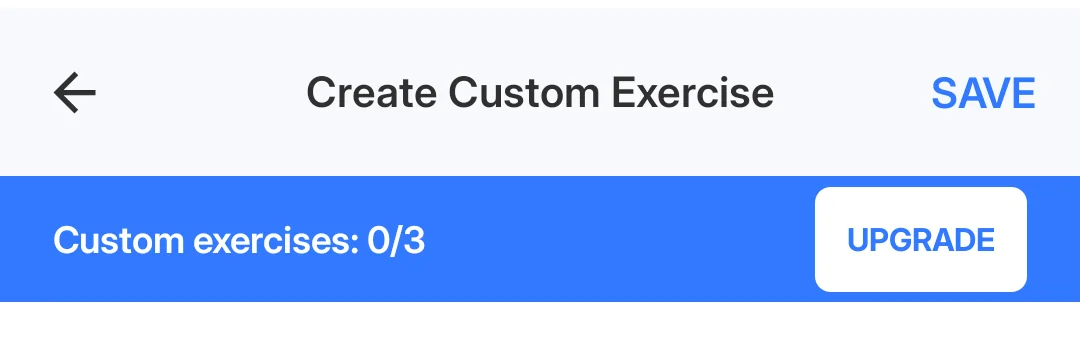
The first screen offered Get Started and Sign in, and Get Started ran a questionnaire of about twenty steps, from training goal to height and injuries, before an Elite offer and then a sign-up wall with no skip [9]. Everything after that ran on a Google account. With no network, the Instant tab built a workout, the log took a 135 pound bench press set, and End & Save Workout kept it, with no offline message at any point [11]. The workout was still counted after a forced stop, and nothing changed when the network came back. The share card after that first workout had Share to community switched on before we touched it [12]. The Elite offer and the in-app Elite Hub printed the same two prices [10]. The custom exercise form opened with a bar that counts the free allowance [13], and we found no export control in Settings, Privacy Settings, Other Support, or the Progress tabs [14].
We did not test a routine cap beyond the first plan, the watch app, or a full month of use, so this page states nothing about them, and the ads question stays with JEFIT’s own words.
A test build of Kinoku 1.2.0, installed outside Google Play, was already on that emulator, so it got the same short check with flight mode on. Its Today screen opened, the picker found a barbell bench press by search, the set sheet took 135 pounds for 5 reps, and that set was still listed after a forced stop. The backup and export facts about Kinoku on this page come from its own documentation, and the roundup pages that cite this test read the same record.
Side by side
Kinoku facts come from the app’s code and its public promise, while JEFIT facts come from JEFIT’s own pages or from our test. Where JEFIT’s pages say nothing and the test did not reach it, the cell says so.
| Kinoku | JEFIT | |
|---|---|---|
| Account | None. The app opens and works. | Needed before the first workout. Google, Facebook, Apple, or email, after a questionnaire and an Elite offer [9]. |
| Where your data lives | On your phone. Backup is a file you own. | “Uploaded to the Company’s servers” or “simply stored on Your device” [8]. |
| Ads on the free plan | None. “Zero ads, on every tier.” | JEFIT’s blog says that with Elite “the app becomes free of all ads” [4]. We saw none in one test session [16]. |
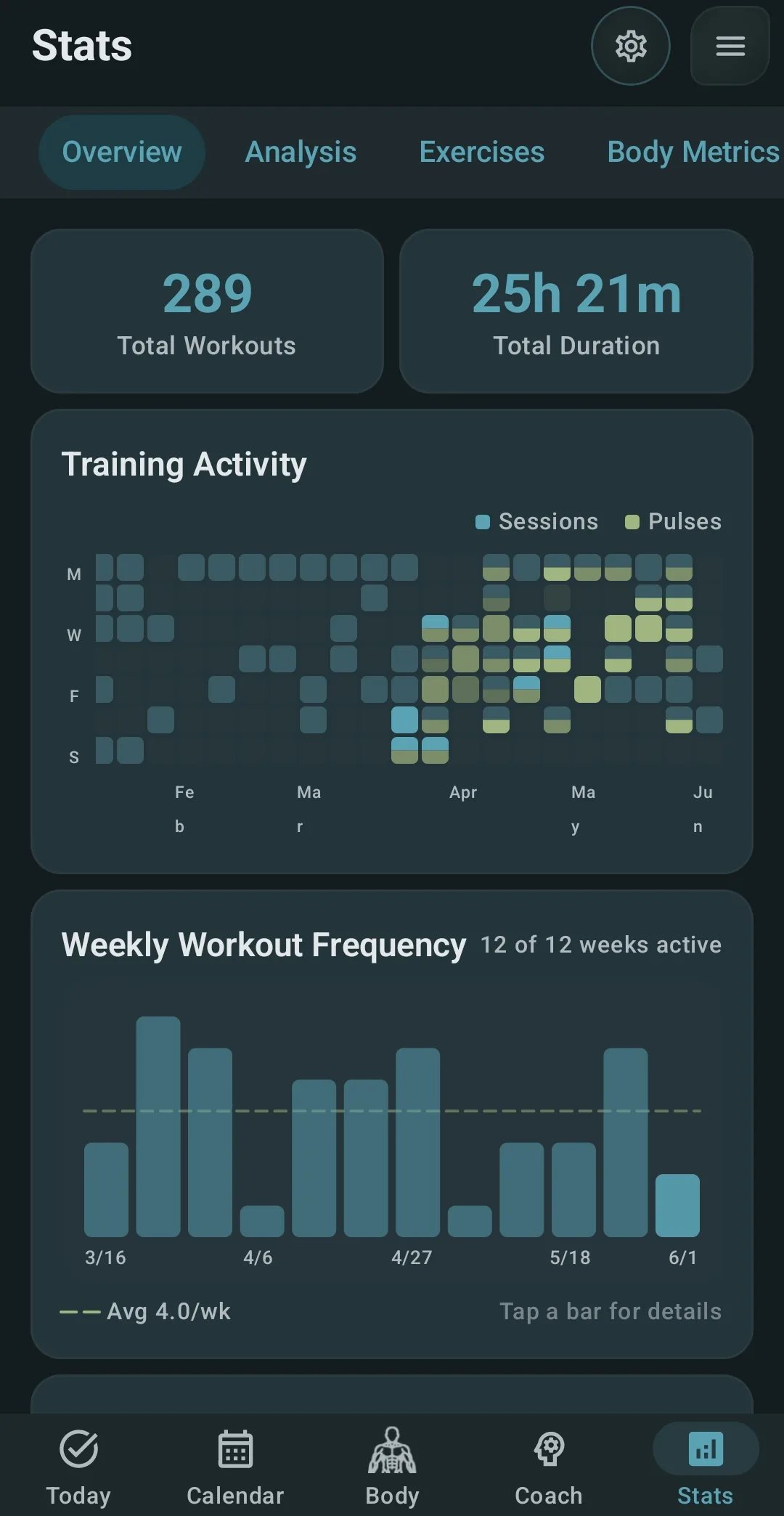
| Analytics on the free plan | Stats, personal records (PRs), one-rep estimates, and volume trends. | “Advanced analytics and tracking” is under Elite [5]. |
| Free custom exercises | No cap. | 3 [13]. |
| Workout privacy | Nothing is posted anywhere. | Share to community was on by default after our first workout [12], and training logs default to Friends [15]. |
| Paid plan price | Pro, US $39.99 a year or US $5.99 a month. | Elite, $12.99 a month or $69.99 a year on jefit.com/elite [7]. On September 14 the app showed us 14.31 euros a month or 76.69 euros a year [10]. |
| Platforms | Android, plus Wear OS. | iOS, Android, and web [1]. Watch app under Elite [2]. |
| Offline use | Yes, by design. Map tiles and opt-in weather need a signal. | “Offline entry” with sync [3]. Logged and saved a set with no network in our test [11]. |
| Export | CSV, an Export for AI file, and a lossless backup file. | Not stated on JEFIT’s pages. We found no export control in the app screens we walked [14]. |
| GPS runs | Free. Pace, splits, a route map, and voice cues. | Not stated on JEFIT’s pages. |
| Muscle map | Free. Frequency and volume maps. Pro adds recovery. | Not stated on JEFIT’s pages. |
| Training programs | Free. The builder, 15 templates, and named plans. No cap. | Elite stores “an unlimited amount of exercise programs” [6]. |
| Languages | 10. | Not stated on JEFIT’s pages. |
| Paid layer | One plan, Pro. Deeper analytics and the smart layer. | One plan, Elite. Ad-free, analytics, watch app, program space. |
“Not stated on JEFIT’s pages” means we found no JEFIT page we could quote and did not reach it in the parts of the app we walked, which is no claim that JEFIT lacks it.
JEFIT sits in two group pages as well: which apps log offline with no account and what the free plans hold.
Where Kinoku differs
The biggest difference is where the app lives, because Kinoku runs on your phone with no account to make and no server holding your training record. A backup is a file you keep, so if you switch phones you move that file.
Kinoku has no ads on the free plan, and none anywhere else, because that line is published on the pricing page: “Zero ads, on every tier.” The promise makes it a rule rather than a perk.
For most lifters the free plan is the whole app. Logging has set types, rate of perceived exertion (RPE), reps in reserve (RIR), timers, and notes, and routines have no cap. Custom exercises have no cap either, and neither does history. Stats are free, with charts per exercise, personal records, and volume trends, and so are GPS runs and the muscle map. The program builder is free too, with 15 templates and named plans like 5/3/1 and GZCLP (a beginner barbell program), and there is no limit on how many plans you keep.
Nothing is shared unless you share it. There is no feed, so a workout cannot be posted by default, because there is nowhere for it to go.
Kinoku speaks 10 languages and has 26 themes, and 20 of those themes are free.
Pro is the one paid layer, at US $39.99 a year or US $5.99 a month, and it buys run analytics, readiness, coach patterns, and the deeper hub. The free app works without any of it.
Where JEFIT is the better pick
Be honest with yourself about your gear before you choose.
If you use an iPhone, JEFIT is the pick, because Kinoku does not run there and JEFIT does [1].
If you want a browser view, JEFIT is the pick, since JEFIT has a web app [1] and Kinoku has none at all.
If you want sync between a phone and a browser, JEFIT is the pick, because it syncs offline entries by itself [3] while Kinoku moves data by a backup file you carry.
If you want a large store of ready programs, JEFIT is a strong pick, because Elite gives space for “an unlimited amount of exercise programs” [6]. Kinoku ships 15 templates and the named plans, and it has no program store.
If you like a suggested weight typed in for you, JEFIT does that on every set in the log we saw [11], while Kinoku shows your last numbers and lets you type.
Kinoku also has no social feed and no community layer, which is worth weighing before you move.
Moving over
Kinoku reads the JEFIT CSV layout, so if you have a JEFIT CSV file the importer knows it. It spots the header with Exercise, Muscle, and Bodypart columns, and it splits rows like 10/8/6/5 into one set each, so a five-set row lands as five sets rather than one.
We did not find an export control in the JEFIT 17.4.4 app during our test [14]. If you have a JEFIT CSV from any source, the layout Kinoku reads is the same.
Start on the backup and import page, which walks through the file picker and what each path keeps. The import format page shows every layout Kinoku reads, with samples you can copy. Weights in the JEFIT layout are read from the column you have, so check the units before you save.
Import is free, and so is the export back out, so your file is never stuck in Kinoku.
What Kinoku does not do
A few limits are worth stating up front.
- It is Android only. There is no iOS app.
- There is no web app. Your data is on the phone, and that is the only screen.
- There is no cloud sync between devices. Two phones do not share a live record. You move a backup file.
- There is no community. There is no feed and no friends list, and programs are not shared between users.
- Some depth is paid. Run analytics, readiness, and coach patterns sit in Pro. The pricing page says which parts.
- “Offline” has edges. Map tiles load when you view a map. Weather is an opt-in call. Billing goes through Google Play.
Those are the trade-offs, and what you get in return is an app with no account, no ads, and a record that stays yours.
Test record
Tested September 11, 2026
- Environment
- Android Studio Pixel phone emulator Kinoku_Phone_Play, API 36, Android 16
- JEFIT
- Version 17.4.4 (version code 2093), installed from Google Play. Official listing
- Kinoku
- Version 1.2.0 (version code 30), a test build installed outside Google Play. Official listing
How this page is checked. Every JEFIT product fact on this page comes from a JEFIT page we could open and quote on September 12, 2026, or from the test recorded above. The sources, with the exact sentence each fact rests on, are listed just above. What we say about JEFIT's export file describes the layout Kinoku's importer reads. Every Kinoku fact is tied to the shipping app's code. If a fact here has gone stale, the support page is the fastest way to tell us.
Test evidence
What the tested builds showed
 Open full-size image ↗
JEFIT's free custom-exercise limit, in its own words
Cropped emulator capture. The Create Custom Exercise form in JEFIT 17.4.4 opens with this bar on a free account, before any exercise has been made.
 Open full-size image ↗
Stats on the free plan
The Stats overview is free. Workout totals, time trained, and a map of every training day, with no paid step in front of it.
Try the other side of the table
Kinoku is free to install
Core tracking works offline, with no account. Your export from JEFIT can come along.
Android only. Some depth is paid, and the pricing page says which parts.
Related features
Every set, one tap. Track how hard each set felt, your rest timers, set types, and notes.
Unlimited routines, Smart Sync, Starter Packs, and follow-along links are free. Pro adds managed Rotation Groups that cycle through several routines.
Charts per exercise, PRs, your best one-rep estimate, volume trends, and date filters. Every exercise type gets a chart that fits it: Best, Total, and Avg Time for holds, Best and Total Reps for rep work, and Best and Total Distance for distance work, not just weight charts.