

Best Fitbod alternatives (2026)
Six apps for lifters leaving Fitbod, grouped by whether they build your plan, run a program you pick or only log, with the free and paid parts each app names.
Alpha Progression, Hevy and JEFIT build a plan for you as Fitbod does, each with its plan builder or coach in a paid tier; Boostcamp and Kinoku run a program you pick and set your next weights for free, and Strong is a plain log.
At a glance
| App | Best for | Better than Fitbod at | Main trade-off |
|---|---|---|---|
| Alpha Progression | Fitbod users who want a plan built from their goals and a target for every set | Pro hands you a weight, rep count and effort target for each set, and the free log has no ads | The plan builder and the weight targets are Pro, and it has no watch app |
| Boostcamp | Fitbod users who want to pick a coach's program and have the app set the next weights | 11,000+ programs, free auto-progression, and an AI coach in Pro | An account to start, and the questionnaire-built program is Pro |
| Hevy | Fitbod users who want a free log with a watch app now and a built program later | Apple Watch and Wear OS logging, and Trainer builds a full program in Pro | Trainer is Pro, and in our test an account came first |
| JEFIT | Fitbod users who want a plan that its maker says adapts each week, with a big video library | 1,400+ exercises with videos, and an Adaptive Plan built around your goal and equipment | The AI coach, the watch app and an ad-free app are listed under Elite |
| Kinoku | Fitbod users on Android who want a named program to set their next weights, free and with no account | 5/3/1, GZCLP, nSuns and simple linear programs set your next weights on the phone, free | Android only for now, it never builds a workout from your goals, and weight tips for single exercises are Pro |
| Strong | Fitbod users who already know their plan and want a plain log with an Apple Watch app | Apps for iPhone with Apple Watch and for Android, cloud sync, and no ads | An account first, three free templates, and no next-weight help on its pages |
Publisher disclosure
Kinoku, made by Dreamsoft Works, writes and publishes this page, and Kinoku is one of the apps on it. Every fact about another app is quoted from a page that app's maker publishes, opened on October 12, 2026, or seen in our own emulator tests on the dates in the sources. We give no score. The apps are grouped by what their own pages say they do for your next session, and every label points at a quoted sentence.
Quickstart
Fitbod builds each session for you with AI and asks for a subscription once its free trial ends. Alpha Progression, Hevy and JEFIT (a gym log app) also build plans, with the builder or coach in a paid tier. Boostcamp and Kinoku run a program you pick and set the next weights for free, and Strong is a plain log. Groups follow each app’s own pages and run A to Z.
What Fitbod does, and why people look elsewhere
Fitbod’s Google Play listing calls it “a personalized workout planner that uses AI to help you make progress”, where “Each training session is custom-built for your fitness level, goals and home or gym workout equipment.” It says the “Adaptive AI learns from your edits to its workout recommendations”, and it lists “Non-linear periodization”, which means the hard and easy days are mixed rather than climbing in a straight line.
On the App Store, Fitbod explains the price model plainly: “After your free trial has ended, this app includes an auto-renewing subscription”, and that subscription covers all premium workouts and features. Plans come “either monthly or yearly”. Neither listing says how long the trial lasts, but Fitbod’s cancellation page, which we read in a browser, says “New users are provided with a trial period of 3 free workouts to see if Fitbod is a good fit.” This page prints no price, because Fitbod’s own site turned away our scripts.
People who search for a Fitbod alternative tend to want one of two things, and the apps below split along that line.
- The same help for less money: An app that still decides what you lift next, ideally on a free plan.
- A different kind of help: An app that runs a program a person wrote, such as 5/3/1 or GZCLP (a beginner barbell program), instead of building a new session every time.
Which Fitbod alternatives build the plan, and which run one you pick?
The six apps fall into three groups by what their own pages say they do for your next session.
- Builds a plan from your answers, with the builder or coach in a paid tier: Alpha Progression, Hevy and JEFIT. Alpha Progression’s plan builder works from “your goals, equipment, training frequency, and duration”. Hevy Trainer “will generate a complete program” after a few questions. JEFIT’s listing describes an “Adaptive Plan” built around your goal, level and equipment.
- Runs a program you pick and sets the next weights, free: Boostcamp and Kinoku. Boostcamp’s listing says “Auto-progression sets your next weights.” Kinoku works out each session’s weights for 5/3/1, GZCLP, nSuns, Reddit PPL (push, pull, legs) and other simple linear plans on the free tier.
- A log where you set every number: Strong. Its listing says it suits “a progressive barbell routine such as Starting Strength or StrongLifts 5x5”, and its pages describe no next-weight engine.
Side by side
A cell quotes or sums up the app’s own page, or what we saw in a dated emulator test, and “Not stated” marks a question its pages leave open.
| App | Builds a plan for you | Sets your next weights | Free plan, in its words | Watch app | Account |
|---|---|---|---|---|---|
| Fitbod (for reference) | Yes, every session | Builds each session; weights not stated | 3 free workouts, then a subscription | Wear OS tile, Apple Watch | Not stated |
| Alpha Progression | Yes, in Pro | Yes, in Pro | “unlimited workout logging, manually created plans” | None, per its blog | “No account required” |
| Hevy | Trainer, in Pro | Trainer adjusts weights, in Pro | Free tracker; program library free | Apple Watch and Wear OS | Sign-up first, in our test |
| JEFIT | Adaptive Plan; AI coach under Elite | AI suggests weight and reps; tier not stated | “Free and custom workout routines” | Wear OS; watch support under Elite | Sign-up first, in our test |
| Boostcamp | AI coach, in Pro | Yes, free in the tracker | Tracker and 11,000+ programs free | Not stated | “create an account” |
| Kinoku | No | Yes, free in named programs; per-exercise suggestions in Pro | No cap on routines, programs or history | Wear OS, free | None |
| Strong | No | Not stated | 3 workout templates | Apple Watch | “prompted to sign up” |
Each app, in its own words
Alpha Progression
Best for: Fitbod users who want a plan built from their goals and a target for every set.
Alpha Progression is the app here whose pages describe the help closest to what Fitbod sells, with a free log underneath.
- What it does well: On its homepage, the algorithm sets “a precise weight, rep count, and intensity target” on each set you log. The plan builder starts when you “Pick your goals, equipment, training frequency, and duration”, and draws on 795 exercises with form videos. The free version keeps “unlimited workout logging, manually created plans” and no ads, in its blog’s words.
- What its pages say about limits: The homepage says “Pro adds personalized plan and workout generation, progression recommendations, charts, multiple gym profiles and advanced training tools.” Building a plan “requires an internet connection”, and “There is currently no dedicated Apple Watch or Wear OS app.” The 14-day trial comes with the yearly plan only.
- Where it is the better pick: A Fitbod user who wants the plan built for them and a number on every set, on iPhone or Android.
- Where Alpha Progression differs: Its homepage lists “No account required”, and guest data stays on the device, while a signed-in free account syncs to the cloud. Official listing: Google Play. Versus page: Kinoku vs Alpha Progression.
Hevy
Best for: Fitbod users who want a free log with a watch app now and a built program later.
Hevy is a social set log, and Hevy Trainer is its add-on for people who want a program made for them.
- What it does well: Hevy calls itself “a free workout tracker for iOS and Android”, and its homepage says to “track your workouts completely from your Apple Watch or WearOS device.” Trainer “creates workout programs based on your fitness goals, experience, available equipment, workout frequency, and time constraints”, and its feature page says it “automatically adjusts your working weights”.
- What its pages say about limits: Trainer “is included in Hevy Pro”, so the built program is paid. Hevy’s program library “will remain available and free”. In our test of Hevy 3.1.12, the first screen offered sign-up or log-in with no guest path.
- Where it is the better pick: A Fitbod user who wants a free log with a watch app today, and a built program when they choose to pay.
- Where Hevy differs: Trainer builds a program you then follow, while Fitbod describes each session being built anew. Official listing: Google Play, and our side-by-side page is Kinoku vs Hevy.
JEFIT
Best for: Fitbod users who want a plan that its maker says adapts each week, with a big video library.
JEFIT is a gym log with free routines, and it sells an AI plan and coach on top of them.
- What it does well: Its listing describes an “Adaptive Plan: a personalized training plan built around your goal, level, and equipment”, and says its “smart AI analyzes your past workout logs to suggest exactly what weight and reps to lift next.” The library holds “1,400+ exercises with HD video instructions”. A blog post on its homepage describes “the weekly signals that decide when to advance, hold, or deload”.
- What its pages say about limits: The listing puts “Adaptive AI Coach” under JEFIT Elite, and the membership page lists “Watch app support” and an “Ad-free experience” under Elite. Neither page says which parts of the Adaptive Plan the free Basic plan includes. In our test of JEFIT 17.4.4, an Elite offer and a sign-up screen came before the first workout.
- Where it is the better pick: A Fitbod user on Android who wants an AI plan that changes week to week, with videos for each move, and who is ready to pay for Elite.
- Where JEFIT differs: A post on its homepage describes “the weekly signals that decide when to advance, hold, or deload”, where Fitbod describes building each session. Official listing: Google Play. Versus page: Kinoku vs JEFIT.
Boostcamp
Best for: Fitbod users who want to pick a coach’s program and have the app set the next weights.
Boostcamp starts from a library of programs written by people, and adds an AI coach for those who pay.
- What it does well: Its listing describes a “free workout tracker and gym logger” that holds 11,000+ programs, and it names nSuns, GZCLP, 5/3/1, Reddit PPL, PHUL (power, hypertrophy, upper, lower) and PHAT (power hypertrophy adaptive training) among “130+ coach programs”. In the tracker, “Auto-progression sets your next weights.” Its Pro page says “The 11,000+ program library and the full workout tracker are free.”
- What its pages say about limits: “Free accounts can build custom programs manually; personalized program building is Pro-only.” The homepage says to “create an account” before choosing a program, and its pages do not mention a watch app.
- Where it is the better pick: A Fitbod user who would rather follow a named coach’s plan than an algorithm’s, and wants the weights worked out at no cost.
- Where Boostcamp differs: The free path runs a fixed program, while the questionnaire-built plan sits in Pro. Official listing: Google Play. Versus page: Kinoku vs Boostcamp.
Kinoku
Best for: Fitbod users on Android who want a named program to set their next weights, free and with no account.
Kinoku is a private training app for Android that runs named programs on the phone, with no account to create.
- What it does well: On the free tier, 5/3/1 Boring But Big, GZCLP and nSuns build from your one-rep maxes and set each session’s weights from your own results. Reddit PPL (push, pull, legs), Classic 5x5, a Greyskull-style plan and the Basic Beginner Routine add weight when you hit your reps. The Today card names the routine you are due for from the rotation you already train. Routines, active programs and history have no cap, and the muscle map and the 1,300+ exercises are free too.
- What its pages say about limits: Smart exercise suggestions and weight progression suggestions are Pro, the second being a small next step for each exercise drawn from your past sets and how hard they felt. Pro also adds a readiness check, weekly set guides and set changes based on effort.
- Where it is the better pick: A Fitbod user on Android who would rather follow a known program than an AI one, and wants the weights worked out for free with no sign-up.
- What Kinoku does not do: Kinoku never builds a workout from your goals and equipment, and it does not learn from your edits the way Fitbod describes. Its library has muscle data and form notes but no filmed videos, though you can save a YouTube link to any move. There is an Android app and a Wear OS app, but no iPhone app yet, and a record on one phone does not sync to another.
Strong
Best for: Fitbod users who already know their plan and want a plain log with an Apple Watch app.
Strong is a quiet set log, and it is the one app here that leaves every number to you.
- What it does well: “We offer apps for iPhone (including Apple Watch) and Android”, in its help centre’s words, with “no ads, ever.” “Strong Cloud keeps your workouts automatically synced between devices”, and the listing offers to “Export all of your data to Email in CSV format”. In our test of Strong 6.2.4, a set saved in flight mode was still there after a forced stop.
- What its pages say about limits: The help centre caps the free version at “up to 3 Workout Templates”, and it says all users are “prompted to sign up” before the first workout. Its pages describe no plan builder or next-weight help.
- Where it is the better pick: A Fitbod user who has outgrown being told what to do, plans their own sessions, and trains with an Apple Watch.
- Where Strong differs: You choose every weight yourself, where Fitbod chooses for you. Official listing: Google Play. Versus page: Kinoku vs Strong.
Is there a free app that tells you what to lift next?
Yes, if you are happy to follow a program rather than have one built. The two free routes work in different ways.
- Boostcamp: You pick one of its programs, and the tracker’s auto-progression sets your next weights. Its Pro page says the tracker and the library are free.
- Kinoku: You pick a named program and enter your one-rep maxes. For 5/3/1, GZCLP and nSuns the next weights come from what you lifted. For Reddit PPL, Classic 5x5 and the other linear plans, the weight goes up when you hit your reps.
What neither does for free is build a fresh session from your goals and equipment, which is the core of Fitbod. Alpha Progression’s Pro, Hevy Trainer and JEFIT’s Elite coach are the paid routes to that kind of help, and each one’s pages name the price model.
When is Fitbod still the better pick?
Fitbod’s own listing makes its case in three situations.
- You want each session built for you: “Each training session is custom-built for your fitness level, goals and home or gym workout equipment.” None of the six apps here describes building every single session that way.
- You often change the plan: Its “Adaptive AI learns from your edits to its workout recommendations”, so swaps you make feed back into what it suggests next.
- You want a video for every move: The listing promises “Hi-res, multi-angle videos of each fitness exercise”, and Kinoku ships no filmed exercise videos.
If the subscription is the reason you are here, the two free program apps above cover the “what do I lift next” part, as long as you pick the program yourself.
How this list was checked
We read each rival’s own pages on October 12, 2026, and added a few things we saw in our own emulator tests.
- Listings and sites: Each rival claim is a sentence from the app’s Google Play or App Store listing, its homepage, its help centre or its blog, and each is numbered in the sources.
- Phone tests: The Hevy and JEFIT sign-up screens and the Strong offline set come from tests on an Android 16 emulator, on the dates in their source notes. Fitbod, Alpha Progression and Boostcamp were not put through a test for this page.
- What we could not read: Fitbod’s website and help centre turned away our scripts, so we read the trial sentence on its cancellation page in a browser. Fitbod’s price, account rule and export stay out of this page.
- Kinoku: Kinoku’s claims come from the app’s code and its feature pages, including which suggestions sit in Pro.
- Order: The three groups follow what each app says it does for your next session. Inside a group the apps run A to Z, and no app paid for its place.
Frequently asked questions
Is there a free app like Fitbod?
No app on this list builds every session from your goals for free the way Fitbod’s paid tier does, though two come close in a different way. Boostcamp’s free tracker sets your next weights inside any of its programs, and Kinoku’s free named programs, such as 5/3/1 and GZCLP, set each session’s weights from your own results. Alpha Progression, Hevy and JEFIT build plans too, with the builder or coach in a paid tier.
Is there an app that tells you what weight to lift next, for free?
Yes, inside a program: Boostcamp’s listing says its auto-progression sets your next weights, and its Pro page says the tracker and the program library are free. Kinoku works out the next weights for 5/3/1, GZCLP, nSuns and linear plans such as a 5x5, free and with no account. Weight targets outside a program are paid in both Alpha Progression and Kinoku.
Which app builds a workout for you the way Fitbod does?
Three apps here do it in a paid tier: Alpha Progression, Hevy and JEFIT. Alpha Progression’s plan builder takes your goals, equipment, training days and session length, and its Pro sets a target for every set. Hevy Trainer asks a few questions and builds a complete program, inside Hevy Pro. JEFIT’s listing describes an AI Adaptive Plan built around your goal, level and equipment, and lists its Adaptive AI Coach under Elite.
Is Fitbod free?
Fitbod’s App Store listing says that after your free trial has ended, an auto-renewing subscription covers all premium workouts and features, with monthly or yearly plans. Its Google Play listing carries the In-app purchases label. Fitbod’s cancellation page, which we read in a browser, says new users get a trial period of 3 free workouts, and this page prints no price.
Which Fitbod alternatives work without an account?
Alpha Progression and Kinoku both let you start without one. Alpha Progression’s homepage lists No account required, and it says data in a guest account is stored only on your device. Kinoku has no account at all, while Strong’s help centre says every user is asked to sign up first. Boostcamp’s homepage says to create an account, and Hevy and JEFIT each showed us a sign-up screen with no guest path.
Which app runs 5/3/1 or GZCLP and works out the weights for me?
Boostcamp and Kinoku both do, and both do it for free. Boostcamp’s listing names nSuns, GZCLP, 5/3/1, Reddit PPL, PHUL and PHAT among its programs, with free auto-progression in the tracker. Kinoku runs 5/3/1 Boring But Big, GZCLP and nSuns from your one-rep maxes, plus Reddit PPL, Classic 5x5 and a Greyskull-style plan that add weight when you hit your reps.
Which of these apps have a Wear OS app?
Hevy’s homepage names Apple Watch and Wear OS, and Kinoku’s Wear OS app is free. JEFIT’s listing describes Wear OS sync, and its membership page lists watch app support under Elite. Fitbod’s listing names a Wear OS tile as well. Strong’s help centre names iPhone with Apple Watch, Alpha Progression’s blog says it has no watch app, and Boostcamp’s pages do not mention one.
Do any of these Fitbod alternatives work offline?
Most of them log a workout with no signal, by their own pages or our tests. Alpha Progression’s blog says most features work offline but building a plan needs a connection. Boostcamp’s listing has a one-word Offline item. Kinoku’s log and its program math run on the phone. In our tests, Strong saved a set in flight mode and Hevy uploaded a saved workout once the network returned.
Can I move my Fitbod history to another app?
Kinoku’s importer reads the CSV layout Fitbod uses, and a review screen lets you match exercise names before anything is saved. Fitbod’s help centre turned away our scripts, so this page does not say how Fitbod’s own export works. None of the other five apps names a Fitbod import on the pages we opened, and we have not tested theirs.
Which Fitbod alternative has the most exercises?
JEFIT’s listing says 1,400+ exercises with video instructions, and Fitbod’s says over 1,000. Kinoku ships more than 1,300 exercises with muscle data and no filmed videos, and it puts no cap on custom ones. Alpha Progression’s homepage says 795 exercises with form videos. Hevy’s listing says hundreds, and Boostcamp’s and Strong’s pages print no count.
When is Fitbod still the better pick?
When you want every session built for you and changed as you go. Fitbod’s listing says each session is custom-built for your level, goals and equipment, and that its AI learns from the edits you make. Of the apps here, only Alpha Progression’s Pro, Hevy Trainer and JEFIT’s Adaptive Plan build plans, and none of the three describes the same session-by-session rebuild in those words.
What does Kinoku not do that Fitbod does?
Kinoku does not build a workout from your goals and equipment, and it does not learn from your edits. Its free programs follow their own written rules. Smart exercise suggestions and weight progression suggestions are Pro, and so are readiness tuning and set changes based on effort. It has no filmed exercise videos and no iPhone app yet, and it does not sync between two phones.
Related pages
- Best workout program apps for periodization: Program engines and loggers for 5/3/1, GZCLP and nSuns, side by side.
- Best Alpha Progression alternatives: The same question for lifters leaving an algorithm that sets every set.
- Best Boostcamp alternatives: Apps sorted by whether they work out program weights for you.
- Free gym apps with progressive overload tracking: Which free plans show records, estimated maxes and stalled lifts.
- Periodization: The 25 program templates in Kinoku and how each named program sets its weights.
- Smart Today: How Kinoku picks the routine you are due for, and what Pro adds.
Which one fits you
- Choose Alpha Progression if you liked having the plan built for you, you want a weight and rep target on every set, and paying for Pro is fine.
- Choose Hevy if you want a free set log with an Apple Watch or Wear OS app, and Hevy Trainer in Pro for the days you want a program built.
- Choose JEFIT if you want an AI-built plan that changes week to week and a library of 1,400+ exercises with videos, and Elite is in your budget.
- Choose Boostcamp if you would rather run a program a coach wrote than one an algorithm wrote, you want it free, and an account is fine.
- Choose Kinoku if you train on Android and want 5/3/1, GZCLP or a 5x5 to set your next weights for free, with no account.
- Choose Strong if you plan your own sessions, you want an Apple Watch app, and three free templates cover your week.
Test record
Tested September 11, 2026
- Environment
- Android Studio Pixel phone emulator Kinoku_Phone_Play, API 36, Android 16
- Hevy
- Version 3.1.12 (version code 3289233), installed from Google Play, tested September 6, 2026. Official listing
- JEFIT
- Version 17.4.4 (version code 2093), installed from Google Play, tested September 11, 2026. Official listing
- Strong
- Version 6.2.4 (version code 602006), installed from Google Play, tested September 11, 2026. Official listing
How this page is checked. Every fact about another app on this page comes from a page that app publishes, which we could open and quote on October 12, 2026, or from a dated emulator test named in that source's note. The sources, with the exact sentence each fact rests on, are listed just above. Every Kinoku fact is tied to the shipping app's code. The page carries no score; the apps are grouped by what their own pages say. If a fact here has gone stale, the support page is the fastest way to tell us.
Test evidence
What the tested builds showed
 Open full-size image ↗
A program that sets the next weights, on the free plan
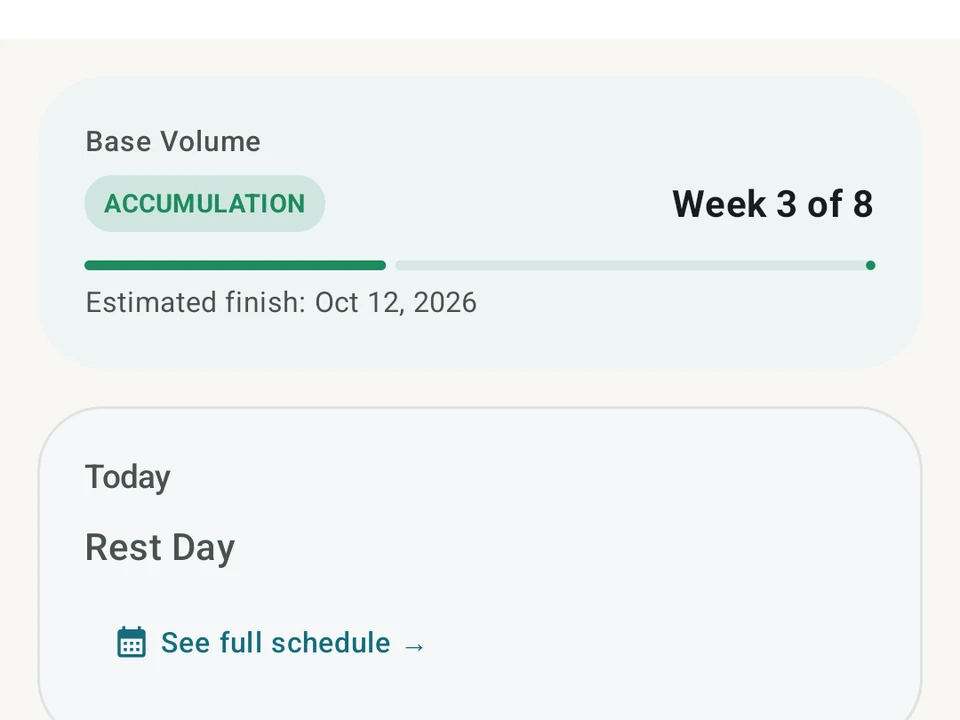
Real app capture, free tier. A Kinoku program card shows the phase, the week of the block and the expected finish date. Named programs such as 5/3/1 and GZCLP fill in each session's weights from your own results, with no account.
One of the apps on this page
Kinoku is free to install
Core tracking works offline, with no account. An export from the app you use today can come along.
Android only for now, with an iPhone version in the works. Some depth is paid, and the pricing page says which parts.
Related features
A 4-phase planning stack. The builder, all 25 templates, named programs with auto-progression, the custom model, and unlimited active programs are free. Pro adds volume targets, readiness tuning, and auto set changes.
A Today card shows the workout you are due for, the muscles it trains and a Start button. Free automatically spots your A/B/C rotation, follows the Rotation Groups you build, and lists routines that are due. Pro shades that body by how fresh each muscle is, and adds an easy-day pick when your sleep or HRV is low.
Unlimited routines, Smart Sync, Starter Packs, and follow-along links are free, and so are Rotation Groups that cycle through several routines for you.
1,300+ built-in exercises with muscle data and unlimited custom moves are free. Pro adds custom form photos and assisted sorting.
Frequency and training-volume maps are free. Pro adds recovery estimates, readiness context, and exercise picks.
A real watch app for workouts, runs, steps, tiles, and watch face data.