

Boostcamp Alternative: Kinoku vs Boostcamp
Boostcamp pairs a free tracker with 11,000+ programs and an AI coach behind an account; Kinoku logs lifts, runs and steps with no account, offline.
Boostcamp fits a lifter who wants to pick a coach-written program from a free library; Kinoku fits one who wants no account, an offline log, a Wear OS app and runs beside the lifts.
Publisher disclosure
Kinoku, made by Dreamsoft Works, writes and publishes this page. Every Boostcamp product fact is quoted from a Boostcamp page we opened on September 20, 2026. What we say about Boostcamp's export file describes the layout Kinoku's importer reads. We say where Boostcamp is the better pick, and we give no score.
Quickstart
Boostcamp’s strength is the program library: its listing calls it “a free workout tracker and gym logger with 11,000+ programs and an AI coach” [1], and its Pro page says that library and the full tracker are free [12]. That is the thing it does best, and Kinoku does not match it. Kinoku’s side is ownership: no account, a log that works offline, a Wear OS app, and lifts, runs, steps and classes in one history. Its 25 program templates and its builder are free too. So pick Boostcamp when you want a program someone else wrote, and pick Kinoku when you want the record kept on your phone by you.
What Boostcamp does well
Boostcamp’s own pages describe a program app first and a logger second. Its homepage calls it “a free workout tracker and program app” with “11,000+ programs” and names three coaches, Geoffrey Schofield, Dr. Eric Helms and Cody Lefever, as program authors [16], with “no paywall on programs” [17]. The listing counts “130+ coach-designed plans with progressions, periodization, and deloads” [7] and says “the library is free. No ads.” [8]. Its AI (artificial intelligence) coach works from a “short questionnaire, then a customized multi-week program you log in the same tracker” [5], and you can “fork any program, or build your own with no cap” [6]. The tracker logs sets, reps and weight with RPE (rate of perceived exertion, how hard a set felt), RIR (reps in reserve, how many reps you had left) and e1RM, an estimated one-rep max [2], and “auto-progression sets your next weights” [3]. The listing lists “Offline.” as a one-word bullet under the tracker [4]. Pro adds a Strength Score and a per-muscle volume heatmap [11], plus personalized programs and “20+ exclusive coach programs” [11], at “$14.99/mo” [13] or “$59.99 yearly” [14] with “7 days free trial” [15]. The app runs on “iOS & Android” [19].
Side by side
Every Boostcamp cell is a quote from its listing, its homepage or its Pro page. A feature its pages leave out is marked “Not stated” in the table.
| Boostcamp | Kinoku | |
|---|---|---|
| Logs sets | Sets, reps, weight, RPE, RIR, e1RM [2] | Yes, with effort, set type and a muscle map |
| Program library | 11,000+ programs, 130+ coach plans [1] [7] | 25 free templates and a builder |
| Generated plan | AI coach from a questionnaire [5] | No built-in plan writer; an AI assistant you use can write one to import |
| Next-set weight | Auto-progression [3] | Program rules free; per-set suggestions Pro |
| Custom programs | “Fork any program, or build your own with no cap” [6] | No cap on programs you keep |
| Runs, steps, classes | Not stated | Yes, in the same history |
| Account | “create an account” to start [18] | None |
| Offline | “Offline.” bullet [4] | Core tracking works offline |
| Watch | Not stated | Wear OS app |
| Health sync | Bodyweight with Apple Health [10] | Health Connect, read and write |
| Export | Not stated | CSV, full ZIP backup |
| Import | Not stated | The export files of Hevy, Strong, FitNotes, JEFIT (a lifting app) and Strava (GPX routes), plus a minimal CSV; no FIT decoder |
| Strength score and muscle heatmap | Pro [9] | Muscle map free; strength standards Pro |
| Price | Library and tracker free [12]; Pro $14.99/mo or $59.99 yearly [13] [14] | Free; Pro US $5.99 a month, US $39.99 a year, Lifetime US $69.99 |
| Platform | iOS and Android [19] | Android |
Where Kinoku differs
Kinoku starts from the log and keeps it on the phone. There is no account, so the first set goes in without an email or a password. No Kinoku server holds what you log, though Android’s system backup can copy eligible app data to your Google account. The core works with no signal, so a basement gym session records the same as any other. The app reaches the network only for map tiles, Play billing, the features you turn on, such as weather, and a check for gifted Pro access at most twice a day. A Wear OS watch can start a session or a run on its own, with no phone in the room and syncs back when the two are paired. Runs, daily steps, swims and classes sit in the same history as the lifts. Each session earns points on one Form curve, so the Form curve on Friday reflects the whole week. The muscle map is free and shows how often and how hard each muscle was trained. Programs are 25 templates plus a builder, all free. Named plans such as GZCLP (a beginner barbell program), nSuns and 5/3/1 compute the weights by their own rules, with no cap on how many you keep.
Where Boostcamp is the better pick
- You want a program someone else wrote. The library holds 11,000+ programs and 130+ coach-designed plans with deloads built in [1] [7], and the homepage says there is no paywall on programs [17]. Kinoku ships 25 templates and no coach content.
- You want a plan built from a questionnaire. The AI coach turns a short questionnaire into a multi-week program in the same tracker [5]. Kinoku has no plan generator of its own, though an AI assistant you already use can write a plan that Kinoku imports, as the Bring your AI page shows. Its readiness and volume adjustments to a running program are Pro.
- You want your next weight set for you on the free plan. Its listing says auto-progression sets your next weights [3]. Kinoku’s named plans compute loads by their own rules, and its per-set weight suggestions are Pro.
- You use an iPhone. Boostcamp runs on iOS and Android [19]. Kinoku is Android only for now.
Moving over
Boostcamp’s listing, homepage and Pro page, as opened on September 20, 2026, do not mention an export file, so this page cannot say which path gets your history out or what the file looks like. If you do have a CSV in hand, Kinoku’s importer accepts a four-column CSV (date, exercise, weight, reps); the import format page shows the exact header. The review screen shows every exercise-name match before anything is saved, names match against an English catalog, and Import History can undo the whole batch. We have not tested a Boostcamp file of any kind.
What Kinoku does not do
Kinoku does not offer a library of programs other people wrote, does not build a plan from a questionnaire, has no coach content, does not run on iPhone, and does not sync between phones through a cloud. Readiness, per-set weight suggestions and the deeper analytics are Pro, and the pricing page names each gate. No emulator test of Boostcamp was run for this page; every Boostcamp fact rests on its listing, its homepage and its Pro page as opened on September 20, 2026.
Related pages
- Best Boostcamp alternatives: the same question against several apps.
- Best workout program apps: Boostcamp beside the other apps that compute the weights for you.
- Best free apps to build your own workout routines: Boostcamp’s free program builder next to apps where you write the whole plan.
- Kinoku vs Alpha Progression: a generated plan beside Kinoku’s templates.
- Best 5/3/1 apps for Android: Boostcamp’s Wendler templates next to six other 5/3/1 apps, with each app’s training max rule.
- Best StrongLifts alternatives: Boostcamp’s free community 5x5 next to Kinoku’s Classic 5x5 and four other apps.
- Free workout trackers with RPE and RIR: Boostcamp’s free RPE and RIR fields beside six other effort logs.
- Best Fitbod alternatives: Boostcamp’s written programs next to five other ways off Fitbod.
- Boostcamp vs Hevy: Boostcamp’s program library next to Hevy’s feed and watch apps.
Which one fits you
- Choose Boostcamp if you want a program someone else wrote, picked from a free library of 11,000+ or built by its AI coach, and creating an account to start is fine with you.
- Choose Kinoku if you want no account, a log that works offline, a Wear OS app, and lifts, runs, steps and classes in one history, with 25 free program templates and a builder you edit yourself.
Frequently asked questions
Is Boostcamp free?
Its Pro page says the 11,000+ program library and the full workout tracker are free, and its listing says the library has no ads. Strength Score, the per-muscle volume heatmap, personalized programs and 20+ exclusive coach programs are in Pro. Kinoku's free plan has no caps on workouts, routines, programs or history, and its deeper analytics are Pro.
Does Boostcamp work offline?
Its listing carries a one-word Offline bullet under the workout tracker, and its pages do not describe what happens with no signal in more detail, so this page claims only that word. Kinoku's core log works offline by design, with no account. It goes online for map tiles, Google Play billing, a check for gifted Pro access (at most twice a day) and features you choose, such as weather.
Does Boostcamp need an account?
Yes, by its own description. Its homepage says to download the app, create an account, and choose a program that fits your goals. Kinoku asks for no account at all, so the first set goes into the log without an email or a password. No Kinoku server holds the record, though Android's system backup may still copy eligible app data to your own Google Drive.
Does Boostcamp have a Wear OS app?
Its pages do not say, so this page makes no claim either way. Its listing names Apple Health for bodyweight sync, which is an iPhone feature. Kinoku has a free Wear OS app that logs sets, records GPS runs and counts steps from the wrist, then syncs back to the phone on its own.
Can I move my Boostcamp history to Kinoku?
Boostcamp's listing, homepage and Pro page do not mention an export file, so this page cannot say how to get your history out. If you can obtain a CSV, Kinoku's importer reads a minimal layout with date, exercise, weight and reps columns, and its review screen shows every exercise-name match before anything is saved.
Which one is cheaper?
Boostcamp's Pro page prints $14.99/mo for the monthly plan, $59.99 yearly for the annual one, and 7 days free trial. Kinoku Pro is US $5.99 a month or US $39.99 a year, with a Pro Lifetime option at US $69.99 and a 14-day trial for eligible new yearly customers. Both apps log without a cap on the free plan.
Which one has more programs?
Boostcamp, by a wide margin. Its listing counts 11,000+ programs, including 130+ coach-designed plans with progressions, periodization and deloads, and an AI coach that builds a plan from a short questionnaire. Kinoku ships 25 built-in templates and a builder, with 5/3/1, GZCLP and nSuns as named plans that compute the weights.
What does Kinoku not do that Boostcamp does?
Offer a library of programs other people wrote, build a plan from a questionnaire, or run on an iPhone. Kinoku has no coach content and no community library; its programs are templates you edit yourself. It also has no social layer and does not sync between phones through a cloud. Readiness and the deeper analytics are Pro.
How this page is checked. Every Boostcamp product fact on this page comes from a Boostcamp page we could open and quote on September 20, 2026. The sources, with the exact sentence each fact rests on, are listed just above. What we say about Boostcamp's export file describes the layout Kinoku's importer reads. Every Kinoku fact is tied to the shipping app's code. If a fact here has gone stale, the support page is the fastest way to tell us.
Kinoku in practice
Where this shows up in the app
 Open full-size image ↗
A program built on the phone
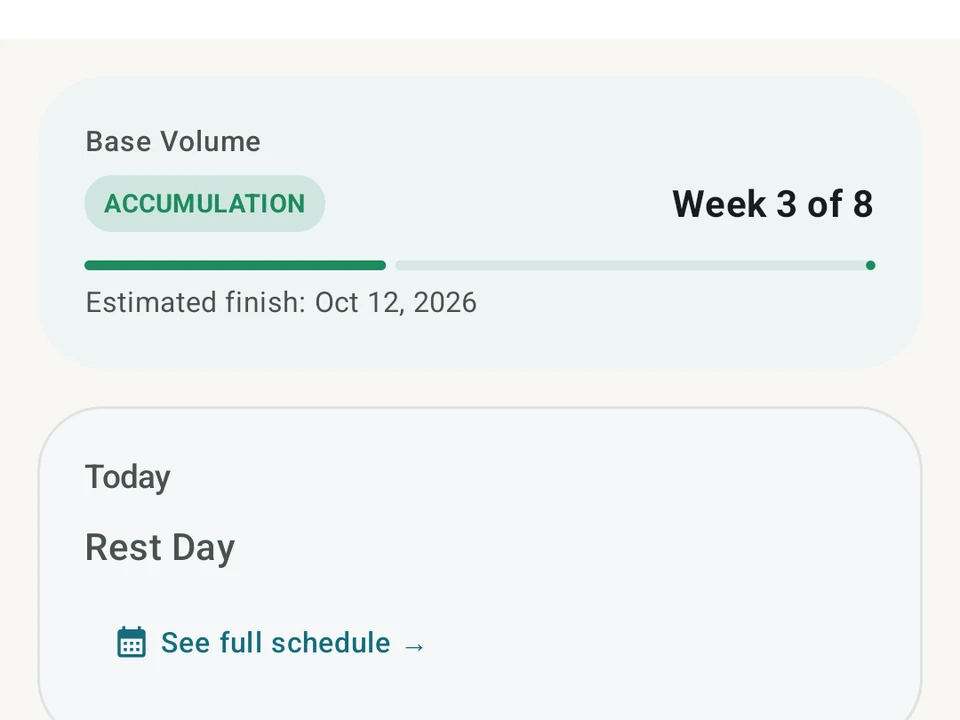
Real app capture. A Kinoku program from one of its 25 free templates, with every block and set editable, and nothing sent to a Kinoku server.
Try the other side of the table
Kinoku is free to install
Core tracking works offline, with no account. Your export from Boostcamp can come along.
Android only for now, with an iPhone version in the works. Some depth is paid, and the pricing page says which parts.
Related features
A 4-phase planning stack. The builder, all 25 templates, named programs with auto-progression, the custom model, and unlimited active programs are free. Pro adds volume targets, readiness tuning, and auto set changes.
Every set, one tap. Track how hard each set felt, your rest timers, set types, and notes.
A real watch app for workouts, runs, steps, tiles, and watch face data.
DOTS, IPF GoodLift, Wilks 2, and FFMI with offline percentile tables. Published tools widely used in strength sport.