

Best 5/3/1 apps for Android (2026)
Seven Android apps that run Jim Wendler's 5/3/1, compared on how each sets and raises the training max, which templates it runs and what it charges for.
Five/Three/One, KeyLifts and two Wendler log apps are built around 5/3/1, Boostcamp and Liftosaur ship several Wendler templates in a wider library, and Kinoku runs Boring But Big for free with no account, raising each training max after week three.
At a glance
| App | Best for | Better at | Main trade-off |
|---|---|---|---|
| Boostcamp | Lifters who want 5/3/1 for Beginners, Boring But Big and Building the Monolith ready to run | Several Wendler templates and community variants for free, in an 11,000+ program library | An account to start, and its Beginners guide has you type each new training max |
| Five/Three/One | Lifters who want a 5/3/1-only app that plans the cycle and the plates | Plate math and a next cycle set from your results | Custom assistance and the Joker set and FSL options are paid add-ons |
| KeyLifts | 5/3/1 lifters who want each new cycle built with one tap | One tap builds the next cycle, and programs can run from 1 to 52 weeks | Its listing puts the templates, the plate calculator and Joker sets in Pro |
| Kinoku | Android lifters who want Boring But Big run free, offline and with no account | The training max, the waves, the deload and the stall reset all run on the phone, free | Android only for now, one 5/3/1 template, and you pick the 5x10 weights yourself |
| Liftosaur | Lifters who want to rewrite any 5/3/1 rule in a plain text script | 5/3/1 for Beginners and Boring But Big as scripts you can edit | Its Boring But Big template works from a one-rep max, and data lives in its cloud |
| Wendler 5/3/1 log | Lifters who want warm-ups and Boring But Big sets in a plain 5/3/1 log | Warm-up and Boring But Big sets, a training max percentage you set, and CSV export | The free version is a trial that covers one cycle |
| Wendler Log 531 | Lifters who want warm-ups worked out and a cycle length they choose | Cycles from 3 to 10 weeks, warm-ups worked out, and a training max you can lower any time | Its listing puts the assistance templates, the plate calculator and cloud backup in Pro |
Publisher disclosure
Kinoku, made by Dreamsoft Works, writes and publishes this page, and Kinoku is one of the apps on it. Every fact about another app, and the quote from Jim Wendler's site, comes from a page that company publishes, opened on October 12, 2026. We give no score. The apps are grouped by what their own pages say, and every label points at a quoted sentence.
Quickstart
Five/Three/One, KeyLifts, Wendler 5/3/1 log and Wendler Log 531 are built around 5/3/1. Boostcamp and Liftosaur run several Wendler templates in a wider library, and Kinoku runs Boring But Big free, offline and with no account. The two groups follow what each app’s own pages say, and each group runs A to Z.
Which apps run 5/3/1 and handle the training max for you?
5/3/1 is Jim Wendler’s strength program. Each main lift works from a training max (TM), a number set below your true one-rep max (1RM), and the program moves through three wave weeks and a deload week. The last set of each wave week is an AMRAP set (as many reps as possible), and how that set goes decides what happens to the training max.
The seven apps here split into two groups by how their own pages describe them.
- Built around 5/3/1: Five/Three/One, KeyLifts, Wendler 5/3/1 log and Wendler Log 531. Each Play listing is written about this one program. Five/Three/One says it handles everything “From calculating your cycles, to telling you what plates to put on the bar”, and Wendler Log 531 asks you to “Enter your one rep max once and never calculate percentages again.”
- A wider library with 5/3/1 in it: Boostcamp, Kinoku and Liftosaur. Boostcamp’s listing names “5/3/1 BBB, 5/3/1 for Beginners, Building the Monolith” among its programs, and Liftosaur’s lists “5/3/1 and its variations”. Kinoku ships Boring But Big as a named program next to nSuns and GZCLP (Cody Lefever’s linear progression) in its free template gallery.
The question most people bring to this page is what an app does with the training max once the first cycle ends. The answers differ from app to app, and the section “How each app moves the training max” walks through them.
Side by side
Every cell below comes from the app’s own listing or site, and “Not stated” marks a cell that none of its pages cover.
| App | Where the training max comes from | What moves it | Assistance templates | Warm-ups | Paid layer |
|---|---|---|---|---|---|
| Five/Three/One | “Enter your 1RMs” | Next cycle set from your results | Joker sets and First Set Last (FSL) in a paid pack | Not stated | Assistance and extra templates |
| KeyLifts | Not stated | One tap builds the next cycle | Joker sets in Pro | Not stated | Templates, plate calculator, Joker sets |
| Wendler 5/3/1 log | A training max percentage you set | Not stated | Boring But Big in the trial; Joker and FSL in Pro | “Warm-up sets included” | Unlimited cycles after a one-cycle trial |
| Wendler Log 531 | One-rep max, with a percentage you can adjust | The app raises it each cycle | 11+ programs, BBB and FSL among them, in Pro | Worked out for each lift | Assistance, plate calculator, backup |
| Boostcamp | You enter it, about 90% of your one-rep max | Two Boostcamp pages describe it differently | Beginners, BBB, Monolith and FSL variants free | “warmup templates” | Strength Score, heatmap |
| Kinoku | 90% of the one-rep max you enter | +5 kg or +2.5 kg after week three; 90% after two misses | Boring But Big; the 5x10 weights are yours | Free generator, outside the program | Programs free; Pro adds readiness tuning |
| Liftosaur | Works from a one-rep max directly | Your script; the template adds weight after week three | Beginners (with FSL), BBB | Not stated | In-app purchases label |
Each app, in its own words
Five/Three/One
Best for: Lifters who want a 5/3/1-only app that plans the cycle and the plates.
Five/Three/One, made by Strong Pigeon, is a small app built for one program.
- What it does well: Its homepage says “Enter your 1RMs and your whole cycle is calculated.” The listing adds plate math and “Calculating your next cycle based on your performance”.
- What its pages say about limits: Custom assistance work and the Beyond 5/3/1 templates sit under “Optional paid features”, and the listing names Joker sets, First Set Last and Pyramid among those templates.
- Where it is the better pick: A lifter who runs plain 5/3/1 and wants a quiet app that hands over the plates for each set.
- Where Five/Three/One differs: Its listing’s Data safety section says “No data collected”. Its pages do not say how much the next cycle’s training max rises, or what happens after a missed set. Official listing: Google Play.
KeyLifts
Best for: 5/3/1 lifters who want each new cycle built with one tap.
KeyLifts is a percentage program app, and its Play listing is written around 5/3/1.
- What it does well: The listing says “KeyLifts automatically calculates all your sets so you can focus on hitting new Personal Records.” When a cycle ends, “With one button press you can create a new cycle with all the weights automatically calculated for you.” Its homepage says you can build percentage programs “from 1 to 52 weeks”.
- What its pages say about limits: The listing places its template library, template editing, a plate calculator and Joker sets in the Pro version. The homepage says it runs on “iPhone, iPad, Apple Watch, and Android.”
- Where it is the better pick: A lifter who likes to start each cycle on purpose with one tap and may later write a program of their own.
- Where KeyLifts differs: Its pages do not say how far the training max moves when you start that new cycle, or whether a missed set changes it. Official listing: Google Play.
Wendler 5/3/1 log (SaraSoft)
Best for: Lifters who want warm-ups and Boring But Big sets in a plain 5/3/1 log.
Wendler 5/3/1 log, from SaraSoft, is a 5/3/1 logger with a trial version.
- What it does well: “This app generates the 5 3 1 workout program based on your current lifts.” Its feature list includes a “Configurable training max percentage”, “Warm-up sets included”, Boring But Big sets and “CSV export via email, google drive”.
- What its pages say about limits: The free download is a “Full working trial for 1 Wendler 531 cycle”, and an in-app purchase removes the limit on the number of cycles. The Pro list adds logging of Joker sets and First Set Last.
- Where it is the better pick: A lifter who wants warm-ups and the 5x10 sets laid out and is happy to pay once the first cycle is done.
- Where Wendler 5/3/1 log differs: Its listing says “This app is not affiliated with Mr. Wendler(creator of the program).” It also declares “No data collected” in Data safety. Official listing: Google Play.
Wendler Log 531 (Vandersoft)
Best for: Lifters who want warm-ups worked out and a cycle length they choose.
Wendler Log 531, from Vandersoft, is a 5/3/1 tracker for Android and iPhone.
- What it does well: You can “Configure cycle length from 3 to 10 weeks including deload weeks” and “Adjust weight increments and training max percentages”. Its site says “The app raises your training max and builds the next cycle for you, cycle after cycle,” and warm-ups are calculated for each lift.
- What its pages say about limits: Its listing puts “11+ pre-built assistance programs (BBB, FSL, Triumvirate, and more)”, the plate calculator and cloud backup behind an upgrade. Vandersoft’s guide says “Wendler Log is free to download on iPhone and Android.”
- Where it is the better pick: A lifter who wants a cycle that is not four weeks long, or who switches between an iPhone and an Android phone.
- Where Wendler Log 531 differs: Its site says “You can reset or lower a training max at any time,” so you can lower it after a stall. The listing says the app “is independently developed and not affiliated with Jim Wendler”. Official listing: Google Play.
Boostcamp
Best for: Lifters who want 5/3/1 for Beginners, Boring But Big and Building the Monolith ready to run.
Boostcamp is a program library and gym logger with a large free catalog.
- What it does well: Its 5/3/1 for Beginners page says that template is free in the app, and it adds that Boring But Big and Building the Monolith are free there too. Its 5/3/1 roundup adds community variants such as Triumvirate, Leviathan and First Set Last on the free tier.
- What its pages say about limits: The homepage says to “create an account” before you choose a program. The Beginners page says to enter your training max at onboarding, about 90% of your one-rep max.
- Where it is the better pick: A lifter who wants a template Kinoku lacks, such as 5/3/1 for Beginners or Building the Monolith, and who is fine with an account.
- Where Boostcamp differs: Two of its own pages describe the training max step differently. Its roundup says Boostcamp “rolls it into the automatic Training Max bump for the next cycle,” while its Beginners guide says “Once complete the 3 weeks, input new TM to start a new cycle.” It also says “Boostcamp is not affiliated with Jim Wendler.” Official listing: Google Play. Versus page: Kinoku vs Boostcamp.
Kinoku
Best for: Android lifters who want Boring But Big run free, offline and with no account.
Kinoku is a free Android training app, and your record sits on no Kinoku server, though Android’s system backup can still copy eligible app data. Its Wendler 5/3/1 template is a four-day Boring But Big program, with press, deadlift, bench and squat days, planned for 12 weeks by default.
- What it does well: You enter a one-rep max for each main lift, or keep the estimate Kinoku fills in from sets you have already logged. The training max is 90% of it, rounded to a weight you can load. Each lift then moves through the 5s week, the 3s week, the 5/3/1 week and a deload week, one step each time you finish that lift’s session.
- What its pages say about limits: The template, the progression, the program builder and the plate calculator are all free, with no account. Pro adds readiness tuning, which can change a planned session based on your sleep and heart rate readings from Health Connect.
- Where it is the better pick: A lifter on Android who runs Boring But Big and wants the training max raised, held and reset by the program’s rules without a sign-up.
- What Kinoku does not do: There is no iPhone version yet, and your record stays on one Android phone with no sync to a second. It ships one 5/3/1 template, so 5/3/1 for Beginners, First Set Last, Joker sets and 5s PRO are missing. The routine lists the five Boring But Big sets, but you pick the 5x10 weights yourself, and warm-ups come from the separate Warmup Generator.
Liftosaur
Best for: Lifters who want to rewrite any 5/3/1 rule in a plain text script.
Liftosaur is a workout planner where each program is a short text script.
- What it does well: Its homepage says you write your program in plain text with its own language, Liftoscript. Its program list includes 5/3/1 for Beginners, described as “Beginner-friendly 3-day full-body program based on Jim Wendler’s 5/3/1 system with FSL supplemental work”, plus Boring But Big. The listing says the app “automatically increases or decreases your weights and reps based on the logic you define.”
- What its pages say about limits: The Boring But Big page says “percentages are expressed as % of 1RM directly (pre-converted from TM)”, so you set a one-rep max, not a training max. The homepage says “All your data is securely stored in the cloud for access anywhere.”
- Where it is the better pick: A lifter who wants to change the increments, the stall rule or the supplemental sets and does not mind a little scripting.
- Where Liftosaur differs: Its template tells you to raise the one-rep max after each three-week cycle and to “Reduce your 1RM by 10-15% and rebuild” after a stall. Official listing: Google Play.
How each app moves the training max
This is the part a spreadsheet makes you do by hand, and the apps handle it in three ways.
- The app raises it for you. Wendler Log 531’s site says the app “raises your training max and builds the next cycle for you”. Five/Three/One sets the next cycle from your performance, and Boostcamp’s roundup describes an automatic bump driven by the last set’s reps. Kinoku also raises it by itself, by a fixed step, as the next section lays out.
- You start the next cycle. KeyLifts builds a new cycle with one tap. Boostcamp’s Beginners guide asks you to type the new training max after three weeks.
- You write the rule. Liftosaur’s Boring But Big template carries its own increase and stall advice, and you can rewrite both.
Jim Wendler’s own one-rep max calculator carries a warning that bears on all of them: “Do not automatically increase a Training Max from this estimate.” A big last set can give you a high estimate, and that page says the estimate is not a reason to jump the training max. Kinoku follows that line. It never turns a big set into a bigger step, it adds the same small amount each cycle, and it lowers the number only after two misses in a row.
How Kinoku runs a 5/3/1 cycle
Kinoku’s 5/3/1 follows Wendler’s published waves and works each weight out from the training max on the phone.
- Weeks one to three: 65, 75 and 85% for fives, then 70, 80 and 90% for threes, then 75, 85 and 95% for five, three and one. The last set of each is marked as an AMRAP set.
- Week four: a deload at 40, 50 and 60% for five reps, with no AMRAP set, so the deload never overwrites your last real rep count.
- The step up: after the week three session, if the top set got at least one rep, the squat and deadlift training max rises 5 kg and the bench and press rise 2.5 kg. With micro loading turned on in Program settings, both steps are halved and sets round to 1.25 kg.
- A stall: one missed week three set holds the training max. Two in a row drop it to 90%, and the waves start again from there.
- Seeing it: the Progression Timeline shows each lift’s training max, today’s sets and your last AMRAP count.
- Changing it: typing a new one-rep max in Program settings resets that lift’s training max and restarts its cycle from the next day, and the sessions you already trained stay as they were.
The full wave table, the Boring But Big guidance and the setup steps are on the 5/3/1 Boring But Big program page. Program weights are worked out in kilograms, and the program has no setting for a five-pound rounding step.
Is there an official 5/3/1 app?
We found none. Jim Wendler’s site sells his books, runs a private forum and offers a one-rep max calculator, and its homepage names no app.
The apps that address it say they are independent. Wendler Log 531’s listing says it is “not affiliated with Jim Wendler or his official training materials”, Wendler 5/3/1 log says the same, and Boostcamp’s Beginners page says “Boostcamp is not affiliated with Jim Wendler.” Kinoku is not affiliated with him either, and its template follows the waves he published.
How this list was checked
We quoted every fact about another app from a page that app’s maker runs, and we opened each of those pages on October 12, 2026.
- Other apps: each cell and label rests on a sentence from the app’s Google Play listing, its homepage or its own program pages. We ran no device test of these apps, so the table holds quotes and gaps only.
- Jim Wendler’s site: the calculator warning is quoted from his own one-rep max calculator page.
- Kinoku: Kinoku’s facts come from the app’s own 5/3/1 code, the template it ships and its feature pages, including the step sizes and the stall rule.
- Order: the apps are grouped by whether their pages are written around 5/3/1 alone, with each group in alphabetical order. No app paid for its place, and the page prints no price because no single page gives one figure for every option.
Frequently asked questions
Is there an app that works out my 5/3/1 training max for me?
Yes, most of the apps here do. Kinoku, Five/Three/One and Wendler Log 531 take a one-rep max and work the waves out from it, and Kinoku sets the training max at 90 percent of that number. Boostcamp asks for the training max itself at onboarding. Liftosaur’s Boring But Big template skips the training max and works from a one-rep max directly.
Which app runs Boring But Big for free?
Boostcamp’s own page says Boring But Big is free in its app, and Kinoku’s Wendler 5/3/1 template is Boring But Big and costs nothing. Liftosaur lists the template among its programs. Wendler 5/3/1 log includes the sets in a one-cycle trial, and Wendler Log 531 puts its Boring But Big template in Pro.
Is there an official Jim Wendler 5/3/1 app?
Not one we could find. Jim Wendler’s own site sells his books, runs a private forum and offers a one-rep max calculator, and its homepage names no app. Wendler Log 531, Wendler 5/3/1 log and Boostcamp each say on their own pages that they are not affiliated with him, and Kinoku is not affiliated with him either.
Which 5/3/1 app works out my warm-up sets?
Wendler Log 531 and Wendler 5/3/1 log both list warm-up sets worked out for each lift, and Boostcamp’s listing names warmup templates. Kinoku’s program does not write warm-ups into the session, but its free Warmup Generator builds a ramp from the working weight and your bar. Five/Three/One’s and KeyLifts’ pages do not mention warm-ups.
Which app has First Set Last and Joker sets?
Several, mostly as paid extras. Five/Three/One sells them in its optional Beyond 5/3/1 pack, KeyLifts puts Joker sets in Pro, and Wendler 5/3/1 log logs both in its Pro version. Wendler Log 531 lists First Set Last among its Pro assistance programs. Boostcamp lists First Set Last variants on its free tier, and Kinoku has neither.
How does Kinoku raise the training max?
Once per cycle, after the week three session for that lift. If the last set of that day got at least one rep, the squat and deadlift training max goes up 5 kg and the bench and press go up 2.5 kg. Micro loading halves both steps. A big rep count does not add extra weight, which matches the caution on Jim Wendler’s own calculator page.
What happens in Kinoku when I miss a 5/3/1 AMRAP set?
One miss holds the training max where it is for the next cycle. If the week three top set misses in two cycles in a row, Kinoku drops that lift’s training max to 90 percent and the waves start again from the lower number. You can also type a new one-rep max in Program settings, which restarts that lift’s cycle from the next day.
Does Kinoku run 5/3/1 for Beginners or First Set Last?
Not as templates. Kinoku ships one 5/3/1 template, Boring But Big, plus the nSuns 5/3/1 linear progression in four, five and six day versions. You can build other layouts in the free program builder, but only the named templates move the training max for you. Boostcamp and Liftosaur both list 5/3/1 for Beginners.
Can I use a 5/3/1 app without an account?
Kinoku asks for no account at all, and the whole program runs on the phone. Boostcamp’s homepage tells you to create an account first. The Play listings of Five/Three/One and Wendler 5/3/1 log declare that no data is collected, while Liftosaur says your data is stored in its cloud. The other pages do not state an account rule.
Is a 5/3/1 calculator enough, or do I need an app?
A calculator turns one number into a table of weights, and you copy them each week. An app keeps the cycle going for you: it knows which week each lift is in, records the last set, and moves the training max at the end of the wave. Jim Wendler’s own site offers a calculator, and the apps here do the rest.
Which app runs nSuns or GZCLP instead of 5/3/1?
Kinoku runs both for free: the nSuns 5/3/1 linear progression, which raises the training max each session from a big last set, and GZCLP, a linear progression by coach Cody Lefever. Boostcamp’s listing names both. Our GZCLP and nSuns app roundup sets five Android apps side by side on how each one moves the weights.
What does Kinoku not do for 5/3/1?
Kinoku has no iPhone app yet and no sync between two phones. It does not work out the Boring But Big 5x10 weights or your warm-ups inside the program, and it has no Joker sets, First Set Last or 5s PRO. The training max starts at 90 percent of the max you enter, and no setting changes that percentage. Program weights round in kilograms.
Related pages
- Best powerlifting apps for Android: Where 5/3/1 apps sit among tools built for a meet, with strength scores and attempt planning.
- Best workout program apps for periodization: GZCLP, nSuns and periodized plans across more apps, beyond 5/3/1.
- Which free app runs GZCLP or nSuns on Android?: Five apps compared on the GZCLP stages, the nSuns layouts and what happens after a stall.
- 5/3/1 Boring But Big program page: The waves, the 5x10 sets and the setup steps in Kinoku.
- Is there an app that plans deload weeks for me?: The 5/3/1 deload week next to apps that time a deload from your feedback.
- nSuns 5/3/1 LP program page: The higher-volume 5/3/1 variant that raises the training max each session.
- GZCLP program page: Cody Lefever’s tiered linear progression, free in Kinoku.
- Kinoku vs Boostcamp: The program library, the account and the free tier, side by side.
- One-rep max calculator: Estimate a one-rep max from a recent set before you start a cycle.
- Periodization: Every program template in Kinoku and what Pro adds on top.
Which one fits you
- Choose Five/Three/One if you run plain 5/3/1, want the plates worked out for each set, and will pay for extra templates.
- Choose KeyLifts if you want a new cycle built with one tap and may later build your own percentage program of up to 52 weeks.
- Choose Wendler 5/3/1 log if you want warm-ups and Boring But Big sets laid out for you, want to choose your training max percentage, and like a CSV export.
- Choose Wendler Log 531 if you want warm-ups worked out, a cycle length other than four weeks, and an iPhone app as well as Android.
- Choose Boostcamp if you want 5/3/1 for Beginners or Building the Monolith ready to run, and an account is fine.
- Choose Kinoku if you run Boring But Big on Android and want the training max raised and reset for you, free, with no account.
- Choose Liftosaur if you want to change every rule of your 5/3/1 template yourself and are happy to write a short script.
How this page is checked. Every fact about another app on this page comes from a page that app publishes, which we could open and quote on October 12, 2026. The sources, with the exact sentence each fact rests on, are listed just above. Every Kinoku fact is tied to the shipping app's code. The page carries no score; the apps are grouped by what their own pages say. If a fact here has gone stale, the support page is the fastest way to tell us.
Kinoku in practice
Where this shows up in the app
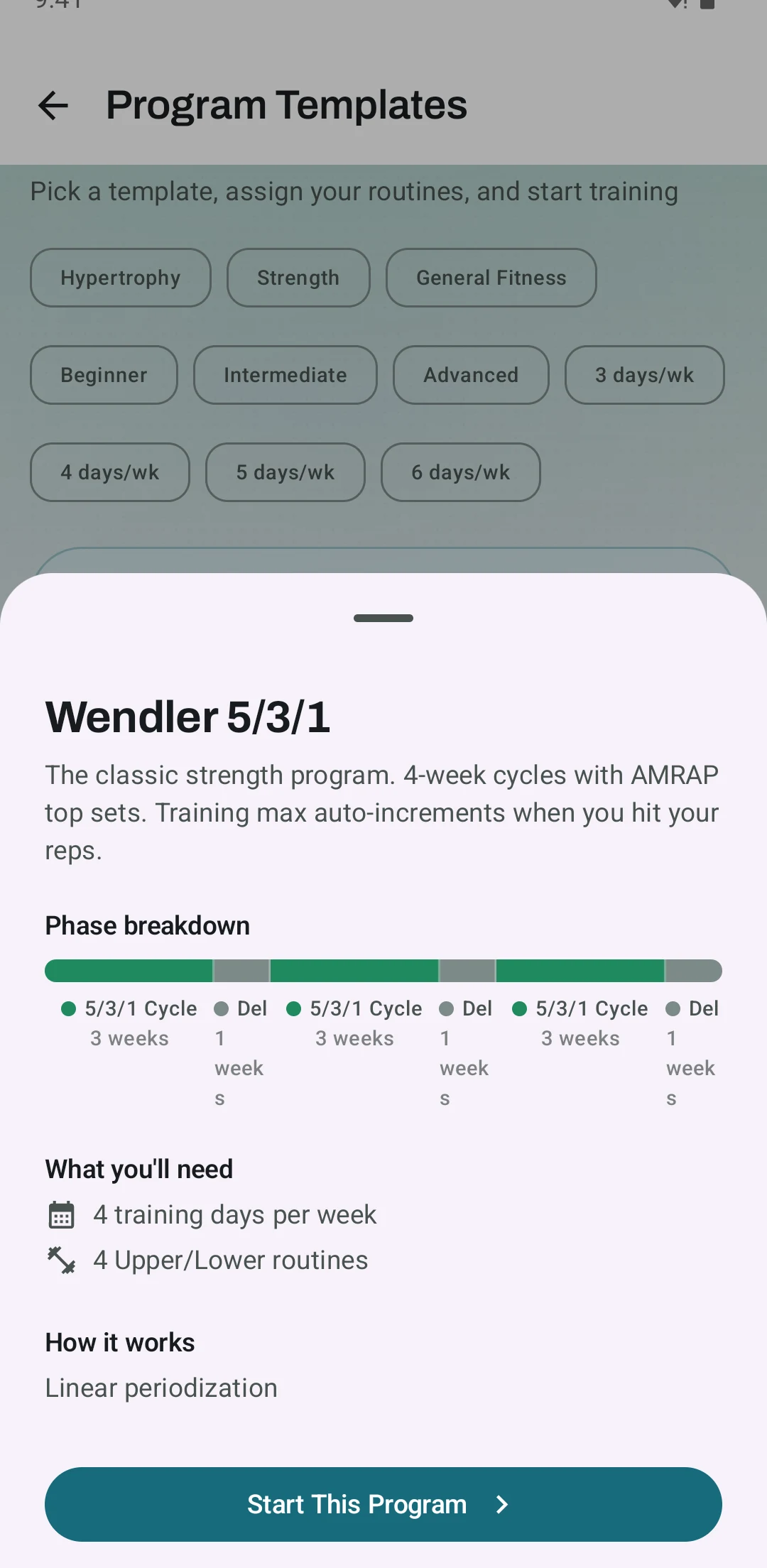 Open full-size image ↗
The Wendler 5/3/1 template in Kinoku
Real Android app capture, free tier. The template sheet shows the phase bar of three-week waves and deload weeks before you start the program.
One of the apps on this page
Kinoku is free to install
Core tracking works offline, with no account. An export from the app you use today can come along.
Android only for now, with an iPhone version in the works. Some depth is paid, and the pricing page says which parts.
Related features
A 4-phase planning stack. The builder, all 25 templates, named programs with auto-progression, the custom model, and unlimited active programs are free. Pro adds volume targets, readiness tuning, and auto set changes.
Load the bar fast with a visual plate layout. The calculator and bar-weight setting are free; Pro adds custom plate inventory settings.
Warmup sets built from your working weight, bar weight, and unit system.
Unlimited routines, Smart Sync, Starter Packs, and follow-along links are free, and so are Rotation Groups that cycle through several routines for you.