

GZCLP: Tiers, Rep Schemes, and Weight Jumps
Cody Lefever's GZCLP in plain terms: the three tiers, their rep schemes, what happens after a missed set, and what Kinoku tracks for you.
Weekly Training Schedule
These are the sessions the Kinoku template builds when you start it, and the same sessions sit in the file below. The rep counts are each routine's starting targets. For the squat, bench press, deadlift and overhead press, the template sets the reps and loads itself from your training max.
- Squat (Barbell)5 x 3
- Bench Press (Barbell)3 x 10
- Lat Pulldown3 x 15
- Overhead Press (Barbell)5 x 3
- Deadlift (Barbell)3 x 10
- Bent Over Row (Barbell)3 x 15
- Bench Press (Barbell)5 x 3
- Squat (Barbell)3 x 10
- Lat Pulldown3 x 15
- Deadlift (Barbell)5 x 3
- Overhead Press (Barbell)3 x 10
- Bent Over Row (Barbell)3 x 15
Ready to lift?
Start GZCLP in Kinoku
GZCLP is a free template in the app. When you start it there, Kinoku builds the 4 routines, puts 12 weeks on your calendar and sets the main-lift loads from your training max.
Any time, from the menu
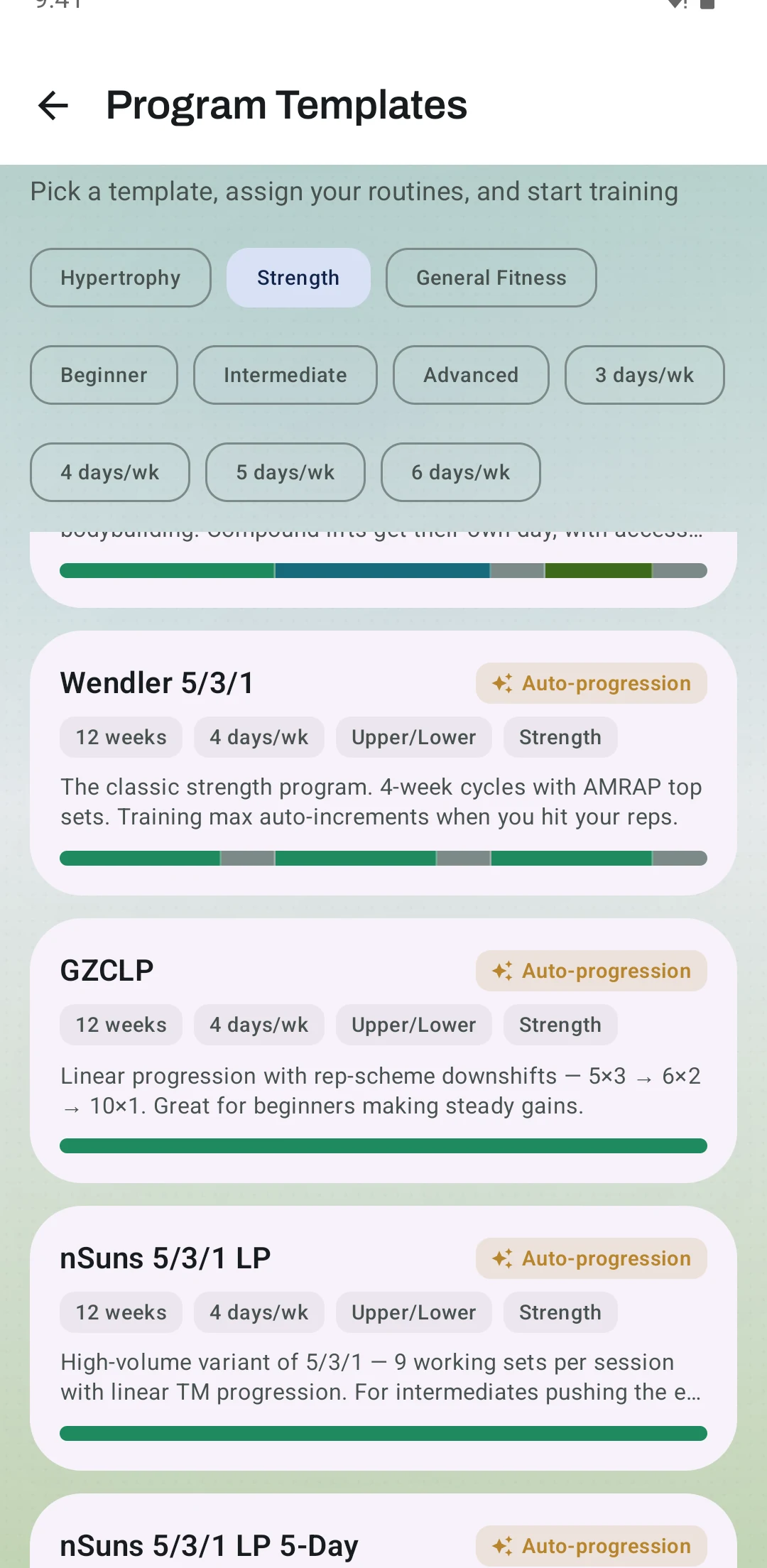
- Open the menu, tap Search Kinoku at the top, type templates and tap Program templates.
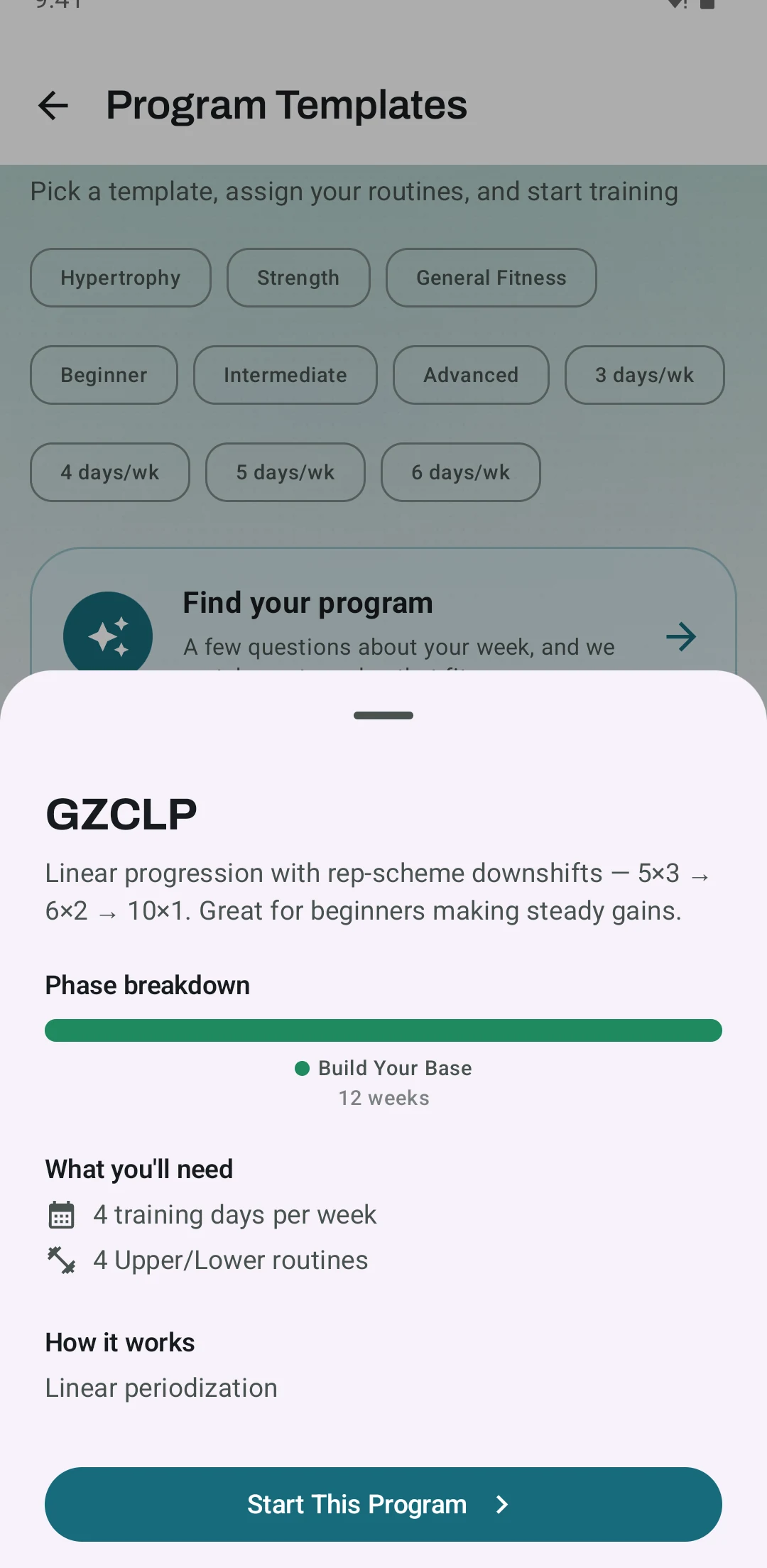
- Tap the Strength filter to shorten the list, then tap GZCLP and Start This Program.
- Choose a start date, tap Next, and tap Create the program routines so Kinoku builds the routines for you.
- Tap Next, then Activate Program, and enter your one-rep max for each main lift before you tap Start program.
On your first launch, from the welcome screen
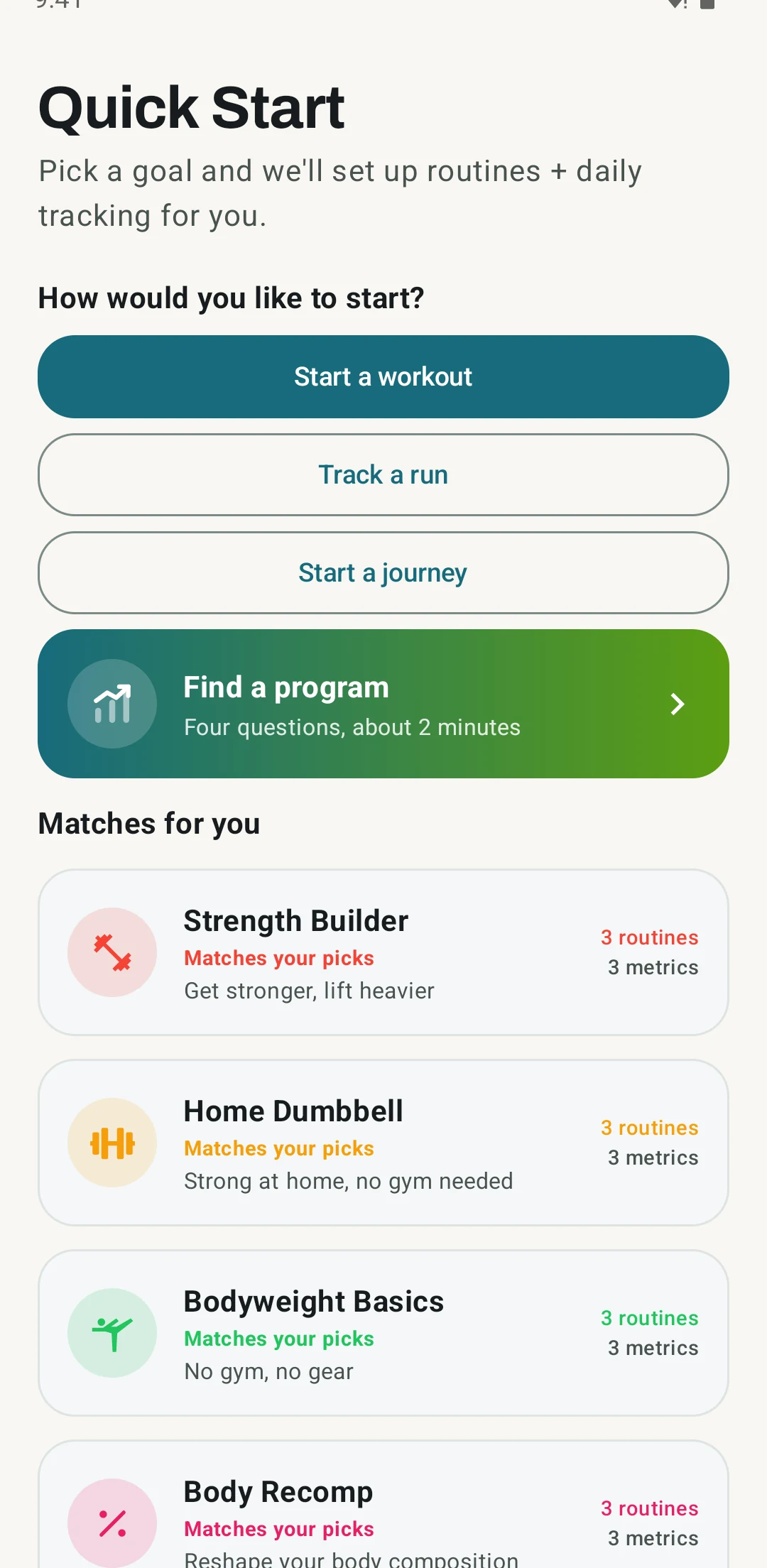
- Pick Strength as a focus, because the finder card only shows for people who lift.
- Tap Find a program on the welcome screen, right under the three start choices.
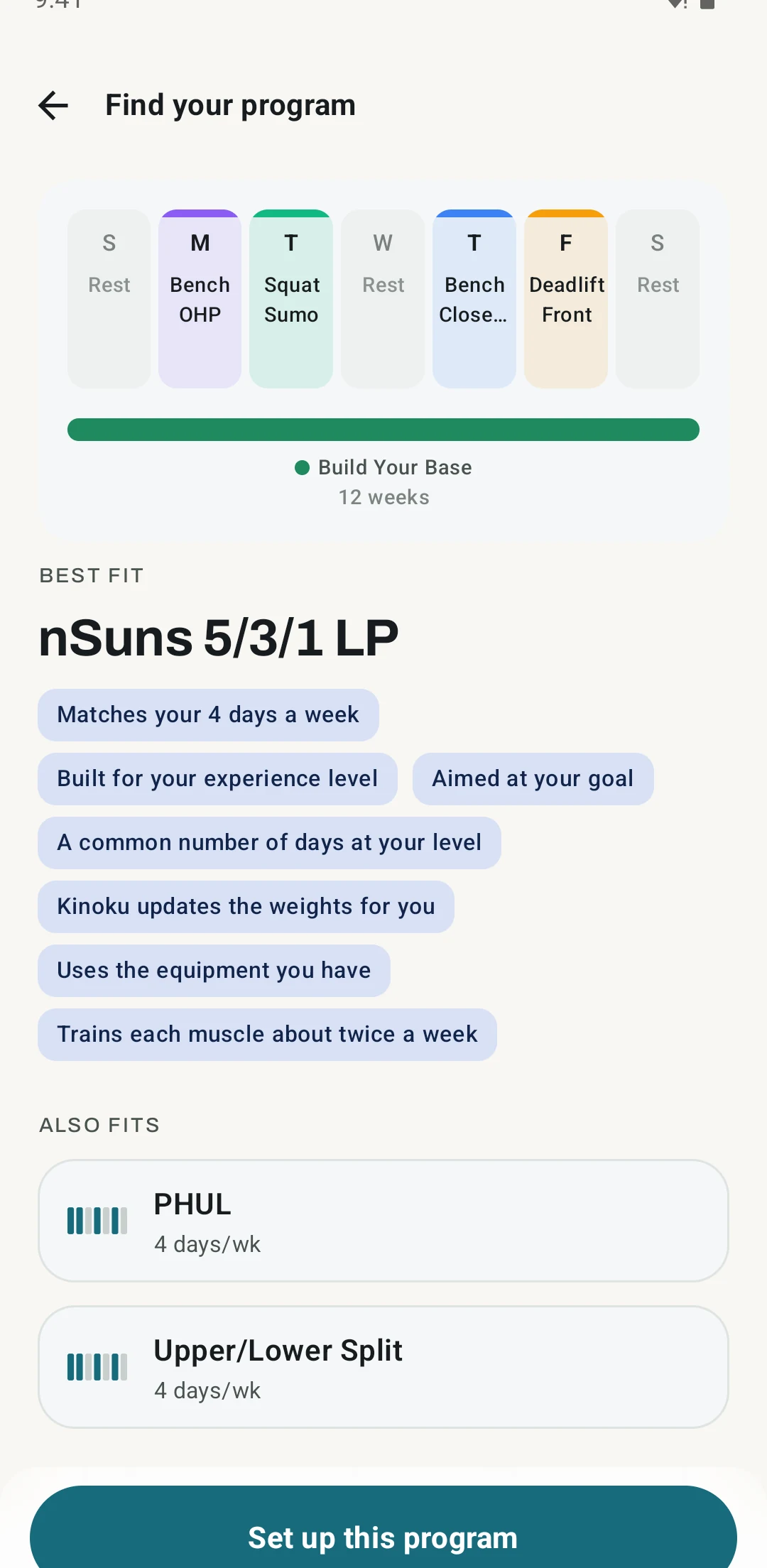
- Answer four questions about your week, and the finder sets up the match for you.
The finder picks the program that fits your answers, so it can suggest a different one, while the menu path above reaches GZCLP every time.
Opens the template in the app when Kinoku is installed, and opens Google Play when it is not.
Prefer a file?
Save the file, then open it with Kinoku, and you get 4 routinesand a 12-week calendar that starts on the Monday after you download it. No workouts are added to your history, and the file does not set loads from your training max.
Kinoku in practice
Track this program on your phone
 Open full-size image ↗
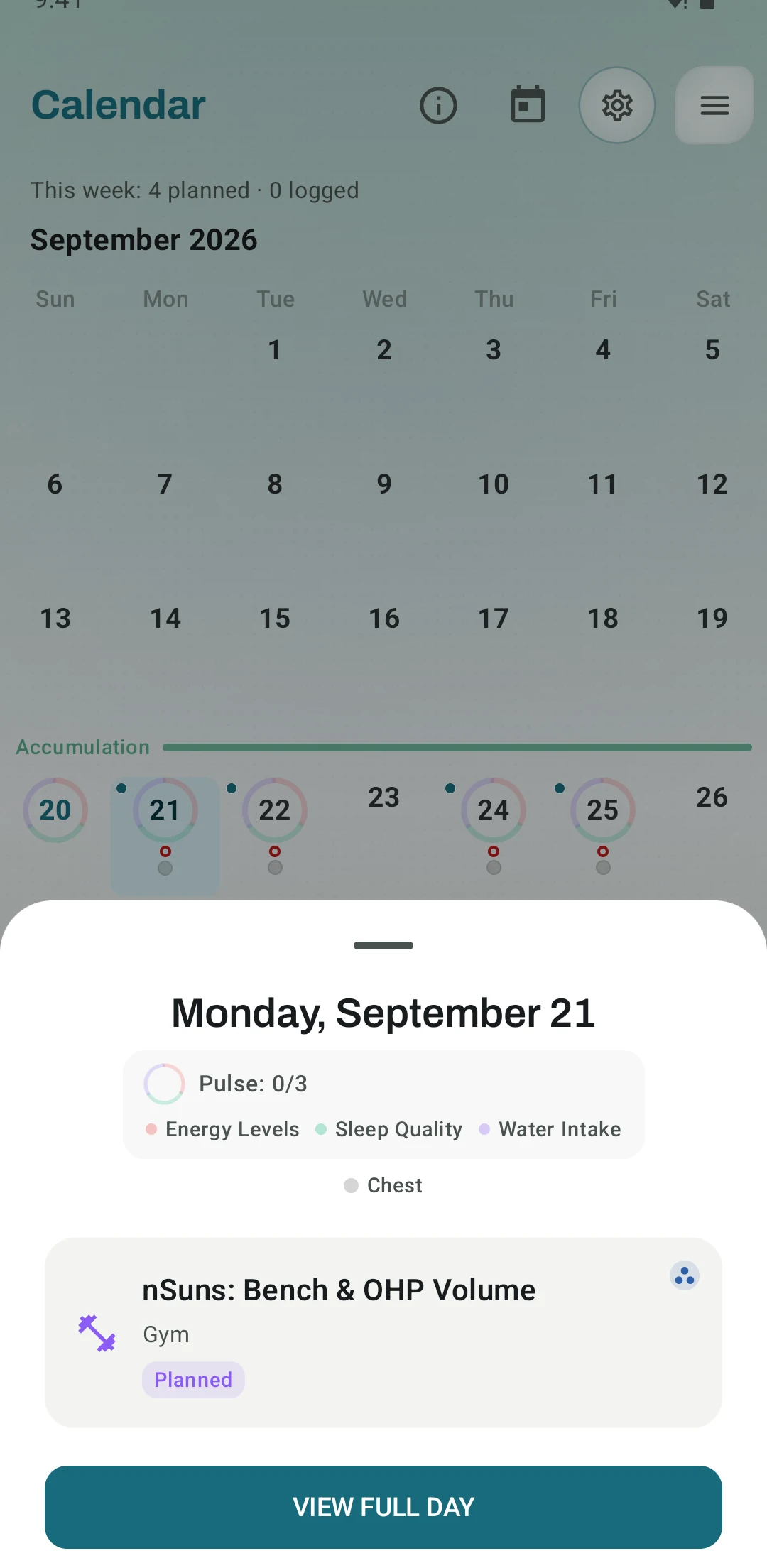
Your weeks land on the calendar
Real Android app capture. Start a template and Kinoku plans every session onto your calendar, here nSuns 5/3/1 LP. The same happens for every program on this page.
 Open full-size image ↗
Kinoku Periodization Engine
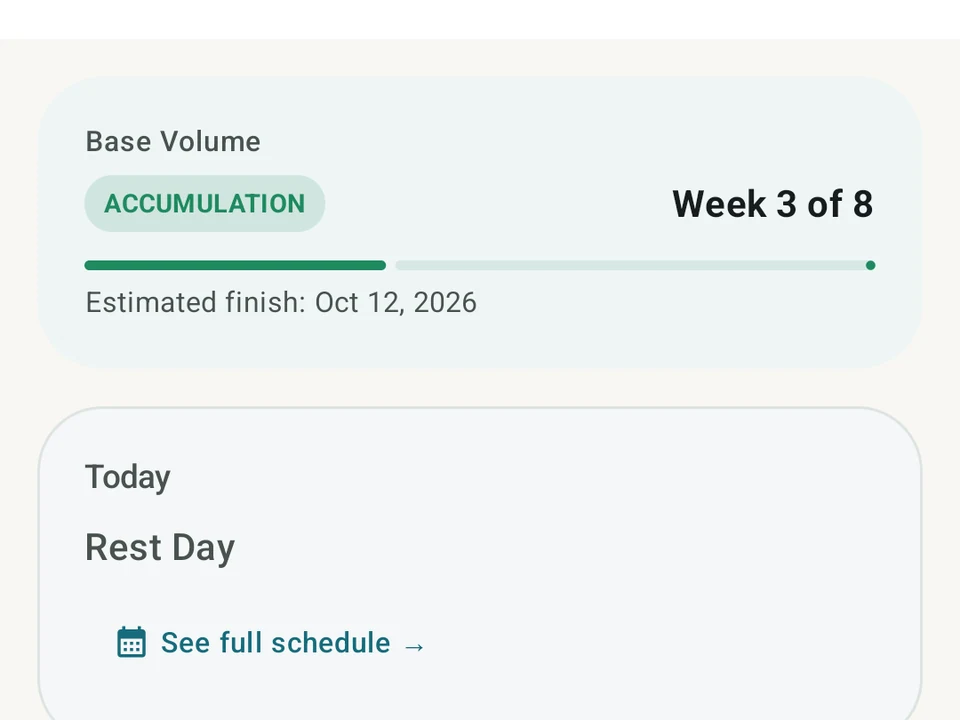
Real Android app capture. Kinoku tracks the GZCLP Tier 1 stages for you, with no subscription and no spreadsheet.
The GZCL (Cody Lefever method) linear progression (GZCLP) is an adaptable strength training system created by powerlifter Cody Lefever. Built on a tiered pyramid, it helps lifters gain maximal strength on main lifts and muscle on accessory work.
Unlike rigid linear programs that force early deloads as soon as you miss a rep, GZCLP uses an autoregulated failure system. When a weight gets too heavy, you do not drop load. You adjust the set scheme to keep working with heavy weights.
The Three-Tier Structure
GZCLP organizes every training session into three distinct tiers based on intensity, volume, and exercise purpose.
       ▲
      / \     Tier 1 (T1): Heavy Compounds
     / T1\    85–100% 1RM · 15 total reps · Strength base
    /─────\
   /  T2   \  Tier 2 (T2): Volume Compounds
  /         \ 65–85% 1RM · 30 total reps · Technical practice
 /───────────\
/     T3      \ Tier 3 (T3): Accessories & Prehab
─────────────── <65% 1RM · 45+ total reps · Muscle hypertrophy
Tier 1 (T1): Primary Compound Lifts
Tier 1 is the core of your strength development. You perform one primary compound barbell movement per workout: the Squat, Bench Press, Deadlift, or Overhead Press (OHP).
Every Tier 1 movement starts at approximately 85% of your five-rep max (5RM). All sets are capped at a specific rep count except the final set, which is an as many reps as possible (AMRAP) set. The plus sign in 5x3+ indicates that you push the final set until one rep short of muscular failure.
Tier 2 (T2): Secondary Compound Lifts
Tier 2 provides technical practice and hypertrophy volume for a complementary compound movement. In Workout A1, your T1 is the heavy Squat, while your T2 is a lighter, higher-rep Bench Press.
Tier 2 exercises start around 65% to 70% of your 5RM. They develop work capacity, build connective tissue tolerance, and refine motor patterns without generating excessive central nervous system fatigue.
Tier 3 (T3): Accessory Hypertrophy & Back Work
Tier 3 exercises focus on muscle growth, muscular balance, and joint health. The non-negotiable foundation of Tier 3 is upper back volume: lat pulldowns, dumbbell rows, chest-supported rows, and face pulls.
Every Tier 3 exercise uses light to moderate resistance and high repetitions (3 sets of 15 reps or more). The final set is always an AMRAP set. Once you can achieve 25 total reps on the final set with clean form, you increase the load.
The Stage Progression & Failure Protocol
Linear progression eventually stalls for every lifter. GZCLP solves plateaus by shifting the set-and-rep scheme across three distinct stages before resetting your base weight.
Tier 1 Failure Protocol
When you cannot complete all prescribed reps in a Tier 1 workout, follow this progression:
- Stage 1: 5 sets of 3 reps (5x3+). Add 2.5 kg (5 lbs) for upper body lifts or 5 kg (10 lbs) for lower body lifts each session. When you fail to hit 15 total reps, move to Stage 2. Keep the failed weight for your next session.
- Stage 2: 6 sets of 2 reps (6x2+). Use the exact weight you failed on in Stage 1. Continue adding 2.5 kg or 5 kg each session until you fail to hit 12 total reps.
- Stage 3: 10 sets of 1 rep (10x1+). Use the exact weight you failed on in Stage 2. Continue linear progression until you fail to hit 10 total reps.
- Reset & Retest: Rest for 3 to 5 days. Test your current 5RM. Take 85% of that new 5RM and return to Stage 1 at 5 sets of 3 reps.
Tier 2 Failure Protocol
Tier 2 movements follow their own progression rules:
- Stage 1: 3 sets of 10 reps (3x10). Add weight each week. When you fail to hit 30 total reps, shift to Stage 2.
- Stage 2: 3 sets of 8 reps (3x8). Use the failed weight from Stage 1 and continue progressing.
- Stage 3: 3 sets of 6 reps (3x6). Continue progressing until you fail to achieve 18 total reps.
- Reset: Return to 3 sets of 10 reps using a weight slightly heavier than your original Stage 1 starting weight.
Micro-Loading for Sustainable Progress
Standard gym weight plates increase in increments of 1.25 kg, which means the minimum barbell jump is 2.5 kg (5.5 lbs). While lower body compound lifts can handle 2.5 kg jumps for months, upper body lifts like the Overhead Press and Bench Press frequently stall on large percentage jumps.
Adding 2.5 kg to a 40 kg Overhead Press represents an immediate 6.25% load increase. In Kinoku, you can enable micro-loading progression to calculate jumps of 1.25 kg (2.75 lbs) on upper body lifts. This small adjustment allows lighter lifters and female athletes to maintain linear progression without hitting artificial plateaus.
Weekly Workout Structure
GZCLP is structured across four repeating workouts:
- Workout A1: T1 Squat (5x3+) · T2 Bench Press (3x10) · T3 Lat Pulldown (3x15+).
- Workout B1: T1 Overhead Press (5x3+) · T2 Deadlift (3x10) · T3 Barbell Row (3x15+).
- Workout A2: T1 Bench Press (5x3+) · T2 Squat (3x10) · T3 Lat Pulldown (3x15+).
- Workout B2: T1 Deadlift (5x3+) · T2 Overhead Press (3x10) · T3 Barbell Row (3x15+).
How to Track GZCLP in Kinoku
Tracking GZCLP by hand means keeping notes on which stage each lift is in, and that is easy to lose track of.
Kinoku ships GZCLP as a 4-day template with Tier 1 progression built in:
- Routines set up for you: when you start the program, Kinoku builds the four workouts with their set and rep targets and puts them on your calendar on Monday, Wednesday, Friday and Saturday.
- Tier 1 stages handled for you: miss reps on a 5x3+ squat, and your next squat session moves to 6 sets of 2 at the same weight. After the 10x1 stage, Kinoku resets that lift’s training max to 90 percent and starts again at 5x3.
- Plate math built in: each set can show the plates that go on your bar.
Kinoku does not track the Tier 2 and Tier 3 stages yet, so you move those by hand. GZCLP is free in Kinoku, like every program template.
To start it, open the menu, tap Search Kinoku, type templates, then tap Program templates and pick GZCLP from the list.
Frequently asked questions
How does GZCLP handle weight increases each workout?
The program adds weight whenever you complete all prescribed sets in a workout. The upper body compound lifts (Bench Press and Overhead Press) go up by 2.5 kg (5 lbs), and the lower body compound lifts (Squat and Deadlift) go up by 5 kg (10 lbs). With micro-plates, the upper body lifts can go up by 1.25 kg instead.
What happens when you fail to hit the required reps on Tier 1?
On Tier 1, the weight does not drop straight away. At the next session it stays the same, and the scheme changes from 5 sets of 3 reps to 6 sets of 2 reps. If 6x2 fails too, the scheme moves to 10 sets of 1 rep. Only after a failed 10x1 do you test a new 5-rep max and restart at 85% of that value, at 5 sets of 3.
Can I run GZCLP 3 days per week instead of 4 days?
Yes. GZCLP rotates across four distinct workouts (A1, B1, A2, B2). On a 3-day weekly schedule, you simply alternate through the sequence continuously: Week 1 runs A1, B1, A2; Week 2 runs B2, A1, B1; Week 3 runs A2, B2, A1; and Week 4 runs B1, A2, B2.
Does Kinoku track GZCLP stages automatically?
For Tier 1, yes. Kinoku sets your Tier 1 loads from a training max, moves you from 5 sets of 3 to 6 sets of 2 and then 10 sets of 1 when you miss reps, and resets you after the last stage. It does not track the Tier 2 and Tier 3 stages yet, so you move those by hand.
Calculators & tools
A strength score that adjusts for your sex and weight. Written for the German federation in 2019, now the cross-federation standard.
Wilks 1 from 1994 and Wilks 2 from 2020. An older score that many groups still keep on record.
What a push-up, pull-up, dip or squat really lifts. Hundreds of exercises, each one labelled measured or estimated.
Track this in the app
Run GZCLP in Kinoku
Kinoku handles all target set weights, plate loading math, and progression jumps offline on your device.
100% free with no mandatory account and no cloud tracking.
Related app features
A 4-phase planning stack. The builder, all 25 templates, named programs with auto-progression, the custom model, and unlimited active programs are free. Pro adds volume targets, readiness tuning, and auto set changes.
Unlimited routines, Smart Sync, Starter Packs, and follow-along links are free, and so are Rotation Groups that cycle through several routines for you.
Every set, one tap. Track how hard each set felt, your rest timers, set types, and notes.
Load the bar fast with a visual plate layout. The calculator and bar-weight setting are free; Pro adds custom plate inventory settings.