

nSuns 5/3/1 LP: 4-Day Setup, Sets, and Weekly Jumps
The 4-day nSuns 5/3/1 linear progression as Kinoku ships it: a 9-set main lift, an 8-set second lift, and a training max that moves with your last set.
Weekly Training Schedule
These are the sessions the Kinoku template builds when you start it, and the same sessions sit in the file below. The rep counts are each routine's starting targets. For the squat, bench press, deadlift and overhead press, the template sets the reps and loads itself from your training max.
- Bench Press (Barbell)9 x 5
- Overhead Press (Barbell)8 x 6
- Lat Pulldown4 x 10
- Squat (Barbell)9 x 5
- Deadlift (Barbell)8 x 5
- Plank3 x 45 s
- Bench Press (Barbell)9 x 5
- Incline Bench Press (Dumbbell)8 x 6
- Bent Over Row (Barbell)4 x 10
- Deadlift (Barbell)9 x 5
- Goblet Squat8 x 5
- Bicycle Crunches3 x 15
Ready to lift?
Start nSuns 5/3/1 LP in Kinoku
nSuns 5/3/1 LP is a free template in the app. When you start it there, Kinoku builds the 4 routines, puts 12 weeks on your calendar and sets the main-lift loads from your training max.
Any time, from the menu
- Open the menu, tap Search Kinoku at the top, type templates and tap Program templates.
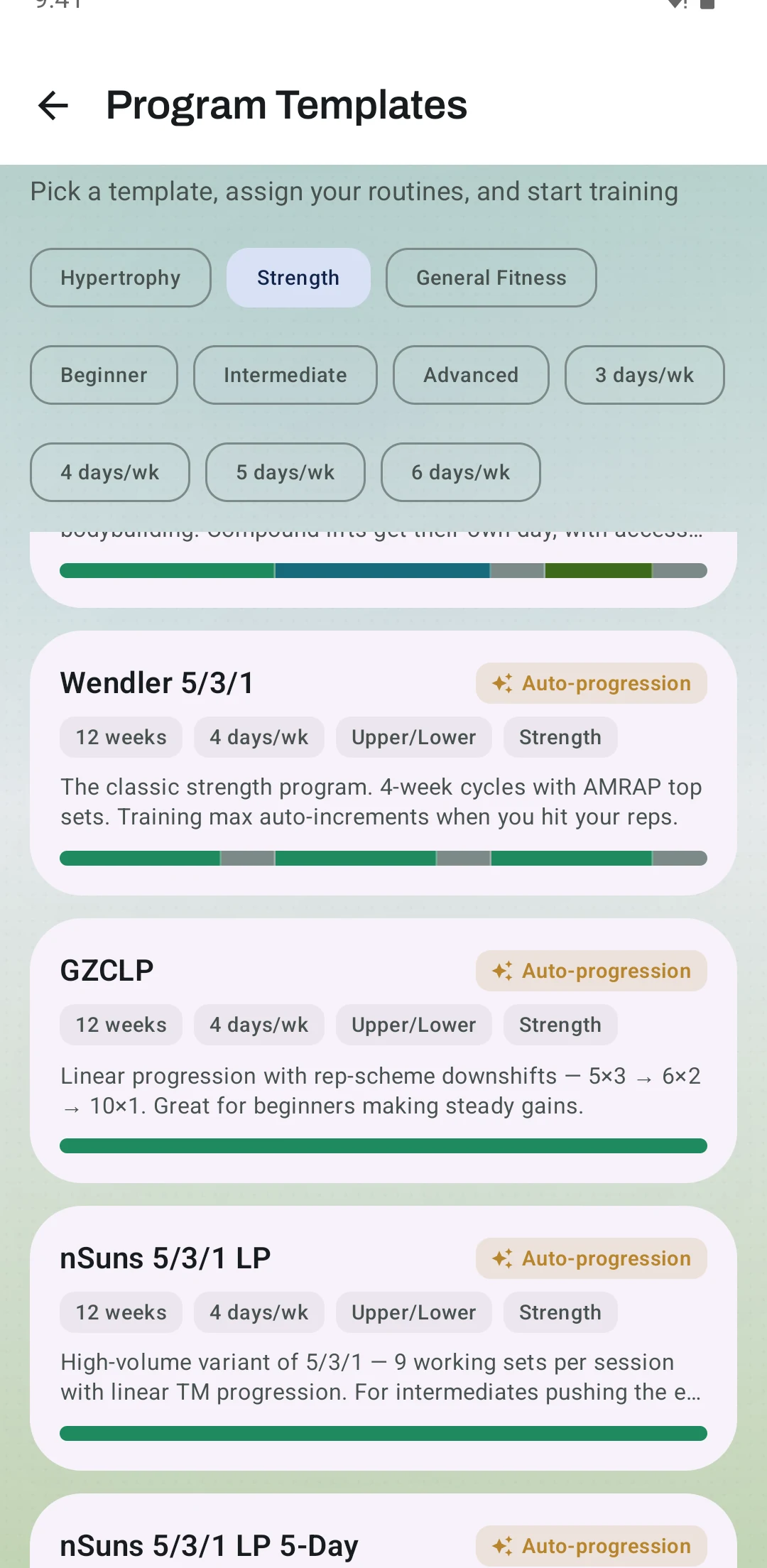
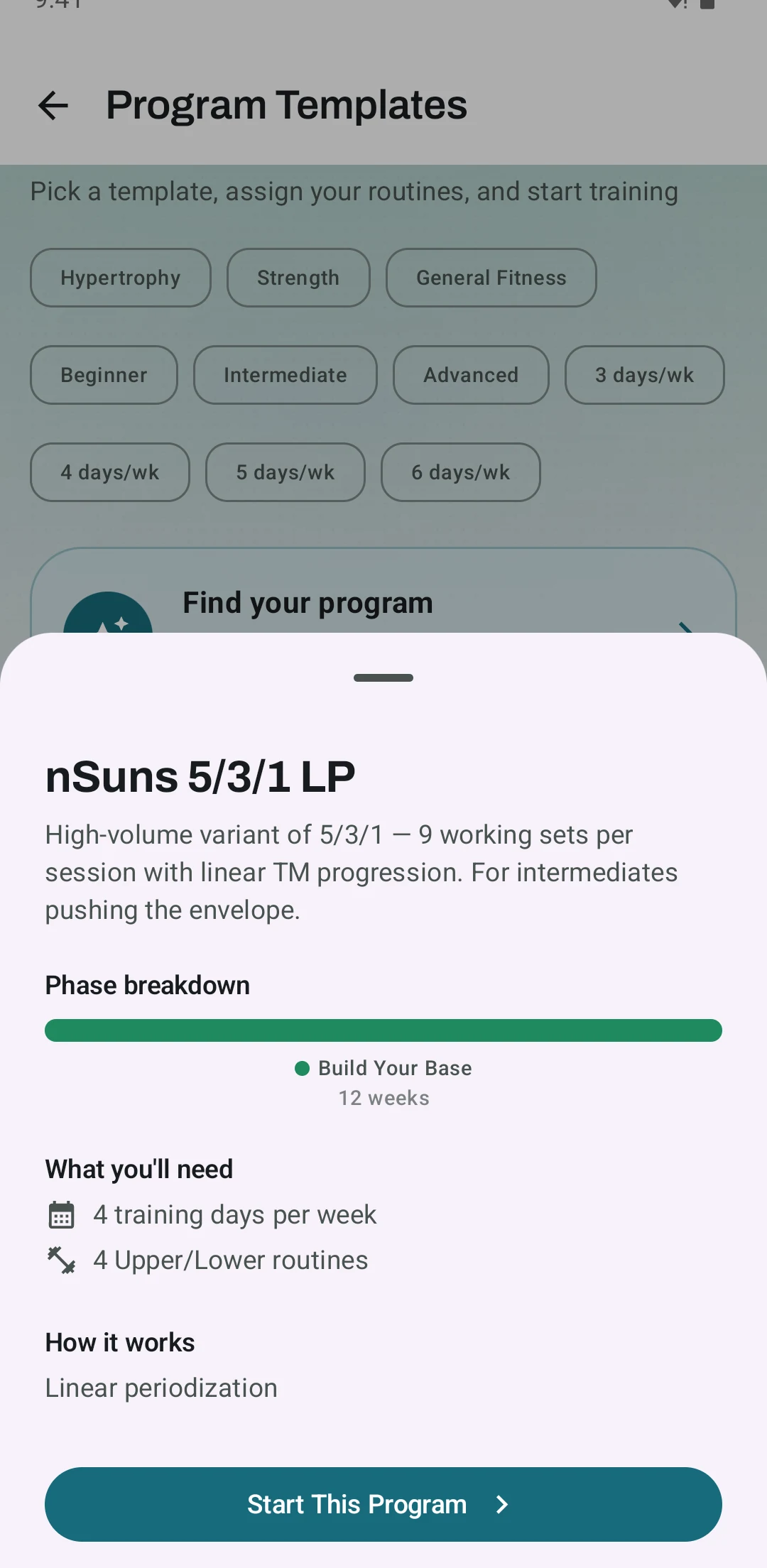
- Tap the Strength filter to shorten the list, then tap nSuns 5/3/1 LP and Start This Program.
- Choose a start date, tap Next, and tap Create the program routines so Kinoku builds the routines for you.
- Tap Next, then Activate Program, and enter your one-rep max for each main lift before you tap Start program.
On your first launch, from the welcome screen
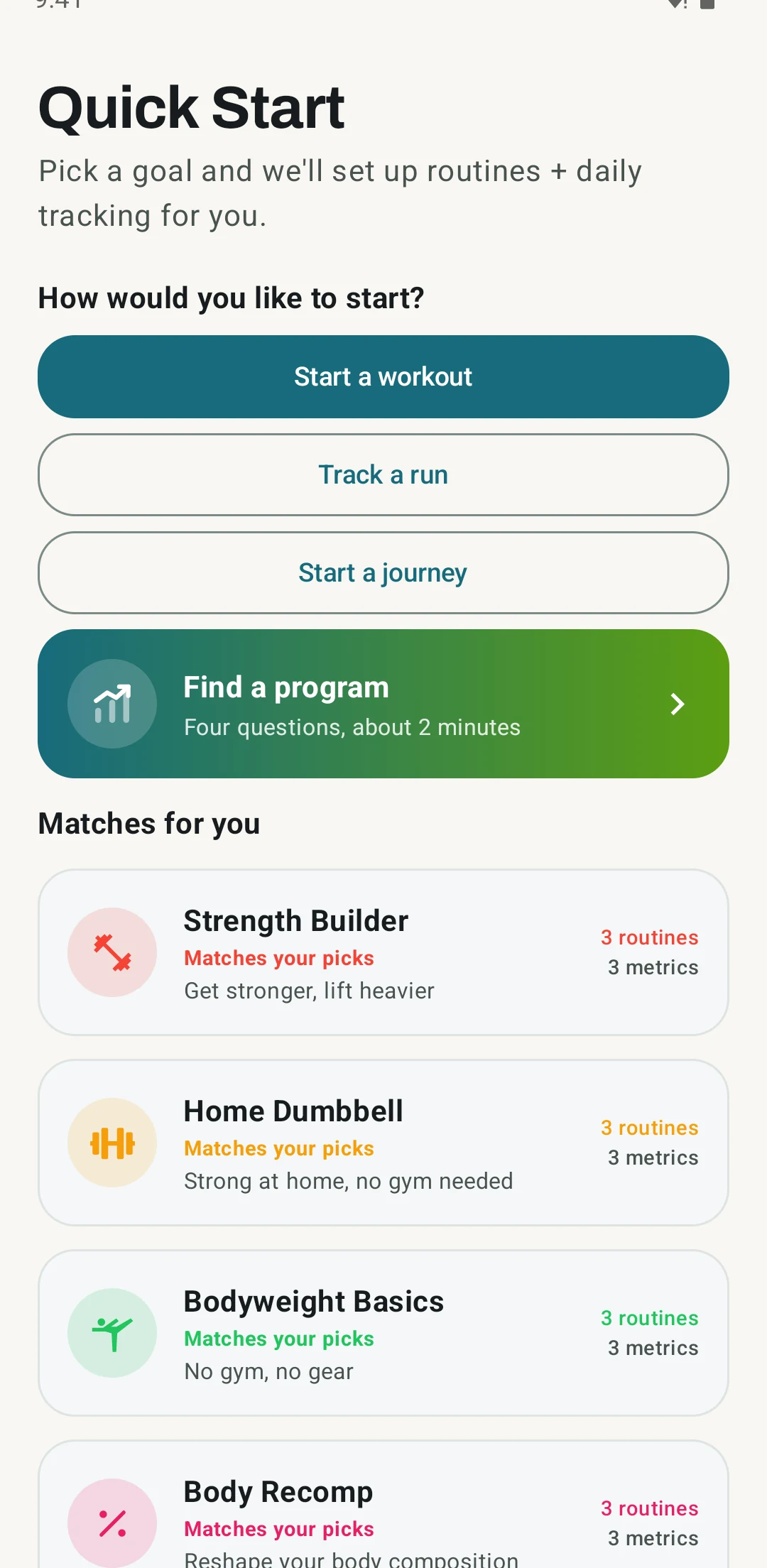
- Pick Strength as a focus, because the finder card only shows for people who lift.
- Tap Find a program on the welcome screen, right under the three start choices.
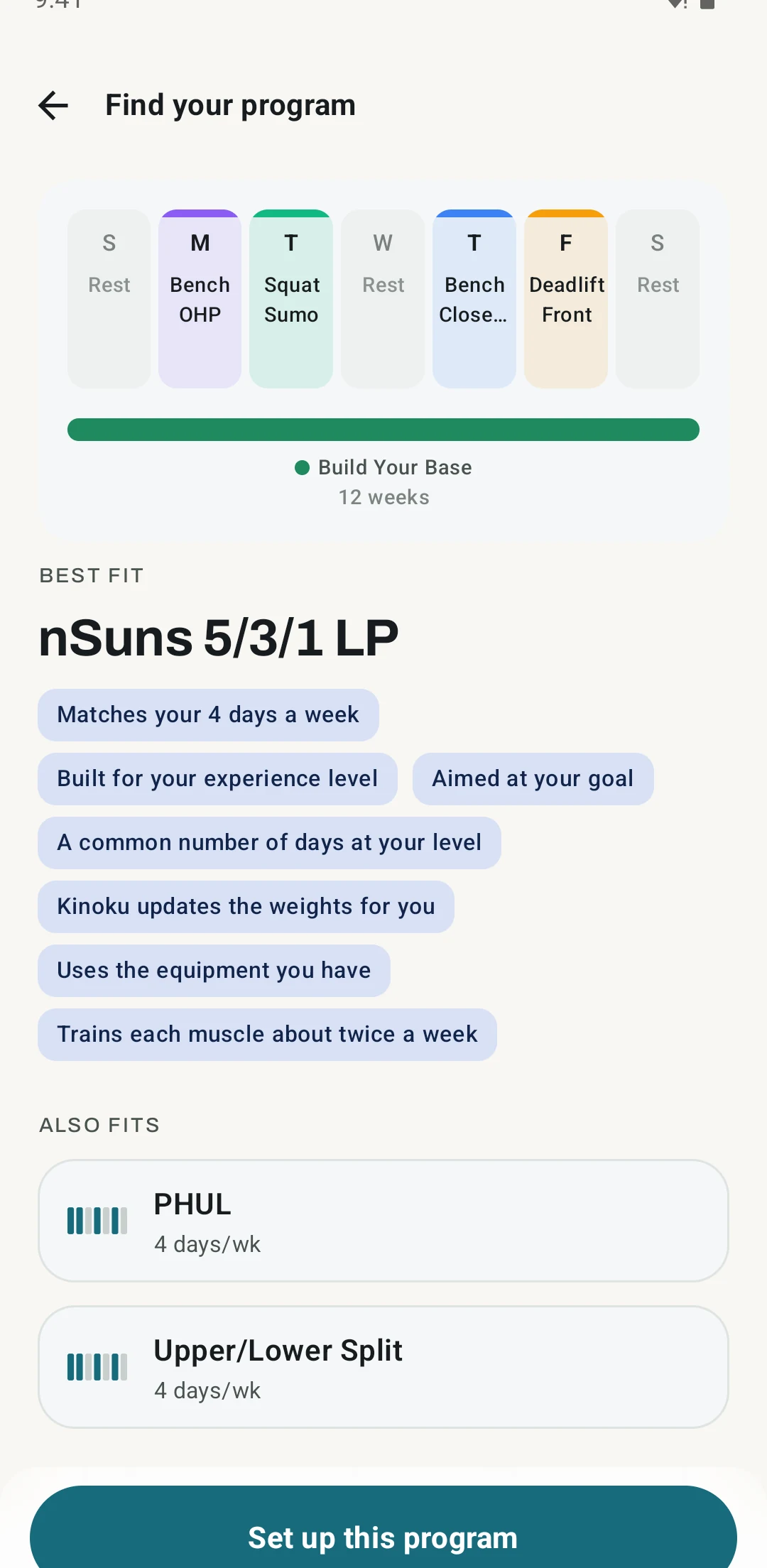
- Answer four questions about your week, and the finder sets up the match for you.
The finder picks the program that fits your answers, so it can suggest a different one, while the menu path above reaches nSuns 5/3/1 LP every time.
Opens the template in the app when Kinoku is installed, and opens Google Play when it is not.
Prefer a file?
Save the file, then open it with Kinoku, and you get 4 routinesand a 12-week calendar that starts on the Monday after you download it. No workouts are added to your history, and the file does not set loads from your training max.
Kinoku in practice
Track this program on your phone
 Open full-size image ↗
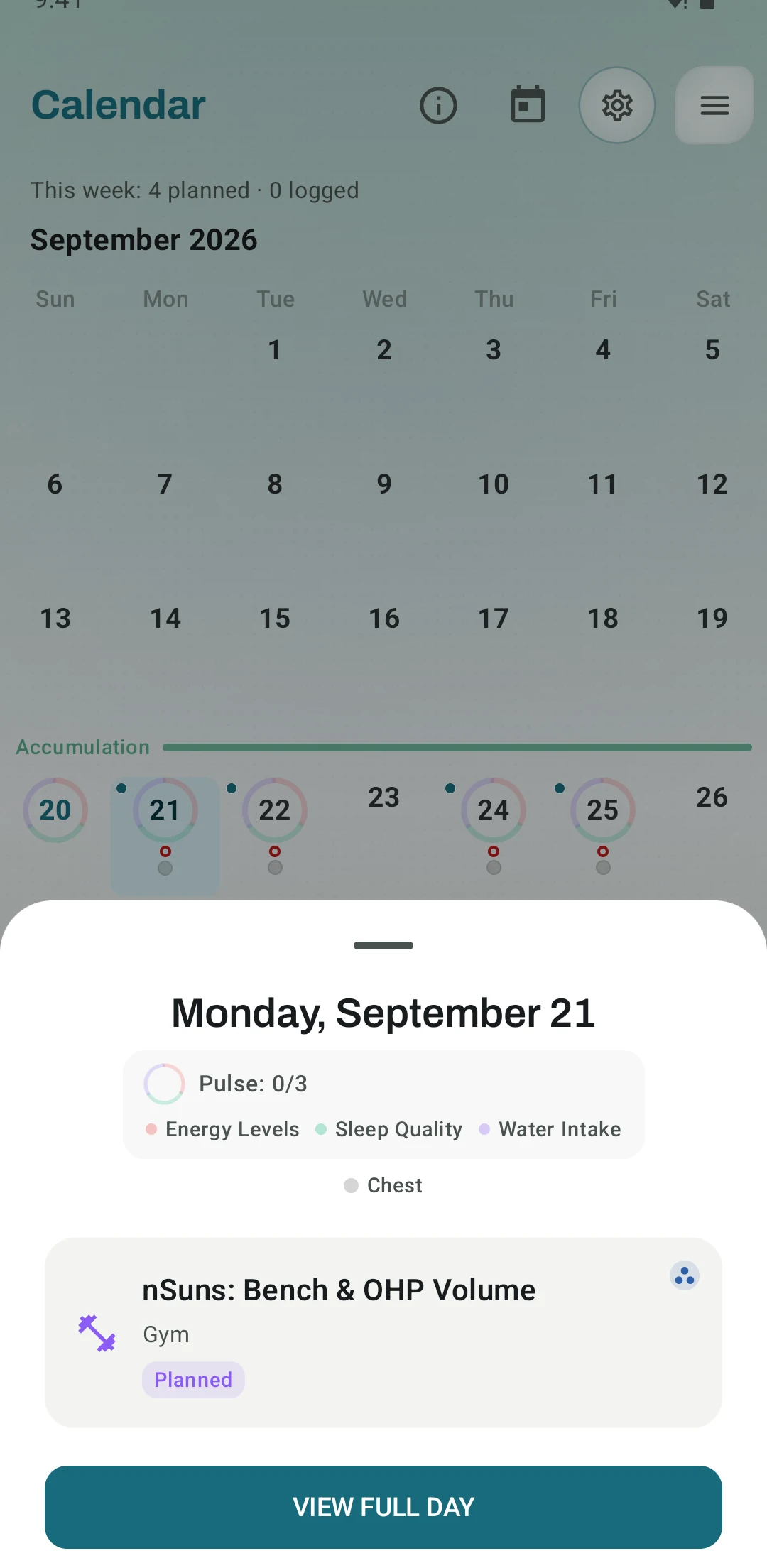
Your weeks land on the calendar
Real Android app capture. Start a template and Kinoku plans every session onto your calendar, here nSuns 5/3/1 LP. The same happens for every program on this page.
 Open full-size image ↗
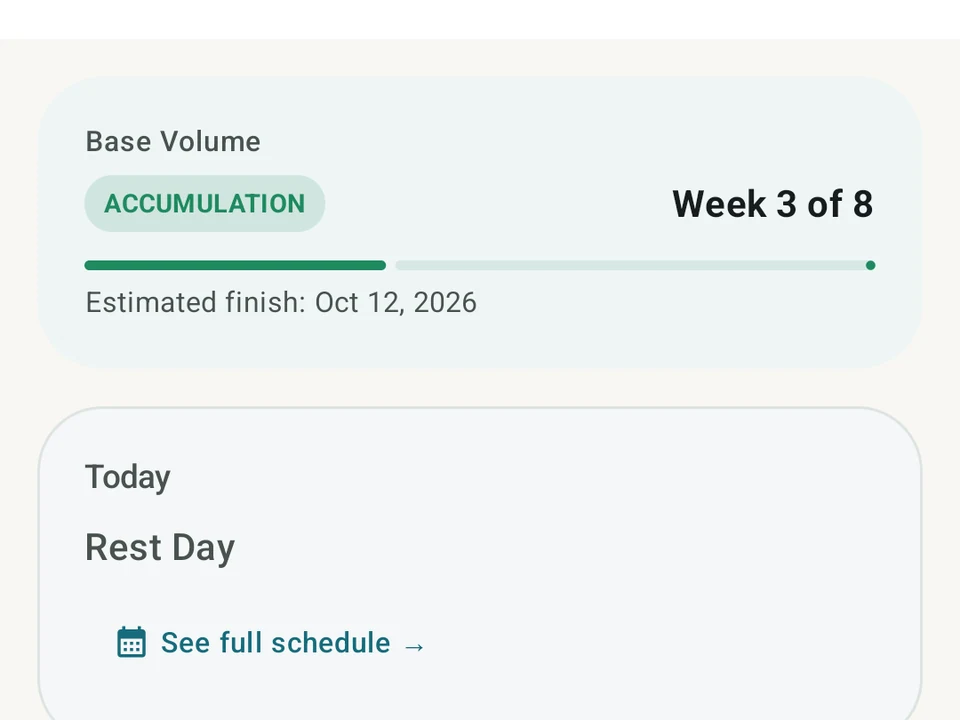
Kinoku program screen
Real Android app capture. Kinoku sets the main-lift loads from your training max and logs your last-set reps offline.
nSuns 5/3/1 linear progression (LP) is a community program from the r/nSuns forum. It takes Jim Wendler’s training max (TM) idea and moves the weights every week instead of every month, so a lifter who is still gaining strength can move faster.
Each day pairs two big lifts with 17 heavy sets between them, plus a few lighter exercises. That is a lot of work, and it suits a lifter with a year or two of steady training behind them.
The 4-day week
Kinoku ships the 4-day version of nSuns. Each day opens with a 9-set main lift, then an 8-set second lift, then one lighter exercise.
- Monday: bench press for 9 sets, overhead press for 8 sets, then lat pulldowns.
- Tuesday: squat for 9 sets, deadlift for 8 sets, then a plank.
- Thursday: bench press for 9 sets, incline dumbbell press for 8 sets, then barbell rows.
- Friday: deadlift for 9 sets, goblet squat for 8 sets, then bicycle crunches.
The 5-day and 6-day versions of nSuns are in the app too, as their own templates in the same list. On those, Kinoku sets the loads for the four main lifts, and you pick the weights for the second lifts yourself.
All three sit in the app’s Program templates list, and Kinoku sets up whichever one you pick. To open the list, tap Search Kinoku in the menu and search for templates.
How the original ladder works
In the original spreadsheet, each main lift climbs to a heavy single set and then steps back down over 9 sets. The third set is marked 1+, which means you do at least one rep and then as many clean reps as you can.
Set 1:  5 reps @ 75% TM
Set 2:  3 reps @ 85% TM
Set 3: 1+ reps @ 95% TM
Set 4:  3 reps @ 90% TM
Set 5:  3 reps @ 85% TM
Set 6:  5 reps @ 80% TM
Set 7:  5 reps @ 75% TM
Set 8:  5 reps @ 70% TM
Set 9: 8+ reps @ 65% TM
Your reps on the 1+ set decide next week’s training max. The table below shows the usual rule from the original program.
| Reps on the 1+ set | Change to your training max | What it means |
|---|---|---|
| 0 to 1 rep | +0 kg (+0 lbs) | Keep the same weight and look at sleep and food. |
| 2 to 3 reps | +2.5 kg (+5 lbs) | A normal week, so take the standard jump. |
| 4 to 5 reps | +5 kg (+10 lbs) | A strong week, so take a bigger jump. |
| 6 or more reps | +5 to +7.5 kg (+10 to +15 lbs) | Your starting weight was light for you. |
Count only reps you finish with clean form, because a shaky rep makes the next jump bigger than your real strength.
The second lift of each day
After the main lift comes a second lift of 8 sets. It adds practice on a related movement without the heavy single, so it builds volume while the main lift carries the test.
In the original spreadsheet the second lift climbs from 50 to 70 percent of its training max, with reps between 3 and 8.
What Kinoku works out for you
Kinoku runs its own, simpler version of the nSuns math, and it is worth knowing where it differs from the spreadsheet.
- One ladder for the main lifts. You enter a one rep max (1RM) for the squat, bench press, deadlift and overhead press. Kinoku sets their loads with one 9-set ladder that climbs to 85 percent of your training max and steps back down, with an as many reps as possible (AMRAP) set at the end.
- A jump for a good last set. Eight or more reps on that last set raises the training max for the next session, by 2.5 kg on the bench and overhead press and 5 kg on the squat and deadlift.
- A reset after two misses. Two misses in a row lower that training max to 90 percent, so you can build back up.
- Plate math on every set. Tap a set to see which plates to load for your bar.
The spreadsheet’s separate 1+ ladder and its table of weekly jumps are not in the app. Kinoku also does not set loads for the incline press and goblet squat, so you pick those weights yourself.
Managing fatigue and when to deload
The volume of nSuns drives quick gains, but tiredness builds up over the weeks and needs some care.
If a lift misses its target on the heavy set two weeks in a row, many lifters drop that training max by 10 percent and build back up from there. Every six to eight weeks, a lighter week of three sets of five at about 60 percent gives your joints a rest.
Balancing the extra work
Seventeen heavy sets a day leave little room for more, so keep the lighter exercises short. Most lifters pair their pressing with rows or pulldowns to keep the upper back strong, and pick two or three extra movements at most.
The template and your logs live in the app, and you can run the whole program without a Kinoku account.
Frequently asked questions
How does the 1+ set decide next week's weight in the original program?
In the original spreadsheet, the 1+ set is an as many reps as possible (AMRAP) set. With 0 or 1 clean rep you keep your training max (TM) where it is. With 2 or 3 reps you add 2.5 kg (5 lbs), and with 4 or 5 reps you add 5 kg (10 lbs). With 6 or more reps you can add 5 to 7.5 kg (10 to 15 lbs).
Why are there so many sets in an nSuns workout?
Each workout pairs two big lifts. The first lift has 9 sets and the second has 8, so you do 17 heavy sets a day before any extra work. That much volume can build strength quickly, but it asks for steady rest between sets and enough food and sleep to recover.
How long should I rest between sets?
Most lifters rest 90 seconds to 2 minutes between the lighter sets. Before and after the heaviest sets, 3 to 4 minutes gives you time to recover so the next set does not suffer.
What does Kinoku work out for nSuns?
You enter a one rep max (1RM) for the squat, bench press, deadlift and overhead press once. Kinoku turns each into a training max and sets the loads for those lifts with one 9-set ladder, where the last set is an AMRAP set. Eight or more reps on that set raises the training max, and two misses in a row lower it to 90 percent.
Calculators & tools
A strength score that adjusts for your sex and weight. Written for the German federation in 2019, now the cross-federation standard.
Wilks 1 from 1994 and Wilks 2 from 2020. An older score that many groups still keep on record.
What a push-up, pull-up, dip or squat really lifts. Hundreds of exercises, each one labelled measured or estimated.
Track this in the app
Run nSuns 5/3/1 LP in Kinoku
Kinoku handles all target set weights, plate loading math, and progression jumps offline on your device.
100% free with no mandatory account and no cloud tracking.
Related app features
A 4-phase planning stack. The builder, all 25 templates, named programs with auto-progression, the custom model, and unlimited active programs are free. Pro adds volume targets, readiness tuning, and auto set changes.
Unlimited routines, Smart Sync, Starter Packs, and follow-along links are free, and so are Rotation Groups that cycle through several routines for you.
Every set, one tap. Track how hard each set felt, your rest timers, set types, and notes.
Load the bar fast with a visual plate layout. The calculator and bar-weight setting are free; Pro adds custom plate inventory settings.