

Best Powerlifting Apps for Android (2026)
Seven Android apps for the squat, bench press and deadlift, grouped by whether they write your plan or run one you pick, with what each one charges for.
JuggernautAI and Sheiko Gold write a powerlifting plan around you and charge for it, while Boostcamp, Intensity, KeyLifts, Kinoku and StrengthLog run a program you pick, and Kinoku runs 5/3/1, GZCLP and nSuns free on the phone with no account.
At a glance
| App | Best for | Better at | Main trade-off |
|---|---|---|---|
| JuggernautAI | Lifters who want a plan built from their feedback and their meet attempts worked out | A Meet Day Advisor that calculates your attempts from your training in the app | A subscription after a two-week free trial |
| Sheiko Gold | Lifters who want Boris Sheiko's method adjusted each day and tapered to a meet date | Sessions built from that day's readiness, and a taper set from your comp date | Full AI coaching is paid, and the AI learns from 30 days of logs first |
| Boostcamp | Lifters who want Sheiko, Candito and TSA blocks ready to run in a free library | Wendler, nSuns, GZCL, Sheiko, TSA and Candito programs in one free library | An account to start, and its personalized programs and some peaking blocks sit in Pro |
| Intensity | Lifters who want a powerlifting log with Smolov and Sheiko and a DOTS calculator | Over 250 programs, Smolov and Sheiko among them, and an IPF GL, Wilks and DOTS calculator | Your workout data is tied to an account and stored in its cloud |
| KeyLifts | Lifters whose meet prep is a percentage program and who want every set worked out | More than 170 percentage templates, from 5/3/1 and GZCL to Tactical Barbell | Automatic training max progression, the plate calculator and graphs sit in Pro |
| Kinoku | Lifters on Android who want 5/3/1, GZCLP and nSuns free, offline and with no account | Named programs, RPE and RIR logging, plate math and warm-ups, free and on the phone | Android only, no meet-day planner, and the DOTS and IPF GL scores sit in Pro |
| StrengthLog | Lifters who want free IPF and Wilks calculators and programs that end in a peak | IPF and Wilks points calculators on the free plan, and peaking programs by its coaches | An account is required, and RPE and RIR logging are premium |
Publisher disclosure
Kinoku, made by Dreamsoft Works, writes and publishes this page, and Kinoku is one of the apps on it. Every fact about another app is quoted from a page that app publishes, opened on October 18, 2026. We give no score. The apps are grouped by what their own pages say, and every label points at a quoted sentence.
Quickstart
JuggernautAI and Sheiko Gold write a powerlifting plan for you and charge for it, while Boostcamp, Intensity, KeyLifts, Kinoku and StrengthLog run a program you pick. Kinoku runs its named programs free on the phone, with no account. The apps are grouped by what their own pages say, A to Z in each group, and no app gets a score.
Which powerlifting apps write your plan, and which run one you pick?
Two of the seven apps write the plan for you, and five run a program you choose from a list or build yourself. Powerlifting comes down to three lifts, the squat, bench press and deadlift (SBD), loaded as a share of your max and peaked before a meet. Most lifters also rate each set by its rate of perceived exertion (RPE), a 1 to 10 score for how hard it felt, or by reps in reserve (RIR), the reps you had left. To rank lifters of different sizes, a total is scored against body weight with DOTS (a body weight score many federations use) or IPF GL (International Powerlifting Federation Good Lift points).
- A plan written for you. JuggernautAI’s listing says it will “design a unique individualized program tailored just for you”, for the three lifts or for powerbuilding. Sheiko Gold’s homepage says it “prescribes sets, reps, and weights for this session” from how you feel and what you have lifted. Both charge for the full plan after a free start.
- A program you pick. Boostcamp’s library holds GZCL (coach Cody Lefever’s family of programs) next to Sheiko and Candito, and its page says it “puts Wendler, nSuns, GZCL, Sheiko, TSA, and Candito in one place”, where TSA stands for The Strength Athlete. Intensity calls itself “A powerlifting-focused workout tracking app” with over 250 programs. KeyLifts runs 5/3/1 and other percentage programs, and StrengthLog lists powerlifting programs in its own app. Kinoku runs Jim Wendler’s 5/3/1, Cody Lefever’s GZCLP (his starter version of GZCL) and the r/nSuns community’s nSuns for free.
The split shows most in the weeks before a meet. Sheiko Gold sets its taper from a comp date you enter, and JuggernautAI works out your meet-day attempts from your training. A library app runs the peaking block you chose, and the meet date stays on your own calendar.
Side by side
Each cell for another app quotes a page that app publishes, Kinoku’s cells come from our own app, and a cell that no page covers says so.
| App | Who writes the plan | Powerlifting programs | RPE and RIR logging | DOTS, Wilks or IPF GL | Meet and peak tools | Account |
|---|---|---|---|---|---|---|
| JuggernautAI | The app, from your feedback | Its own Powerlifting and Powerbuilding system | An RPE calculator in its tools | Not stated on a page we could open | A Meet Day Advisor for attempts | Not stated on a page we could open |
| Sheiko Gold | The app, from your readiness each day | Boris Sheiko’s method | Effort estimates checked against bar speed with Velos-ID | Not stated on a page we could open | A comp date sets the taper | Not stated on a page we could open |
| Boostcamp | You pick; Pro adds questionnaire-built programs | Wendler, nSuns, GZCL, Sheiko, TSA and Candito, free | RPE free on every set, with reps-in-reserve hints | A 0 to 100 Strength Score, adjusted with DOTS | TSA and Candito blocks free, more peaking blocks in Pro | Yes (“create an account”) |
| Intensity | You pick | Over 250, Smolov and Sheiko among them | RPE named in its watch features | An IPF GL, Wilks and DOTS calculator | Not stated on a page we could open | “No account required”, data in its cloud |
| KeyLifts | You pick | 5/3/1, GZCL, nSuns and Tactical Barbell | Not stated on a page we could open | Not stated on a page we could open | Not stated on a page we could open | Not stated on a page we could open |
| Kinoku | You pick | 5/3/1 Boring But Big, GZCLP and nSuns, free | Free on every set | DOTS, IPF GL and Wilks 2 in Pro | An 8-week Strength Peaking template | No account |
| StrengthLog | You pick | Beginner to advanced programs and Powerlifting Polka, some premium | Premium | IPF and Wilks calculators, free | Programs that end in a peak and max attempts | Yes, required |
Each app, in its own words
JuggernautAI
Best for: Lifters who want a plan built from their feedback and their meet attempts worked out.
JuggernautAI is a paid coaching app, and its listing says it was “Designed by legendary coach Chad Wesley Smith”.
- What it does well: You pick a goal of powerlifting or powerbuilding, and the app builds the whole plan for you. Its listing says the plan keeps changing as you rate how ready you feel, from one session to the next and from one block to the next.
- What its pages say about meets: Its homepage has a Meet Day Advisor that looks at your training in the app “to calculate your attempts for the most successful meet”. Its tools run “from a warm up planner with plate math to RPE calculator”.
- Where it is the better pick: A lifter heading to a meet who wants the plan, the weekly changes and the attempts all written for them, and who would rather pay than build it.
- Where JuggernautAI differs: Its plan cards offer a “2 week free trial” before you pay, and its pages say nothing about accounts or use without a connection.
Sheiko Gold
Best for: Lifters who want Boris Sheiko’s method adjusted each day and tapered to a meet date.
Sheiko Gold brings Boris Sheiko’s way of training to a phone, and its homepage says it “puts that same programming logic in your pocket”.
- What it does well: Before each session it weighs how ready you feel against your past training, then “prescribes sets, reps, and weights for this session”. You can “Train 3 days a week or 6”, and a Velos-ID bar sensor lets it read bar speed as you lift.
- What its pages say about meets: “Set a comp date and Sheiko Gold runs you through technique, strength, and taper blocks.”
- Where it is the better pick: A lifter who likes frequent Sheiko-style sessions and wants each day’s work to match how they slept and recovered.
- Where Sheiko Gold differs: The homepage suggests 30 days of Freestyle workouts first, “so the AI learns how you respond to training”. Freestyle use is free, the full AI coaching is paid, and the price “varies by country”. Its pages say nothing about accounts or use without a connection.
Boostcamp
Best for: Lifters who want Sheiko, Candito and TSA blocks ready to run in a free library.
Boostcamp is a free tracker built around a big program library, and its own powerlifting page lists the classic methods side by side.
- What it does well: Its powerlifting page names “community-uploaded Sheiko routines, TSA 9 Week Intermediate and Beginner Approach (The Strength Athlete), Candito 6 Week Strength, 70s Powerlifter, and Bullmastiff” in the library. RPE sits on every set for free, and in place of a separate RIR field “the RPE picker shows reps-in-reserve hints”.
- What its pages say about limits: Boostcamp promises “No paywall on programs.” on its homepage. Its Strength Score runs from 0 to 100 and is adjusted for body weight “via the DOTS powerlifting formula”, and “The Score view is free”. Its Pro page adds personalized programs and coach blocks “for peaking, hypertrophy, and competition prep” that the free library lacks.
- Where it is the better pick: A lifter who wants a TSA or Candito peaking block, or a Sheiko cycle, ready to run without paying. Kinoku ships none of those templates.
- Where Boostcamp differs: The homepage tells you to “create an account” first, and some peaking blocks are Pro. Our Kinoku vs Boostcamp page covers the two apps in more depth.
Intensity
Best for: Lifters who want a powerlifting log with Smolov and Sheiko and a DOTS calculator.
Intensity calls itself “A powerlifting-focused workout tracking app”, and it runs on Android, iOS and the web.
- What it does well: Its homepage lists over 250 programs, with Candito, the Juggernaut Method, Sheiko and Smolov among them. Its listing names an “IPF-GL, Wilks, and DOTS calculator” and a plate calculator, and it can bring in your log from FitNotes, Strong, Hevy and StrongLifts.
- What its pages say about limits: The homepage says it is free “with all core features” and that there is “no account required”. Its FAQ also says your workout data is tied to your account “and stored securely in the cloud”. It “works both online and offline”, though a steady connection is advised.
- Where it is the better pick: A lifter who wants Smolov or Sheiko ready to run and the three strength scores free in the app, with the same log on a phone and a desktop.
- Where Intensity differs: Your training sits in its cloud and syncs between devices, and the listing carries the in-app purchases label.
KeyLifts
Best for: Lifters whose meet prep is a percentage program and who want every set worked out.
KeyLifts’ Play listing is all about 5/3/1, and its homepage now covers percentage programs of many kinds.
- What it does well: Its homepage says you “train with every set’s weight already calculated.” The library holds “more than 170 verified templates” across 5/3/1, GZCL, nSuns, Tactical Barbell and Starting Strength, and you can build your own plan from 1 to 52 weeks.
- What its pages say about limits: The homepage FAQ says KeyLifts is free to download, and that “Pro adds automatic training max progression, cloud backup and sync, a plate calculator, and progress graphs.”
- Where it is the better pick: A lifter whose meet plan is a percentage program, who wants each session’s weights laid out and may write a long block of their own.
- Where KeyLifts differs: Its pages name no meet tools, no RPE logging and no strength score, and they say nothing about accounts.
Kinoku
Best for: Lifters on Android who want 5/3/1, GZCLP and nSuns free, offline and with no account.
Kinoku is our app: a free Android tracker whose named programs, logs and charts all run on the phone.
- What it does well: It runs 5/3/1 Boring But Big, GZCLP and the nSuns 5/3/1 linear progression as named programs that set the weights and move the training max for you, free. An eight-week Strength Peaking template lays out a volume base, heavy singles, a deload week and a test week, and you set those loads yourself. RPE and RIR log on every set, next to each lift’s personal records (PRs) and best estimated one-rep max, with a plate calculator and a warm-up generator.
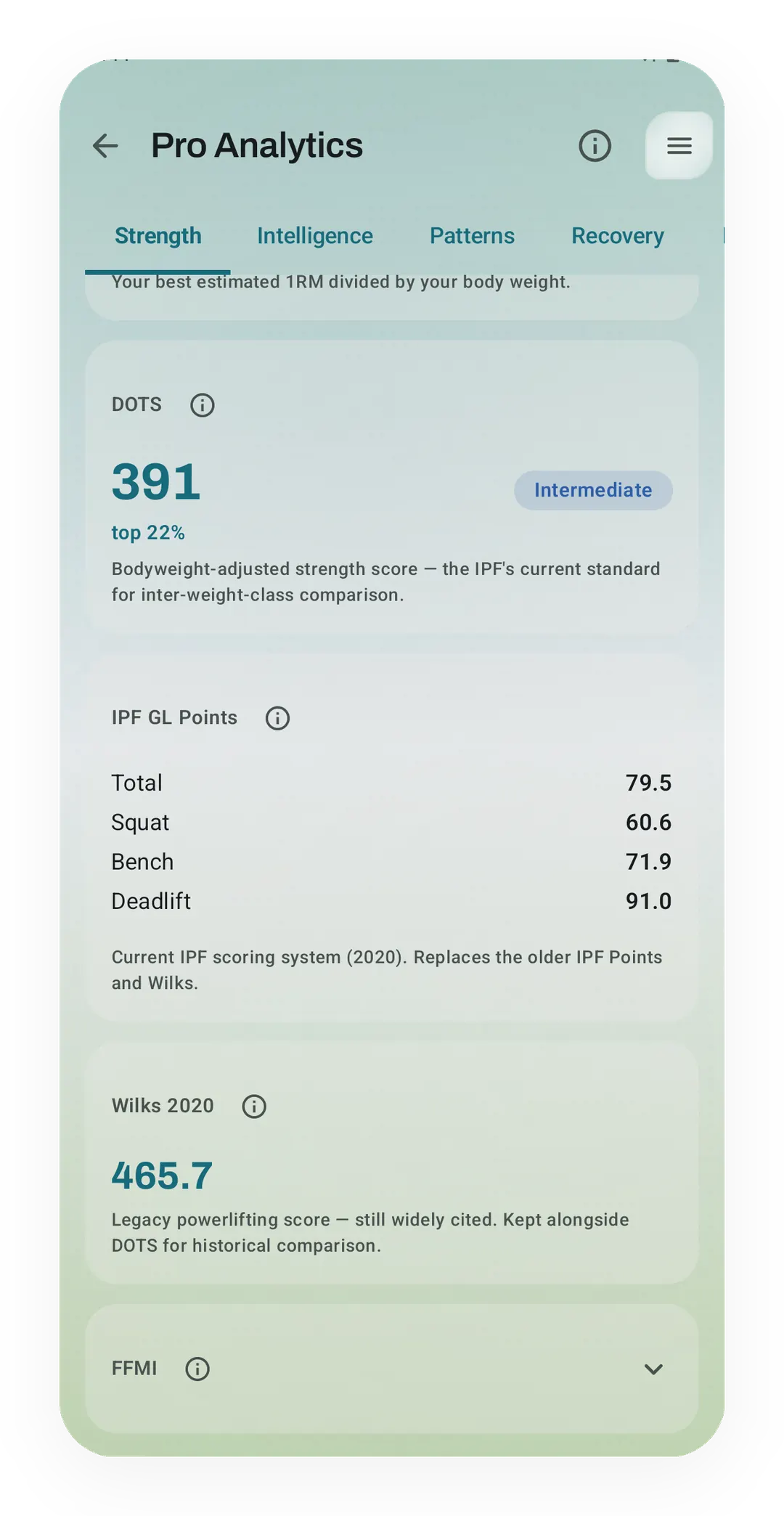
- Strength scores: The Pro Analytics hub shows DOTS, IPF GL, Wilks 2 and FFMI (fat-free mass index), with percentile tables stored on the phone. It adds your best estimated squat, bench press and deadlift, so the score is a training estimate, not a meet result. Free web calculators work out DOTS, IPF GL and Wilks from numbers you type.
- Where it is the better pick: A lifter on Android who runs 5/3/1, GZCLP or nSuns and wants the log kept on their own phone, with no sign-up and no server holding it.
- What Kinoku does not do: It has no meet-day attempt planner and does not plan back from a meet date. It ships no Sheiko, Smolov, Candito or TSA template, and no coach reviews your training. The in-app strength scores and the set changes based on your RIR are Pro. Kinoku runs on Android only, with an iPhone version in progress, and it has no sync between two phones.
StrengthLog
Best for: Lifters who want free IPF and Wilks calculators and programs that end in a peak.
StrengthLog “is a free workout log app for iOS and Android”, with a list of programs you can follow inside it.
- What it does well: Its free version has calculators for your one-rep max (1RM), for “IPF/Wilks Points” and for warm-ups before a new PR. Its powerlifting page lists beginner, intermediate and advanced programs, plus Powerlifting Polka and Powerlifting ABC (an 11-week block), which ends in “three weeks of peaking”.
- What its pages say about limits: “While some of our programs require a premium subscription, StrengthLog is free.” Its listing puts RPE and RIR logging and the full program list in the paid plan. The homepage says only paying users can write programs with “% of 1RM and RPE/RIR”, and that the app “began requiring an account.”
- Where it is the better pick: A lifter who wants IPF and Wilks points worked out in a free app, and a program that ends in a peak and max attempts.
- Where StrengthLog differs: It needs an account so it can keep a copy of your log in the cloud, and the effort fields most powerlifting plans use are paid.
What the three strength scores measure
DOTS, Wilks and IPF GL all divide a lift total by a curve fitted to body weight, so a 60 kg lifter and a 120 kg lifter can sit on the same list. IPF GL is the one the International Powerlifting Federation uses to rank its own meets. DOTS is the one most other federations and most apps mean by a coefficient, and Wilks is the older formula that was revised in 2020.
The numbers only mean as much as the total behind them. A meet total is three lifts done to a judge’s commands, while an app’s total usually comes from training sets. Our explainer on Wilks, DOTS and IPF GL shows the three formulas and when each one fits.
How this list was checked
Every label, cell and answer traces to a page the app publishes or to the code of our own app.
- Public pages: We read each homepage, help page and Google Play listing quoted here on October 18, 2026, and our source check matched every quote against the live page that day.
- Which apps: The list covers Android apps whose own pages describe powerlifting programs, a meet tool or percentage programs. Sheiko Gold has a Google Play listing and an Android link on its homepage, so it is on the list.
- Prices: No price is printed. JuggernautAI’s homepage prints two plan prices, and Sheiko Gold says its pricing varies by country.
- No device test: We did not install the other apps for this page, so every claim about them is a quoted sentence.
- No paid places: No app paid to appear, and the apps run A to Z inside each group.
Frequently asked questions
Which Android app calculates DOTS and IPF GL points?
Intensity’s Play listing names an IPF-GL, Wilks and DOTS calculator, and StrengthLog’s free version lists calculators for IPF and Wilks points. Boostcamp adjusts its own Strength Score with the DOTS formula. Kinoku works out DOTS, IPF GL and Wilks 2 from the lifts you log, inside its Pro Analytics hub, and the free calculators on kinoku.app need no app at all.
Is there a free powerlifting app that works offline?
Kinoku logs your sets and runs its named programs on the phone with no account, and no Kinoku server holds your history. Intensity says it works online and offline, then syncs your sets to its cloud. Boostcamp’s listing prints the word Offline in its tracker list. StrengthLog asks for an account so it can keep a cloud copy of your log.
Which app works out my attempts for a powerlifting meet?
JuggernautAI is the app whose pages name one: its Meet Day Advisor looks at your training in the app to calculate your attempts. Sheiko Gold plans the weeks before a meet from a comp date you set. The other five apps state no attempt planner on the pages we read, and Kinoku does not have one.
Is there an app that builds a peaking block before a meet?
Sheiko Gold runs you through technique, strength and taper blocks once you set a comp date. StrengthLog’s Powerlifting ABC closes with three weeks of peaking, and its advanced programs end in a short peak and max attempts. Boostcamp’s free library holds TSA and Candito blocks, and its Pro plan adds more peaking blocks. Kinoku’s eight-week Strength Peaking template tapers into a test week, with loads you set.
Which app runs Sheiko or Smolov?
Intensity lists Sheiko and Smolov among its 250-plus programs, and Boostcamp lists community-uploaded Sheiko routines next to its Candito and TSA programs. Sheiko Gold is built on Boris Sheiko’s own method and writes each session for you. Kinoku has no Sheiko or Smolov template, though its free program builder lets you lay one out by hand.
Which app writes a powerlifting program for me?
JuggernautAI and Sheiko Gold do, and both charge for it after a free start. JuggernautAI asks about your experience and goals, then designs the program, while Sheiko Gold builds each session from how ready you feel that day. Boostcamp’s Pro plan adds personalized programs built from a short questionnaire. Kinoku, Intensity, KeyLifts and StrengthLog run programs you choose or build.
Can I log RPE and RIR for free in a powerlifting app?
Kinoku logs both RPE and RIR on the free plan. Boostcamp logs RPE for free and shows reps-in-reserve hints in its RPE picker in place of a separate RIR field. StrengthLog puts RPE and RIR logging in its subscription, and Intensity’s listing names RPE logging among its watch features. Kinoku’s RIR-based set adjustment, which changes your next sets from how hard the last ones felt, sits in Pro.
Do I need an account to use these apps?
Kinoku needs none. Boostcamp’s homepage tells you to create an account, and StrengthLog began requiring one so it can keep a cloud copy of your training. Intensity says no account is required, while its FAQ ties your workout data to an account in its cloud. The pages of JuggernautAI, KeyLifts and Sheiko Gold state no account rule.
Which powerlifting apps are free?
Boostcamp’s program library is free, Intensity is free to use with its core features, and StrengthLog and KeyLifts are free with a paid tier above. Kinoku’s named programs, logging and plate math are free, and Pro adds the in-app strength scores and the smart layer. JuggernautAI starts with a two-week trial, and full AI coaching in Sheiko Gold is paid.
What is the difference between DOTS, Wilks and IPF GL?
All three scale a lift total by body weight, so lifters of different sizes can be ranked on one list. IPF GL is the score the International Powerlifting Federation ranks its own meets by. DOTS is the one most other federations and apps use, and Wilks is the older formula, revised in 2020. Our explainer sets the three formulas side by side.
Does Kinoku add up my squat, bench press and deadlift total?
Yes, in Pro. The Pro Analytics hub takes your best estimated one-rep max on each of the three lifts, adds them up, and scores the sum against your body weight. The maxes come from training sets, so the total reads as a training estimate rather than a meet result. Personal records for each lift stay free.
What does Kinoku not do for powerlifting?
Kinoku has no meet-day attempt planner and no plan that counts back from a meet date. It ships no Sheiko, Smolov, Candito or TSA template, and no coach writes or reviews your training. The in-app strength scores and the RIR-based set changes are Pro. Kinoku runs on Android only for now, with no sync between two phones.
Related pages
- Best workout program apps: Apps that run 5/3/1, GZCLP and other periodized programs, next to plain loggers.
- Best 5/3/1 apps for Android: Seven apps compared on how each sets and raises the 5/3/1 training max.
- Which free app runs GZCLP or nSuns on Android?: Five apps that run these two strength programs, and what each does when a lift stalls.
- Free workout trackers with RPE and RIR: Which free plans log effort on every set.
- Wilks vs DOTS vs IPF GL: The three strength scores, their formulas, and when each one fits.
- DOTS score calculator and IPF GL points calculator: Free calculators that score a total against body weight.
- Wilks calculator: The Wilks formula, for reading older records.
- Programs in Kinoku: 5/3/1 Boring But Big, GZCLP, nSuns 5/3/1 LP, Classic 5x5, Greyskull-style LP and PHUL (power hypertrophy upper lower).
Which one fits you
- Choose JuggernautAI if you want a coach-designed plan that adapts to your feedback and works out your meet attempts, and a subscription is fine.
- Choose Sheiko Gold if you want Boris Sheiko's method adjusted to how you feel each day, with the taper set from your comp date.
- Choose Boostcamp if you want Sheiko, Candito or TSA blocks ready to run for free, and an account is fine.
- Choose Intensity if you want Smolov or Sheiko ready to run and a DOTS calculator in the app, with your log synced to its cloud.
- Choose KeyLifts if your meet prep is a percentage program and you want every set's weight worked out before you train.
- Choose Kinoku if you run 5/3/1, GZCLP or nSuns on Android and want the log on your phone with no account.
- Choose StrengthLog if you want free IPF and Wilks calculators in the app and a program that ends in a peak, and an account is fine.
How this page is checked. Every fact about another app on this page comes from a page that app publishes, which we could open and quote on October 18, 2026. The sources, with the exact sentence each fact rests on, are listed just above. Every Kinoku fact is tied to the shipping app's code. The page carries no score; the caption above names the measure the list is ordered by. If a fact here has gone stale, the support page is the fastest way to tell us.
Kinoku in practice
Where this shows up in the app
 Open full-size image ↗
Strength scores from your own lifts
Real Android app capture, Pro tier. The Strength tab of Pro Analytics scores your best estimated squat, bench press and deadlift against your body weight as DOTS, IPF GL and Wilks 2.
One of the apps on this page
Kinoku is free to install
Core tracking works offline, with no account. An export from the app you use today can come along.
Android only for now, with an iPhone version in the works. Some depth is paid, and the pricing page says which parts.
Related features
A 4-phase planning stack. The builder, all 25 templates, named programs with auto-progression, the custom model, and unlimited active programs are free. Pro adds volume targets, readiness tuning, and auto set changes.
DOTS, IPF GoodLift, Wilks 2, and FFMI with offline percentile tables. Published tools widely used in strength sport.
Every set, one tap. Track how hard each set felt, your rest timers, set types, and notes.
Load the bar fast with a visual plate layout. The calculator and bar-weight setting are free; Pro adds custom plate inventory settings.
Warmup sets built from your working weight, bar weight, and unit system.