

PHUL: 4-Day Power Hypertrophy Workout Guide
Kinoku runs Brandon Campbell's 4-day PHUL workout routine for free. Here is the weekly split, progression rules, and how power and hypertrophy combine.
Weekly Training Schedule
These are the sessions the Kinoku template builds when you start it, and the same sessions sit in the file below. The rep counts are each routine's starting targets. For the bench press, barbell row, back squat and deadlift, the template works out the first weights from your one-rep max and moves the weight or reps after each session.
- Bench Press (Barbell)3 x 3
- Bent Over Row (Barbell)3 x 3
- Overhead Press (Barbell)3 x 5
- Lat Pulldown3 x 6
- Bicep Curl (Barbell)3 x 6
- Skullcrushers3 x 6
- Squat (Barbell)3 x 3
- Deadlift (Barbell)3 x 3
- Leg Press3 x 8
- Leg Curl (Lying)3 x 8
- Calf Raise (Standing)4 x 10
- Incline Bench Press (Dumbbell)4 x 12
- Seated Row (Cable)4 x 12
- Chest Flys (Dumbbell)3 x 12
- Lateral Raise (Dumbbell)3 x 15
- Hammer Curl (Dumbbell)3 x 15
- Triceps Pushdown3 x 15
- Front Squat (Barbell)4 x 12
- Romanian Deadlift (Dumbbell)3 x 12
- Leg Extension3 x 15
- Leg Curl (Seated)3 x 15
- Calf Raise (Seated)4 x 15
Ready to lift?
Start PHUL in Kinoku
PHUL is a free template in the app. When you start it there, Kinoku builds the 4 routines and puts 10 weeks on your calendar. It also works out the first weights for the bench press, barbell row, back squat and deadlift from your one-rep maxes.
Any time, from the menu
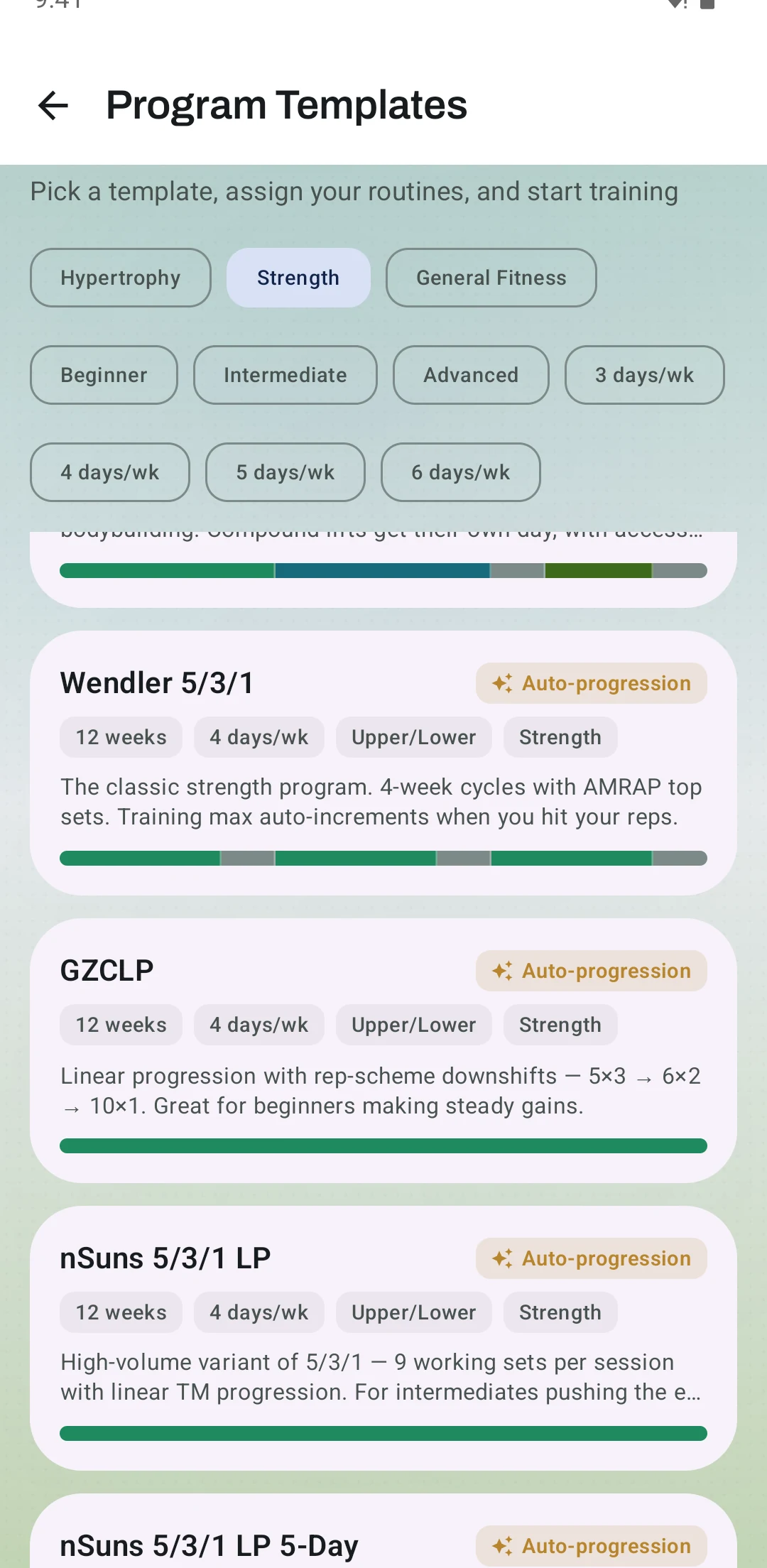
- Open the menu, tap Search Kinoku at the top, type templates and tap Program templates.
- Tap the Strength filter to shorten the list, then tap PHUL and Start This Program.
- Choose a start date, tap Next, and tap Create the program routines so Kinoku builds the routines for you.
- Tap Next, then Activate Program, and enter your one-rep max for each lift it lists before you tap Start program.
On your first launch, from the welcome screen
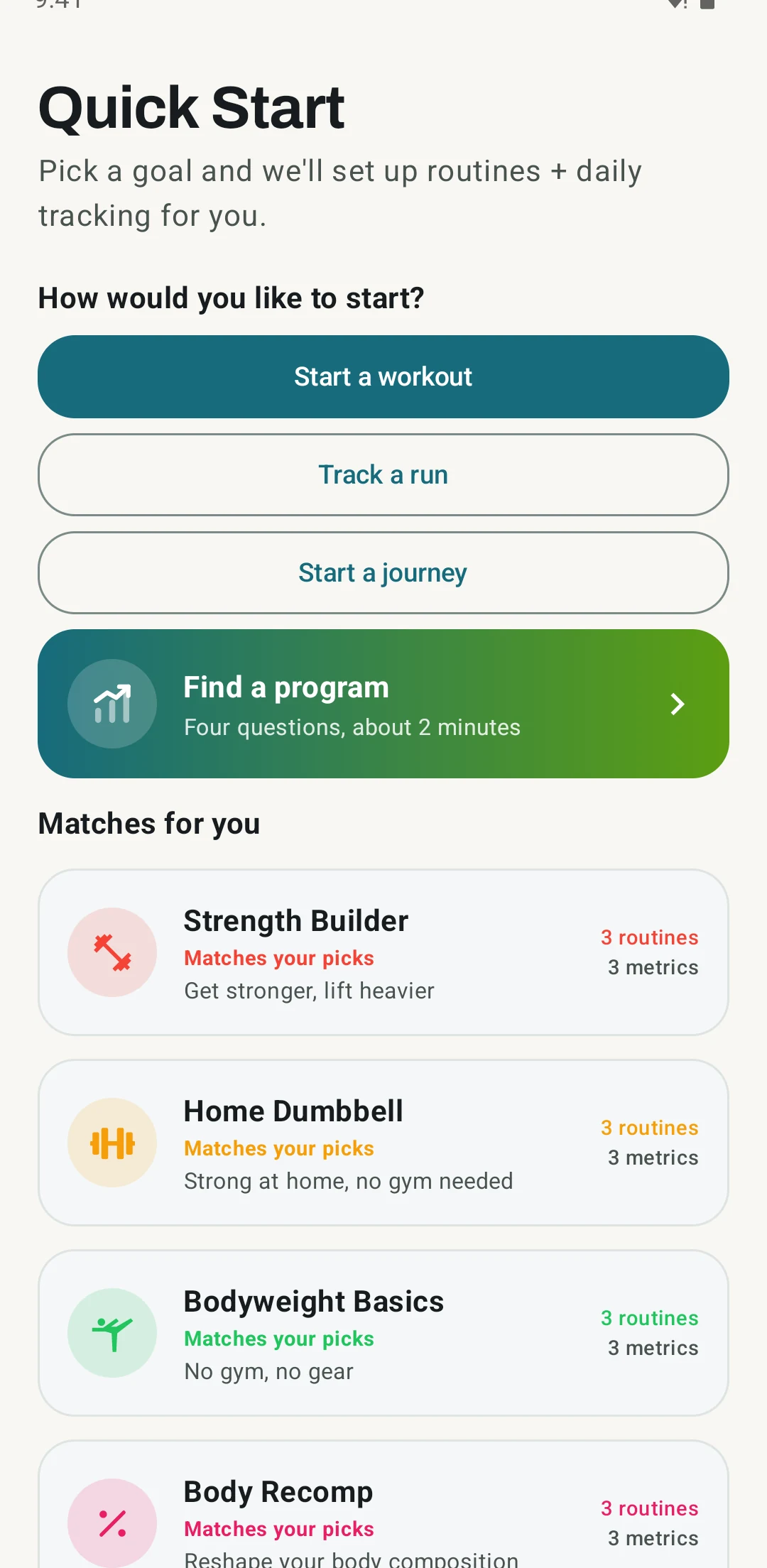
- Pick Strength as a focus, because the finder card only shows for people who lift.
- Tap Find a program on the welcome screen, right under the three start choices.
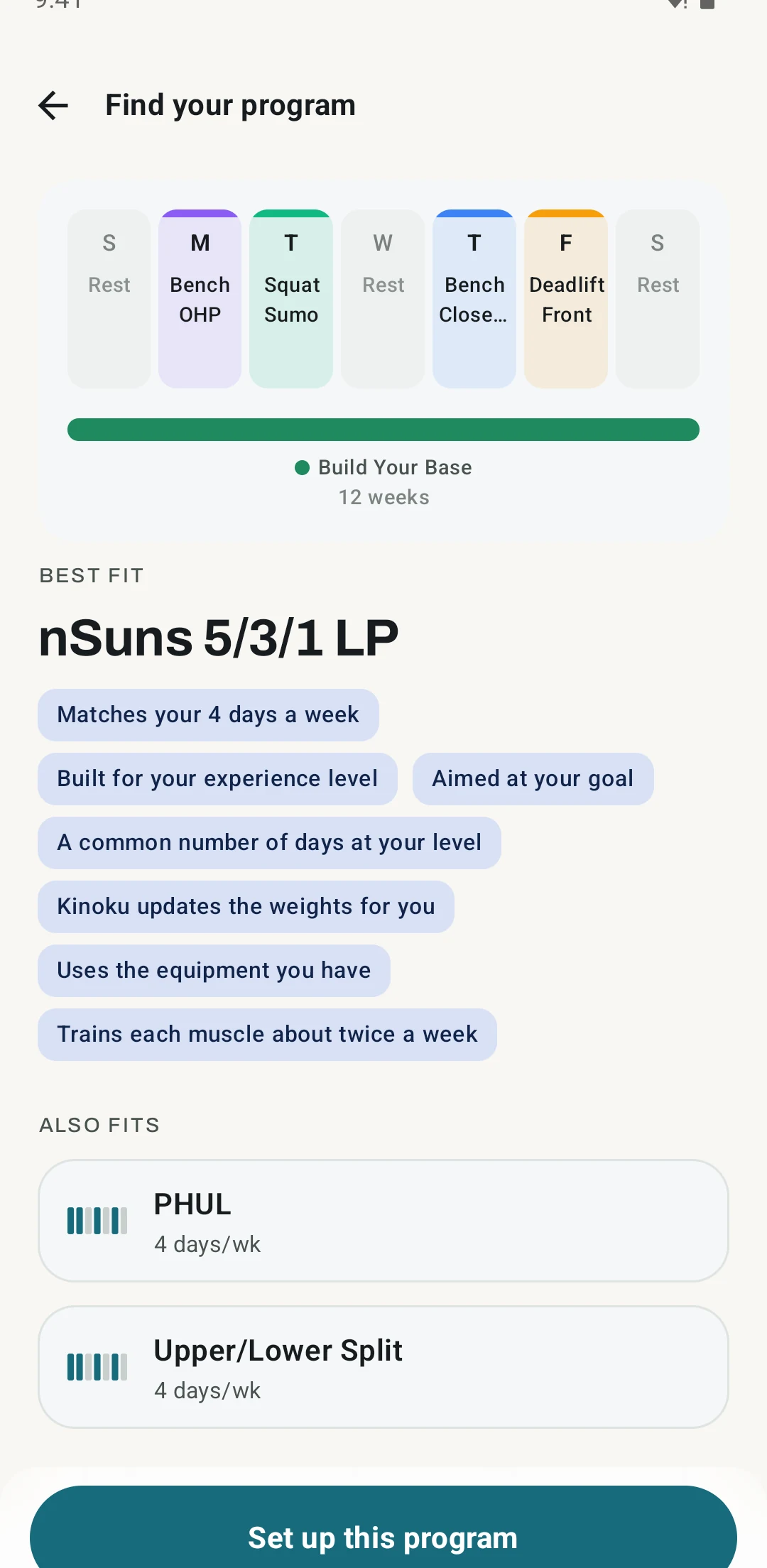
- Answer four questions about your week, and the finder sets up the match for you.
The finder picks the program that fits your answers, so it can suggest a different one, while the menu path above reaches PHUL every time.
Opens the template in the app when Kinoku is installed, and opens Google Play when it is not.
Prefer a file?
Save the file, then open it with Kinoku, and you get 4 routines and a 10-week calendar that starts on the Monday after you download it. No workouts are added to your history, and the file does not work out loads from your one-rep max.
Kinoku in practice
Track this program on your phone
 Open full-size image ↗
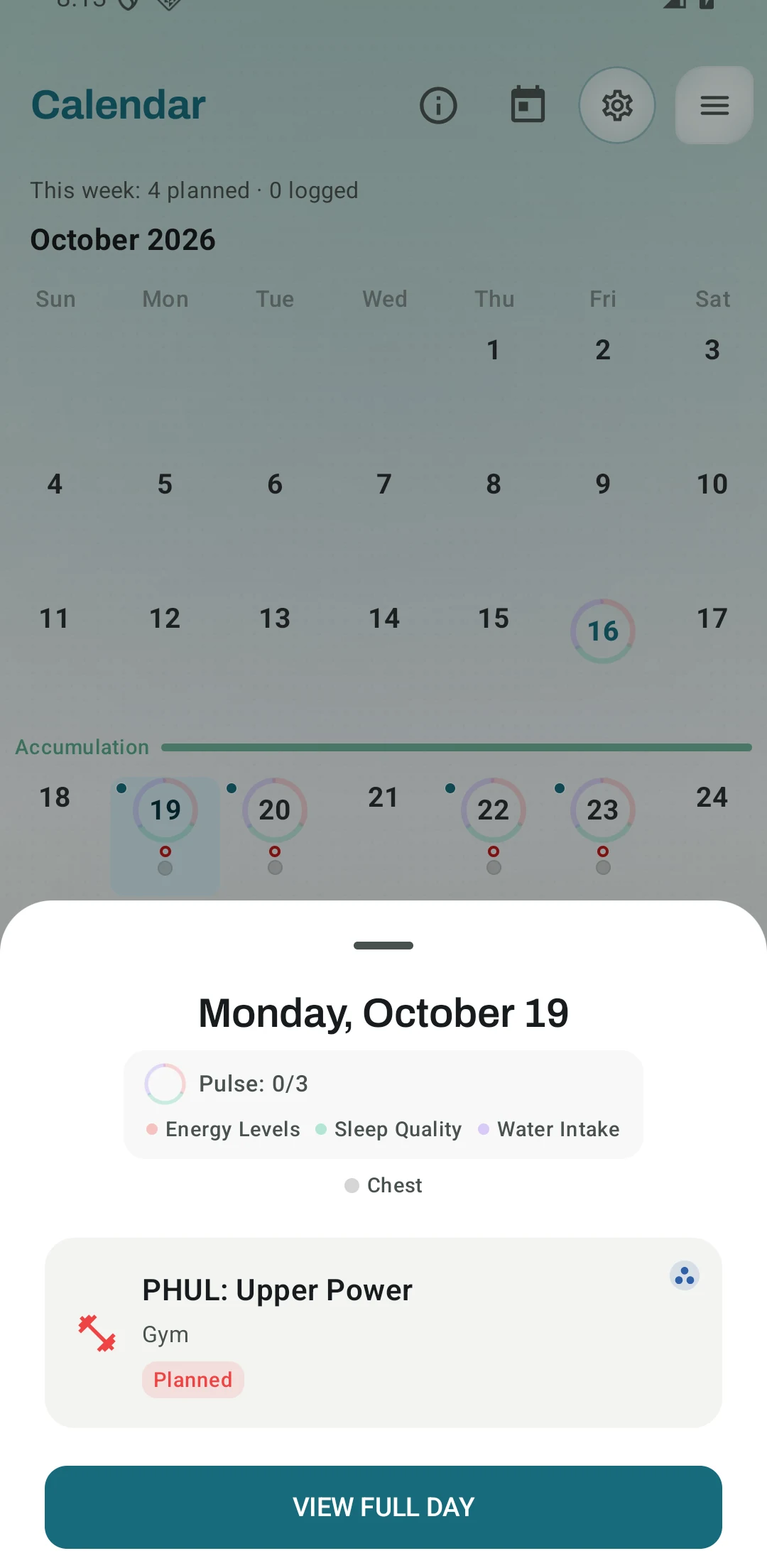
Your weeks land on the calendar
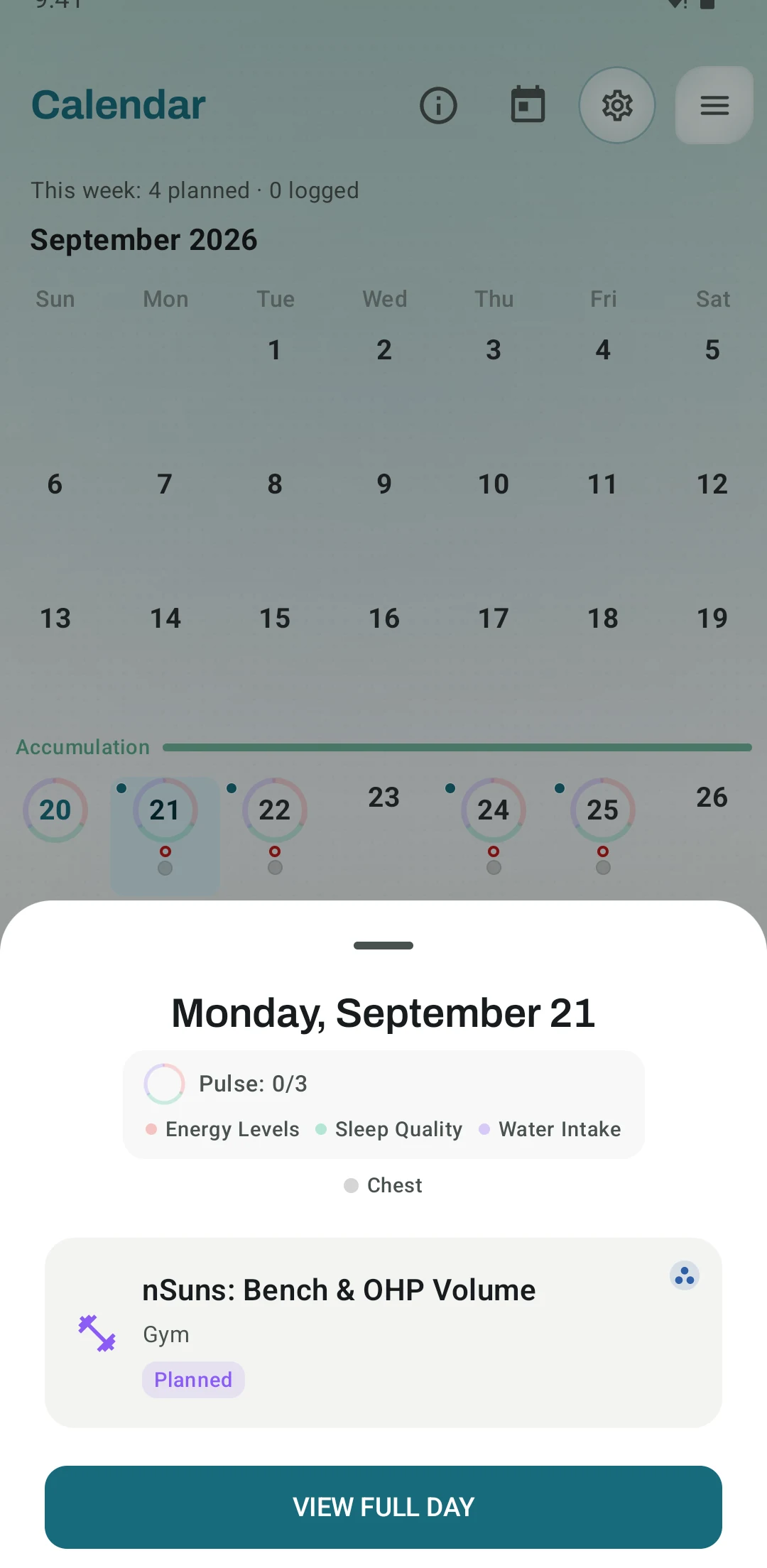
Real Android app capture of PHUL set to start on a Monday. Its four sessions land on Monday, Tuesday, Thursday and Friday, and tapping Monday shows the first one, PHUL: Upper Power.
 Open full-size image ↗
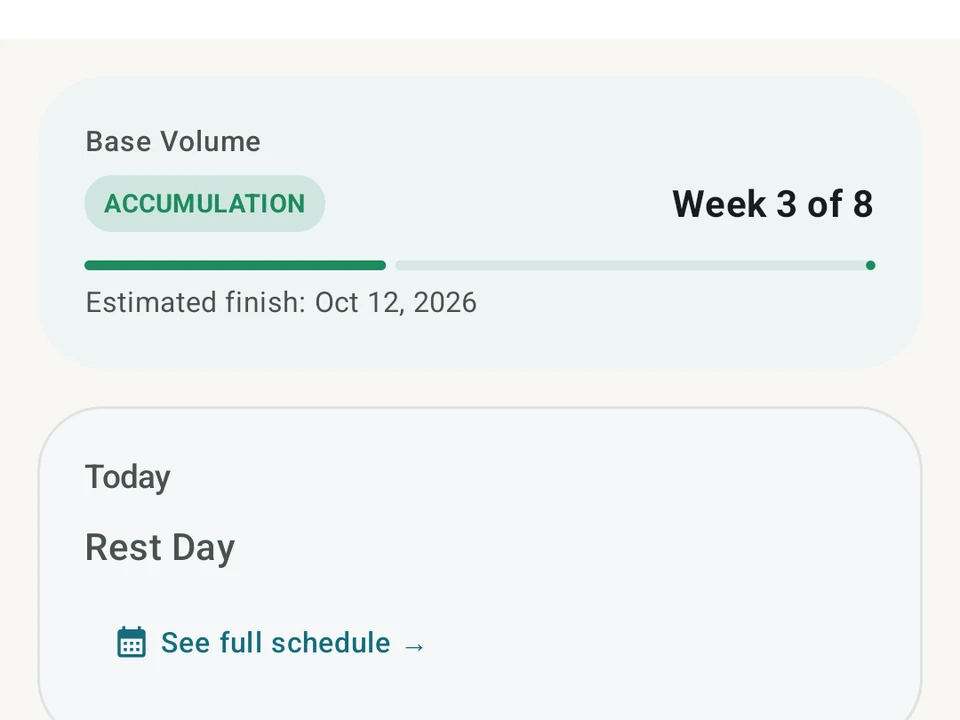
Your week in the program
Real Android app capture of the program dashboard, from an 8-week template. PHUL shows its own phase and week on the same card, out of 10.
PHUL, short for Power Hypertrophy Upper Lower, is a four-day split that Brandon Campbell published on Muscle & Strength in February 2013. Two days a week train heavy for strength and two train lighter for size, and every muscle gets worked on both kinds of day.
How Campbell builds the week
Campbell’s week puts upper power on day 1 and lower power on day 2, then a day off, then upper hypertrophy and lower hypertrophy on days 4 and 5, with the weekend free. The article lists the plan as 12 weeks long and aims it at intermediate lifters.
The power days open with the big barbell lifts for 3 or 4 sets of 3 to 5 reps. The bench press and bent-over row are the heavy lifts of the upper day, and the squat and deadlift lead the lower day, with lighter accessory work around them. The hypertrophy days move to variations such as the incline bench press, the front squat and the seated cable row, at 8 to 12 reps or 10 to 15.
Two notes in the article set the effort. Campbell asks for at least one rep “left in the tank” on every set, so the heavy sets are hard without going to failure. The main compound lifts stay as written, while the other exercises can be swapped for similar ones.
How the weights go up
Campbell gives each exercise a rep range but no fixed weight jump, so the rate of increase is left to the lifter. Kinoku fills that gap with double progression, a method where the weight stays the same while the reps climb to the top of the range, and only then goes up.
What Kinoku works out for you
Kinoku’s PHUL template tracks four lifts on the power days: the bench press, barbell row, back squat and deadlift. You enter a one-rep max for each one, and Kinoku starts the lift at 80 percent of it, a load that leaves room for five reps.
- Three sets that climb from 3 reps to 5. A good session, with every set at its target, adds one rep to the target for next time. After a good session at 5 reps, the weight goes up and the target drops back to 3.
- Jumps that suit the lift. The bench press and row go up 2.5 kg at a time, and the squat and deadlift go up 5 kg. In Program settings, choosing Smaller under Weight jumps halves all four.
- A reset after three misses. The third missed session in a row on a lift takes 10 percent off its weight, and the climb starts again at 3 reps.
Everything else in a PHUL week is yours to load. That covers the overhead press, pulldown and arm work on the upper power day, the leg press, leg curl and calf raise on the lower power day, and both hypertrophy days in full.
Where the app’s version differs
Kinoku runs PHUL for 10 weeks where Campbell lists 12. It splits them into four weeks of power and hypertrophy work, four weeks of strength focus, a deload week and a peak-and-test week. The program dashboard names each phase as you reach it. In the deload week the dashboard shows a lower target volume, but Kinoku does not cut the sets or the weights, so how far to back off is your call.
Campbell’s day lists also run a little longer than the app’s. The upper power day in Kinoku has no incline dumbbell bench press, and the upper hypertrophy day has no one-arm dumbbell row. The lower hypertrophy day uses a dumbbell Romanian deadlift where Campbell has a barbell lunge, with one calf exercise in place of two. Your routines stay editable, so an exercise the app left out can go back in.
If you have six days a week to train, Reddit PPL (push, pull, legs) puts a heavy barbell lift at the top of every session.
Frequently asked questions
What app can track PHUL and set the power-day weights for me?
Kinoku runs Brandon Campbell's PHUL for free on Android. It sets the weights for the bench press, row, squat and deadlift on the power days, where three sets climb from 3 reps to 5 before the weight goes up. The hypertrophy days and the other power-day moves, such as the overhead press and leg press, are yours to load.
How does PHUL balance strength and muscle growth in one week?
The week has two power days and two hypertrophy days, each split into upper and lower body. The power days use heavy compound lifts for 3 to 5 reps. The hypertrophy days use lighter loads for 8 to 15 reps, so every muscle gets both kinds of work each week.
How do the weights go up on the power lifts?
Brandon Campbell's article gives rep ranges but no fixed weight jump. In Kinoku, the bench press, barbell row, squat and deadlift each run three sets that climb from 3 reps to 5, one rep per good session. The weight then rises by 2.5 kg on the bench press and row and 5 kg on the squat and deadlift. After that jump, the reps start again at 3.
Does Kinoku lighten the deload week?
No. The program dashboard labels week 9 as a deload and shows a lower target volume, but Kinoku does not cut your sets or weights that week. How much to back off is your call.
Can I adjust accessory exercises in Kinoku?
Yes. Campbell keeps the main compound lifts fixed and allows swaps for similar exercises in the rest of the plan. Your routines in Kinoku can be edited the same way. Kinoku sets weights only for the four power lifts it tracks, so you pick the load for everything else.
Calculators & tools
Compare Epley and Brzycki estimates, then print percentage and rep-max charts in kilograms or pounds.
A strength score that adjusts for your sex and weight. Written for the German federation in 2019, now the cross-federation standard.
What a push-up, pull-up, dip or squat really lifts. Hundreds of exercises, each one labelled measured or estimated.
Track this in the app
Run PHUL in Kinoku
Kinoku works out the weights and the jumps for the lifts it tracks, offline on your phone.
100% free with no mandatory account and no cloud tracking.
Related app features
A 4-phase planning stack. The builder, all 25 templates, named programs with auto-progression, the custom model, and unlimited active programs are free. Pro adds volume targets, readiness tuning, and auto set changes.
Unlimited routines, Smart Sync, Starter Packs, and follow-along links are free, and so are Rotation Groups that cycle through several routines for you.
Every set, one tap. Track how hard each set felt, your rest timers, set types, and notes.
Load the bar fast with a visual plate layout. The calculator and bar-weight setting are free; Pro adds custom plate inventory settings.