

Wilks vs DOTS vs IPF GL: Which Strength Score to Use
Three scores rate a powerlifting total against body weight. Which one to watch depends on where you lift. Here is the choice, with the numbers Kinoku uses.
Kinoku in practice
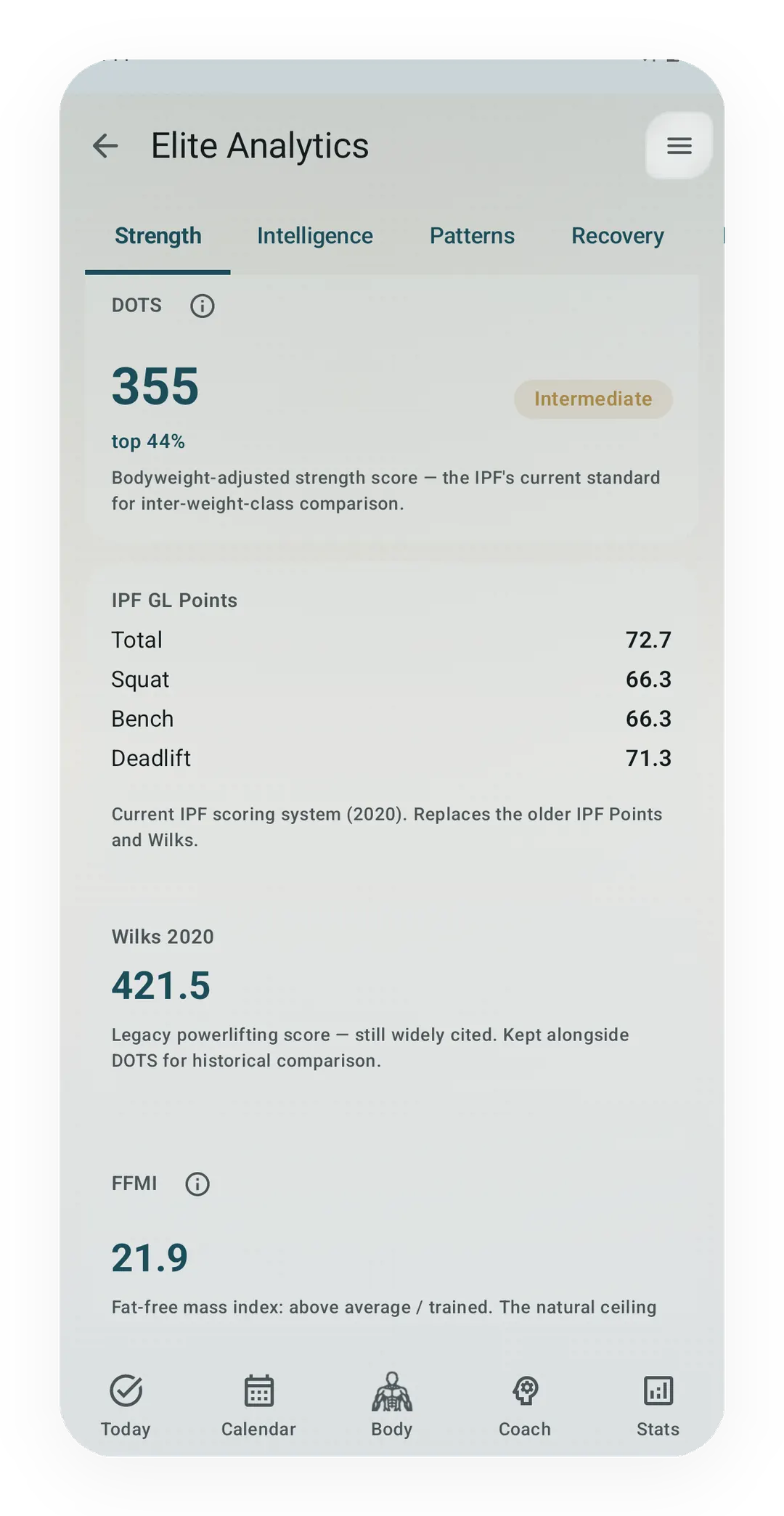
Where this shows up in the app
 Open full-size image ↗
One total, three scores
The Strength Scores surface prints Wilks 2, DOTS, and IPF GL from the same lifts and the same body weight, so the three can be read against each other.
Quickstart
DOTS (a formula that scores lifting strength across body weights) is the score to watch when you want to compare yourself with lifters of other sizes. The International Powerlifting Federation (IPF) ranks its own meets in IPF GoodLift (GL) points instead, and Wilks now mostly serves for reading old records. All three turn one total into one number, and Kinoku computes all three from your logged lifts, with its five strength bands set on DOTS.
If you want the score without the app, the DOTS, IPF GL, and Wilks calculators run the same math in your browser.
What each score measures
All three answer one question, which is how strong a total is for a lifter of this size and sex. Each one fits a curve to meet results and then reads a body weight bonus off that curve, so the curve is where they differ.
Wilks came first, in 1994, when Robert Wilks fitted one curve to the meet data of the day. He refit it in 2020, and that version is Wilks 2. The Wilks page covers both.
DOTS arrived in 2019, written by Tim Konertz for the German federation. The old Wilks curve read too kind at the heavy end and too harsh at the light end, and DOTS fixed most of that. Most federations outside the IPF rank in DOTS now, and the DOTS page has the band table and the percentiles.
IPF GL is the federation’s own score, in use since 1 May 2020, and it splits the sport by event. Raw and equipped get their own curves, and so do the three-lift total and the bench-only meet. The IPF GL page has the coefficients.
Side by side
The three scores on one grid, from the year each one was fitted to the gap each one leaves.
| Wilks 2 | DOTS | IPF GL | |
|---|---|---|---|
| Year | 2020 refit of a 1994 curve | 2019 | 2020 |
| Curve | Fifth-degree polynomial, numerator 600 | Fourth-degree polynomial, numerator 500 | Exponential, numerator 100 |
| Typical range | 300 to 600 | 300 to 600 | 50 to 100 |
| Events | One curve for all raw lifting | One curve for all raw lifting | Separate curves for raw, equipped, total, and bench |
| Who ranks in it | Some federations, and old records | Most federations outside the IPF | IPF meets and IPF rankings |
| Blind spot | Old version is kind to heavy lifters | No official bands exist | No squat-only or deadlift-only row |
The scores do not convert into each other, because each was fitted to its own pool of lifters, so there is no clean formula between them.
Which one Kinoku shows you, and where
Kinoku prints all three from the same lifts, and here is what the app does with each, as of September 2026.
- DOTS uses the OpenPowerlifting coefficients with the 500 numerator. Body weight is clamped to the fitted range before scoring: 40 to 210 kg for men, 40 to 150 kg for women. The five strength bands in the app read off DOTS, with Novice starting at 200, Intermediate at 300, Advanced at 400, and Elite at 500.
- IPF GL uses the 2020 raw classic rows, and the federation publishes rows for the three-lift total and the bench only. The app’s IPF GL card also shows a squat and a deadlift figure under the same heading, and those two are our estimates on the IPF curve shape rather than IPF scores.
- Wilks 2 uses the 2020 coefficients with the 600 numerator. Body weight is clamped to 40 to 200.95 kg for men and 40 to 150.95 kg for women, which matches the OpenPowerlifting implementation. The app does not compute the 1994 version, though the web Wilks calculator does, for old records.
- The percentiles next to your DOTS come from a reference file shipped inside the app, built from OpenPowerlifting raw classic totals, 2020 to 2024, in tested federations. The full tables are on the strength standards by body weight page.
Two limits are worth stating plainly. The app does not apply age factors, so a masters lifter reads the raw score only. And the reference group is people who enter meets, so any score ranks higher against gym lifters than the table says.
When to use which
Where you lift decides the score, and these are the four situations lifters run into most.
- If you compete in IPF meets, watch IPF GL, because it is the number that sets your ranking there.
- If you lift in another federation, or you do not compete, watch DOTS, which is the score most apps, spreadsheets, and federations mean when they say “coefficient”.
- If you are checking a record from before 2020, use the Wilks version that record was set in, since federation records from the 1990s to the mid-2010s are stored in Wilks 1 points.
- If your federation still posts Wilks, watch Wilks 2 alongside DOTS, which feel familiar side by side because they share a range.
Whichever you pick, read it against your own past scores first. A strength score is slow to move, so a couple of strong weeks barely register, and progress week by week shows up better in each lift on its own.
Track this in Kinoku
The Strength Standards feature works out DOTS, IPF GL, and Wilks 2 from your own training log, with the reference tables shipped in the app, and it is part of Pro Analytics. Your lift history and stats are on the free plan, and they are what the scores are read from.
The three web calculators are free and need no install. They share a test fixture with the app, so the coefficients on the site and in the app are held to the same reference values.
References
Track this in the app
Strength Standards
DOTS, IPF GoodLift, Wilks 2, and FFMI with offline percentile tables. Published tools widely used in strength sport.
Core tracking works offline, with no mandatory account.
Related features
DOTS, IPF GoodLift, Wilks 2, and FFMI with offline percentile tables. Published tools widely used in strength sport.
A Pro hub with five core tabs, plus a Cycle tab when cycle tracking is on. Its 20+ features include strength scores like DOTS, IPF GL, Wilks, and FFMI, the Banister Form Band, plateau alerts, ACWR, muscle balance, and cycle links.
Charts per exercise, PRs, your best one-rep estimate, volume trends, and date filters. Every exercise type gets a chart that fits it: Best, Total, and Avg Time for holds, Best and Total Reps for rep work, and Best and Total Distance for distance work, not just weight charts.