

The Wilks Score Explained
Wilks ran powerlifting from 1994 to 2020. What the two versions do, what a good Wilks score looks like, and when you still want the old one.
Kinoku in practice
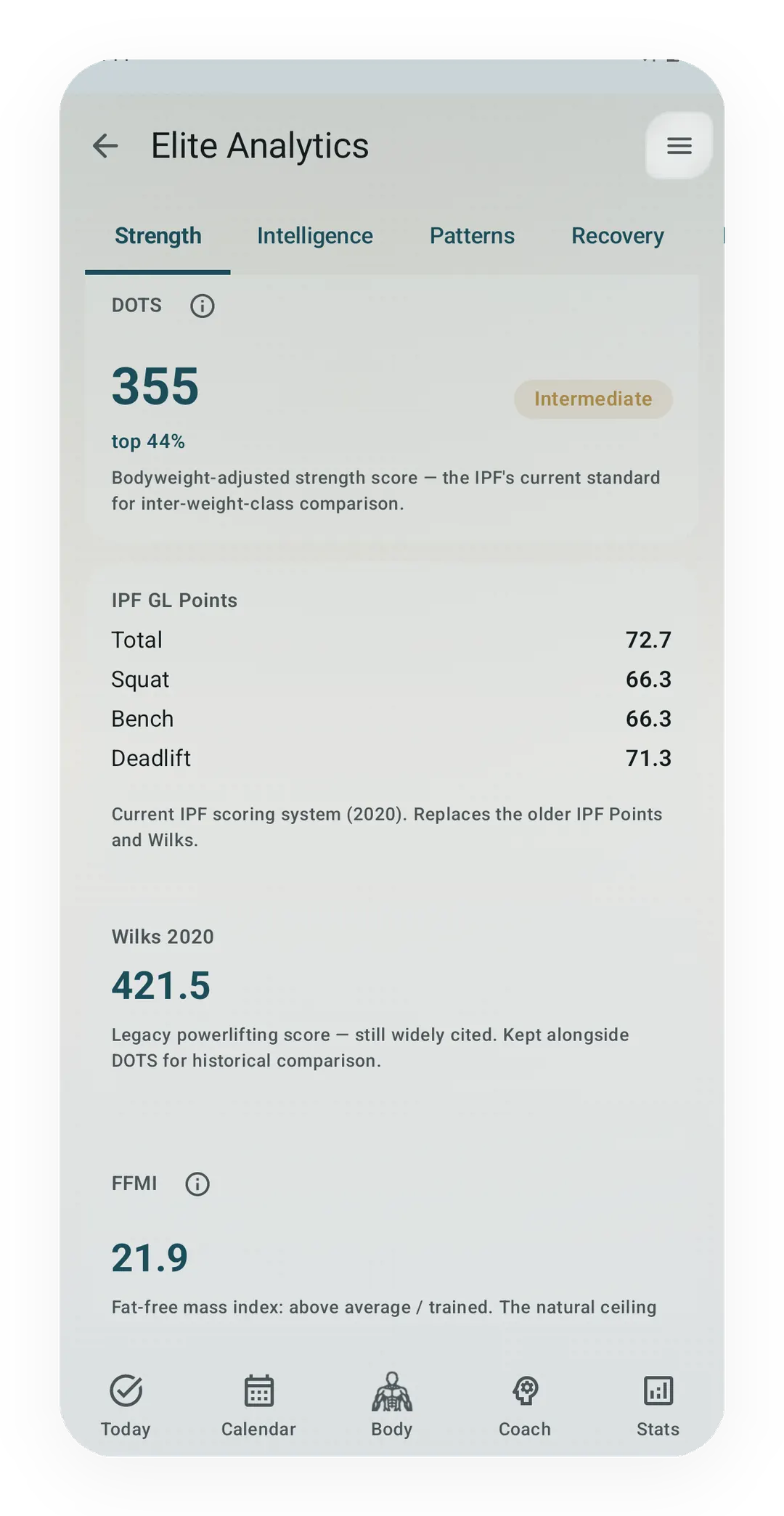
Where this shows up in the app
 Open full-size image ↗
Wilks beside modern alternatives
The Strength Scores surface lets Wilks be read next to DOTS and IPF GL using the same visible inputs.
Quickstart
Wilks scores a powerlifting total against body weight, so lifters of different sizes can be compared on one scale. It ran the sport from 1994 to about 2020, and most federations now rank with two newer scores instead. One is DOTS (the open cross-federation strength score), and the other is IPF GL (the International Powerlifting Federation’s Goodlift score). Wilks stays useful for reading old records that were written in it.
Rough bands for a raw male lifter, untested:
- Wilks 250: a year or so of steady training
- Wilks 300: solid. Ahead of most people in the gym
- Wilks 400: advanced
- Wilks 500: elite
Women’s Wilks lands on the same scale by design, because the formula uses different numbers for each sex so the bands mean the same thing.
The Wilks calculator here runs both versions side by side.
What problem did Wilks solve?
Before Wilks, comparing lifters across weight classes was guesswork, because different federations used different charts that disagreed with each other.
Robert Wilks fitted one curve to meet results in 1994, and it gave every body weight a multiplier. Multiply your total by that multiplier and you get a number you can line up against anyone else’s.
The idea is simple, and it held up for 25 years, so Wilks became the default in gyms, in spreadsheets, and in every federation that ranked lifters at all.
How is Wilks calculated?
Wilks runs body weight x, in kilograms, through a fifth-degree curve to get a coefficient, then multiplies your total by it. Wilks 1 (1994) puts 500 on top of the fraction; Wilks 2 (2020) puts 600. The six values A through F change with the version and with sex. All four sets are printed on the calculator page.
Wilks 1 (1994):  coefficient = 500 / (A + B·x + C·x² + D·x³ + E·x⁴ + F·x⁵)
Wilks 2 (2020):  coefficient = 600 / (A + B·x + C·x² + D·x³ + E·x⁴ + F·x⁵)
Wilks = total × coefficient
A fifth-degree curve just means the formula uses body weight raised to five powers, which gives it enough flex to bend the right way across the whole weight range instead of drawing a straight line.
What is the difference between Wilks 1 and Wilks 2?
Wilks 1 is the 1994 curve, and Wilks 2 is the 2020 refit that federations mean today when they say Wilks.
The 1994 curve read a little off at the edges, so it was kind to very heavy lifters and hard on very light ones. That bias was measured and published as early as 1999.
Robert Wilks refit the curve in 2020 on a bigger and newer pool of results, and that refit is Wilks 2.
For a mid-weight lifter the two versions land close together, but the gap opens at the ends of the scale. If you weigh 55 kg or 145 kg, the version you use changes your number by a visible margin.
| Wilks 1 (1994) | Wilks 2 (2020) | |
|---|---|---|
| Fitted on | Meet data up to the early 1990s | A larger, newer pool |
| Bias | Generous over ~140 kg, harsh under ~53 kg | Flatter across the range |
| Where you see it | Records set 1994 to about 2020 | Current federation rankings that still use Wilks |
When should I still use Wilks?
Two situations still call for Wilks rather than a newer score.
Old records. Federation records from the 1990s through the mid-2010s are stored in Wilks 1 points, so if you want to know how your total lines up against a 2004 record, Wilks 1 is the score that record was written in. Anything else is comparing two different scales.
Federations that never moved. Not everyone switched, so some organisations still post Wilks 2 as their ranking score, and some post it next to DOTS.
For everything else, DOTS is the score most of the sport reads now, because it was fitted on cleaner data and behaves better at the light and heavy ends.
What is a good Wilks score?
Wilks 300 is solid and ahead of most people in the gym. Wilks 400 is advanced, top of most gyms. Wilks 450 is elite, a local or state meet contender, and 500 is regional or national level. Wilks 250 is about a year of steady training. These are loose bands for raw, untested lifting.
| Wilks | What it usually means |
|---|---|
| 200 | Beginner. Just starting a real program |
| 250 | Novice. Six to twelve months in |
| 300 | Intermediate. A few years of steady gains |
| 350 | Upper intermediate |
| 400 | Advanced. Top of most gyms |
| 450 | Elite. Local or state meet contender |
| 500 | Regional or national level |
| 550+ | National or international, tested raw |
Two cautions matter when you read these bands.
The charts mix tested and untested lifting, so a 500 in a strict tested division is a harder number than a 500 in an open one, even though the score is the same.
And a meet total is not a gym total. A meet lift is judged, with depth calls and pause commands, while a gym personal record (PR) with a friendly spot is still yours and simply a different measurement.
Which is better: Wilks, DOTS, or IPF GL?
All three ask how strong you are for your size, and they differ in what they were fitted to and who uses them.
- Wilks ran the sport from 1994 to 2020. Best for reading old records.
- DOTS is the open cross-federation standard now. Same 300 to 600 range as Wilks, so the two feel familiar side by side.
- IPF GL is the IPF’s own score. It runs 50 to 100 and splits by event.
You cannot convert cleanly between them, because each was fitted on its own pool of lifters.
The decision guide, Wilks vs DOTS vs IPF GL, lays the three out side by side and says which one to watch for where you lift.
Track this in Kinoku
The Strength Standards feature scores Wilks 2 from your training log, next to DOTS, IPF GL, and FFMI (fat-free mass index). The app sticks to Wilks 2, since that is the version federations rank in today.
Wilks 1 lives on the web Wilks calculator so you can look up the older records without installing anything. Both run offline, and neither sends your numbers anywhere.
The percentile rows behind every DOTS band are on Strength standards by body weight.
References
Track this in the app
Strength Standards
DOTS, IPF GoodLift, Wilks 2, and FFMI with offline percentile tables. Published tools widely used in strength sport.
Core tracking works offline, with no mandatory account.
Related features
DOTS, IPF GoodLift, Wilks 2, and FFMI with offline percentile tables. Published tools widely used in strength sport.
A Pro hub with five core tabs, plus a Cycle tab when cycle tracking is on. Its 20+ features include strength scores like DOTS, IPF GL, Wilks, and FFMI, the Banister Form Band, plateau alerts, ACWR, muscle balance, and cycle links.
Charts per exercise, PRs, your best one-rep estimate, volume trends, and date filters. Every exercise type gets a chart that fits it: Best, Total, and Avg Time for holds, Best and Total Reps for rep work, and Best and Total Distance for distance work, not just weight charts.