

IPF GoodLift Points Explained
GL Points is the score the IPF has used to rank lifters since 2020. What the formula does, how to read your number, and where it parts ways with DOTS.
Kinoku in practice
Where this shows up in the app
 Open full-size image ↗
IPF GL in context
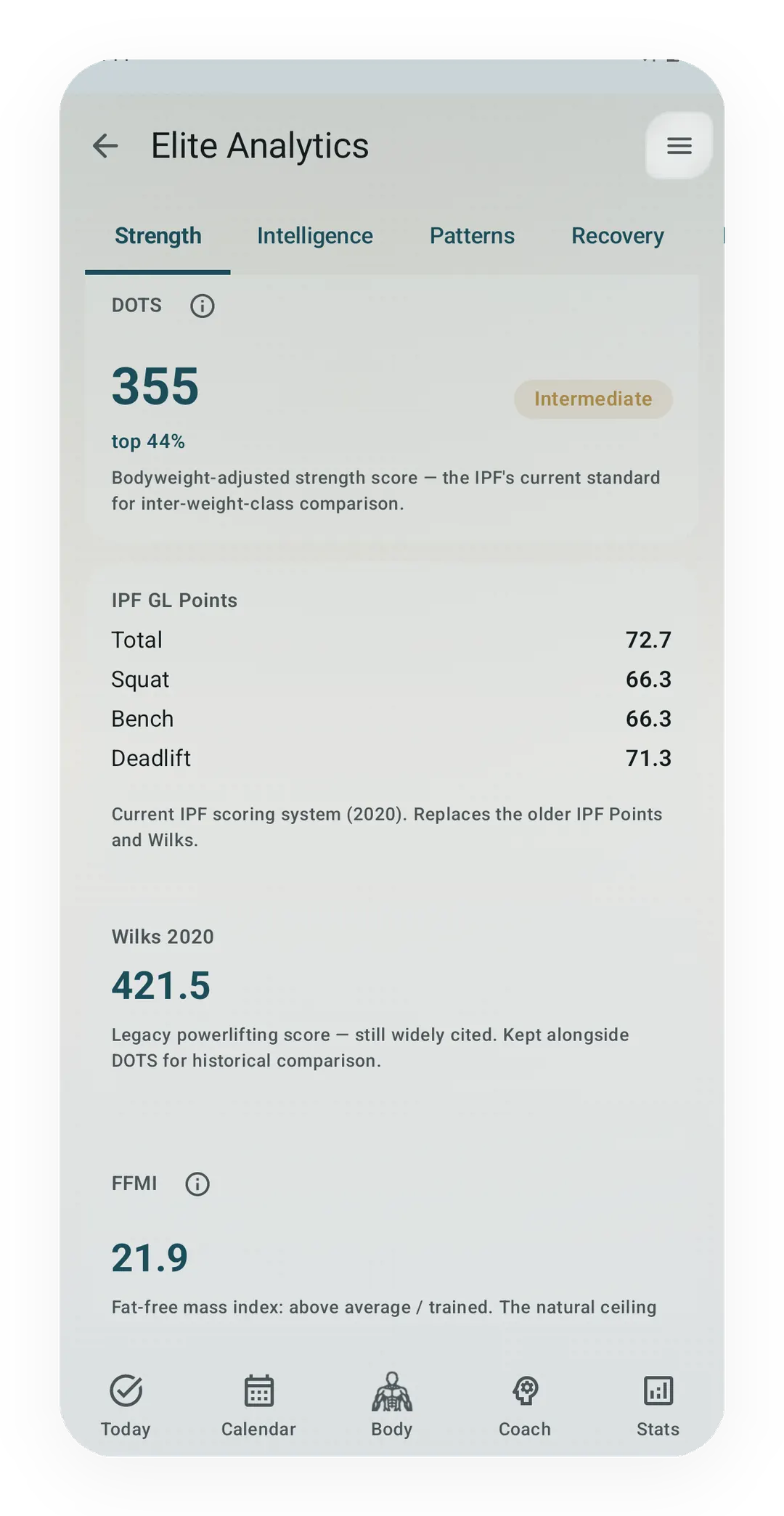
The Strength Scores view shows IPF GL alongside the bodyweight and lift data used to calculate it.
Quickstart
GL Points, or GoodLift, is the International Powerlifting Federation (IPF) score for a powerlifting total against your body weight and sex. The formula is scaled so that 100 sits near the top of the sport, though real records run past it. The IPF has used it to rank its own meets since 1 May 2020, where higher is stronger.
Rough bands for the raw classic three-lift event:
- 55 to 70: regional meets and strong club lifters
- 70 to 85: national level
- 85 to 100: elite international
- Over 100: world class. Agata Sitko scored 124.40, Gustav Hedlund 117.27
You can run your own total through the IPF GL calculator, which reads the same IPF coefficients the app does, and a shared test fixture holds both to the IPF’s own worked examples.
Why did the IPF build its own score?
Every strength score is trying to solve the same problem. A 60 kg lifter and a 120 kg lifter cannot be compared on raw total alone, so you need a curve that levels the field.
DOTS (a strength score that levels body weights) does that job well, and most of the sport uses it. The IPF wanted something tuned to its own meets, so in 2020 it moved its rankings to GoodLift.
The difference is what the curve was fitted to: DOTS is one open curve for all raw lifting, while GL splits the sport into separate events and fits each one on its own:
- Raw lifting gets one set of numbers. Equipped lifting, with squat suits and bench shirts, gets another.
- The classic three-lift total gets one set. Bench-only meets get their own. The IPF publishes no squat-only or deadlift-only row.
So a bench-only GL and a full-total GL are not the same scale, but separate scores that happen to share a name.
How are IPF GL points calculated?
GL uses a different shape than DOTS: where DOTS runs body weight through a long polynomial, GL uses a curve that flattens out as body weight rises. The values A, B, and C in it change with sex and event:
GL Points = 100 × total / (A − B × e^(−C × bodyweight_kg))The e is the natural exponential, so in plain terms the bottom of the fraction grows fast at light body weights and then levels off. That bottom is the body-weight allowance, so past a point, weighing more does less to explain lifting more.
For the classic (raw) three-lift total the values are:
Male:    A = 1199.72839   B = 1025.18162   C = 0.00921
Female:  A =  610.32796   B = 1045.59282   C = 0.03048
Watch the row you copy, because the equipped numbers sit directly above these in the IPF table and look almost identical:
Male:    A = 1236.25115   B = 1449.21864   C = 0.01644   <- EQUIPPED, not raw
Female:  A =  758.63878   B =  949.31382   C = 0.02435   <- EQUIPPED, not raw
Using the equipped pair for a raw lifter understates the score by about 17%, and this page shipped exactly that mistake until August 2026.
The 100 on top is a scaling choice that puts world-record lifts near 100 instead of near 1.
How do I read my IPF GL points?
On the raw classic three-lift total, 55 to 70 is regional or strong club, 70 to 85 is national level, 85 to 100 is elite international, and over 100 is world class. The IPF publishes coefficients, not bands, so the ladder below is our reading rather than a standard, anchored on real results: Sitko 124.40 and Hedlund 117.27 on the classic raw total.
| GL Points | What it usually means |
|---|---|
| Under 40 | Early days. The score climbs fast at this stage |
| 40 to 55 | Intermediate. A year or two of steady work |
| 55 to 70 | Regional or strong club |
| 70 to 85 | National level |
| 85 to 100 | Elite international |
| 100 to 110 | World class |
| Over 110 | World-record territory |
One thing is worth knowing: IPF divisions are drug tested, and the bands above are drawn from tested lifting. A GL of 80 in a tested meet and a GL of 80 in an untested one are not the same achievement, even though the number matches.
What is the difference between IPF GL and DOTS?
The two answer the same question and disagree on the details.
| DOTS | IPF GL | |
|---|---|---|
| Who uses it | Most federations, apps, spreadsheets | IPF meets and rankings |
| Curve | Fourth-degree polynomial | Exponential |
| Events | One curve for raw lifting | Separate curves per event |
| Typical range | 300 to 600 | 50 to 100 |
| Since | 2019 | 2020 |
A score in one does not convert to a score in the other, and there is no clean formula between them, because they were fitted to different pools.
Which one to watch depends on where you lift. If you compete in IPF meets, GL is the number that sets your ranking, and if you track gym lifts or compare with friends across federations, DOTS is the score most people mean. The Wilks vs DOTS vs IPF GL guide puts all three next to each other.
What does IPF GL not tell you?
It does not track short-term progress. GL moves only when your total moves, so two good weeks barely shift it. For week-to-week progress, watch each lift on its own.
It does not know your body type. Body weight is the only body number in the formula, so two lifters at the same weight can be built very differently.
It does not know your event. If you enter a bench-only total into a classic-total calculator, the number will look wrong, because the curve behind it was fitted to three lifts.
Track this in Kinoku
The Strength Standards feature works out GL Points from your own training log. It sits next to DOTS, Wilks 2, and FFMI (fat-free mass index), so you can read one total four ways. The scores run on your device, with the parameter tables shipped inside the app.
The Pro Analytics Strength tab puts those scores next to your PR (personal-record) timeline and your compound lift ratios.
You can also use the IPF GL calculator here on the site without installing anything, for the same numbers and the same result.
The DOTS rows from real meets sit on Strength standards by body weight.
References
Track this in the app
Strength Standards
DOTS, IPF GoodLift, Wilks 2, and FFMI with offline percentile tables. Published tools widely used in strength sport.
Core tracking works offline, with no mandatory account.
Related features
DOTS, IPF GoodLift, Wilks 2, and FFMI with offline percentile tables. Published tools widely used in strength sport.
A Pro hub with five core tabs, plus a Cycle tab when cycle tracking is on. Its 20+ features include strength scores like DOTS, IPF GL, Wilks, and FFMI, the Banister Form Band, plateau alerts, ACWR, muscle balance, and cycle links.
Charts per exercise, PRs, your best one-rep estimate, volume trends, and date filters. Every exercise type gets a chart that fits it: Best, Total, and Avg Time for holds, Best and Total Reps for rep work, and Best and Total Distance for distance work, not just weight charts.