

Phrak's Greyskull LP: Free 3-Day App Template
Kinoku runs a free Greyskull-style plan based on Phrak's variant: a last set taken past five, a double jump at 10 reps, and a 10 percent cut after a miss.
Weekly Training Schedule
These are the sessions the Kinoku template builds when you start it, and the same sessions sit in the file below. The program has two different weeks, which take turns until the plan ends. The rep counts are each routine's starting targets. For the overhead press, back squat, bench press, barbell row and deadlift, the template works out the first weights from your one-rep max and moves the weight or reps after each session. The chin-up starts with no added weight.
Weeks 1, 3, 5, 7, 9 and 11
- Overhead Press (Barbell)3 x 5
- Chin-Up3 x 5
- Squat (Barbell)3 x 5
- Bench Press (Barbell)3 x 5
- Bent Over Row (Barbell)3 x 5
- Deadlift (Barbell)1 x 5
- Overhead Press (Barbell)3 x 5
- Chin-Up3 x 5
- Squat (Barbell)3 x 5
Weeks 2, 4, 6, 8, 10 and 12
- Bench Press (Barbell)3 x 5
- Bent Over Row (Barbell)3 x 5
- Deadlift (Barbell)1 x 5
- Overhead Press (Barbell)3 x 5
- Chin-Up3 x 5
- Squat (Barbell)3 x 5
- Bench Press (Barbell)3 x 5
- Bent Over Row (Barbell)3 x 5
- Deadlift (Barbell)1 x 5
Ready to lift?
Start Greyskull-style LP in Kinoku
Greyskull-style LP is a free template in the app. When you start it there, Kinoku builds the 2 routines and puts 12 weeks on your calendar. It also works out the first weights for the overhead press, back squat, bench press, barbell row and deadlift from your one-rep maxes. The chin-up starts with no added weight.
Any time, from the menu
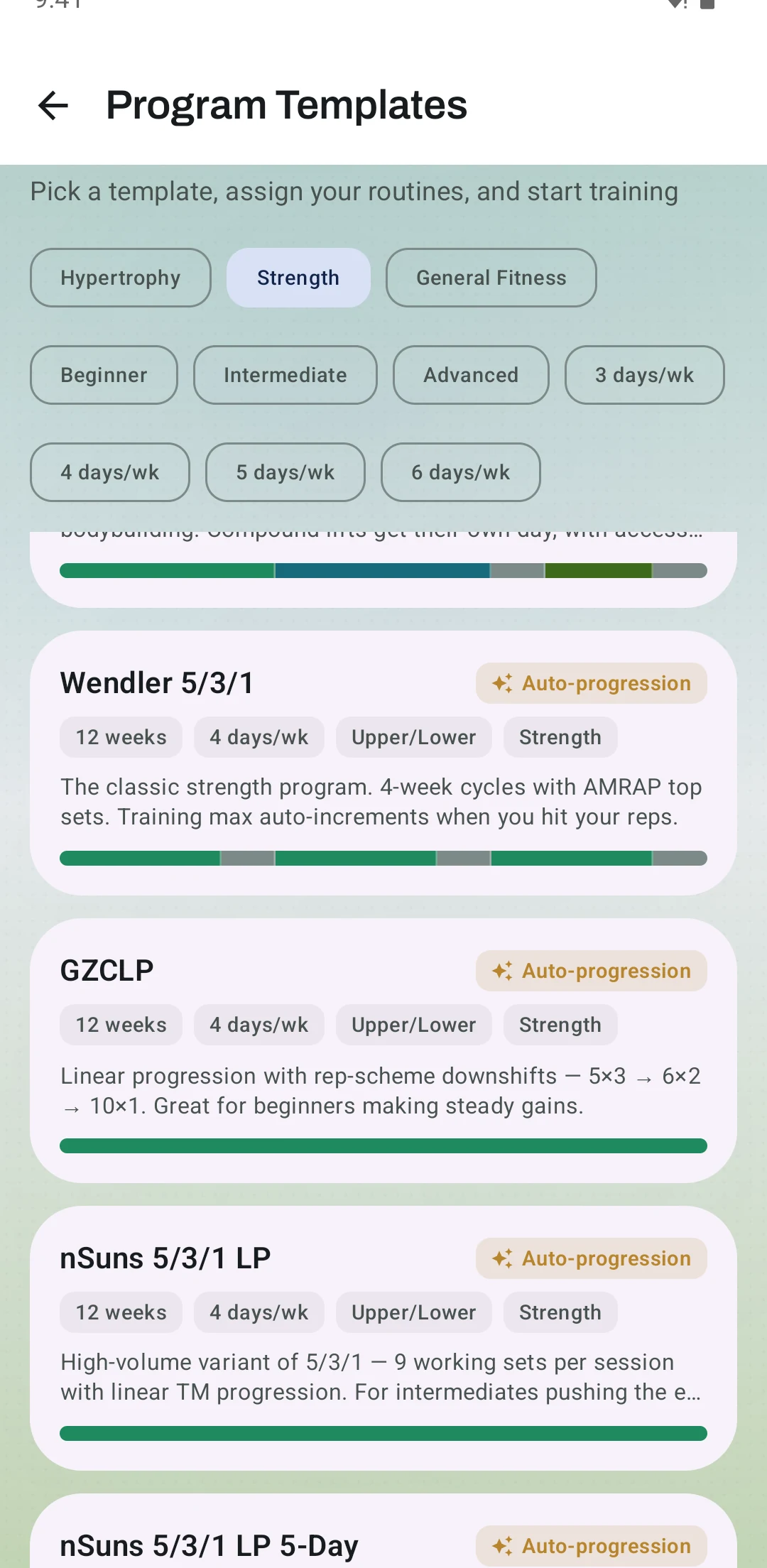
- Open the menu, tap Search Kinoku at the top, type templates and tap Program templates.
- Tap the Strength filter to shorten the list, then tap Greyskull-style LP (Phrak's variant) and Start This Program.
- Choose a start date, tap Next, and tap Create the program routines so Kinoku builds the routines for you.
- Tap Next, then Activate Program, and enter your one-rep max for each lift it lists before you tap Start program.
On your first launch, from the welcome screen
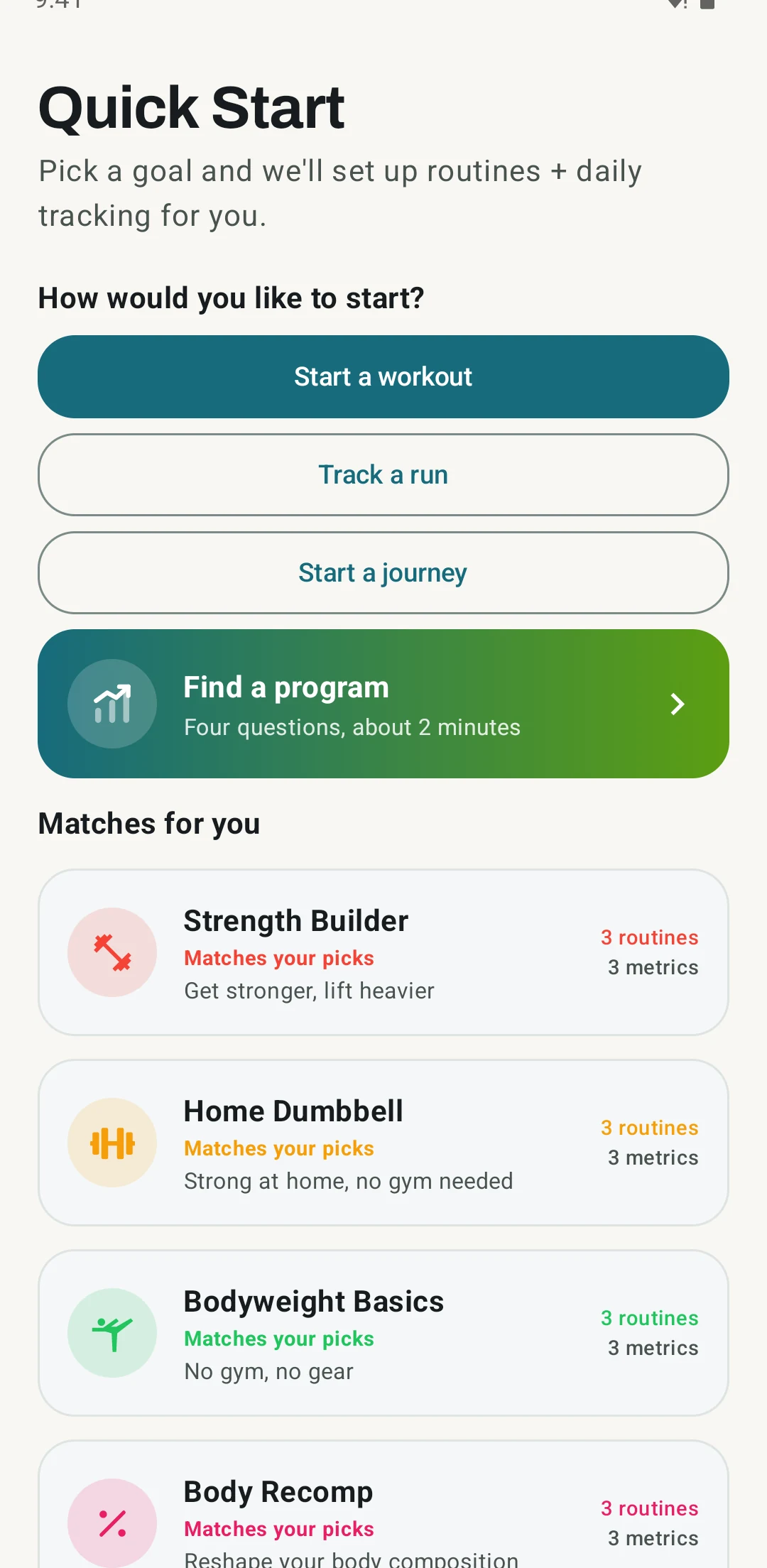
- Pick Strength as a focus, because the finder card only shows for people who lift.
- Tap Find a program on the welcome screen, right under the three start choices.
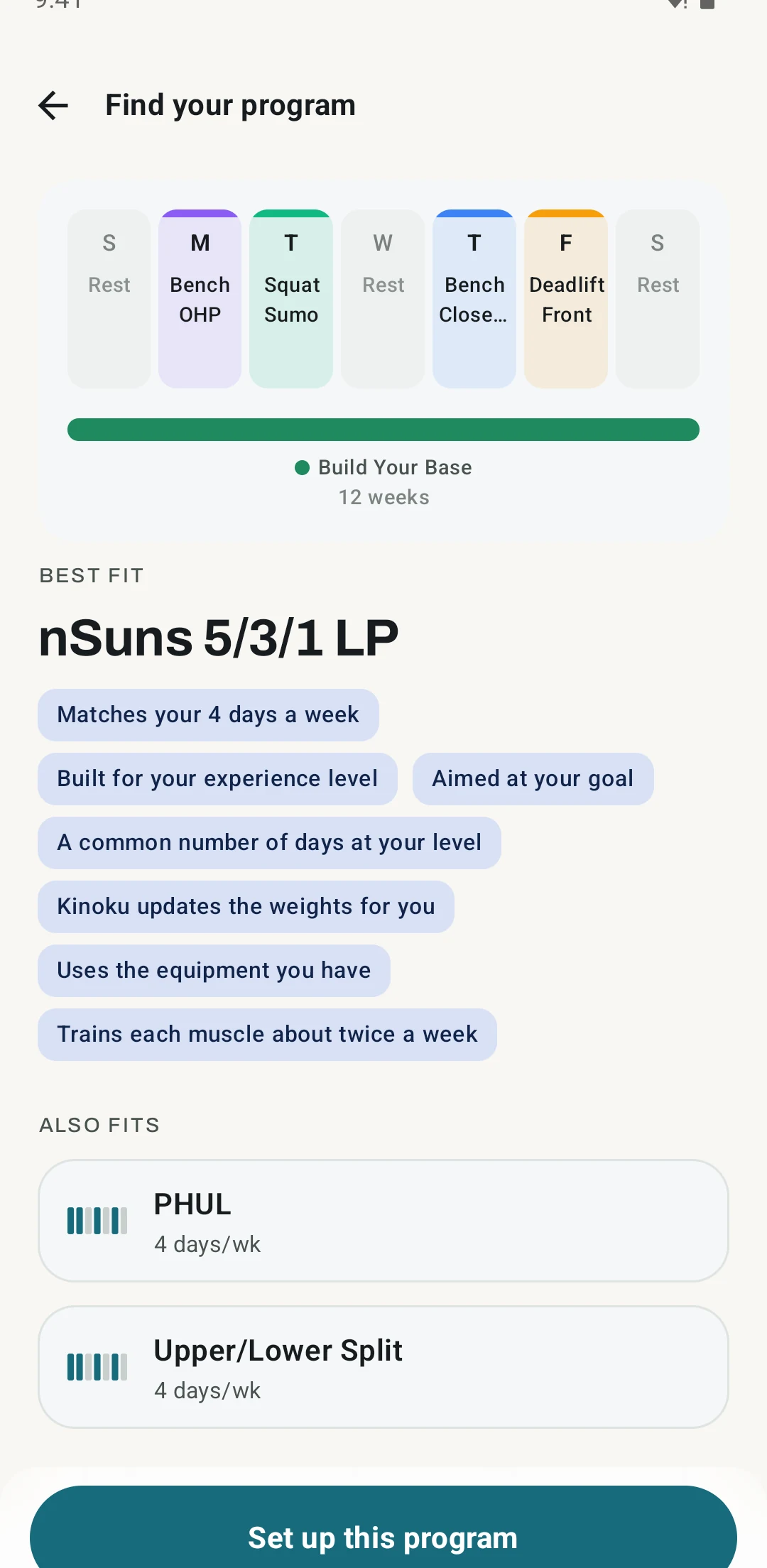
- Answer four questions about your week, and the finder sets up the match for you.
The finder picks the program that fits your answers, so it can suggest a different one, while the menu path above reaches Greyskull-style LP every time.
Opens the template in the app when Kinoku is installed, and opens Google Play when it is not.
Prefer a file?
Save the file, then open it with Kinoku, and you get 2 routines and a 12-week calendar that starts on the Monday after you download it. No workouts are added to your history, and the file does not work out loads from your one-rep max.
Kinoku in practice
Track this program on your phone
 Open full-size image ↗
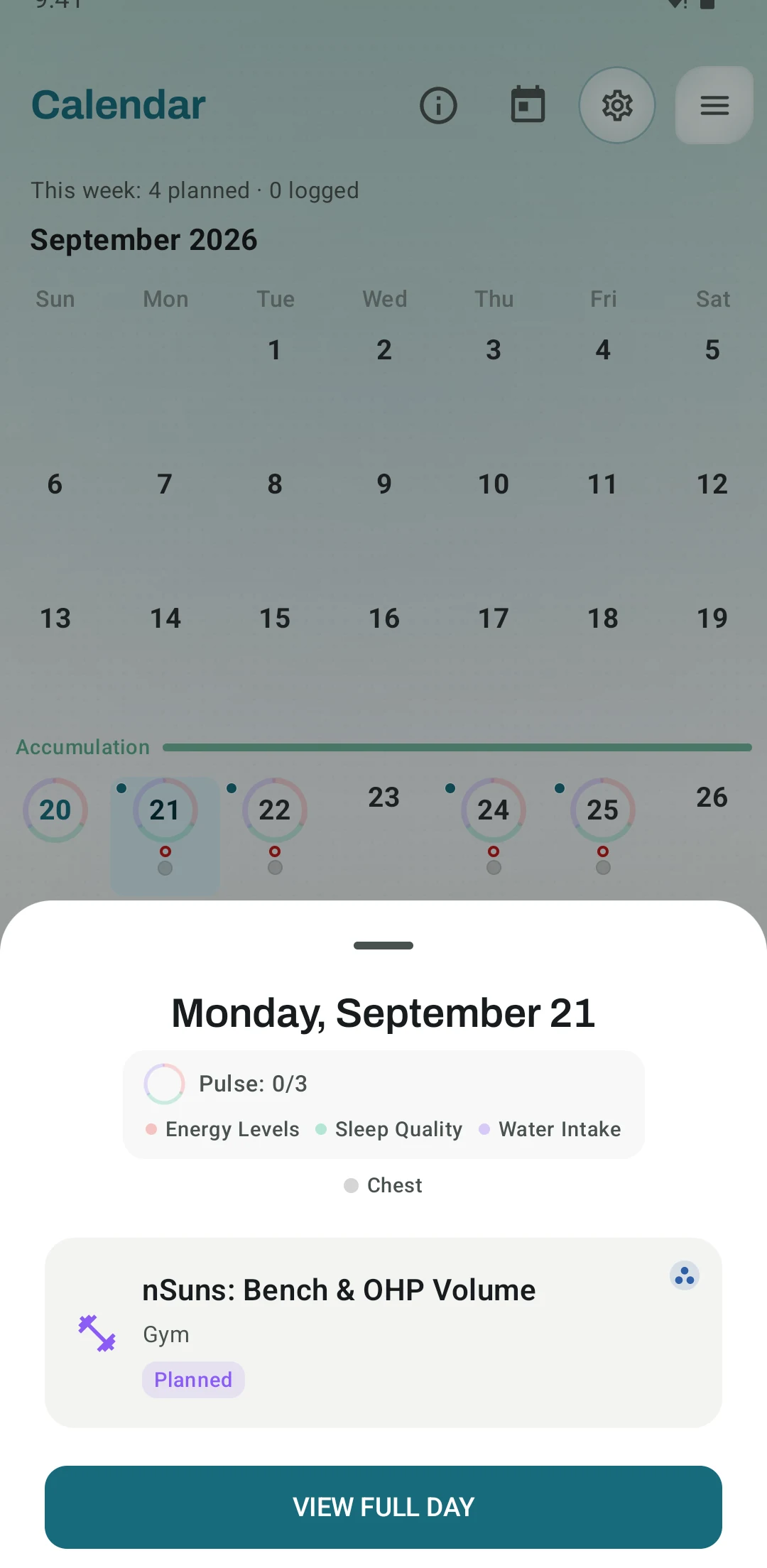
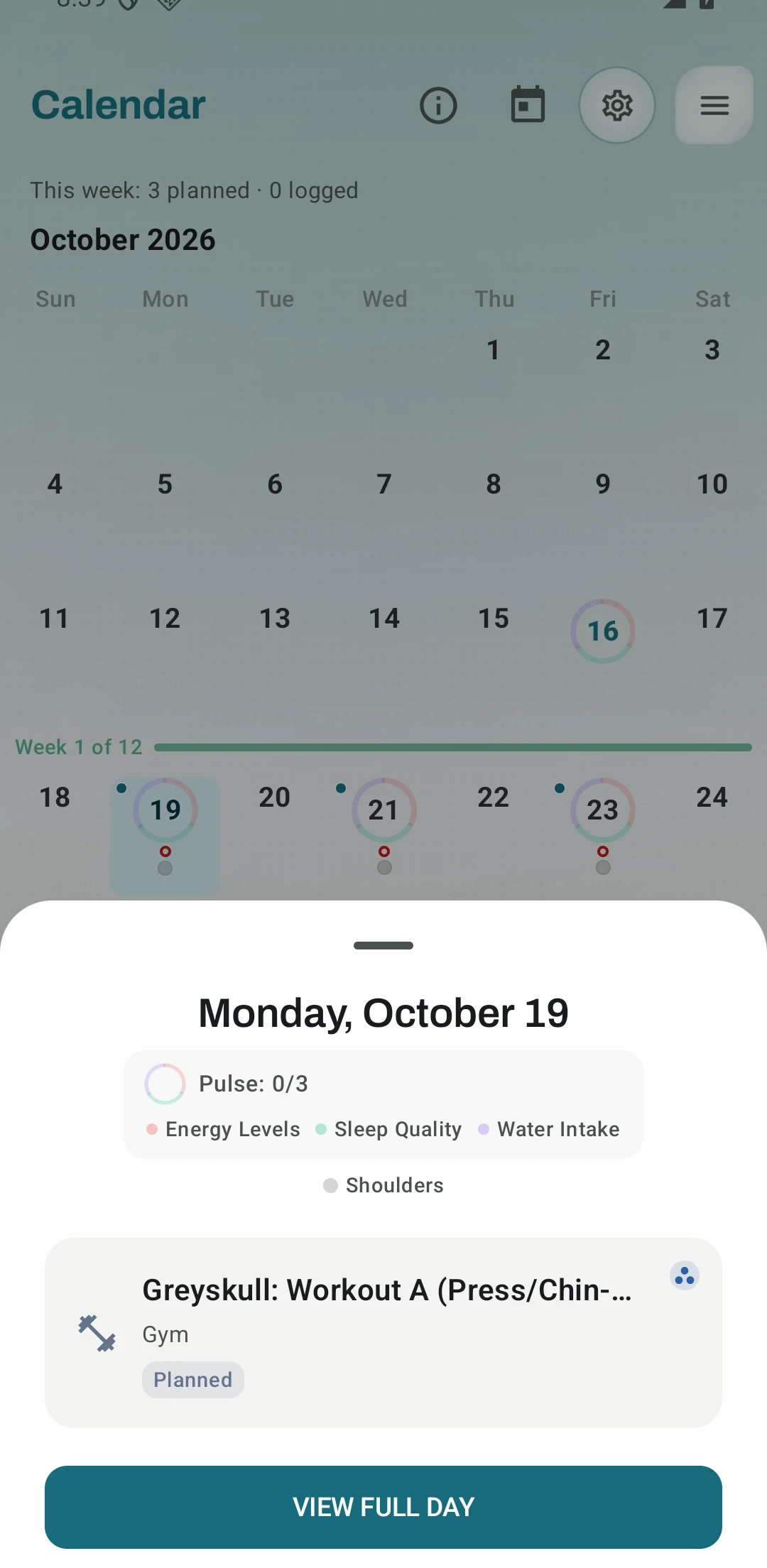
Your weeks land on the calendar
Real Android app capture of the Greyskull-style plan set to start on a Monday. The plan uses Monday, Wednesday and Friday with Workout A first, and its two workouts trade places from week to week.
 Open full-size image ↗
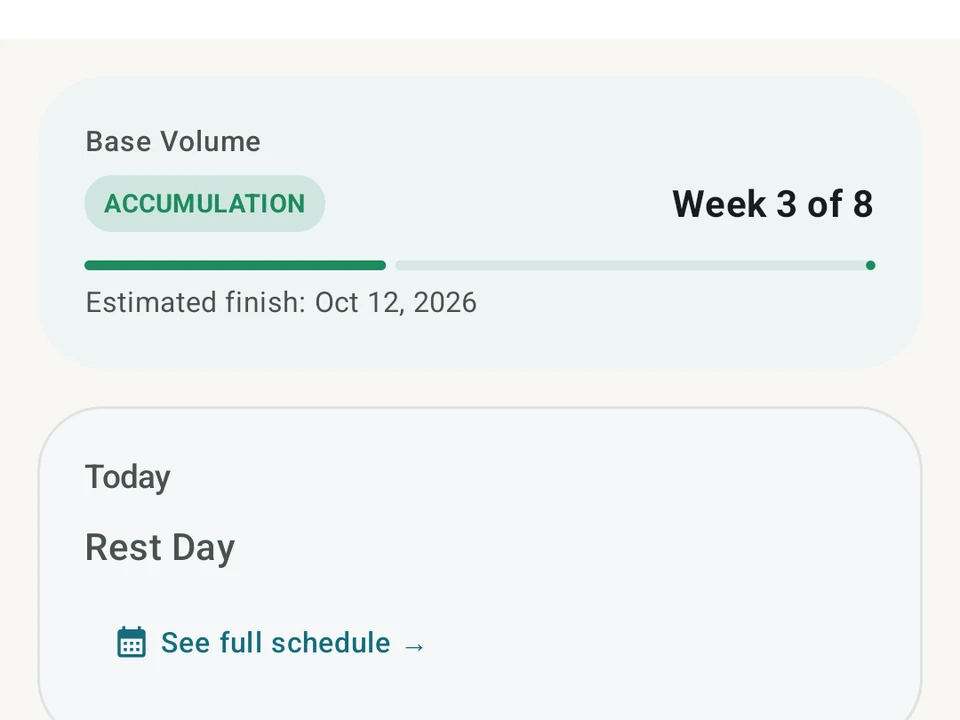
Your week in the program
Real Android app capture of the program dashboard, from an 8-week template. A running Greyskull-style plan shows where it stands on the same card, out of 12 weeks.
Greyskull LP is a beginner barbell program, and its LP stands for linear progression, a plan that adds a little weight every session. The full program is sold as a book, Greyskull LP: Third Edition. The r/Fitness wiki once kept a free summary of it called Phrak’s Greyskull LP Variant, and Kinoku’s Greyskull-style template follows that summary.
How Phrak’s variant works
The wiki version trains on Monday, Wednesday and Friday, and each session runs in the same order: a pull, a press, then a leg lift. The pull is chin-ups or barbell rows, and the press is the overhead press or the bench press. Each one alternates from one workout to the next, with the bench press paired with rows and the overhead press paired with chin-ups.
The leg lift depends on the day. Monday and Friday end with three sets of squats, and Wednesday ends with one set of deadlifts. Every lift gets three sets of five, and the last set is taken further, which the wiki marks with a plus sign. That set ends with one or two reps still left, around the point where the bar starts to slow.
The wiki asks for 2 to 3 minutes of rest between sets. It suggests running the program as written for three months at most, and it compares the program to the concrete slab that a house is later built on.
How the weights move on the wiki
The wiki adds 2.5 lb (about 1.1 kg) to the upper-body lifts and 5 lb (about 2.3 kg) to the squat and deadlift after each workout. A last set of more than 10 reps may double that jump. A lift that gets fewer than 15 reps across all its sets is cut by 10 percent.
Take a bench press at 60 kg as a worked example. Sets of 5, 5 and 8 make 18 reps, so the bar goes up next time, and sets of 5, 5 and 11 earn the double jump. Sets of 5, 4 and 5 make only 14 reps, so the wiki’s rule brings the bench press down to 54 kg.
What Kinoku works out for you
Kinoku tracks six lifts in this template: the overhead press, chin-up, back squat, bench press, barbell row and deadlift. You enter a one-rep max for each barbell lift, and the app plans the first working weight at 80 percent of it, rounded to the nearest 2.5 kg. The chin-up starts with no added weight, and a barbell field left blank starts on the empty 20 kg bar.
After a session where every set reaches five reps, the press, bench press and row each gain 2.5 kg. The chin-up gains 2.5 kg of added weight, and the squat and deadlift gain 5 kg. Ten or more reps on the last set double the jump.
A session where any set falls short takes 10 percent off that lift straight away, rounded to the nearest 2.5 kg. So the bench press from the example comes back at 55 kg rather than the wiki’s 54 kg.
Where the app’s version differs
The size of the jumps is the biggest difference. Kinoku adds 2.5 kg and 5 kg where the wiki adds 2.5 lb and 5 lb, which is about twice as much. Choosing Smaller under Weight jumps in Program settings halves Kinoku’s jumps to 1.25 kg and 2.5 kg, which is close to the wiki’s steps. With Smaller on, the cut after a missed session rounds to the nearest 1.25 kg as well.
The week is built differently too. Kinoku keeps the deadlift in Workout B with the bench press and row, so a week with two B days holds two deadlift sessions and one squat session. On the wiki, squats stay on Monday and Friday and the deadlift stays on Wednesday every week, and only the upper-body lifts alternate. Inside each workout, Kinoku puts the press before the pull, where the wiki starts with the pull.
Two rules also work a little differently. The wiki adds up the reps across all three sets, so sets of 5, 4 and 6 reach 15 and avoid the cut. Kinoku counts any short set as a miss, so the same session takes 10 percent off. The double jump starts at 10 reps in the app, one rep sooner than the wiki’s “more than 10”.
The wiki’s extra options stay with you, such as chin-up negatives or three sets of deadlifts for more work. The routines are yours to edit, though Kinoku plans weights only for the six lifts it tracks.
Where the wiki page went
The r/Fitness wiki address for Phrak’s variant now points to the r/Fitness Basic Beginner Routine. That routine keeps three sets of five with a last set taken further, but it fixes the lifts into two workouts that never change and adds cardio days. Kinoku runs it as a separate template, which the Basic Beginner Routine page describes.
Frequently asked questions
Which app runs a Greyskull-style linear progression with the double jump?
Kinoku runs a free plan based on Phrak's variant. It plans a first weight at 80 percent of your one rep max, adds 2.5 kg or 5 kg after a session where every set reaches five reps, and doubles the jump when the last set reaches 10. A session with any short set takes 10 percent off that lift straight away.
Is this the official Greyskull LP?
No. Kinoku's template follows Phrak's Greyskull LP Variant, a free summary on the r/Fitness wiki that names the book Greyskull LP: Third Edition as its source. Kinoku has no connection with the book or the store that sells it.
What counts as a missed session in Kinoku?
Any set that ends below five reps counts as a miss, the last set included. The next session plans 10 percent less for that lift, rounded to the nearest 2.5 kg, and the usual jumps start again after that.
How does the chin-up progress?
The chin-up starts at your body weight with nothing added, and it stays there until every set reaches five reps. After each session that does, Kinoku plans 2.5 kg more added weight for next time. The wiki suggests negatives, or a pulldown with your palms facing you, until chin-ups come.
How long can I run a Greyskull-style plan?
The wiki suggests three months at most, and Kinoku plans 12 weeks. After that, some of Kinoku's other strength templates vary the load from week to week or day to day, such as Jim Wendler's 5/3/1 and PHUL (power hypertrophy upper lower). A plan that adds weight every session cannot keep that pace for long.
Calculators & tools
Compare Epley and Brzycki estimates, then print percentage and rep-max charts in kilograms or pounds.
What a push-up, pull-up, dip or squat really lifts. Hundreds of exercises, each one labelled measured or estimated.
A strength score that adjusts for your sex and weight. Written for the German federation in 2019, now the cross-federation standard.
Track this in the app
Run Greyskull-style LP in Kinoku
Kinoku works out the weights and the jumps for the lifts it tracks, offline on your phone.
100% free with no mandatory account and no cloud tracking.
Related app features
A 4-phase planning stack. The builder, all 25 templates, named programs with auto-progression, the custom model, and unlimited active programs are free. Pro adds volume targets, readiness tuning, and auto set changes.
Pull-ups, push-ups, and dips get real per-rep load from body-movement math, not just reps times one. The load math, snapshots, and Total Load chart are free; Pro scales the volume charts in Stats Analysis to your body weight.
Load the bar fast with a visual plate layout. The calculator and bar-weight setting are free; Pro adds custom plate inventory settings.
Open a lift in Stats and a plain label says if it is progressing, holding steady, or slipping, with a flat-zone band on the chart. The label is free. Pro adds ideas for a stuck lift (options, never orders), an all-lifts dashboard, and a Coach card. It stays quiet when the data is thin.