

Basic Beginner Routine: Free Beginner Workout Plan
A free beginner workout routine from r/Fitness, 3 days a week: rows, bench and squats one day, then chin-ups, presses and deadlifts, with weights set for you.
Weekly Training Schedule
These are the sessions the Kinoku template builds when you start it, and the same sessions sit in the file below. The program has two different weeks, which take turns until the plan ends. The rep counts are each routine's starting targets. For the barbell row, bench press, back squat, overhead press and deadlift, the template works out the first weights from your one-rep max and moves the weight or reps after each session. The chin-up starts with no added weight.
Weeks 1, 3, 5, 7, 9 and 11
- Bent Over Row (Barbell)3 x 5
- Bench Press (Barbell)3 x 5
- Squat (Barbell)3 x 5
- Chin-Up3 x 5
- Overhead Press (Barbell)3 x 5
- Deadlift (Barbell)1 x 5
- Bent Over Row (Barbell)3 x 5
- Bench Press (Barbell)3 x 5
- Squat (Barbell)3 x 5
Weeks 2, 4, 6, 8, 10 and 12
- Chin-Up3 x 5
- Overhead Press (Barbell)3 x 5
- Deadlift (Barbell)1 x 5
- Bent Over Row (Barbell)3 x 5
- Bench Press (Barbell)3 x 5
- Squat (Barbell)3 x 5
- Chin-Up3 x 5
- Overhead Press (Barbell)3 x 5
- Deadlift (Barbell)1 x 5
Ready to lift?
Start Basic Beginner Routine in Kinoku
Basic Beginner Routine is a free template in the app. When you start it there, Kinoku builds the 2 routines and puts 12 weeks on your calendar. It also works out the first weights for the barbell row, bench press, back squat, overhead press and deadlift from your one-rep maxes. The chin-up starts with no added weight.
Any time, from the menu
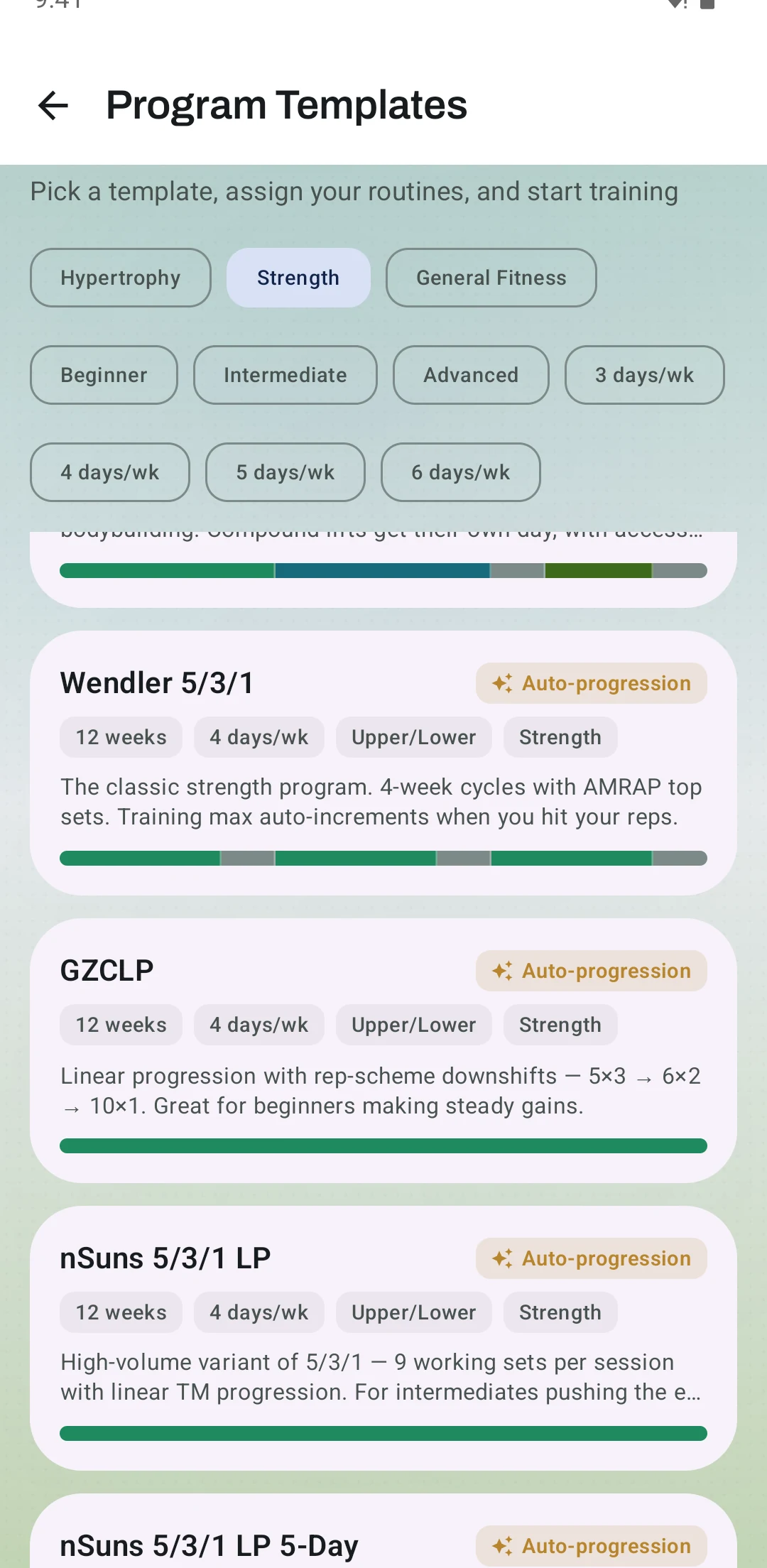
- Open the menu, tap Search Kinoku at the top, type templates and tap Program templates.
- Tap the Strength filter to shorten the list, then tap Basic Beginner Routine (r/Fitness) and Start This Program.
- Choose a start date, tap Next, and tap Create the program routines so Kinoku builds the routines for you.
- Tap Next, then Activate Program, and enter your one-rep max for each lift it lists before you tap Start program.
On your first launch, from the welcome screen
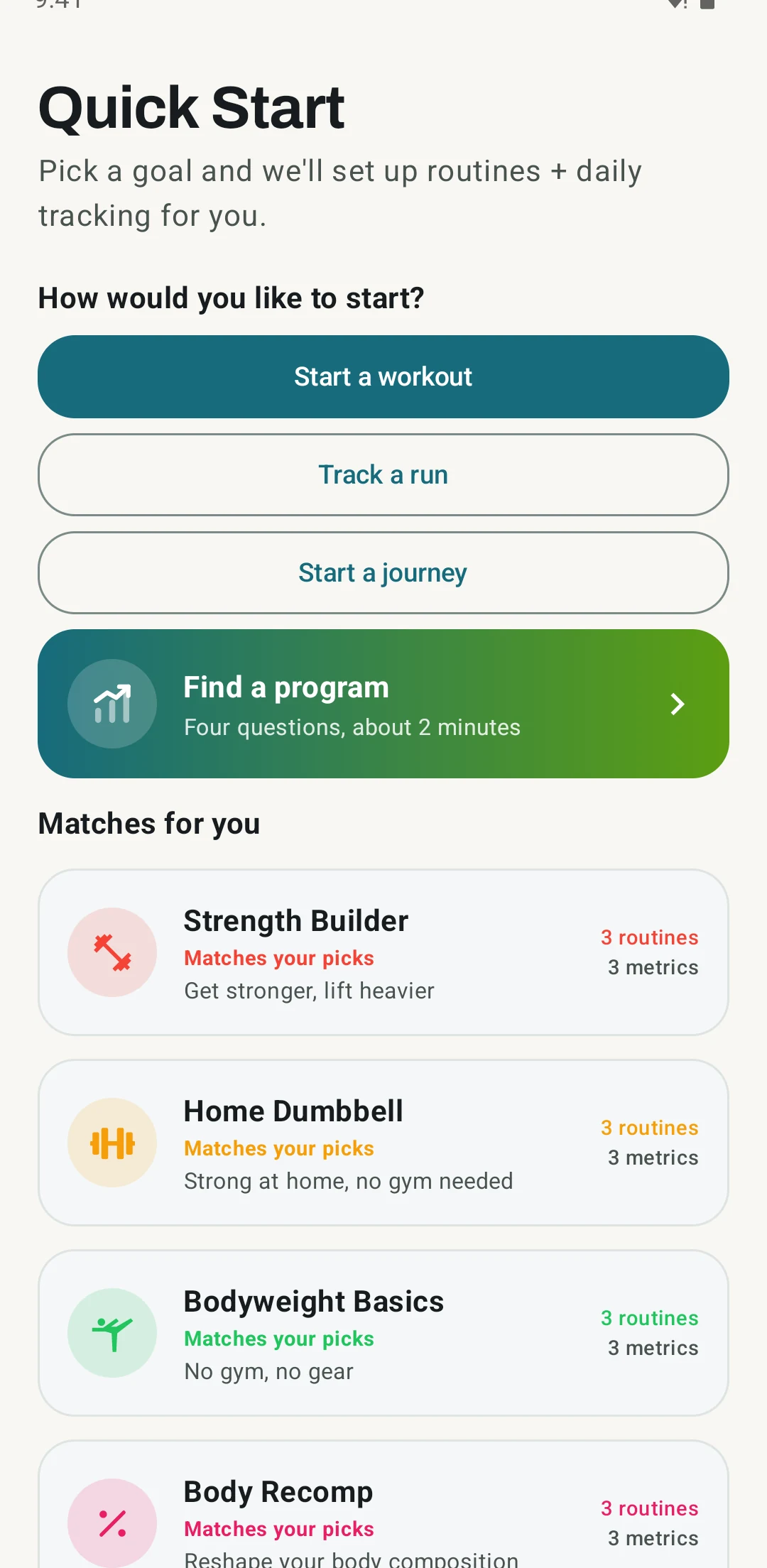
- Pick Strength as a focus, because the finder card only shows for people who lift.
- Tap Find a program on the welcome screen, right under the three start choices.
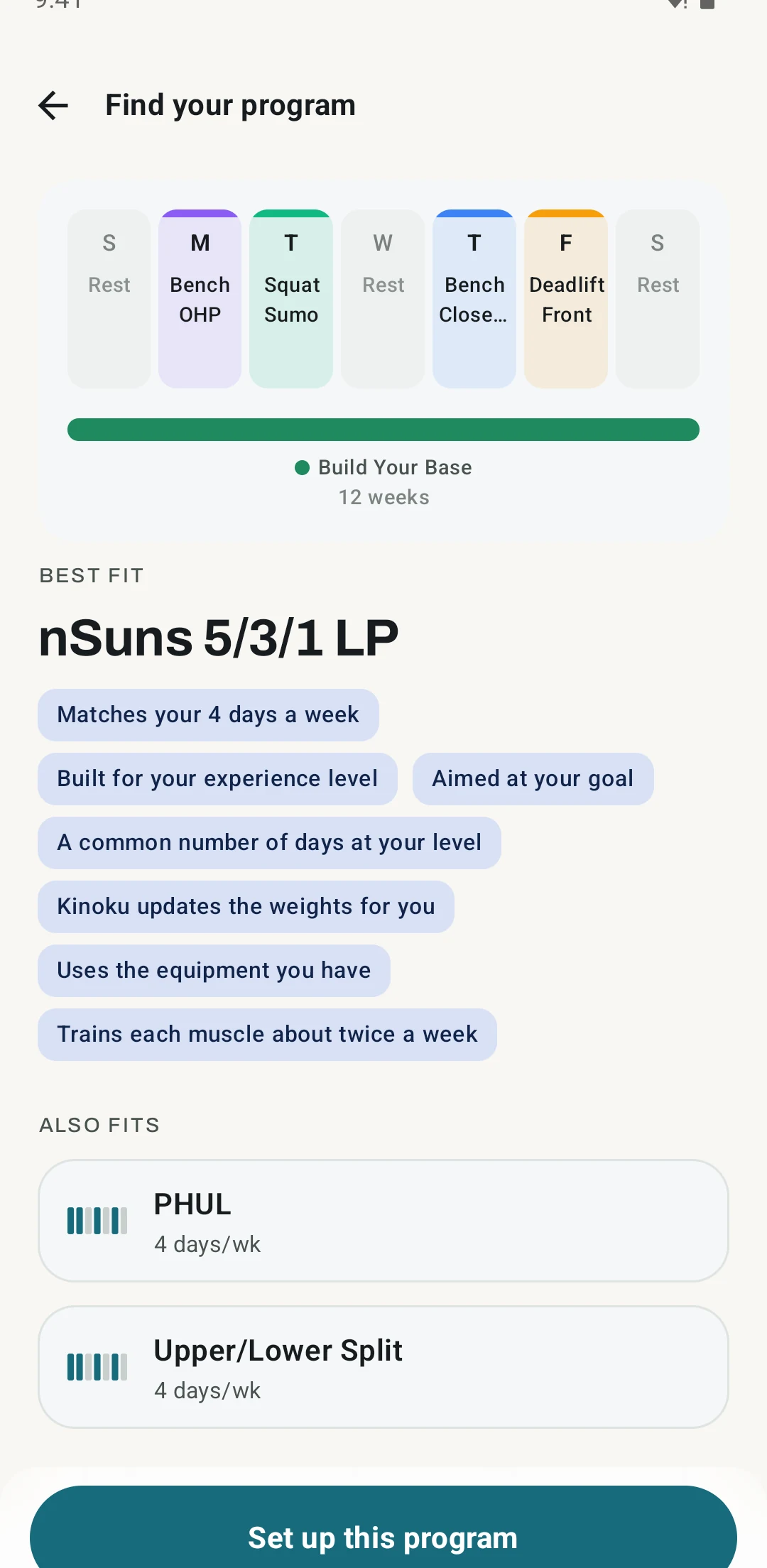
- Answer four questions about your week, and the finder sets up the match for you.
The finder picks the program that fits your answers, so it can suggest a different one, while the menu path above reaches Basic Beginner Routine every time.
Opens the template in the app when Kinoku is installed, and opens Google Play when it is not.
Prefer a file?
Save the file, then open it with Kinoku, and you get 2 routines and a 12-week calendar that starts on the Monday after you download it. No workouts are added to your history, and the file does not work out loads from your one-rep max.
Kinoku in practice
Track this program on your phone
 Open full-size image ↗
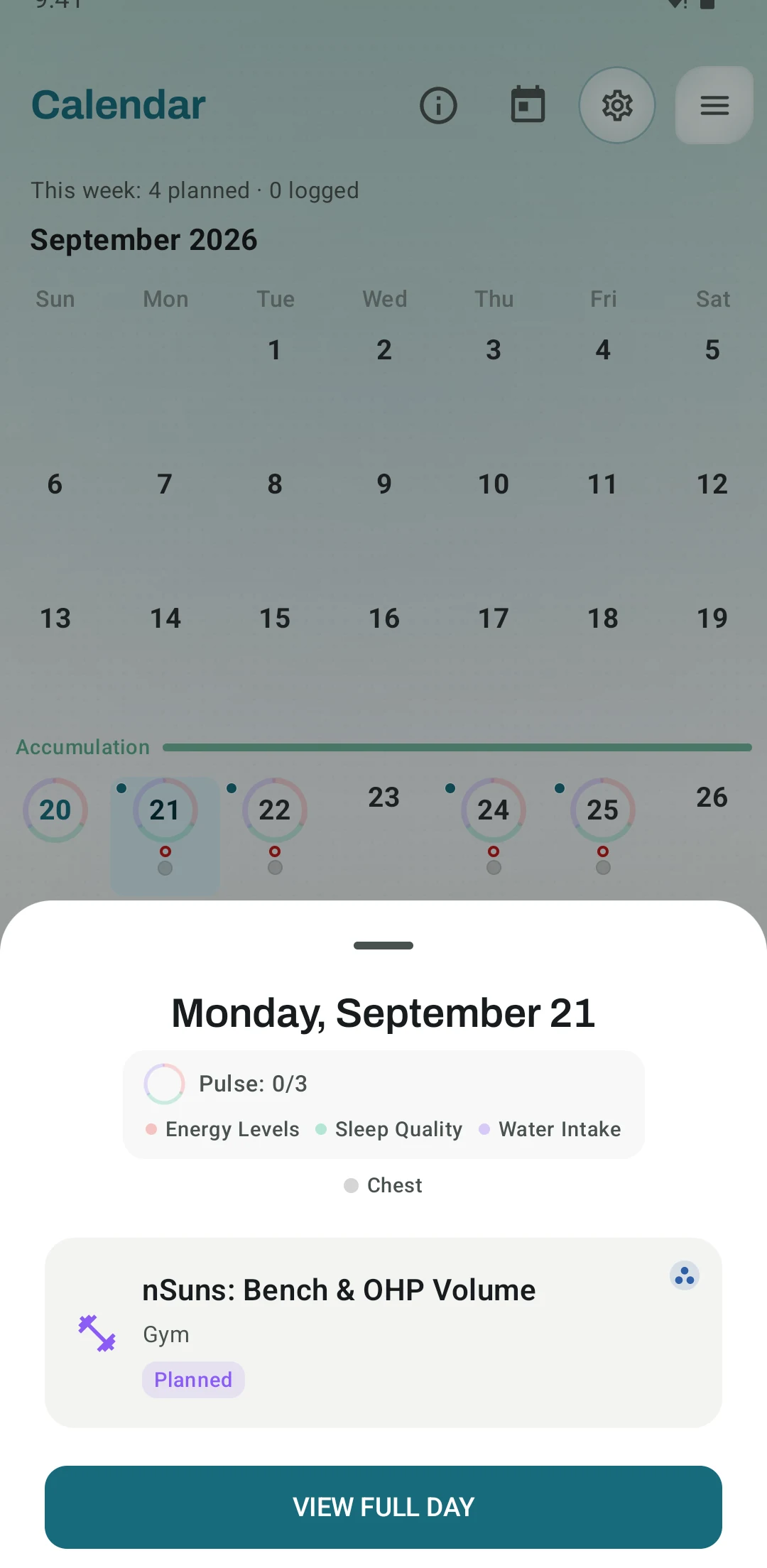
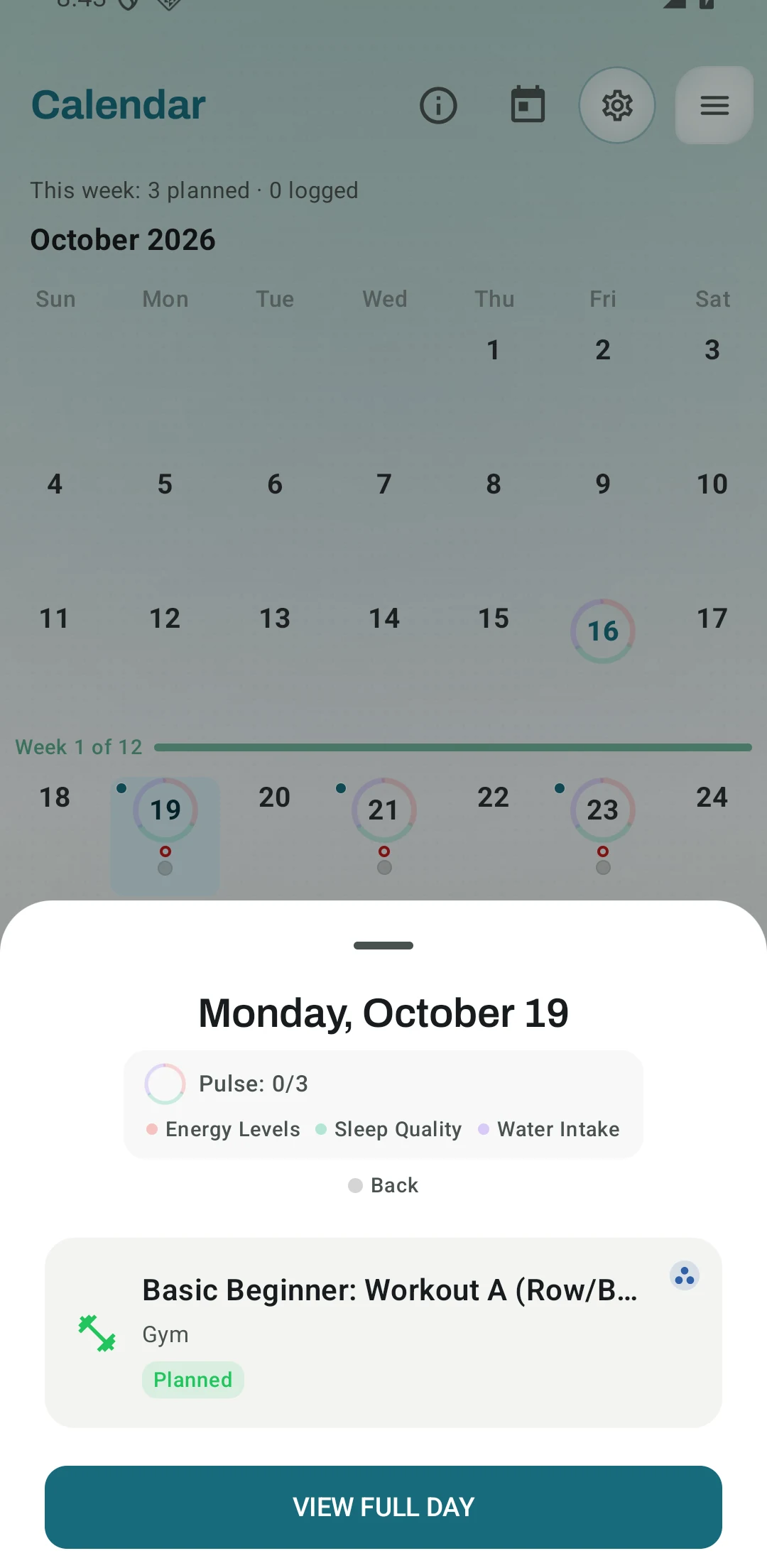
Your weeks land on the calendar
Real Android app capture of the Basic Beginner Routine set to start on a Monday. Workout A comes first on Monday, and the two workouts take turns on Monday, Wednesday and Friday.
 Open full-size image ↗
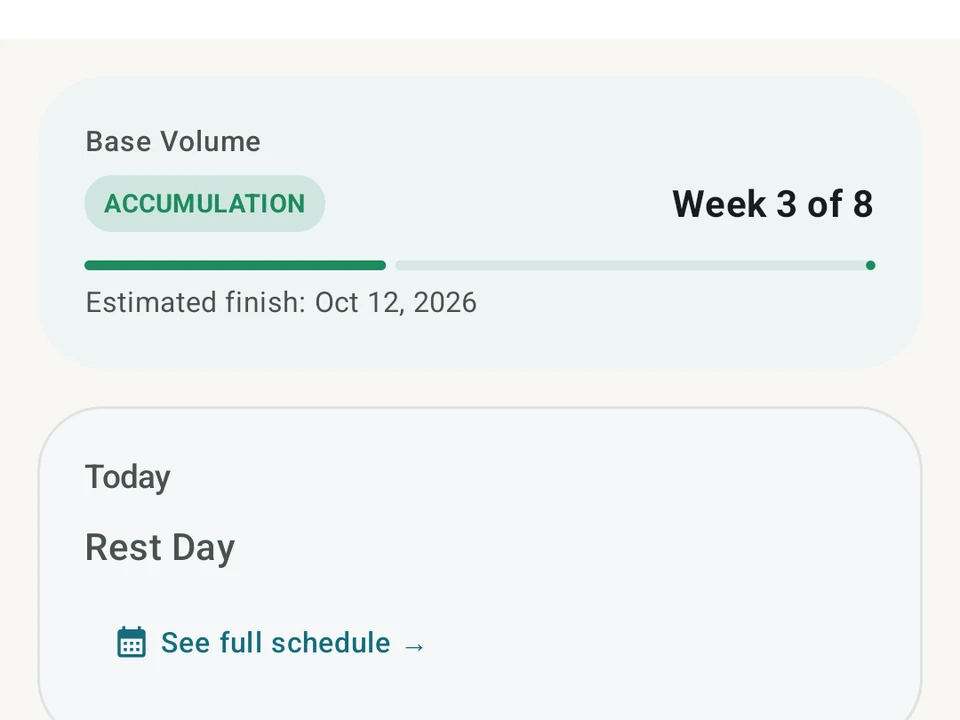
Your week in the program
Real Android app capture of the program dashboard, from an 8-week template. The Basic Beginner Routine keeps its own week count on this card, out of 12.
The Basic Beginner Routine is the starter barbell program on The Fitness Wiki, where the r/Fitness wiki moved. It takes turns between two short workouts, one with rows, bench press and squats and one with chin-ups, overhead press and deadlifts. Each lift gets three sets of five reps with the last set taken further, and the weight goes up a little every time you do the lift.
Who the routine is for
The wiki writes the routine for people who are new to barbell training, and it calls it a “training wheels” routine. Its main aim is a gym habit, with few lifts to learn and short sessions on three days a week. It also wants new lifters to count progress in reps as well as weight, which is why the last set of each lift is open-ended.
The wiki suggests running the routine for three months at most and then moving to a fuller program, and the last section of this page covers the two programs it names for that step.
How the routine works
Workout A and Workout B alternate, with a full rest day between lifting days, which usually means Monday, Wednesday and Friday. Workout A is barbell rows, bench press and squats, and Workout B is chin-ups, overhead press and deadlifts. All six lifts are three sets of five, and the last set of each one is taken as far as it goes, stopping with one or two reps left.
Rest runs 2 to 3 minutes between sets and up to 5 minutes between lifts. The routine also asks for two cardio days a week, one easy and one hard, on whatever days suit you.
How the weights go up on the wiki
The wiki adds 2.5 lb (about 1.1 kg) to the bench press, overhead press, row and chin-up each time you do the lift. The squat and deadlift get 5 lb (about 2.3 kg). More than 10 reps on the last set adds 5 or 10 lb instead. Fewer than 15 reps across a lift’s three sets brings a 10 percent cut next time, and the wiki suggests using those lighter sessions to set new rep records.
Here is how that plays out on a squat at 50 kg. Sets of 5, 5 and 6 add the usual 5 lb, and sets of 5, 5 and 12 earn the bigger jump. Sets of 5, 4 and 4 total 13 reps, so the next squat session starts 10 percent lighter, at 45 kg.
What Kinoku works out for you
Kinoku’s template tracks the same six lifts and builds Workout A and Workout B as two routines. You enter a one-rep max for each barbell lift, and the first working weight is 80 percent of it, rounded to the nearest 2.5 kg. The chin-up starts with no added weight, and a barbell field left blank starts on the empty 20 kg bar, close to the wiki’s advice to work up from the bar.
Whenever every set of a lift reaches five reps, that lift moves up for next time. The bench press, overhead press and row go up 2.5 kg, the chin-up takes 2.5 kg more added weight, and the squat and deadlift go up 5 kg. Each lift counts its own missed sessions, and the third in a row takes 10 percent off, rounded to the nearest 2.5 kg.
Where the app’s version differs
The deadlift is the clearest change. The wiki lists three sets of five or more for the deadlift, and Kinoku plans a single set of five or more, as its Greyskull-style plan does.
The jumps are about twice the wiki’s, because Kinoku adds 2.5 kg and 5 kg where the wiki adds 2.5 lb and 5 lb. Choosing Smaller under Weight jumps in Program settings halves them to 1.25 kg and 2.5 kg, and the cut after three missed sessions then rounds to the nearest 1.25 kg. Kinoku also leaves out the bigger jump that the wiki gives for more than 10 reps on the last set.
The cut for a bad session comes later in the app. The wiki takes 10 percent off after a single session under 15 reps, while Kinoku waits for three missed sessions in a row. In Kinoku, a session counts as missed when any set ends below five reps.
The two cardio days are not in Kinoku’s plan, which holds only the lifting days. You can log them on the free days as a run with GPS or as a workout of your own.
After three months
The wiki suggests Cody Lefever’s GZCLP (a program that sorts lifts into three tiers) or Jim Wendler’s 5/3/1 for Beginners when the three months are up. Kinoku has a GZCLP template, and its 5/3/1 template is 5/3/1 Boring But Big, a different variant from the beginner version. The old r/Fitness wiki page for Phrak’s Greyskull variant now points to this routine, and Kinoku runs both as separate templates.
Frequently asked questions
Is there an app that runs the r/Fitness Basic Beginner Routine for me?
Kinoku has it as a free template on Android. It builds Workout A and Workout B, plans a first weight at 80 percent of the one rep max you enter, and adds weight to a lift once every set reaches five reps. Each lift counts its own misses, and a third missed session in a row takes 10 percent off that lift.
What if I cannot do a chin-up yet?
The wiki lists negatives, a lat pulldown machine, a bodyweight progression from r/bodyweightfitness, and bands or an assisted machine. Kinoku's routine keeps the chin-up and starts it at body weight, and it plans weights only for the chin-up itself.
How do I pick my starting weights?
The wiki starts from the empty bar and adds 10 to 20 lb a set until the bar slows or your form slips. In Kinoku, a one-rep max becomes a first working weight at 80 percent of it. A field left blank starts that lift on the empty 20 kg bar.
What happens when I miss reps in Kinoku?
The weight stays where it was for the next session of that lift. Each lift keeps its own count of missed sessions, and the third miss in a row takes 10 percent off, rounded to the nearest 2.5 kg. The wiki cuts sooner, after a single session under 15 reps.
How is it different from Phrak's Greyskull variant?
Both use three sets of five with a last set taken further, and both list the same weight jumps. The Basic Beginner Routine keeps each workout fixed, so rows and bench press always come with squats. It also lists three sets of deadlifts and two cardio days a week, which Phrak's variant does not.
Calculators & tools
Compare Epley and Brzycki estimates, then print percentage and rep-max charts in kilograms or pounds.
What a push-up, pull-up, dip or squat really lifts. Hundreds of exercises, each one labelled measured or estimated.
The IPF's own score since 2020. It rates a raw 3-lift total with the same math Kinoku uses in the app.
Track this in the app
Run Basic Beginner Routine in Kinoku
Kinoku works out the weights and the jumps for the lifts it tracks, offline on your phone.
100% free with no mandatory account and no cloud tracking.
Related app features
A 4-phase planning stack. The builder, all 25 templates, named programs with auto-progression, the custom model, and unlimited active programs are free. Pro adds volume targets, readiness tuning, and auto set changes.
Unlimited routines, Smart Sync, Starter Packs, and follow-along links are free, and so are Rotation Groups that cycle through several routines for you.
Live pace, splits, a route map, and audio cues. Your run record is not uploaded to Kinoku; map tiles load when you view maps, and weather is a clear opt-in.
Load the bar fast with a visual plate layout. The calculator and bar-weight setting are free; Pro adds custom plate inventory settings.