

5/3/1 Boring But Big: Waves, BBB Sets, and Setup
Build raw strength and dense muscle with Jim Wendler's 5/3/1 Boring But Big. Complete percentage wave guide, assistance guidelines, and setup.
Weekly Training Schedule
These are the sessions the Kinoku template builds when you start it, and the same sessions sit in the file below. The rep counts are each routine's starting targets. For the squat, bench press, deadlift and overhead press, the template sets the reps and loads itself from your training max.
- Overhead Press (Barbell)8 x 10
- Chin-Up4 x 10
- Plank3 x 45 s
- Deadlift (Barbell)8 x 10
- Bicycle Crunches3 x 15
- Lat Pulldown3 x 12
- Bench Press (Barbell)8 x 10
- Bent Over Row (Barbell)4 x 10
- Pushups3 x 15
- Squat (Barbell)8 x 10
- Lunges (Dumbbell)3 x 10
- Plank3 x 45 s
Ready to lift?
Start 5/3/1 BBB in Kinoku
5/3/1 BBB is a free template in the app. When you start it there, Kinoku builds the 4 routines, puts 12 weeks on your calendar and sets the main-lift loads from your training max.
Any time, from the menu
- Open the menu, tap Search Kinoku at the top, type templates and tap Program templates.
- Tap the Strength filter to shorten the list, then tap Wendler 5/3/1 and Start This Program.
- Choose a start date, tap Next, and tap Create the program routines so Kinoku builds the routines for you.
- Tap Next, then Activate Program, and enter your one-rep max for each main lift before you tap Start program.
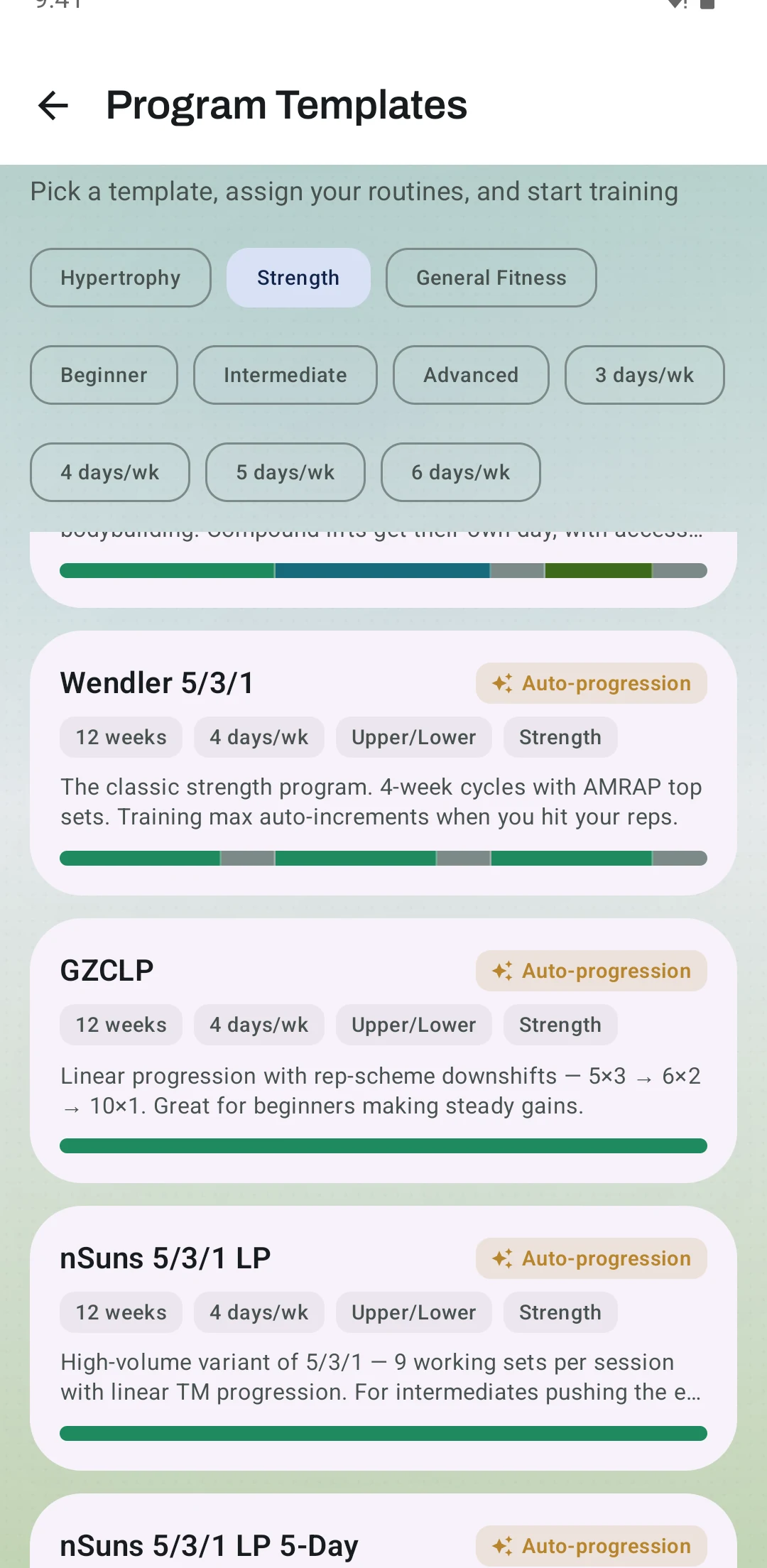
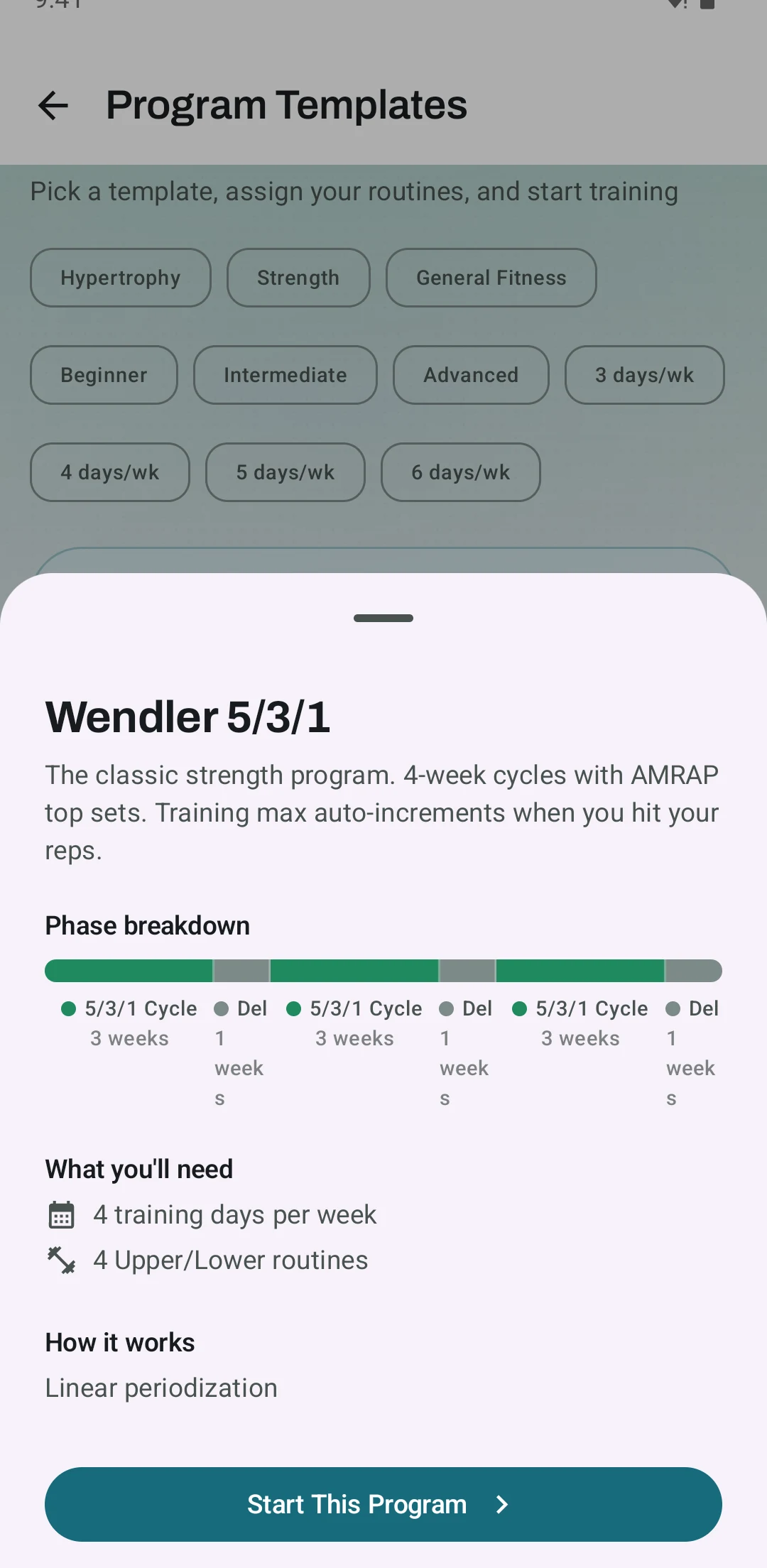
On your first launch, from the welcome screen
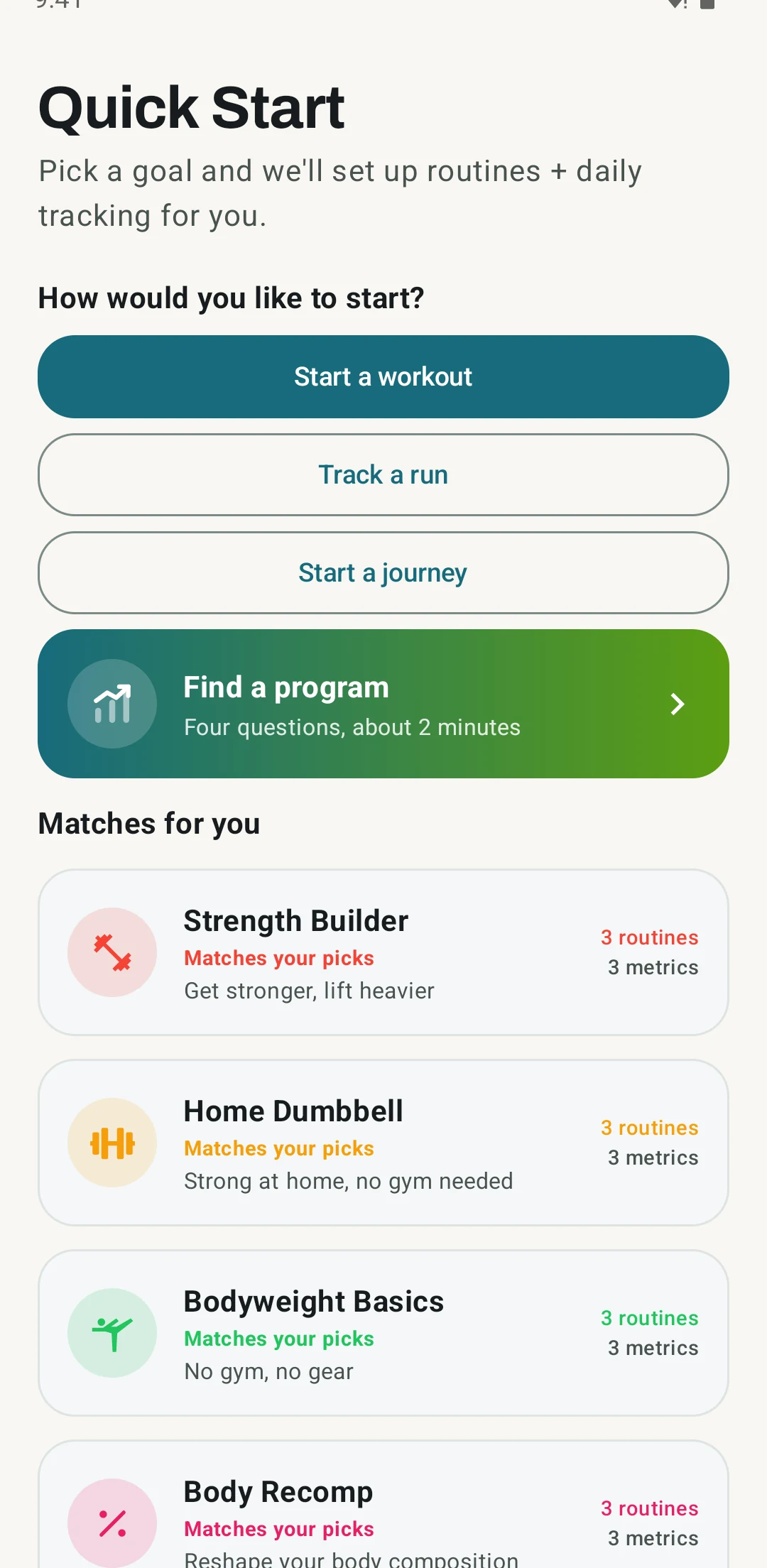
- Pick Strength as a focus, because the finder card only shows for people who lift.
- Tap Find a program on the welcome screen, right under the three start choices.
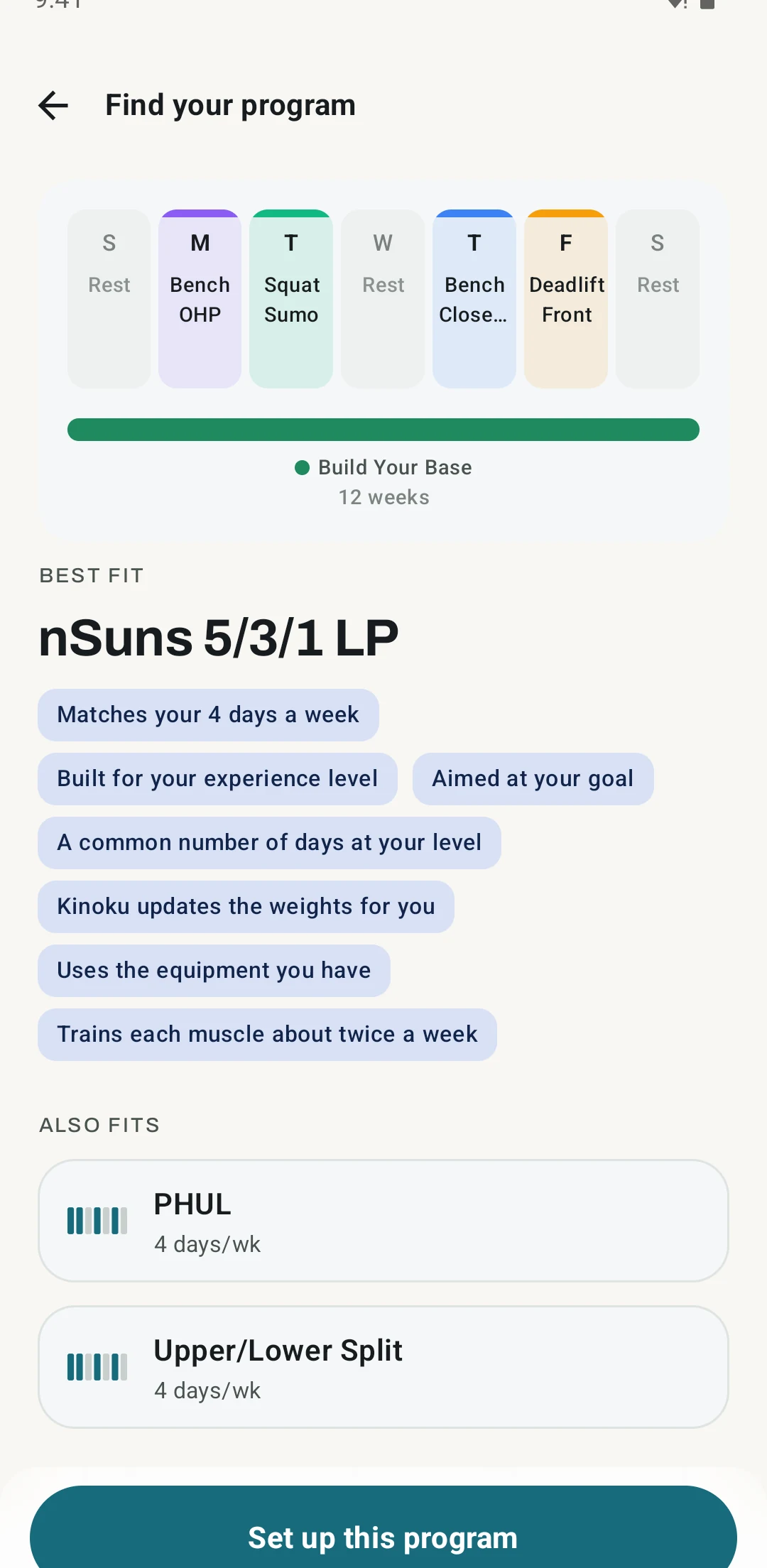
- Answer four questions about your week, and the finder sets up the match for you.
The finder picks the program that fits your answers, so it can suggest a different one, while the menu path above reaches 5/3/1 BBB every time.
Opens the template in the app when Kinoku is installed, and opens Google Play when it is not.
Prefer a file?
Save the file, then open it with Kinoku, and you get 4 routinesand a 12-week calendar that starts on the Monday after you download it. No workouts are added to your history, and the file does not set loads from your training max.
Kinoku in practice
Track this program on your phone
 Open full-size image ↗
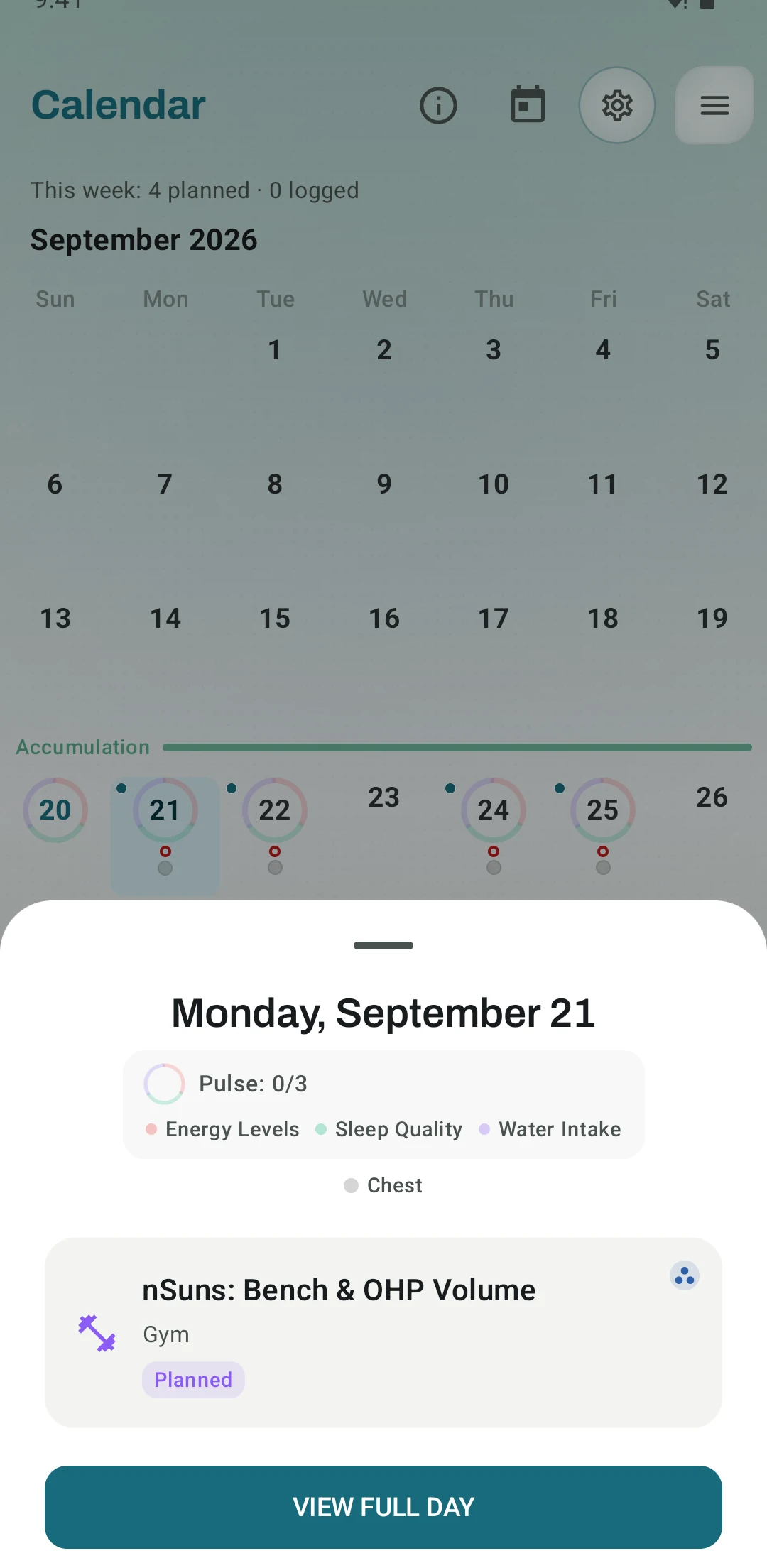
Your weeks land on the calendar
Real Android app capture. Start a template and Kinoku plans every session onto your calendar, here nSuns 5/3/1 LP. The same happens for every program on this page.
 Open full-size image ↗
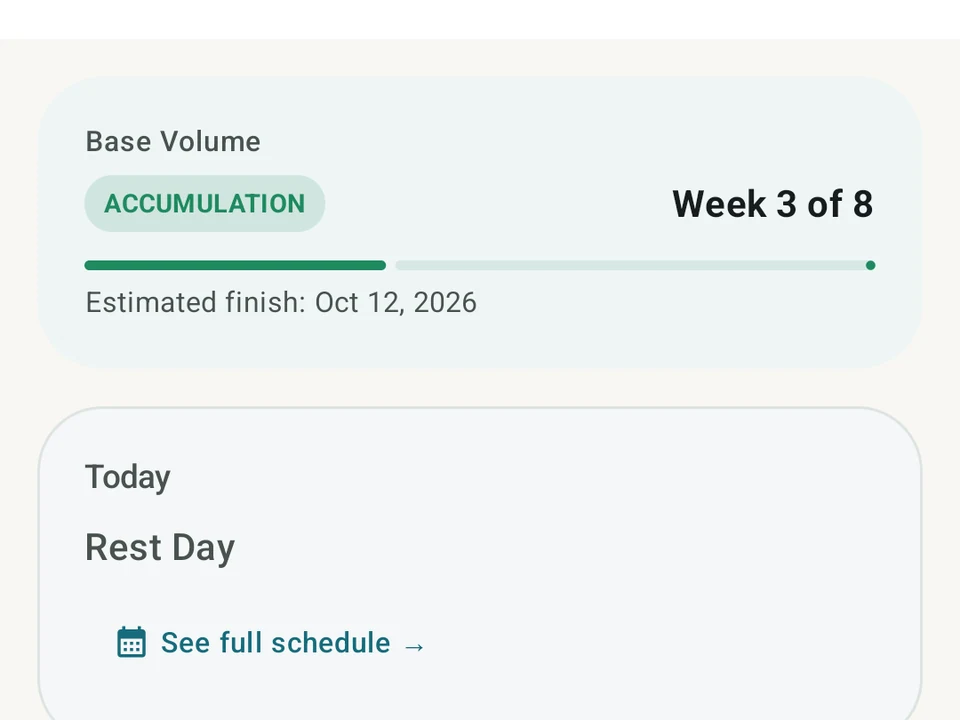
Automated 5/3/1 Wave Periodization
Real Android app capture. Kinoku works out the wave sets and the deload week from your Training Max.
Created by powerlifter Jim Wendler, 5/3/1 Boring But Big (BBB) is a proven strength program that pairs heavy compound barbell lifts with dedicated high-rep volume work.
Workouts are simple and predictable, moving through monthly percentage waves while adding fifty extra reps per session for steady muscle growth.
Training Max (TM)
The most common mistake lifters make in 5/3/1 is starting too heavy. Wendler built the program around lighter weights moved with high bar speed, which keeps your form clean and prevents burnout.
To set up your weights, you never use a true one-rep max (1RM) directly in daily calculations. Instead, you work from a conservative Training Max (TM).
$$\text{Training Max (TM)} = \text{1RM} \times 0.90.$$
If your best Deadlift is 180 kg, your starting Training Max is 162.5 kg, and every cycle percentage keys off that number. Starting light protects your joints against early wear and leaves plenty of room for steady monthly gains.
4-Week Wave Schedule
A standard 5/3/1 cycle runs four weeks, changing load and rep targets on each main lift.
| Week | Set 1 | Set 2 | Set 3 (AMRAP) | Focus |
|---|---|---|---|---|
| Week 1 | 5 reps @ 65% TM | 5 reps @ 75% TM | 5+ reps @ 85% TM | Volume base |
| Week 2 | 3 reps @ 70% TM | 3 reps @ 80% TM | 3+ reps @ 90% TM | Moderate load |
| Week 3 | 5 reps @ 75% TM | 3 reps @ 85% TM | 1+ reps @ 95% TM | Heavy peak |
| Week 4 | 5 reps @ 40% TM | 5 reps @ 50% TM | 5 reps @ 60% TM | Rest and deload |
On the final main set of Weeks 1 to 3, the plus sign marks an as many reps as possible (AMRAP) set. You complete the prescribed reps first, and then keep lifting until you have one or two solid reps left in the tank.
Week 4 serves as a deload, using three light sets of five reps without an AMRAP set so your body can rest before the next wave begins.
BBB Volume Sets
After your three heavy sets, you move straight into the Boring But Big volume work. The Kinoku routine lists all eight sets of the main lift together, three wave sets and then five volume sets.
$$\text{5 sets of 10 reps (5x10) at 50% to 60% of your Training Max.}$$
While fifty percent feels light on set one, fifty total reps with short rests builds dense muscle and tests your stamina.
Starting the volume sets at 50% TM for two cycles leaves room to raise them to 55% or 60% once your body gets used to the work.
Accessory Assistance Work
After completing the main lift and the 5x10 BBB sets, Wendler suggests adding 25 to 50 reps of targeted accessory work.
- Pushing Days (Overhead Press & Bench): 25 to 50 reps of pulling (Chin-ups, Lat Pulldowns, or Rows) alongside 25 to 50 reps of core or single-leg work.
- Pulling Days (Deadlift & Squat): 25 to 50 reps of core or lower back movements (Hanging Leg Raises, Ab Wheel, Back Extensions).
Keep your accessory selections simple, and ensure you train opposing muscle groups equally to protect long-term joint health.
Moving to the Next Cycle
At the end of Week 4, raise your Training Max numbers.
- Add 2.5 kg (5 lbs) to your Overhead Press and Bench Press TM.
- Add 5 kg (10 lbs) to your Squat and Deadlift TM.
Use these new numbers to set weights for next month, and start Week 1 again. For the Overhead Press, Kinoku allows small jumps of 1.25 kg to keep progress going without stalling.
Tracking 5/3/1 BBB in Kinoku
Working out percentage waves by hand takes time before every session. Kinoku runs the 5/3/1 cycle offline and free:
- Wave sets worked out for you: enter your one rep max (1RM) or training max once, and Kinoku sets the three wave sets and the deload week for the squat, bench press, deadlift and overhead press.
- Training max raised each cycle: after week 3, Kinoku adds 2.5 kg to the bench and overhead press and 5 kg to the squat and deadlift. If you miss the week 3 AMRAP target in two cycles in a row, that training max drops to 90 percent.
- Up to 52 weeks on your calendar: the program finder can plan 4, 12, 24 or 52 weeks of waves onto your calendar.
- Plate math built in: Kinoku lists the plates for every set you load.
Kinoku does not work out the Boring But Big volume sets or your warm-up sets, so you load those yourself at 50 to 60 percent of your training max. The 5/3/1 template is free to start and free to keep running.
In the app the template is named Wendler 5/3/1, and you reach it by tapping Search Kinoku in the menu and searching for templates. After Start This Program, you choose a start date, tap Create the program routines to build the four routines, and enter your one-rep max for each main lift.
Frequently asked questions
How do I calculate my Training Max (TM) for 5/3/1?
Find or estimate your true one-rep max (1RM) on the Squat, Bench Press, Deadlift, and Overhead Press. Your Training Max is exactly 90% of that number. For example, if your gym 1RM on the Bench Press is 100 kg, your starting Training Max is 90 kg. All workout percentages are calculated from the TM, not your 1RM.
What weight percentage should I use for the 5x10 BBB sets?
Jim Wendler recommends starting the 5 sets of 10 reps at 50% of your current Training Max. Over successive 4-week cycles, you can gradually progress this assistance weight to 55% or 60% as your work capacity improves.
When and how do I increase my Training Max?
The Training Max goes up at the end of every 4-week cycle, after the deload week. It rises 2.5 kg (5 lbs) on the upper body lifts (Bench Press and Overhead Press) and 5 kg (10 lbs) on the lower body lifts (Squat and Deadlift). The program does not speed up when your AMRAP sets go very well.
Do I have to do the same lift for the 5x10 sets?
You can do the same lift (for example, heavy Squat followed by 5x10 Squat), or you can pair opposites across the week (heavy Squat followed by 5x10 Deadlift, and heavy Bench followed by 5x10 Press). Keeping the same lift gives a beginner to BBB more practice with each movement.
Calculators & tools
A strength score that adjusts for your sex and weight. Written for the German federation in 2019, now the cross-federation standard.
What a push-up, pull-up, dip or squat really lifts. Hundreds of exercises, each one labelled measured or estimated.
Wilks 1 from 1994 and Wilks 2 from 2020. An older score that many groups still keep on record.
Track this in the app
Run 5/3/1 BBB in Kinoku
Kinoku handles all target set weights, plate loading math, and progression jumps offline on your device.
100% free with no mandatory account and no cloud tracking.
Related app features
A 4-phase planning stack. The builder, all 25 templates, named programs with auto-progression, the custom model, and unlimited active programs are free. Pro adds volume targets, readiness tuning, and auto set changes.
Unlimited routines, Smart Sync, Starter Packs, and follow-along links are free, and so are Rotation Groups that cycle through several routines for you.
Every set, one tap. Track how hard each set felt, your rest timers, set types, and notes.
Load the bar fast with a visual plate layout. The calculator and bar-weight setting are free; Pro adds custom plate inventory settings.