

Best Boostcamp alternatives (2026)
Five apps to replace Boostcamp, ordered by whether the app computes program weights for you, with accounts, free plans and watch apps from each app's pages.
Alpha Progression, KeyLifts and Kinoku compute the working weights of a program for you, and Kinoku is the only one of the three whose pages say it needs no account; Hevy and Strong are loggers.
At a glance
| App | Best for | Better than Boostcamp at | Main trade-off |
|---|---|---|---|
| Alpha Progression | Lifters who want a weight and rep target handed to them for every set | A per-set weight and rep target from its algorithm, and 795 exercises with video | Recommendations and the plan generator sit in Pro, and there is no watch app |
| KeyLifts | Lifters on 5/3/1, GZCL (a linear-progression method) or nSuns who want the session's weights prepared | Over 170 verified percentage-based templates with training weights prepared | Built for percentage programs; its pages state no price and no account policy |
| Kinoku | Android lifters who want 5/3/1, GZCLP (a beginner barbell program) and nSuns computed offline with no account | Named programs with auto-progression and a builder, free, with no account | Android only for now, and no coach library; volume targets and readiness sit in Pro |
| Hevy | Lifters who bring their own program and want a social log on every screen | Apps on iPhone, Android, Apple Watch, Wear OS and the desktop | No program engine on its pages, four free routines, and an account first |
| Strong | Lifters on iPhone and Apple Watch who write their own cycles and want a quiet log | An Apple Watch app and cloud sync between devices, with no ads | No program engine on its pages, three free templates, and charts under PRO |
Publisher disclosure
Kinoku, made by Dreamsoft Works, writes and publishes this page, and Kinoku is one of the apps on it. Every fact about another app is quoted from a page that app publishes, opened on September 20, 2026, or observed in our own emulator tests. We give no score. Where the list is ordered, the caption names the measure, and every label points at a quoted sentence.
Quickstart
Alpha Progression, KeyLifts and Kinoku compute the working weights of a program for you, and Kinoku is the only one of the three whose pages say it needs no account, while Hevy and Strong are loggers you fill in yourself. The list is ordered by whether the app computes program weights, those first and alphabetical inside each group. A label is only as good as the sentence behind it, so each one points at the app’s own pages or at a dated emulator test, and there is no score.
Why lifters look for a Boostcamp alternative
Boostcamp’s listing describes “a free workout tracker and gym logger with 11,000+ programs and an AI coach that builds a custom plan from your goal, schedule, and equipment.” The Pro page says “The 11,000+ program library and the full workout tracker are free.” Its own pages also name three things that send lifters looking.
- An account first: The homepage says to “create an account” before choosing a program.
- The analysis sits in Pro: The Pro page lists “Strength Score, per-muscle volume heatmap” and “20+ exclusive coach programs” as paid, at $14.99 a month or $59.99 a year after a 7-day trial.
- No watch app on its pages: Neither the homepage nor the listing mentions Apple Watch or Wear OS.
We do not write that Boostcamp’s free plan is uncapped. Its listing says you can “Fork any program, or build your own with no cap”, and that is the sentence, quoted as it stands.
Which Boostcamp alternatives compute the weights for you?
This is the measure the list is ordered by, because a program app and a logger are different kinds of tool.
- A program engine: Alpha Progression’s homepage says “The algorithm hands you a precise weight, rep count, and intensity target for every set.” KeyLifts prepares “training weights and progression” for every session of a percentage-based program. Kinoku ships 5/3/1, GZCLP (a beginner barbell program) and nSuns as named programs with the progression computed on the phone, plus a builder for your own phases.
- A logger: Hevy’s homepage says “Build routines and track progress with friends.” Strong’s help pages describe workout templates. Neither describes a program engine, so you bring the numbers.
Side by side
A cell rests on the app’s own words or on our dated emulator run, and where its pages are silent the cell reads “Not stated”.
| App | Computes program weights | Program library | Account required | Free plan, in its words | Watch app |
|---|---|---|---|---|---|
| Alpha Progression | Yes, in Pro (“a precise weight, rep count, and intensity target”) | A plan generator, not a coach library | Not stated | Unlimited logging, manual plans, 795 exercises, no ads | None (“no dedicated Apple Watch or Wear OS app”) |
| KeyLifts | Yes (“training weights and progression prepared”) | Over 170 templates for 5/3/1, GZCL (the program family GZCLP belongs to), nSuns and more | Not stated | Free to download; subscription options in the stores | Apple Watch |
| Kinoku | Yes, on the phone, free | Templates and named programs, built in | No account | No cap on routines, programs or history | Yes, Wear OS |
| Hevy | Not stated | Not stated | Yes, in our test | 4 routines in our test | Apple Watch and Wear OS |
| Strong | Not stated | Not stated | Yes (“prompted to sign up”) | 3 templates | Apple Watch; Wear OS not mentioned |
Each app, in its own words
Alpha Progression
Best for: Lifters who want a weight and rep target handed to them for every set.
Alpha Progression is a strength app for iPhone and Android built around generated plans and per-set recommendations.
- What it does well: Its homepage says “The algorithm hands you a precise weight, rep count, and intensity target for every set.” It offers “795 exercises. Real form videos.” and “CSV export when you want the raw numbers”. Its blog says the free version has unlimited workout logging, manually created plans, all 795 exercises with their videos, and no ads.
- What its pages say about limits: The recommendations and the plan generator are Pro, and “At standard US pricing, Alpha Progression Pro costs $12.99 per month or $79.99 per year”, after a 14-day free trial. “Most training features work offline. Generating a plan or standalone workout requires an internet connection.” And “There is currently no dedicated Apple Watch or Wear OS app.”
- Where it is the better pick: A Boostcamp user who wants the app to pick the weight for every set, on either phone platform.
- Where Alpha Progression differs: No watch app, and the engine that computes the weights is in Pro. Official listing: Google Play.
KeyLifts
Best for: Lifters on 5/3/1, GZCL or nSuns who want the session’s weights prepared.
KeyLifts is a program app built for percentage-based lifting, with an Apple Watch app on its platform list.
- What it does well: Its homepage promises “training weights and progression prepared for every session” for percentage-based programs such as 5/3/1. Under the heading Over 170 verified templates, it lists 5/3/1, GZCL, nSuns, Tactical Barbell and Starting Strength among the programs you can browse.
- What its pages say about limits: The homepage lists iPhone, iPad, Apple Watch and Android, calls the app free to download, and points to the App Store and Google Play for the subscription and in-app purchase options. It prints no price and states no account policy.
- Where it is the better pick: A Boostcamp user who runs a percentage-based program and wants the day’s numbers ready when the session opens.
- Where KeyLifts differs: It is built for percentage-based lifting, and its pages describe no run log, no muscle map and no coach library of Boostcamp’s kind. Official listing: Google Play.
Kinoku
Best for: Android lifters who want 5/3/1, GZCLP and nSuns computed offline with no account.
Kinoku is a private training app for Android whose program engine runs on the phone.
- What it does well: The program builder, all the templates, and named programs such as 5/3/1, GZCLP and nSuns with auto-progression are free, with no cap on active programs. A failed GZCLP set moves the lift to the next stage on its own, and 5/3/1 sets the wave and the deload week from your training max. Nothing needs an account or a connection, and a free Wear OS app logs the sets on the wrist.
- What its pages say about limits: The program engine is free with no trial behind it, and Pro holds volume targets, readiness tuning and auto set changes, none of which gate basic logging.
- Where it is the better pick: A Boostcamp user who wants the weights computed for a named program with no account and no Kinoku server.
- What Kinoku does not do: Kinoku has no library of programs from outside coaches and no AI coach that writes a plan for you, though an AI assistant you already use can write one for Kinoku to import, as the Bring your AI page shows. Its iPhone version is still on the way, and it has no social feed.
Hevy
Best for: Lifters who bring their own program and want a social log on every screen.
Hevy is a social workout tracker with apps on more screens than any other app here.
- What it does well: Hevy describes itself as a free workout tracker for iOS and Android, with Apple Watch and Wear OS apps and a desktop view. The homepage puts it as “Build routines and track progress with friends.”
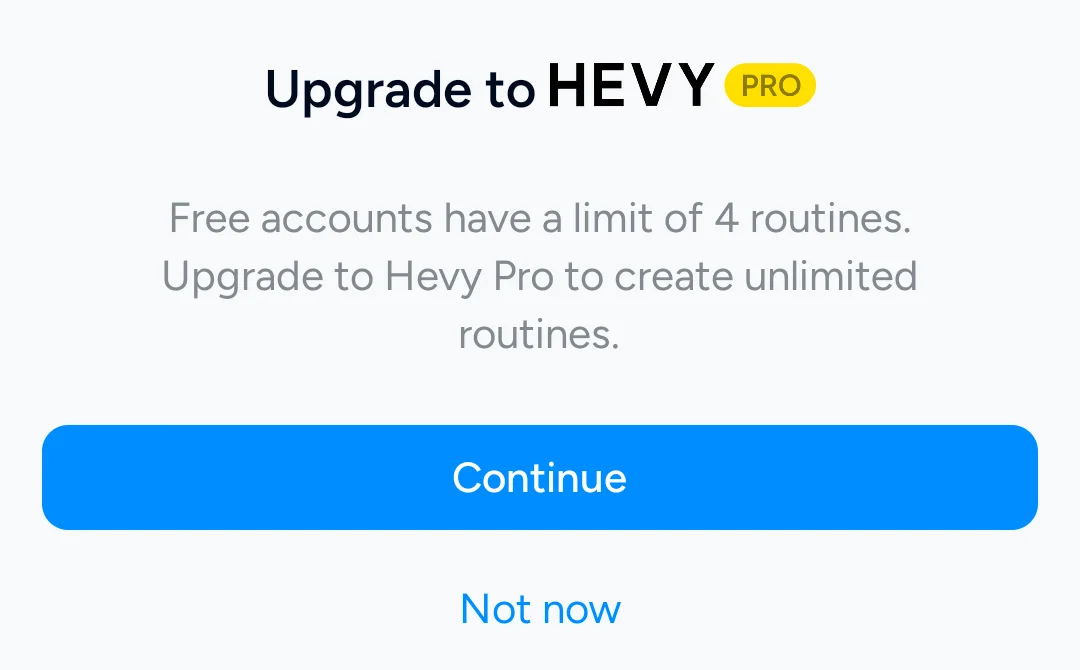
- What its pages say about limits: Hevy 3.1.12 capped us at four routines with an upgrade sheet on the fifth, and its first screen asked us to sign up or log in and offered no way around it. Its pages describe no program engine.
- Where it is the better pick: A Boostcamp user who computes their own percentages and wants a feed and a watch app for the log.
- Where Hevy differs: You bring the numbers, and a five-day split needs Hevy Pro. Official listing: Google Play. Versus page: Kinoku vs Hevy.
Strong
Best for: Lifters on iPhone and Apple Watch who write their own cycles and want a quiet log.
Strong is an early phone gym log whose help pages describe templates rather than programs.
- What it does well: “We offer apps for iPhone (including Apple Watch) and Android.” Strong Cloud keeps workouts synced between devices, and the help centre says “And no ads, ever.”
- What its pages say about limits: Three workout templates is the free ceiling, unlimited templates need Strong PRO, and on Strong 6.2.4 the Learn More screen read “Current free limit: 3 templates”. “Access to all Charts” is a PRO feature, and all users are prompted to sign up before using the app.
- Where it is the better pick: A Boostcamp user on an iPhone who plans their own cycles and wants a quiet log with an Apple Watch app.
- Where Strong differs: No program engine on its pages, and three free templates. Official listing: Google Play. Versus page: Kinoku vs Strong.
When is Boostcamp still the better pick?
You do not always need to leave. Boostcamp’s own pages make the case in three situations.
- You want a coach’s program, free: The listing names nSuns, GZCLP, 5/3/1 and three Reddit programs among “130+ coach programs”, and the Pro page says the library and the tracker are free.
- You want the plan written for you: The listing describes an AI coach that builds a custom plan from your goal, schedule and equipment.
- You train on an iPhone: The homepage says “iOS & Android”, and Kinoku is Android only for now.
If the account or the Pro wall on Strength Score is what bothers you, the three program engines above compute the weights without either, and Kinoku does it with no account.
How this list was checked
Each fact about another app comes from its store listing, its homepage or its Pro page, opened on September 20, 2026, or from a dated emulator run.
- Public citations: Each competitor claim is cited by number in the sources aside, with the exact sentence.
- Phone observations: The Hevy routine cap and sign-up wall and the Strong template cap are observations from an Android 16 emulator, each dated in its source note. Boostcamp, Alpha Progression and KeyLifts had no emulator test.
- One measure, no money: Whether the app computes program weights is the only thing that orders this list, no app paid to appear, and ties stay alphabetical.
Frequently asked questions
The questions Boostcamp users ask before switching, answered from the apps’ own pages.
Which Boostcamp alternatives compute the program weights for you?
Three on this page. Alpha Progression’s homepage says its algorithm hands you a precise weight, rep count and intensity target for every set, and its homepage’s pricing list places those recommendations under Pro. KeyLifts’ homepage says it runs percentage-based programs with training weights and progression prepared for every session. Kinoku ships 5/3/1, GZCLP and nSuns as named programs whose progression runs on the phone. Hevy’s and Strong’s pages describe routines you fill in yourself.
Is Boostcamp free?
Its Pro page says the 11,000+ program library and the full workout tracker are free, and the Play listing adds that the library is free with no ads. Pro holds Strength Score, the per-muscle volume heatmap, personalized programs and 20+ exclusive coach programs, at $14.99 a month or $59.99 a year after a 7-day trial, as printed on that page on September 20, 2026.
Which Boostcamp alternatives work without an account?
Only Kinoku asks for none. Boostcamp’s homepage says to download the app, create an account and choose a program. In our test, Hevy 3.1.12 put a sign-up screen first with no way past it, and Strong’s help page on accounts has every user prompted to sign up before the first workout. Alpha Progression’s and KeyLifts’ pages do not state their account policy, so this page does not say.
Does any Boostcamp alternative have a coach program library?
Not one of this size on the pages we opened. Boostcamp’s listing names nSuns, GZCLP, 5/3/1 and three Reddit programs among 130+ coach programs. KeyLifts’ homepage offers over 170 verified templates for percentage-based programs such as 5/3/1, GZCL, nSuns and Starting Strength. Kinoku ships program templates and named programs, built by us rather than by outside coaches. Alpha Progression’s pages describe a plan generator instead of a coach library.
Which of these apps runs 5/3/1 with the weights ready?
KeyLifts names 5/3/1 first among the percentage-based programs it prepares training weights for. Kinoku ships 5/3/1 Boring But Big and the nSuns 5/3/1 variant as named programs with auto-progression from your training max, free and offline. Boostcamp’s listing names 5/3/1 among the programs you can run. Alpha Progression’s pages describe its own generated plans rather than 5/3/1 by name.
Which Boostcamp alternatives have a watch app?
Hevy’s homepage names Apple Watch and Wear OS. Strong’s help centre lists Apple Watch beside its iPhone app and is silent on Wear OS. KeyLifts’ homepage lists iPhone, iPad, Apple Watch and Android. Kinoku has a free Wear OS app. Alpha Progression’s blog says there is currently no dedicated Apple Watch or Wear OS app, and Boostcamp’s pages do not mention a watch.
Which Boostcamp alternatives work offline?
Boostcamp’s listing carries a one-word bullet, Offline, under its workout tracker. Alpha Progression’s blog says most training features work offline and that generating a plan needs an internet connection. Kinoku’s whole program engine runs on the phone with no connection. Strong 6.2.4 saved a set with the network off in our test, and Hevy 3.1.12 saved one and uploaded it later. KeyLifts’ pages do not state offline behaviour.
Can I move my Boostcamp history to another app?
Boostcamp’s pages we could open do not describe an export, so this page cannot say what file you would get. Kinoku’s importer takes exports from Hevy, Strong, FitNotes and JEFIT (a lifting app), a Strava archive, and a minimal CSV with date, exercise, weight and reps columns, so a Boostcamp export in that shape would come in that way. We have not tested a Boostcamp file, and the other apps here state no Boostcamp import.
Is Boostcamp Pro worth paying for instead of switching?
Sometimes, when what you want sits on its Pro page: Strength Score, the per-muscle volume heatmap, personalized programs and the 20+ exclusive coach programs. If the draw is the coach library itself, that stays free in Boostcamp’s own words, so there is nothing to pay for. If you want the weights computed with no account, Kinoku does that for free, and KeyLifts and Alpha Progression do it on iPhone too.
Which app is closest to Boostcamp in feel?
KeyLifts, if you came for programs, because both put a library of named programs in front of a log and prepare the session from the plan. Hevy, if you came for the tracker, because both run on iOS and Android with an account and a set table. Boostcamp’s own listing calls itself a workout tracker and gym logger with programs, so it sits between the two.
Which of these apps handles deloads and periodization?
Boostcamp’s listing says its coach-designed plans come with progressions, periodization and deloads. Alpha Progression’s homepage lists periodization and deloads as optional Pro features. Kinoku’s 5/3/1 program sets the wave sets and the deload week from your training max, and its builder handles multi-week phases. KeyLifts speaks of progression prepared for every session and does not name deloads. Hevy’s and Strong’s pages describe no deload logic.
What does Kinoku not do that Boostcamp does?
Kinoku has no library of programs from outside coaches and no AI coach that writes a plan from your goal, schedule and equipment; its templates and named programs are built in. It is Android only for now, and its volume targets, readiness tuning and auto set changes sit in Pro. Boostcamp’s listing covers iOS and Android and names 130+ coach programs.
Related pages
- Best workout program apps for periodization: The program engines and the loggers, sorted by who computes the weights.
- Best Alpha Progression alternatives: Apps with a watch app, for lifters leaving Alpha Progression.
- Best Hevy alternatives: Where to go when four routines is not enough.
- Best Strong alternatives: Where to go when three templates is not enough.
- Periodization: How Kinoku runs multi-week programs on the phone.
- Best 5/3/1 apps for Android: For lifters who only need 5/3/1, the apps built around it and how each moves the training max.
- Best StrongLifts alternatives: The same question one step earlier, for lifters leaving a paid 5x5 app.
- Best Fitbod alternatives: For lifters leaving an AI planner, with the free ways to have your next weights set.
- Boostcamp vs Hevy: Boostcamp against Hevy alone, on programs, free caps and the social feed.
Which one fits you
- Choose Alpha Progression if you want the app to hand you a weight and a rep count for every set, you train on iPhone or Android, and Pro after a 14-day trial is fine.
- Choose KeyLifts if you run 5/3/1, GZCL, nSuns or another percentage-based program and want the training weights ready when you open the session.
- Choose Kinoku if you train on Android and want 5/3/1, GZCLP and nSuns with the progression computed on your phone, free, offline and with no account.
- Choose Hevy if you already know your own numbers and want a log with a friends feed, a desktop view and a watch app on either platform.
- Choose Strong if you plan your own cycles, train on an iPhone and an Apple Watch, and three free templates cover your week.
Test record
Tested September 11, 2026
- Environment
- Android Studio Pixel phone emulator Kinoku_Phone_Play, API 36, Android 16
- Hevy
- Version 3.1.12 (version code 3289233), installed from Google Play. Official listing
- Strong
- Version 6.2.4 (version code 602006), installed from Google Play. Official listing
- Kinoku
- Version 1.2.0 (version code 30), a test build installed outside Google Play. Official listing
How this page is checked. Every fact about another app on this page comes from a page that app publishes, which we could open and quote on October 4, 2026, or from a dated emulator test named in that source's note. The sources, with the exact sentence each fact rests on, are listed just above. Every Kinoku fact is tied to the shipping app's code. The page carries no score; the caption above names the measure the list is ordered by. If a fact here has gone stale, the support page is the fastest way to tell us.
Test evidence
What the tested builds showed
 Open full-size image ↗
What a logger's free plan looks like, in Hevy's words
Cropped emulator capture from September 6, 2026. On the fifth New Routine tap, Hevy 3.1.12 showed this sheet. A logger that caps routines is a different kind of app from a program engine, which is why this page sorts by who computes the weights.
One of the apps on this page
Kinoku is free to install
Core tracking works offline, with no account. An export from the app you use today can come along.
Android only for now, with an iPhone version in the works. Some depth is paid, and the pricing page says which parts.
Related features
A 4-phase planning stack. The builder, all 25 templates, named programs with auto-progression, the custom model, and unlimited active programs are free. Pro adds volume targets, readiness tuning, and auto set changes.
Unlimited routines, Smart Sync, Starter Packs, and follow-along links are free, and so are Rotation Groups that cycle through several routines for you.
Open a routine's stats and see the whole routine trend across every time you have done it: a work-done chart and a strength trend where each lift is measured against its own start, so a light move and a heavy move count the same. Plus a look-back on the recap after a big session.