

Best free workout tracker apps for Android (2026)
Six free Android workout trackers, grouped by what their own pages say each free plan holds: no stated cap, a stated cap, paid ad removal, or paid analytics.
Publisher disclosure
Kinoku, made by Dreamsoft Works, writes and publishes this page, and Kinoku is one of the apps on it. Every fact about another app is quoted from a page that app publishes, opened on September 12, 2026, or observed in our own emulator tests: Hevy 3.1.12 on September 6, 2026, and Strong 6.2.4 and JEFIT 17.4.4 on September 11, 2026. We give no score and no winner, and the apps are grouped by what their own pages say.
Quickstart
FitNotes and Kinoku have no stated cap on the basics. Hevy and Strong each state a cap on free routines or templates. JEFIT (a lifting app) sells ad removal in its paid plan, and Strava records for free but charges for analytics. No score, no winner: the apps are grouped by what their own pages say, alphabetical inside each group.
What does each free tier include?
Free with no stated cap on the basics
FitNotes says it is free to use with no ads, ever [1], and that you are not required to register an account to use it [2]. Its paid part is a Supporter app on Google Play that adds some extra exercise types [3], and no FitNotes page we could open prints that app’s price or states a cap on routines, custom exercises, or history.
Kinoku is free with no caps on workouts, routines, history, or runs, and it shows no ads on any plan. There is no account to make. Pro is the one optional extra, and the app works without it, so the pricing page lists what sits in Pro rather than this page.
Free with a stated cap
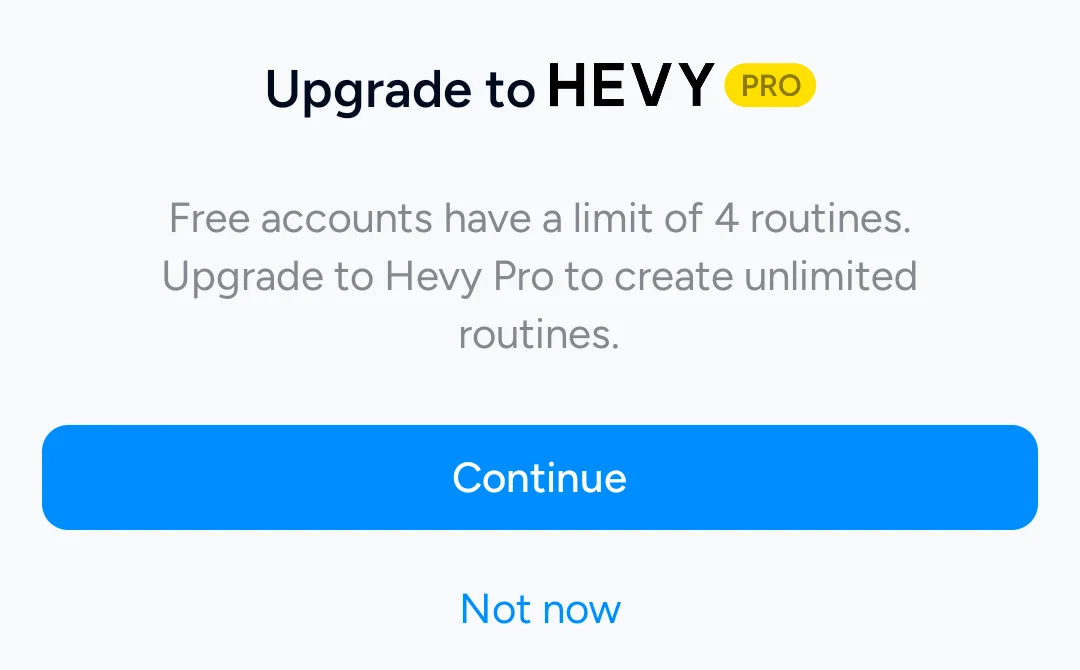
Hevy calls itself a free workout tracker for iOS and Android [4]. In our test of Hevy 3.1.12, the app’s own upgrade sheet said free accounts have a limit of 4 routines [5], and a matching sheet put custom exercises at 7 [6]. Hevy Pro lifts both caps, at the prices its Pro screen showed us [7].
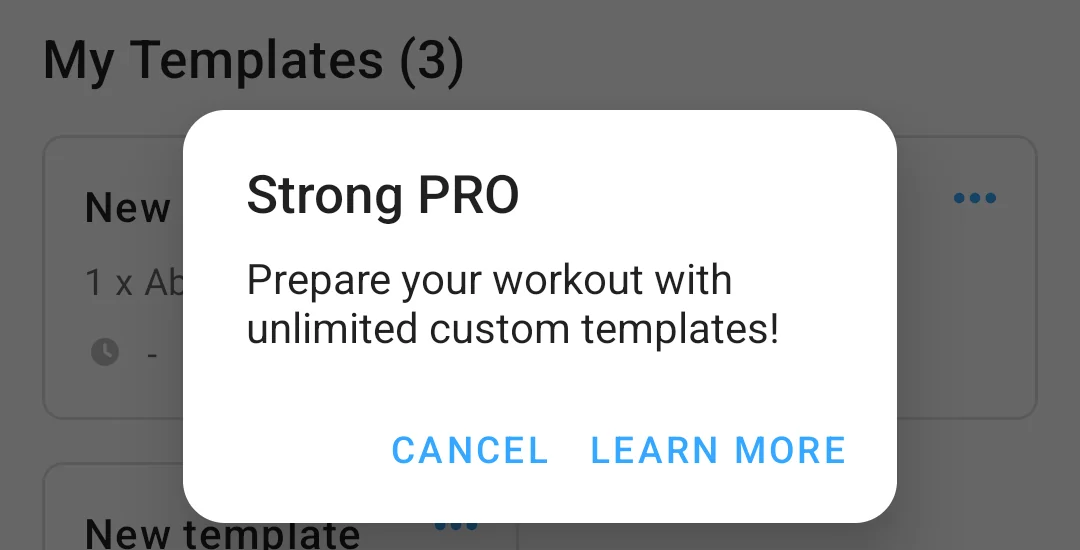
Strong says its accounts are free forever [8], and its help centre says the free version allows up to 3 workout templates, with unlimited templates in Strong PRO [9]. In our test of Strong 6.2.4, the fourth New template tap opened a PRO dialog, and the screen behind it read “Current free limit: 3 templates” [10]. Charts sit on the PRO list as well [11].
Free, with ad removal as a paid benefit
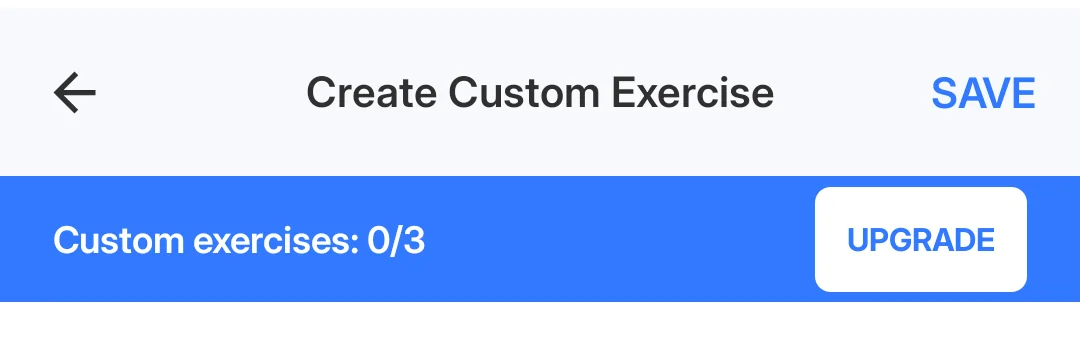
JEFIT lists an ad-free experience under its Elite plan [12], and its blog says that with Elite the app becomes free of all ads [13]. In our test of JEFIT 17.4.4, the custom-exercise form read “Custom exercises: 0/3” beside an Upgrade button [14]. We saw no third-party ad on the screens we walked, which is an absence in one session and not a claim about the free build [15].
Free recording, paid analytics
Strava says there is no cost to record and share your activities [16]. Its subscriber list holds the training analytics, the Training Log, routes that download for offline use, and leaderboards [17]. Strava is a run and ride app, so routines and custom exercises are not its question.
Side by side
A cell that reads “Not stated on a page we could open” means no first-party sentence covered it and our test walk did not reach it, which is not a claim that the app lacks the thing.
| Free routines or templates | Custom exercises on the free plan | Charts and analytics | Ads on the free plan | Export | Paid tier price | |
|---|---|---|---|---|---|---|
| FitNotes | Not stated on a page we could open | Not stated on a page we could open | Not stated on a page we could open | None [1] | CSV, and it cannot be restored into FitNotes [18] | A Supporter app [3]. Its price is not printed on a page we could open |
| Kinoku | No cap | No cap | Per-exercise charts, personal records, and volume trends are free. The Stats Analysis tab and the Pro Analytics hub are paid | None, on any plan | CSV, a backup file you own, and Export for AI | Pro at US $5.99 a month, US $39.99 a year, or US $99.99 once |
| Hevy | 4 on a free account [5] | 7 on a free account [6] | Not stated on a page we could open | Not stated on a page we could open | A CSV of everything, which Hevy says cannot come back in [19] | Pro, shown to us on September 6 at 3.49 euros a month, 26.49 euros a year, or 79.99 euros once [7] |
| Strong | 3 templates [9] [10] | Not stated on a page we could open | “Access to all Charts” is a PRO feature [11] | None, in its own words [20] | CSV [21]. It cannot be imported back into Strong [22] | PRO, shown to us on September 14 at 5.62 euros a month after a one-month trial, 32.72 euros a year, or 97.14 euros once [23] |
| JEFIT | Not stated on a page we could open | 3 on the free plan, in the app’s own header [14] | “Advanced analytics and tracking” is under Elite [12] | Ad removal is an Elite benefit [13] | Not stated on a page we could open | Elite at $12.99 a month or $69.99 a year on jefit.com [24]. On September 14 the app’s own sheet showed us 14.31 euros a month or 76.69 euros a year [25] |
| Strava | Not stated on a page we could open | Not stated on a page we could open | Training Log and Fitness & Freshness are for subscribers [17] | Not stated on a page we could open | GPX, TCX or FIT per activity, plus a bulk archive, on the website only [26] | Omitted. Strava’s own pages print more than one figure, so this page prints none |
Kinoku’s row comes from its own pricing page and its written promise: workouts, routines, history, and runs have no caps, there are zero ads on every tier, per-exercise charts, personal records, and volume trends are free while the Stats Analysis tab and the Pro Analytics hub are paid, and export is a CSV, a backup file you own, and Export for AI. Pro is US $5.99 a month or US $39.99 a year, with a one-time Lifetime buy at US $99.99, and Google Play shows your local price before you buy.
Each app, in its own words
FitNotes
FitNotes does one job with very little in the way. There is no account to register [2], and its privacy page says every workout you record is stored on your device [27]. The homepage says free to use with no ads, ever [1], and the paid part is a Supporter app on Google Play that adds some extra exercise types [3]. Its CSV export cannot be restored into the app, so a separate Backup option covers that [18]. FitNotes is the better pick if you want sets and reps and nothing else, or no plan to weigh at all. It is Android only, and its FAQ says there are no plans for an iPhone version [28]. FitNotes on Google Play, and our Kinoku vs FitNotes page.
Kinoku
Kinoku covers logging, routines, training programs, GPS runs, a muscle map, and stats on the free plan, with no cap on any of them. There is no account and no ad on any plan, and the app works offline, with map tiles, opt-in weather, and Google Play billing as the named exceptions. Pro is the one optional extra, which the pricing page describes as deeper analysis, recovery signals, and the smart layer, at US $5.99 a month, US $39.99 a year, or US $99.99 once. Train often and the Rewards system grants Pro time on its own, with no card. What Kinoku does not do: there is no iPhone app, no web app, no social feed, and no cloud sync between devices, since backup is a file you own and move yourself. Kinoku on Google Play.
Hevy
Hevy is a free workout tracker on iOS and Android [4] that logs from an Apple Watch or a Wear OS watch [29] and is built around training with friends [30]. It asks for an account before the first set, with no guest path we could find [31]. On a free account the app states the caps itself, 4 routines [5] and 7 custom exercises [6], and Hevy Pro lifts both at the monthly, yearly, and lifetime prices its Pro screen showed us [7]. The whole history exports to a CSV file that Hevy says cannot come back in [19]. Hevy is the better pick if you use an iPhone or an Apple Watch, or if your training partners are already on it. Hevy on Google Play, and our Kinoku vs Hevy page.
Strong
Strong is a polished lifting log with a free account [8], a cloud that keeps your workouts in sync between devices [32], and apps for iPhone, Apple Watch, and Android [33]. Its own page says no ads, ever [20]. The first screen is an account wall with no guest path we could find [34]. The free version allows 3 workout templates [9], which the app states as “Current free limit: 3 templates” [10], and charts are a PRO feature [11]. The PRO sheet showed us a monthly price with a one-month trial, a yearly price, and a one-time Strong PRO Forever price [23]. Strong is the better pick if you live on an iPhone or want two devices in sync without carrying a file. Strong on Google Play, and our Kinoku vs Strong page.
JEFIT
JEFIT reaches iOS, Android, and the web [35], allows offline entry that syncs later [36], and gives Elite members space for an unlimited number of exercise programs [37]. The way in runs through a questionnaire and an Elite offer to an account wall with no guest path [38]. On the free plan the custom-exercise form shows its own count, 0 of 3 [14], and an ad-free experience is an Elite benefit [12] [13]. Elite is priced on jefit.com at $12.99 a month or $69.99 a year [24], and the app’s own sheet printed euro figures instead [25]. JEFIT is the better pick if you want a browser view, an iPhone, or a large store of ready-made programs. JEFIT on Google Play, and our Kinoku vs JEFIT page.
Strava
Strava records and shares activities at no cost [16], and while it records it uses no data unless you open the map or its live features [39]. The subscription holds the training layer: the Training Log, Fitness & Freshness, routes you can take offline, and leaderboards [17]. Export runs on the website only, per activity or as a bulk archive [26]. We print no Strava price, because its own pages showed us more than one figure. Strava is the better pick if your running friends are there, or if you want one account across a phone, a watch, and the web [40]. Strava on Google Play, and our Kinoku vs Strava page.
How this list was checked
Every fact about another app on this page rests on one of two things: a sentence on a page that app publishes, quoted in the source list with its address, or something we saw on screen in our own emulator test and wrote down with the app’s version. Where neither exists, the cell says so. The tests ran on an Android 16 Pixel emulator: Hevy 3.1.12 on September 6, 2026, then Strong 6.2.4 and JEFIT 17.4.4 on September 11, 2026, each installed from Google Play, with a test build of Kinoku 1.2.0 given a lighter offline check beside each. We opened the Strong and JEFIT price screens again on September 14, 2026, and every figure had moved, by as much as 3.30 euros. The table prints that day’s prices for those two apps, and Hevy’s figures date from September 6. Prices seen in a test are in the currency of the test account’s Google Play country, and your store may show a different figure. This page gives no score and names no winner.
Frequently asked questions
Which workout apps have no subscription at all?
FitNotes has no plan to weigh: it is free with no ads [1], and its paid part is a separate Supporter app on Google Play [3]. Kinoku’s free plan is a complete app, and Pro can be bought once at US $99.99 instead of as a subscription. Strong showed us a one-time Strong PRO Forever option [23], and Hevy showed a Lifetime price [7]. JEFIT’s Elite page prints a monthly and a yearly plan [24].
What does Hevy’s free plan limit?
In our test, Hevy 3.1.12 put the caps on screen itself: free accounts have a limit of 4 routines [5] and 7 custom exercises [6], and Hevy Pro removes both. The routine sheet appeared on the fifth New Routine tap, and the exercise sheet on the eighth custom exercise. We did not test a per-workout set cap, so this page states nothing about it.
What does Strong’s free version limit?
Strong’s help centre says the free version allows up to 3 workout templates, and unlimited templates come with Strong PRO [9]. The app agrees: in our test the fourth New template tap opened a PRO dialog, and the screen behind it read “Current free limit: 3 templates” [10]. The same help page lists access to all charts as a PRO feature [11], so the free version logs sets but keeps all of its charts behind the paid tier, in its help centre’s words.
Do free workout apps show ads?
It depends on the app, and their own pages are the place to look. FitNotes says no ads, ever [1], and Strong’s page says the same [20]. Kinoku shows none on any plan. JEFIT lists an ad-free experience as an Elite benefit [12] [13], though our one session on 17.4.4 met only JEFIT’s own Elite banner [15]. Hevy and Strava say nothing about ads on a page we could open.
Is a free workout tracker enough for progressive overload?
Progressive overload needs two things from an app: last session’s numbers in front of you as you type, and a history that stays. The five lifting apps here all log the set, so the caps are where they differ: a lifter who runs many routines or builds custom exercises meets Hevy’s [5] [6] or JEFIT’s [14] limits sooner than a lifter with one program. Charts show the trend, and on Strong those are a PRO feature [11], while Kinoku’s Stats charts are free.
Related pages
- Kinoku vs FitNotes: the no-account, on-device logger.
- Kinoku vs Hevy: the social lifting log and its stated free caps.
- Kinoku vs Strong: the cloud-synced lifting log with a 3-template free version.
- Kinoku vs JEFIT: the cross-platform lifting app with an Elite plan.
- Kinoku vs Strava: the social run tracker with free recording.
- Kinoku pricing: what the free plan holds and what Pro adds.
Test record
Tested September 11, 2026
- Environment
- Android Studio Pixel phone emulator Kinoku_Phone_Play, API 36, Android 16
- Strong
- Version 6.2.4 (version code 602006), installed from Google Play. Official listing
- JEFIT
- Version 17.4.4 (version code 2093), installed from Google Play. Official listing
- Kinoku
- Version 1.2.0 (version code 30), a test build installed outside Google Play. Official listing
How this page is checked. Every fact about another app on this page comes from a page that app publishes, which we could open and quote on September 12, 2026, or from a dated emulator test named in that source's note. The sources, with the exact sentence each fact rests on, are listed just above. Every Kinoku fact is tied to the shipping app's code. The page carries no score and no winner. If a fact here has gone stale, the support page is the fastest way to tell us.
Test evidence
What the tested builds showed
 Open full-size image ↗
Hevy's free routine limit, in its own words
Cropped emulator capture from September 6, 2026. On the fifth New Routine tap, Hevy 3.1.12 showed this sheet. A matching sheet, with 7 custom exercises in place of 4 routines, appeared on the eighth custom exercise.
 Open full-size image ↗
Strong's template limit, on the fourth template
Cropped emulator capture from September 11, 2026. With three templates saved, the fourth New template tap in Strong 6.2.4 opened this dialog instead of the editor. Learn More led to a PRO screen whose header read Current free limit: 3 templates.
 Open full-size image ↗
JEFIT's custom-exercise count, on the form itself
Cropped emulator capture from September 11, 2026. The Create Custom Exercise form in JEFIT 17.4.4 carries the free count in its own header, next to an Upgrade button.
 Open full-size image ↗
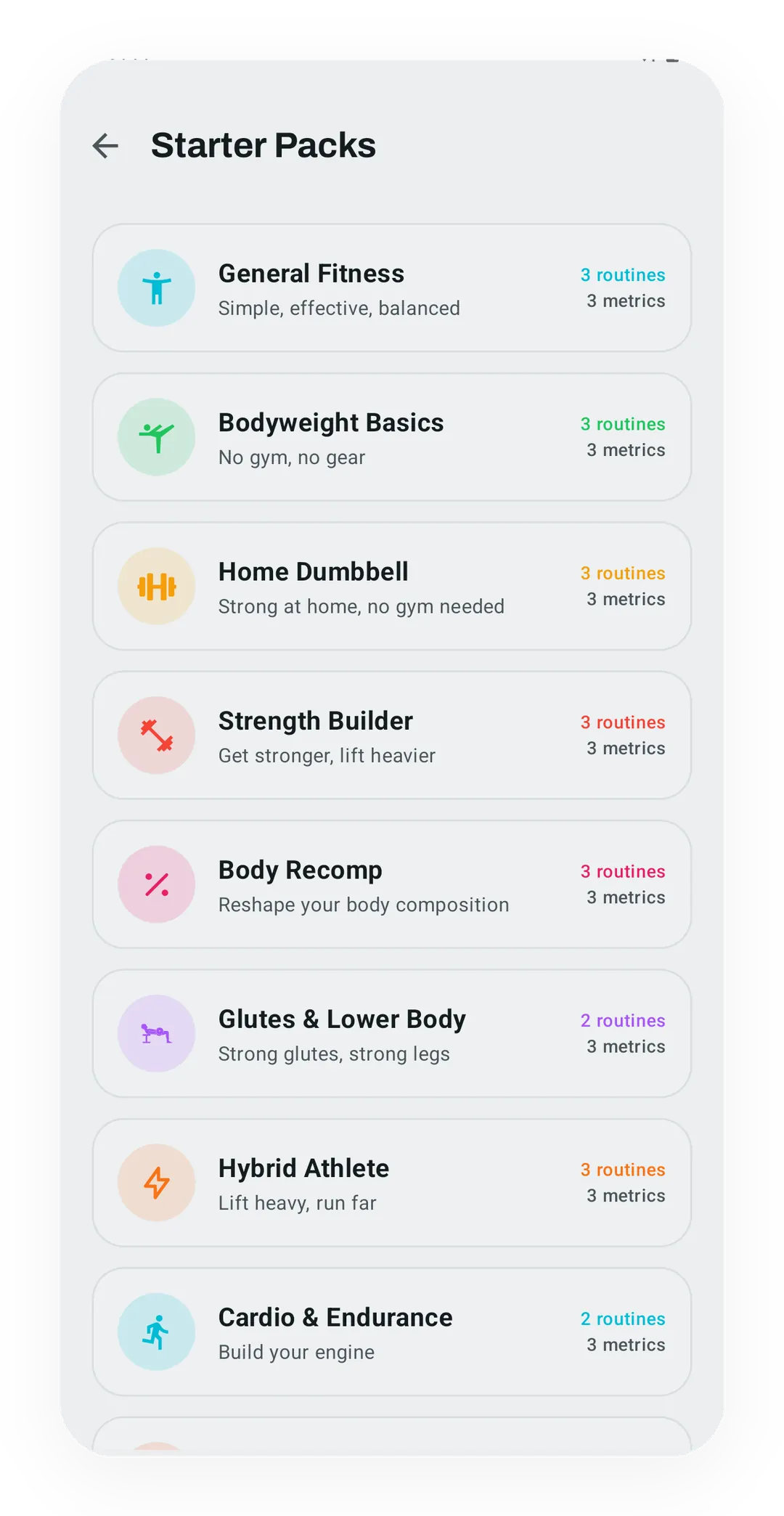
Routines in Kinoku, with no count to watch
Real capture, free plan. Starter packs are routines you inspect and keep, and the free plan puts no cap on how many routines you save.
One of the apps on this page
Kinoku is free to install
Core tracking works offline, with no account. An export from the app you use today can come along.
Android only. Some depth is paid, and the pricing page says which parts.
Related features
Every set, one tap. Track how hard each set felt, your rest timers, set types, and notes.
Unlimited routines, Smart Sync, Starter Packs, and follow-along links are free. Pro adds managed Rotation Groups that cycle through several routines.
Free users earn short-term Pro access by logging often. Paid Pro already has that access, so it does not get reward grants.