

Kinoku vs FitNotes
FitNotes is a free, local, no-account logger for lifters who want sets and reps. Kinoku keeps that and adds runs, a muscle map, programs, and Wear OS.
Publisher disclosure
Kinoku, made by Dreamsoft Works, writes and publishes this page. Every FitNotes product fact is quoted from a FitNotes page we opened on September 12, 2026. The file facts come from our own offline test of FitNotes 25.1 on September 2, 2026, run on an emulator. We say where FitNotes is the better pick, and we give no score and no winner.
Quickstart
FitNotes is a free Android logger with no account, data kept on your phone, and no ads, and it is a good one. Kinoku matches it on all three, then adds scope: GPS runs, a muscle map, training programs, Wear OS, and a paid analytics layer. So FitNotes is the pick if you only want sets and reps, and Kinoku is the pick if you want runs, maps, and plans in one app.
What FitNotes does well
FitNotes gets the basics right, and its own pages back that up.
- No account. FitNotes says you do not need to register an account to use it [1].
- Your data stays on the phone. Every workout you record is stored on your device. FitNotes says it does not send that data off the phone [2].
- Free, with no ads. The homepage says it plainly: free to use, and no ads, ever [3].
- CSV export. You can export your log to a CSV file. FitNotes notes that this file cannot be restored into the app, so it also has a Backup option [4].
- Backup to Google Drive, if you turn it on. About an hour after each workout, a backup can save to your Google Drive account [5].
- Android only. FitNotes says it has no plans for an iPhone version right now [6].
That last one is not a flaw but a scope choice, and Kinoku makes the same one.
What we tested
On September 2, 2026 we ran FitNotes 25.1 from Google Play on an Android 16 emulator with flight mode on and Wi-Fi off, and these were the steps in order:
- Stop the app and open it with no network.
- Start a workout and add bench press.
- Save one set with weight and reps.
- Open the log and find that set.
- End the workout the way the app does it.
- Make a backup file and a CSV file.
- Open restore and load the backup just made.
- Check that the set is still there.
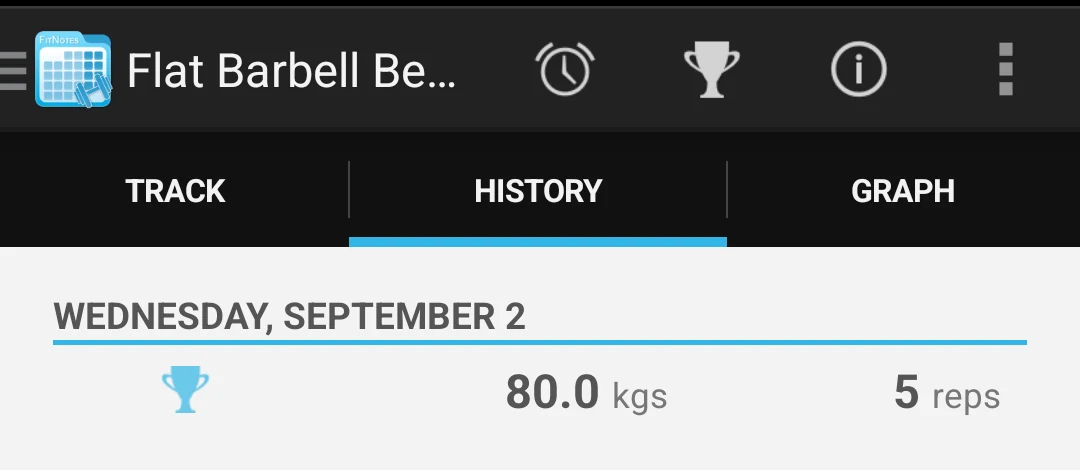
FitNotes has no “finish workout” step for a plain day log, so a saved set sits on that day’s home screen and that was the end state. The run produced FitNotes_Backup.fitnotes and FitNotes_Export.csv, and the CSV held the date, the lift, the muscle group, 80 kg, and 5 reps. The cropped screenshot in the test evidence section, below the sources, shows the set in the log.
Kinoku 1.1.1 got a lighter check on the same emulator: the Today screen opened with no network, read the local log, listed the exercises, and started a bench-press workout. We did not run the full backup and restore loop on that build. Kinoku’s backup and export facts on this page come from its own documentation.
Side by side
FitNotes’ own pages fill the left column and Kinoku fills the right. Each bracketed number is a FitNotes source, listed at the end of the page.
| FitNotes | Kinoku | |
|---|---|---|
| Account | None needed [1]. | None. No email, no password. |
| Where your data lives | On your phone [2]. | On your phone. |
| Price of the core app | Free [3]. | Free. No caps on workouts, routines, or history. |
| Ads | None [3]. | None, on any plan. |
| Export | CSV. It cannot be restored into FitNotes [4]. | CSV, a lossless ZIP backup, and an Export for AI. |
| Backup | Its own Backup option [4], plus opt-in Google Drive backup [5]. | A ZIP file you own. Android system backup may copy eligible data. |
| Platforms | Android only [6]. | Android and Wear OS. |
| GPS run tracking | Not stated on FitNotes’ pages. | Free. Live pace, splits, a route map, and audio cues. |
| Muscle map | Not stated on FitNotes’ pages. | Free. Frequency and volume maps. Pro adds recovery. |
| Training programs | Not stated on FitNotes’ pages. | Free. A builder, 15 templates, and 5/3/1, GZCLP (a beginner barbell program), and nSuns. |
| Wear OS | Not stated on FitNotes’ pages. | Free. |
| Languages | Not stated on FitNotes’ pages. | 10. |
| Paid layer | A Supporter app on Google Play adds extra exercise types [7]. Its price is not on the FitNotes site. | Pro, at US $39.99 a year or US $5.99 a month. Analytics, readiness, and the smart layer. |
“Not stated on FitNotes’ pages” means we did not find that fact on a FitNotes page we could quote, and it does not mean the app lacks it.
FitNotes also appears in two roundups: offline trackers with no account and what each free tier includes.
Where Kinoku differs
Every item here is on the free plan unless it says Pro.
- GPS runs. Kinoku records your route, pace, and splits. It reads cues out loud as you run. Map tiles load when you view a map. Weather is an opt-in.
- A muscle map. Frequency and training-volume views show what your log hits. Pro adds recovery estimates and readiness context.
- Training programs. A program builder, 15 templates, and named plans like 5/3/1, GZCLP, and nSuns. There is no cap on how many you keep.
- Readiness. Pro reads sleep, muscle recovery, lifting load, and heart rate variability (HRV) when it is there. Then it suggests how hard to go today.
- Wear OS. Log sets on a watch. They sync to the phone. Free.
- Ten languages. English, Spanish, French, German, Portuguese, Italian, Japanese, Korean, Bulgarian, and Turkish.
- A free plan with no caps on the basics. Workouts, routines, history, and runs have no limit. A build check blocks a free feature from moving behind Pro without a recorded sign-off.
- Pro. One paid plan. US $39.99 a year, or US $5.99 a month. It buys the analytics hub, run analytics, and the smart layer. The app works without it.
Where FitNotes is the better pick
Some people should stay with FitNotes, and we mean that.
- You want a small, simple app. FitNotes does one job. Kinoku has more screens, and more to learn.
- Your log already lives there. If you like FitNotes and your history is in it, that is a good reason to stay. Nobody needs to switch apps for the sake of it.
- You do not want a paid tier in the picture. Kinoku has one. FitNotes’ paid part is a Supporter app that adds some exercise types [7]. There is no plan to weigh up.
- You only want sets and reps. A lifter who wants a fast log and nothing else needs none of what Kinoku adds.
Moving over
Kinoku’s importer reads FitNotes CSV, and FitNotes 25.1 exported this header in our test:
Date,Exercise,Category,Weight,Weight Unit,Reps,Distance,Distance Unit,TimeExport from FitNotes, then in Kinoku open Settings, then Import & Export, then Import from CSV, and pick the file. The importer detects the FitNotes layout, reads the weight unit and the Distance Unit column, and maps each row to a set. Check the exercise-name matches on the review screen, then save, because the import is one batch that Import History can undo. Use the workout CSV rather than the .fitnotes backup, which is the file FitNotes restore wants. The backup page walks through it, and the import format page shows the FitNotes layouts the importer reads.
Two things are worth knowing first. FitNotes’ own page says its CSV cannot be restored into FitNotes [4], so keep its Backup file too in case you go back. And a FitNotes CSV has no row ids, so importing the same file twice makes two copies that Import History in Kinoku can undo.
What Kinoku does not do
- Android only. There is no iPhone app. FitNotes shares this point [6].
- No cloud sync between devices. Backup is a file you own. Restore it on a new phone yourself.
- No social layer. There is no feed and no followers.
- Some depth is paid. The analytics hub, run analytics, and readiness sit behind Pro. The pricing page says which parts.
- “Offline” has edges. Map tiles load from the network when you view a map. Weather is an opt-in call. Google Play handles billing.
If those limits are fine, and you want more than sets and reps, Kinoku is worth a look, and if not, FitNotes is a solid place to stay.
Test record
Tested September 2, 2026
- Environment
- Android Studio Pixel phone emulator, API 36, Android 16
- FitNotes
- Version 25.1 (version code 64), installed from Google Play. Official listing
- Kinoku
- Version 1.1.1 (version code 28), test build. Official listing
How this page is checked. Every FitNotes product fact on this page comes from a FitNotes page we could open and quote on September 12, 2026, or from the test recorded above. The sources, with the exact sentence each fact rests on, are listed just above. What we say about FitNotes's export file describes the layout Kinoku's importer reads. Every Kinoku fact is tied to the shipping app's code. If a fact here has gone stale, the support page is the fastest way to tell us.
Test evidence
What the tested builds showed
 Open full-size image ↗
FitNotes kept the logged set offline
Cropped emulator capture. With the emulator offline, FitNotes 25.1 saved an 80 kg by 5 bench-press set and showed it in the exercise history.
 Open full-size image ↗
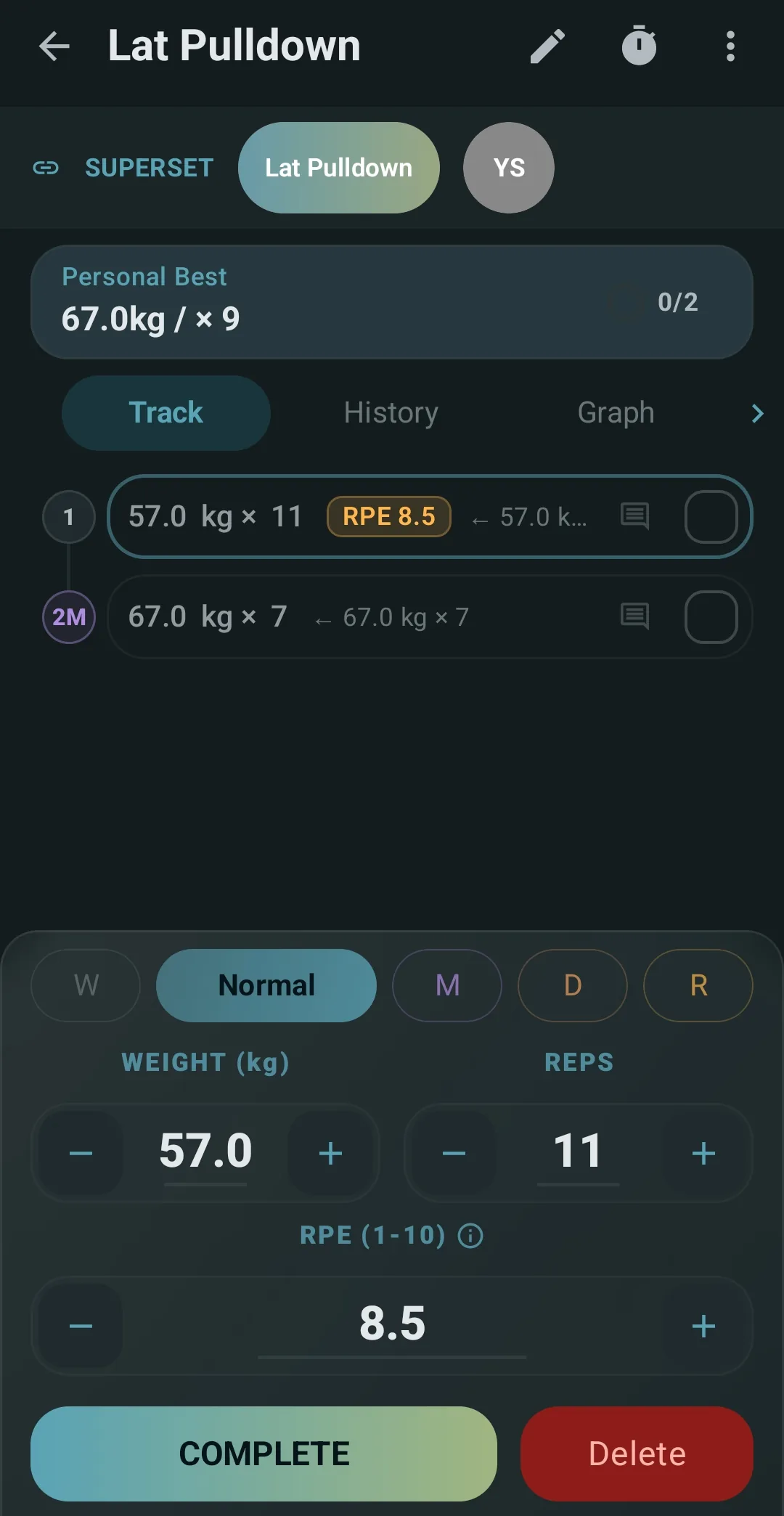
Set entry, mid-workout
The same job FitNotes does, in Kinoku: weight, reps, set type, and how hard the set felt, with your last numbers right where you type.
Try the other side of the table
Kinoku is free to install
Core tracking works offline, with no account. Your export from FitNotes can come along.
Android only. Some depth is paid, and the pricing page says which parts.
Related features
Every set, one tap. Track how hard each set felt, your rest timers, set types, and notes.
Lossless backup, open CSV and JSON import, Strava import, and a scoped Export for AI handoff.
Frequency and training-volume maps are free. Pro adds recovery estimates, readiness context, and exercise picks.