

Best offline workout tracker apps for Android (2026)
FitNotes and Kinoku log workouts with no account and keep the record on the phone. Hevy, JEFIT, and Strong ask for an account first, then log offline and sync.
Publisher disclosure
Kinoku, made by Dreamsoft Works, writes and publishes this page, and Kinoku is one of the apps on it. Every fact about another app is quoted from a page that app publishes, opened on September 12, 2026, or observed in our own emulator tests of FitNotes 25.1 on September 2, Hevy 3.1.12 on September 6, and Strong 6.2.4 and JEFIT 17.4.4 on September 11, 2026. We say where each app is the better pick, and we give no score and no winner.
Quickstart
Two of these five apps need no account and keep the record on the phone: FitNotes and Kinoku. Hevy, JEFIT (a lifting app), and Strong ask for an account first, then log offline and sync later. There is no score and no winner here. The apps are grouped by what their own pages say, alphabetical inside each group.
Which apps work offline with no account?
No account, and the record lives on the phone
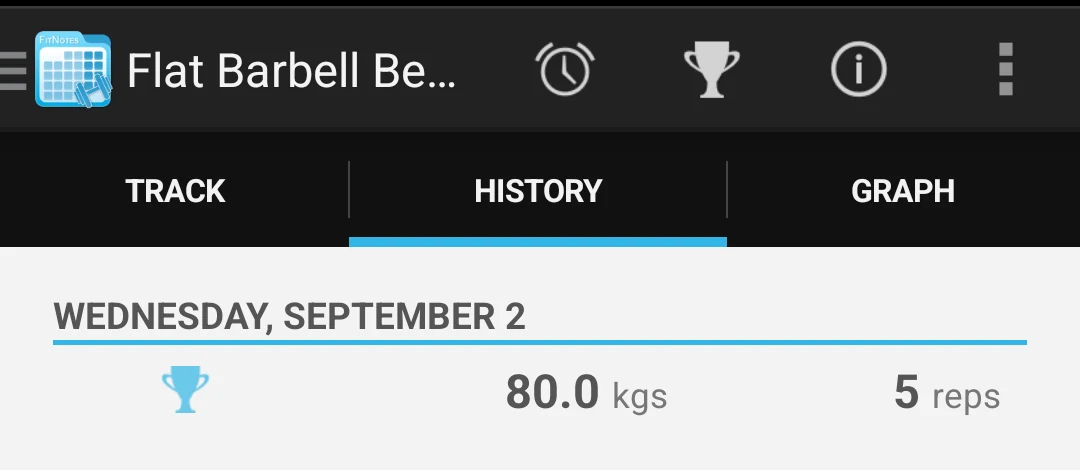
FitNotes says you are not required to register an account [1], and that every workout you record is stored on your device [2]. In our test it saved a bench press set with the network off and listed it in the exercise history [3].
Kinoku asks for no account either, and no Kinoku server holds your training history. The record sits in the app’s private storage on your phone, and core logging works with no signal.
Account first, then offline entry that syncs later
Hevy opened on a sign-up screen with no skip in our test [4]. With flight mode on it still logged and saved a set, showed a banner that one workout had failed to upload, and sent it when the network came back [5].
JEFIT put a sign-up wall after its questionnaire, with no guest path [6]. Its blog says the app allows offline entry and syncs across Android and iOS [7], and in our test a set logged with no network was still counted after a forced stop [8].
Strong’s first screen offered register, log in, or a Google, Facebook, or Apple sign-in, with no guest path [9]. The account is free [10], and Strong Cloud keeps your workouts synced between devices [11]. With no network Strong took a set, finished the workout, and kept it across a forced stop [12].
Side by side
Each cell rests on a page the app publishes or on a test we ran, and the bracketed number names the source. Kinoku’s row comes from its own code and documentation, so it carries no bracket.
| App | Account required | Logs a set offline | Where your record lives | Export | Platforms |
|---|---|---|---|---|---|
| FitNotes | No [1] | Yes, in our test [3] | On your phone [2] | CSV, plus its own backup file. The CSV cannot be restored into FitNotes [13] | Android only [14] |
| Kinoku | No | Yes, in our test | On your phone | CSV, a full backup file, and Export for AI | Android and Wear OS |
| Hevy | Yes, before the first set [4] | Yes. The upload waited and retried [5] | Uploads to your Hevy account once the network is there [5] | One CSV with the whole history, and Hevy says it cannot be imported back [15] | iOS, Android, Apple Watch, Wear OS, and desktop [16] [17] [18] |
| JEFIT | Yes, after a questionnaire and an Elite offer [6] | Yes, in our test [8]. Its blog says offline entry with sync [7] | Its servers, or your device, per its privacy policy [19] | Not stated on a page we could open | iOS, Android, and web [20]. A watch app under Elite [21] |
| Strong | Yes, and the account is free [9] [10] | Yes, in our test [12] | Strong Cloud, on servers in the United States and other countries [11] [22] | CSV [23], and it cannot be imported back into Strong [24] | iPhone, Apple Watch, and Android [25] |
Kinoku’s row, from its own pages: there is no account to make, and no Kinoku server holds your history. Workouts, routines, history, and runs have no caps on the free plan, and there are zero ads on every tier. The backup ZIP restores on a new phone, and the app runs on Android with a Wear OS companion. “Not stated on a page we could open” means no page from that app says either way, which is not a claim that the app lacks the feature.
Each app, in its own words
FitNotes
FitNotes gets the basics right, with a fast set log that asks for no account and sends nothing off the phone. Its privacy page says you are not required to register [1], and that workout data stays on your device and is not transmitted from it [2]. The homepage says free to use with no ads, ever [26]. For a spare copy it has its own Backup option and an opt-in Google Drive backup about an hour after each workout [27]. The CSV export is for reading elsewhere, because FitNotes says data cannot be restored from it [13].
FitNotes is the better pick if you want one small app that logs sets and reps and nothing else, or if you want no paid plan in the picture. It is Android only, and its FAQ page says there are no plans for an iPhone version at the moment [14].
FitNotes on Google Play, and our Kinoku vs FitNotes page.
Kinoku
Kinoku logs sets with no account and keeps the record on your phone, then adds GPS runs, a muscle map, training programs, and a Wear OS app, all on the free plan. Backup is a ZIP file you own, and Android’s own system backup may copy eligible app data to your Google account. The importer reads FitNotes, Strong, Hevy, JEFIT, RepCount, Liftin, Fitbod, and Strava files, with a review screen before anything is saved.
On September 11, 2026 we ran a test build of Kinoku 1.2.0, installed outside Google Play, on the same emulator as Strong and JEFIT, with flight mode on. The Today screen opened, the set sheet took 135 pounds for 5 reps of a barbell bench press, and the set was still listed after a forced stop. The listing is Kinoku on Google Play.
What Kinoku does not do: there is no iPhone app and no web app. Two phones share a record only through a backup file you move yourself, because there is no cloud sync between devices. Nobody sees your workouts unless you share a card, since there is no feed and no friends list. Some depth is paid, and the pricing page says which parts. And “offline” has edges, because map tiles load when you view a map, weather on a run is an opt-in call, and Google Play handles billing.
Hevy
Hevy is a clean, free lifting log with a social feed, on both phone platforms, both watch platforms, and the desktop [16] [17] [18]. It asks for an account before the first set, with no way past that screen [4]. Offline, the log still works: with flight mode on Hevy saved our set, told us one workout had failed to upload, and sent it once the network came back [5]. On privacy, the Save Workout sheet preselected Everyone on our new account, with a note that the workout is publicly available to all users on Hevy, and Private was one tap away [28]. Your whole history exports to a CSV file, which Hevy says cannot be imported back [15].
Hevy is the better pick if you use an iPhone or an Apple Watch, if you train with friends and want their workouts in a feed [29], or if you want your log on more than one device through your account.
Hevy on Google Play, and our Kinoku vs Hevy page.
JEFIT
JEFIT runs on iOS, Android, and the web, per its support page [20], with a watch app under its Elite plan [21]. Its blog says the app allows offline entry and syncs across Android and iOS [7]. In our test, with flight mode on, the Instant tab built a workout, the log took a bench press set, and End & Save Workout kept it with no message [8]. The account came after a questionnaire of about twenty steps and an Elite offer, with no guest path [6]. Its privacy policy says information may be uploaded to the company’s servers or simply stored on your device [19], and the share card after our first workout had Share to community switched on before we touched it [30]. JEFIT’s pages that we could open do not say how to export a log.
JEFIT is the better pick if you use an iPhone, if you want a browser view of your training, or if you want a phone and a web app that sync on their own.
JEFIT on Google Play, and our Kinoku vs JEFIT page.
Strong
Strong is a polished lifting logger on iPhone, Apple Watch, and Android [25], and Strong Cloud keeps your workouts synced between devices [11]. The account is free [10] and comes first, because the opening screen offered register, log in, or a Google, Facebook, or Apple sign-in, with no guest path [9]. Offline logging worked with no fuss: Strong started an empty workout with flight mode on, took a set, finished it with a summary, and still had it in History after a forced stop [12]. Your record sits in Strong Cloud, on servers in the United States and other countries [22]. Export is a CSV file [23], and Strong says exported files cannot be imported back [24].
Strong is the better pick if you use an iPhone or an Apple Watch, or if you want two devices that stay in sync without a file to carry.
Strong on Google Play, and our Kinoku vs Strong page.
How this list was checked
Every fact about another app on this page is a sentence from a page that app publishes, opened and quoted on September 12, 2026, or a thing we saw on screen in a test we ran. The sources list at the end holds the exact sentence behind each bracketed number, and a fact in neither place is not on this page.
The tests ran on an Android Studio Pixel phone emulator on Android 16. FitNotes 25.1 was tested on September 2, 2026, and Hevy 3.1.12 on September 6, each recorded on its own versus page. Strong 6.2.4, JEFIT 17.4.4, and a test build of Kinoku 1.2.0 were tested on September 11, 2026, and the test record under this page lists those versions. Every test logged one set with flight mode on. The Hevy, JEFIT, and Strong tests also looked for a way in without an account, stopped the app by force with the set logged, and turned the network back on to watch for any message.
The page gives no score and no winner, and the groups come from what each app’s own pages say.
Frequently asked questions
Does a workout tracker need an account to work offline?
No, because the account and the network are separate questions. FitNotes and Kinoku take no account and keep the record on the phone. Hevy, JEFIT, and Strong ask for an account first, and in our tests each one still logged a set with flight mode on, then synced or waited until the network came back. An account decides where the record ends up, not whether the log works in a basement gym.
Which free workout apps keep the data on the phone?
Two of the five here. FitNotes says workout data is stored locally on your mobile device and not transmitted from it [2]. Kinoku keeps the record in the app’s private storage with no Kinoku server behind it, and Android system backup may copy eligible data to your Google account. Hevy, JEFIT, and Strong sync the record to an account, though JEFIT’s policy also allows for it to stay on the device [19].
Can I move my log from Hevy or Strong to an offline app?
Yes, by file. Hevy exports the whole history as one CSV from Settings, and says the file cannot be imported back into Hevy [15]. Strong exports a CSV too [23], and says the same about its own file [24]. Kinoku’s importer reads both layouts and shows a review screen before it saves. Kinoku 1.3.0, the version on Google Play now, fixed the Hevy import bugs our test found, and the Strong one is still open, as the Hevy and Strong pages describe, so the original file is worth keeping.
What happens to an offline log when the phone is lost?
The log goes with it unless a copy exists elsewhere, which is the cost of a record that lives on the phone. FitNotes has its own Backup option [13] and an opt-in Google Drive backup about an hour after each workout [27]. Kinoku writes a full backup ZIP you keep on a drive you pick, and Android system backup may hold eligible app data too. Strong Cloud keeps workouts synced between devices [11], and Hevy uploads each workout to your account once the network is there [5].
Is offline the same as private?
No, because offline says the log works with no signal, and private says where the record goes and who can see it. Hevy logged offline in our test, and its Save Workout sheet preselected Everyone on a new account [28]. JEFIT logged offline too, and its share card had Share to community switched on by default [30]. FitNotes says the record stays on the phone [2], and Kinoku has no feed, so there is nowhere for a workout to be posted.
Related pages
- Kinoku vs FitNotes
- Kinoku vs Hevy
- Kinoku vs JEFIT
- Kinoku vs Strong
- Kinoku vs Strava for GPS runs
- Offline-first fitness tracking, the learn page on where a record lives and what Kinoku gives up for it
Test record
Tested September 11, 2026
- Environment
- Android Studio Pixel phone emulator Kinoku_Phone_Play, API 36, Android 16
- Kinoku
- Version 1.2.0 (version code 30), a test build installed outside Google Play. Official listing
- JEFIT
- Version 17.4.4 (version code 2093), installed from Google Play. Official listing
- Strong
- Version 6.2.4 (version code 602006), installed from Google Play. Official listing
How this page is checked. Every fact about another app on this page comes from a page that app publishes, which we could open and quote on September 12, 2026, or from a dated emulator test named in that source's note. The sources, with the exact sentence each fact rests on, are listed just above. Every Kinoku fact is tied to the shipping app's code. The page carries no score and no winner. If a fact here has gone stale, the support page is the fastest way to tell us.
Test evidence
What the tested builds showed
 Open full-size image ↗
FitNotes kept the logged set with no network
Cropped emulator capture from September 2, 2026. With flight mode on, FitNotes 25.1 saved an 80 kg by 5 bench press set and listed it in the exercise History tab.
 Open full-size image ↗
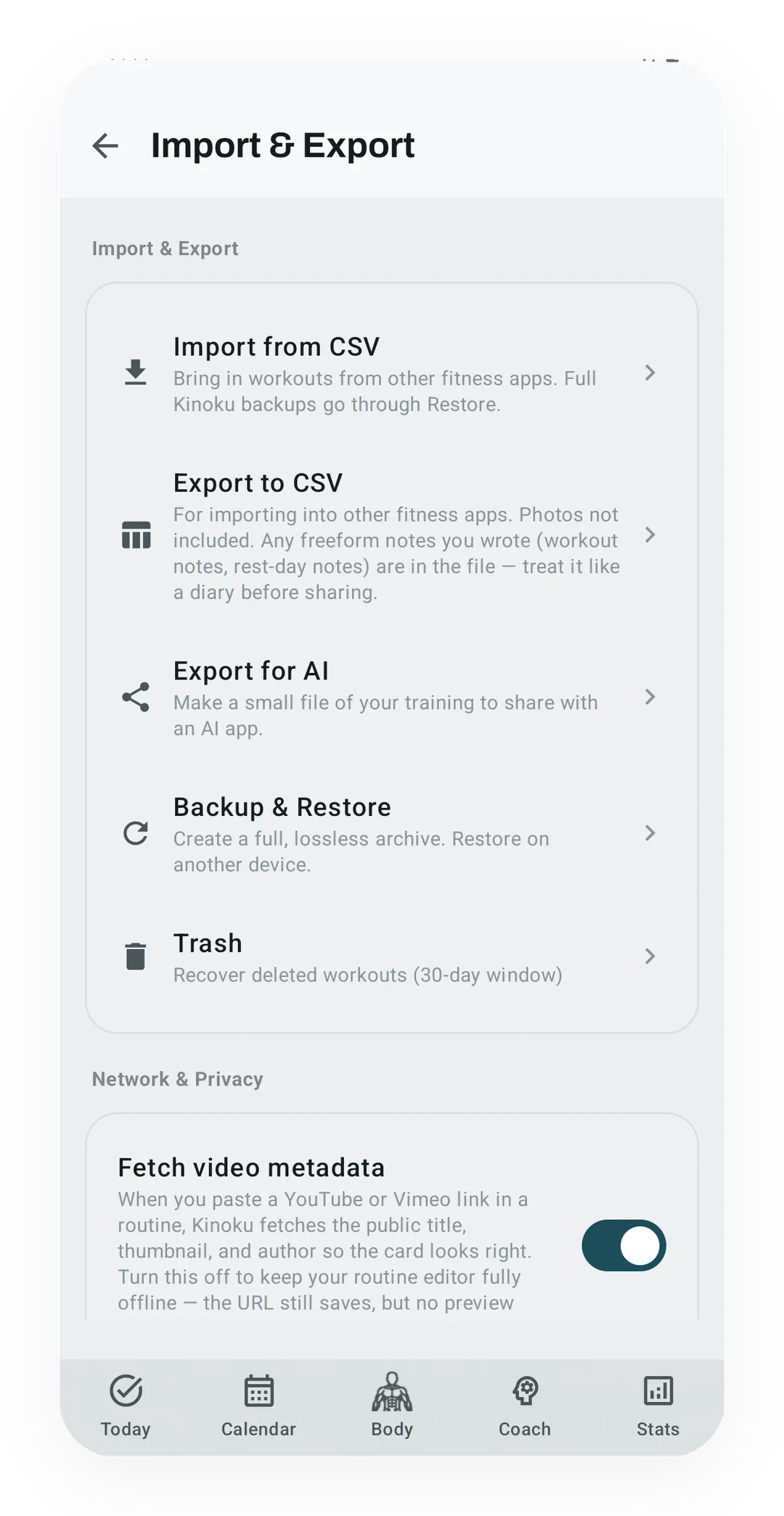
Kinoku's data controls
Backup, restore, import, export, and deletion sit together in Kinoku's Data & Storage settings, and each one runs on the phone with no account behind it.
One of the apps on this page
Kinoku is free to install
Core tracking works offline, with no account. An export from the app you use today can come along.
Android only. Some depth is paid, and the pricing page says which parts.
Related features
Lossless backup, open CSV and JSON import, Strava import, and a scoped Export for AI handoff.
Every set, one tap. Track how hard each set felt, your rest timers, set types, and notes.
Bring your Strava history with no login token. Choose the Strava archive ZIP once; Kinoku reads activities.csv and supported route files from it on your phone. Kinoku never touches Strava's servers.