
Best apps for lifting and running in one app (2026)
Five apps sorted by whether they log gym sets and GPS runs in one history. Activ.run and Kinoku do both; Hevy and Strong log lifts; Strava records runs.
Activ.run and Kinoku log gym sets and GPS runs in one Android app with no account gate; Kinoku also keeps steps, classes and one fitness curve for both, while Hevy, Strong and Strava each cover one half.
At a glance
| App | Best for | Better at | Main trade-off |
|---|---|---|---|
| Activ.run | lifters who run and want a fast gym log with GPS runs, Garmin sync and no subscription wall | logs lifts and GPS runs in one app; imports FIT files and syncs Garmin and Strava | no training plans yet, and offline use and steps are not stated on its pages |
| Kinoku | lifters who run and want lifts, runs, steps and classes on one fitness curve with no account | one Form curve scores a gym session and a run in the same units; Wear OS; imports Hevy, Strong, FitNotes, JEFIT and Strava files | Android only for now, no social feed, deeper run analytics are Pro |
| Hevy | lifters who want a social feed and Apple Watch or Wear OS logging, with runs in another app | a feed, a desktop view, Apple Watch and Wear OS logging | an account before the first set; free plan caps routines at 4; no run tracking on its pages |
| Strong | lifters on iPhone or Apple Watch who want cloud sync between devices, with runs in another app | Strong Cloud sync between devices; Apple Watch | an account before use; free plan caps templates at 3; no run tracking on its pages |
| Strava | runners who want the feed and segments, with lifting logged elsewhere | free recording and sharing of runs; a large feed; Wear OS 3 and Apple Watch | training analysis and offline route maps sit behind the subscription; set logging is not on the pages we opened |
Publisher disclosure
Kinoku, made by Dreamsoft Works, writes and publishes this page, and Kinoku is one of the apps on it. Every fact about another app is quoted from a page that app publishes, opened on September 20, 2026, or observed in a dated emulator test named in that source's note. We give no score. The list is ordered by what the app logs in one history, both first, then lifts only, then runs only, and every label points at a quoted sentence.
Quickstart
Activ.run and Kinoku log gym sets and GPS runs in one Android app, and neither puts an account between you and the first set. Kinoku also keeps steps, classes and one fitness curve that scores both halves of the week, while Hevy and Strong log lifts and Strava records runs. The list is ordered by what the app logs in one history, both first, then lifts only, then runs only. The caption on the table names that measure, every label points at a sentence the app publishes, and we give no score.
Why lifters who run look for one app
The common setup is two apps. A gym logger such as Hevy or Strong takes the sets, a running app such as Strava takes the miles, and the week’s total lives in nobody’s history. That works until a heavy leg day changes how Wednesday’s run goes, because neither app can see the other one. The apps below are sorted by what their own pages say about logging both.
Which apps log lifts and runs in one place?
- Both in one app: Activ.run, whose listing opens with “one app for your lifts and your runs” [1], and Kinoku, which logs sets, GPS runs, steps and classes in one history on the phone.
- Lifts, with runs elsewhere: Hevy, “a free workout tracker for iOS and Android” [6], and Strong, which “offer[s] apps for iPhone (including Apple Watch) and Android” [10]. Neither page describes run tracking.
- Runs, with lifts elsewhere: Strava, where “there is no cost to record and share your activities” [14], and set logging is not on the pages we opened.
Side by side
Every cell comes from a first-party quote or our emulator test. Where an app’s pages do not state a feature, the cell reads “Not stated”.
| Activ.run | Kinoku | Hevy | Strong | Strava | |
|---|---|---|---|---|---|
| Logs sets | Yes [1] | Yes | Yes [6] | Yes [10] | Not stated |
| GPS runs | Yes [1] | Yes | Not stated | Not stated | Yes [14] |
| Steps and classes | Not stated | Yes | Not stated | Not stated | Not stated |
| One load curve for both | Not stated | Yes | Not stated | Not stated | Not stated |
| Account before use | No gate [4] | None | Sign-up first [8] | Sign-in first [13] | Sign-up page [17] |
| Free plan | Core free [3] | No caps on the basics | Caps routines at 4 [9] | Caps templates at 3 [12] | Recording free; analysis paid [15] |
| Watch | Garmin sync [2] | Wear OS | Apple Watch, Wear OS [7] | Apple Watch [10] | Wear OS 3+, Apple Watch [16] |
| Platforms | Android [1] | Android | iOS, Android [6] | iPhone, Android [10] | Android, iOS, web [16] |
| Imports | FIT, Strava sync [2] | Hevy, Strong, FitNotes, JEFIT (a lifting app), Strava | Not stated | Not stated | Not stated |
| Training plans | On the roadmap [5] | Free templates and a builder | Not stated | Not stated | Subscriber feature [15] |
Each app, in its own words
Activ.run
Best for: lifters who run and want a fast gym log with GPS runs, Garmin sync and no subscription wall.
Activ.run’s listing describes “one app for your lifts and your runs” that tracks “gym workouts and GPS runs in a single place” [1]. It syncs a Garmin watch, imports FIT files and connects a Strava account [2], and it states “no subscription wall on the core features” [3]. Its homepage promises “no account gate, no onboarding wall” [4].
- Where it is the better pick: you want the lightest one-app setup and Garmin or Strava sync, and steps, classes and a shared fitness curve are not on your list.
- What its pages do not say: offline use, step counting and a watch app of its own. Its Strava page says “training plans are on the roadmap, not shipped” [5].
- Official listing: Google Play. Versus page: Kinoku vs Activ.run.
Kinoku
Best for: lifters who run and want lifts, runs, steps and classes on one fitness curve with no account.
Kinoku logs a set with weight, reps, effort and set type, records a GPS run with splits, pace, climb and heart rate, counts daily steps, and logs swims and classes, all in one history on the phone with no account. A gym session and a run each earn training stress points on the same Form curve, so the readiness read knows the whole week. The importer reads Hevy, Strong, FitNotes, JEFIT and Strava files, and there is a Wear OS app.
- Where it is the better pick: you want one record for everything you do, no account, and a load curve that sees both halves.
- What Kinoku does not do: iPhone, a social feed, or cloud sync between phones. The deeper run dashboard, readiness and zone training are Pro; the pricing page lists every gate.
- Official listing: Google Play.
Hevy
Best for: lifters who want a social feed and Apple Watch or Wear OS logging, with runs in another app.
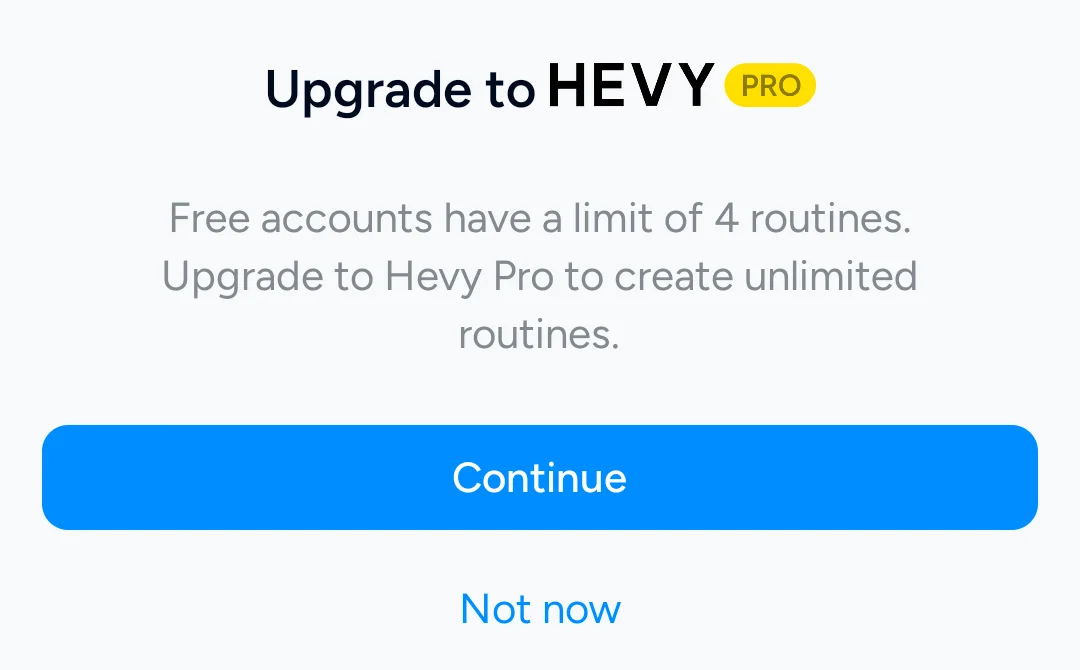
Hevy calls itself “a free workout tracker for iOS and Android” [6] and logs “completely from your Apple Watch or WearOS device” [7]. In our test, Hevy 3.1.12 opened on a sign-up screen with no skip path [8] and capped a free account at four routines [9].
- Where it is the better pick: the feed, the desktop view and the watch app matter, and a separate running app suits you.
- Official listing: Google Play. Versus page: Kinoku vs Hevy.
Strong
Best for: lifters on iPhone or Apple Watch who want cloud sync between devices, with runs in another app.
Strong’s help centre offers “apps for iPhone (including Apple Watch) and Android” [10] and says “Strong Cloud keeps your workouts automatically synced between devices” [11]. The free version allows “up to 3 Workout Templates” [12], and the app opened on a sign-in screen in our test [13].
- Where it is the better pick: you want the same log on two devices with no file to carry, and the three-template cap does not bind you.
- Official listing: Google Play. Versus page: Kinoku vs Strong.
Strava
Best for: runners who want the feed and segments, with lifting logged elsewhere.
Strava’s help centre says “there is no cost to record and share your activities” [14], while offline route maps, Fitness & Freshness and the training log sit with the subscription [15]. It supports “Wear OS 3.0 and above” [16] as well as Apple Watch. Set logging is not described on the pages we opened.
- Where it is the better pick: the run feed, segments and routes are the point, and your lifting lives in a gym app or a notebook.
- Official listing: Google Play. Versus page: Kinoku vs Strava.
How this list was checked
Every fact about another app is quoted from a page that app publishes, opened on September 20, 2026, or observed in a dated emulator test recorded below. Activ.run had no emulator test on that date, so its facts rest on its listing and site. Kinoku facts come from the shipping app. Where a page does not state something, the table says “Not stated” rather than guessing.
Frequently asked questions
The questions people ask before they pick one app for lifts and runs, answered from the same sources as the table above.
Which apps log both lifts and GPS runs in one app?
On the pages we opened, two do: Activ.run, whose listing says it is one app for your lifts and your runs, and Kinoku, which logs sets and GPS runs in one history on the phone. Hevy and Strong describe themselves as workout trackers for the gym, and Strava’s help centre describes recording and sharing activities.
Do I need an account for Activ.run or Kinoku?
Activ.run’s homepage says there is no account gate and no onboarding wall. Kinoku asks for no account at all; the log lives on the phone and moves by a backup file or by Android’s own backup. Hevy and Strong both opened on a sign-up screen with no skip path in our emulator tests, and Strava’s sign-up page is where recording starts.
Is either one-app option free?
Activ.run’s listing says there is no subscription wall on the core features, and no in-app purchase flag showed on its listing on September 20, 2026. Kinoku’s free plan has no cap on workouts, routines, history or runs, with no ads. Kinoku’s deeper run analytics, readiness and zone training are Pro.
Can I move my Hevy, Strong or Strava history into one app?
Kinoku reads the Hevy CSV, the Strong CSV and the Strava bulk archive with its GPX route files, and also FitNotes and JEFIT exports; it does not read FIT files. Activ.run’s listing names FIT import and Strava sync. Hevy and Strong both state that their own exports cannot be imported back.
Which app scores a gym session and a run on the same fitness curve?
Kinoku does. A set session and a run each get training stress points, and both land on one Form curve, so a Thursday readiness read reflects Monday’s squats and Wednesday’s run. The other apps on this page do not describe a shared load curve on the pages we opened.
Does Activ.run work offline?
Its pages do not say, so this page makes no claim either way. Kinoku’s core tracking works offline, and map tiles for a route load from the network into a cache. Strava’s help centre says recording uses no data unless you view maps or turn on Live Segments or Beacon.
Which app has a watch app?
Hevy names both Apple Watch and Wear OS on its homepage. Strong’s help centre names iPhone with Apple Watch and Android, without Wear OS. Strava supports Wear OS 3.0 and above and Apple Watch. Kinoku has a Wear OS app. Activ.run’s pages name Garmin sync rather than a watch app of its own.
Which app tracks steps and classes as well?
Kinoku counts daily steps, logs swims and classes, and keeps them in the same history as lifts and runs. None of the other four apps on this page describes step counting or class logging on the pages we opened, so the table leaves those cells as not stated.
What does Activ.run not do yet?
Its own Strava alternative page says training plans are on the roadmap and not shipped. Its pages do not mention offline use, steps or a watch app. We had no emulator test of Activ.run on September 20, 2026, so every Activ.run fact here rests on its listing and its site.
Why is Strava on a lifting page at all?
Because the common two-app setup is a gym logger plus Strava, and this page compares that setup with one app for both. Strava records and shares runs for free, puts analysis behind its subscription, and does not describe set logging on the pages we opened.
What are Kinoku’s limits on this page?
Android only for now, no social feed, and no cloud sync between phones. The deeper run dashboard with heart-rate zones and race forecasts is Pro, as are readiness and the forecast tails on the Form curve. Free covers set logging, GPS runs, steps, classes and the base curve.
How was this list checked?
Every sentence about another app is quoted from a page that app publishes, opened on September 20, 2026, or from a dated emulator test. The sources sit at the foot of the page. Where an app’s pages do not state a fact, the table says so instead of guessing.
Related pages
- One app or two: tracking lifts and runs together, the reasoning behind a shared load curve.
- Best hybrid training apps for Android, the plan-led apps for runners who lift.
- All-in-one fitness tracker apps for Android, the big health apps compared by how many kinds of training they keep.
- Best gamified fitness apps for Android, the apps that turn sets, runs or steps into a game.
- Kinoku vs Strava and Kinoku vs Hevy, the two halves of the usual setup.
- Which Android app logs both swimming and lifting?, the same question for lifters whose other sport is the pool.
- Which free app runs GZCLP or nSuns on Android?, for a lifter who wants the app to run a strength program and set the weights.
- Best Runkeeper alternatives, run trackers for Runkeeper users, including one that keeps a gym log in the same history.
Which one fits you
- Choose Activ.run if you lift and run, you want a fast gym log with GPS runs in the same place, and Garmin or Strava sync matters more to you than steps, classes or a shared fitness curve.
- Choose Kinoku if you lift and run on Android, you want no account and the record on your phone, and you want steps, classes and one fitness curve that scores both halves of the week.
- Choose Hevy if your lifting log matters most, you want a feed and a watch app, and you are fine keeping runs in a separate app.
- Choose Strong if you are on iPhone or Apple Watch, you want your lifts synced across devices by Strong Cloud, and runs live elsewhere.
- Choose Strava if the run feed, segments and routes are the point, and you log lifts in a gym app or not at all.
Test record
Tested September 11, 2026
- Environment
- Android Studio Pixel phone emulator Kinoku_Phone_Play, API 36, Android 16
- Strong
- Version 6.2.4 (version code 602006), installed from Google Play. Official listing
- Hevy
- Version 3.1.12 (version code 3289233), installed from Google Play, tested September 6, 2026. Official listing
- Kinoku
- Version 1.2.0 (version code 30), a test build installed outside Google Play. Official listing
How this page is checked. Every fact about another app on this page comes from a page that app publishes, which we could open and quote on September 20, 2026, or from a dated emulator test named in that source's note. The sources, with the exact sentence each fact rests on, are listed just above. Every Kinoku fact is tied to the shipping app's code. The page carries no score; the caption above names the measure the list is ordered by. If a fact here has gone stale, the support page is the fastest way to tell us.
Test evidence
What the tested builds showed
 Open full-size image ↗
Hevy's free routine limit, in its own words
Cropped emulator capture from September 6, 2026. On the fifth New Routine tap, Hevy 3.1.12 showed this sheet.
One of the apps on this page
Kinoku is free to install
Core tracking works offline, with no account. An export from the app you use today can come along.
Android only for now, with an iPhone version in the works. Some depth is paid, and the pricing page says which parts.
Related features
Live pace, splits, a route map, and audio cues. Your run record is not uploaded to Kinoku; map tiles load when you view maps, and weather is a clear opt-in.
Every set, one tap. Track how hard each set felt, your rest timers, set types, and notes.
Daily steps, streaks, brisk minutes, and an hour-by-hour view of how you moved.
The lead card on the Coach screen shows how fresh or tired you are right now. One Form line sits over three soft bands: Fresh, OK, and Tired, with a state pill beside it. Tap Show fitness details for the fitness and fatigue lines behind it. The base chart is free for all. Pro adds forecast lines and a note in plain words.