

One App or Two: Tracking Lifts and Runs Together
A gym app plus a running app, or one app that logs both. What each setup can see, and how Kinoku scores a squat session and a tempo run on one curve.
Kinoku in practice
Where this shows up in the app
 Open full-size image ↗
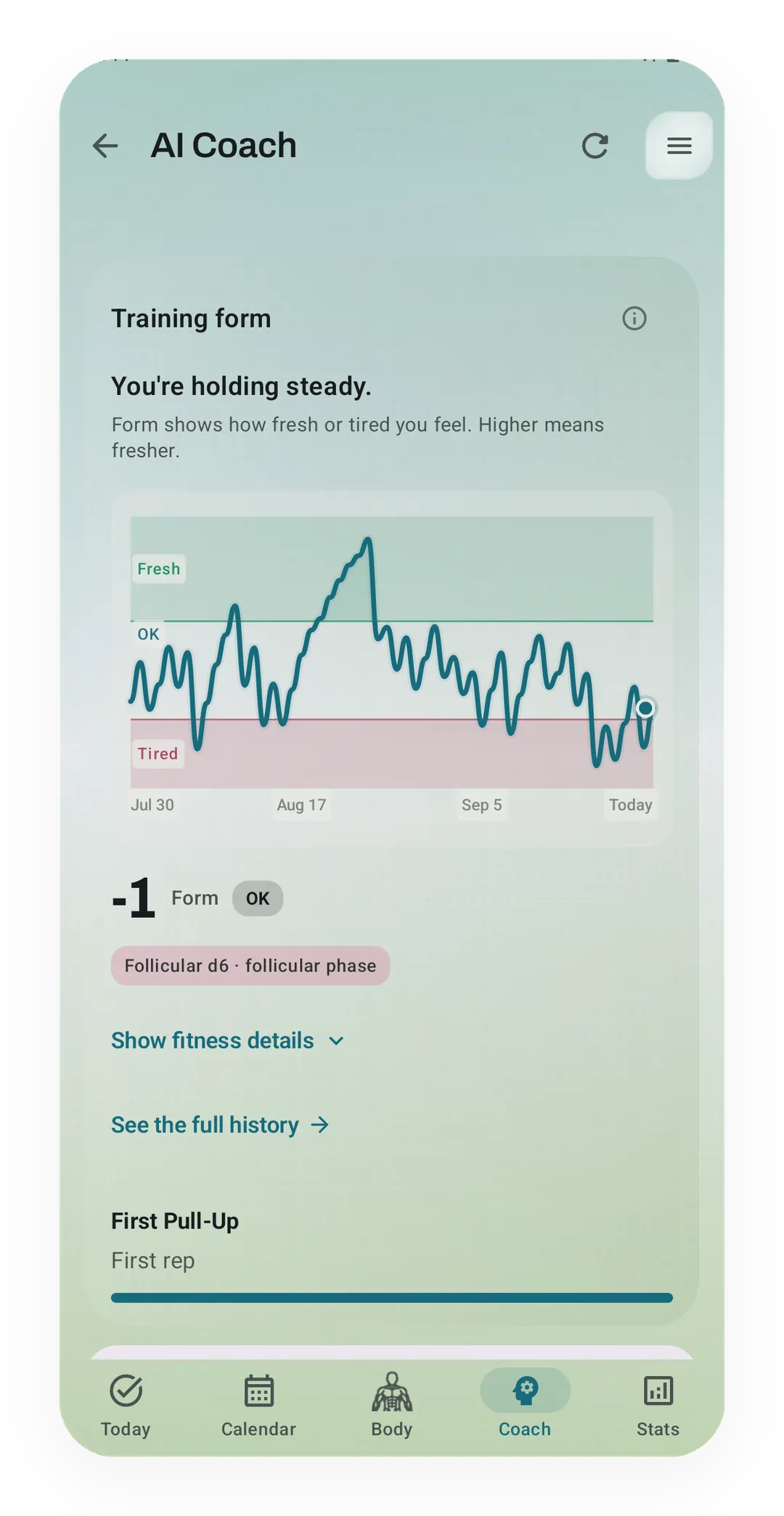
One curve for lifts and runs
Real app capture. The Form curve on the Coach screen scores every session, gym or road, in the same training stress units, so the week's load is one line.
Quickstart
One app that logs lifts and runs can score both on one fitness curve, so a Thursday readiness read knows about Monday’s squats and Wednesday’s tempo run. Two apps, one for the gym and one for the road, each see half the week, and the person carries the sum in their head. Kinoku is the one-app setup: sets, reps and effort in the same history as GPS runs, steps and classes, with no account. The compare pages list the other apps that do part of this.
What each setup gives you
Two apps is the common answer, and it is a good one for each half. A gym logger such as Hevy, which its own page calls “a free workout tracker for iOS and Android” [1], is fast between sets and knows what a drop set is. A running app such as Strava, which “is free to record and share your activities” [2], knows pace, splits and routes, and puts the deeper analysis behind a subscription [3]. Neither app reads the other one’s log, so the week’s total load lives nowhere.
One app trades some depth on each side for one record. Kinoku logs a set with weight, reps, effort (RPE, rate of perceived exertion) and set type. A run gets GPS, splits, heart rate and a route map, and Kinoku writes both to one history on the phone. The gain is not the logging. It is what the app can compute once both halves are in the same place.
Side by side
| Two apps | One app (Kinoku) | |
|---|---|---|
| Set logging | The gym app’s, with its own caps and account rules | Free, no cap on routines or history, no account |
| GPS runs | The running app’s, with analysis behind its subscription [3] | Free capture with splits, pace, climb and heart rate; deeper run analytics are Pro |
| Steps, classes, swims | A third app, or not tracked | The same history |
| One load curve for the week | Not possible; each app scores its own half | One Form curve from every scored session |
| Readiness that knows the whole week | No | Yes, Pro, from sleep, heart rate variability and the shared load |
| Social feed | Strava’s feed, Hevy’s feed | None |
| Watch | Each app’s own | Wear OS only, no Apple Watch |
| Where the data lives | Each vendor’s account | The phone, plus a backup file you own |
How Kinoku scores both halves
Take a Monday session of 10 working sets at 80 kg for 5 reps at RPE 8, and a 45-minute tempo run on Wednesday. Kinoku scores the gym session at about 64 training stress points from the sets, load, reps and effort, and the run at about 81 from its duration and effort [4]. Both numbers land on the same fitness and fatigue curve, the Banister model, so the curve dips after each one and the form read on Thursday reflects both [5]. A two-app week produces two curves that never meet, or more often no curve at all.
One edge to know: a run shows on the muscle map only as a session. The map’s frequency view counts each workout that trained a muscle, so a run adds a leg session there. Its volume and recovery views leave cardio out, and a run carries no resistance volume, so the fatigue curve is where its load shows [6]. Map tiles for the route load from the network and stay in a cache, so the route draws again offline once it has been seen.
When to use which
- Two apps when one half of your training is the whole point. A powerlifter who runs twice a year loses nothing by keeping a gym logger. A marathoner whose lifting is two sessions of accessories can keep a running app and a notebook.
- One app when the two halves compete for the same recovery. If a heavy leg day changes how Wednesday’s run goes, the app that can see both is the one that can say so, and the does running kill gains page covers what the research says about that overlap.
- Kinoku when you also want no account and the record on your phone. The free plan covers the logging, the runs, the steps and the base curve. The readiness read and the deeper run dashboard are Pro, and there is no social feed and no iPhone version.
Track this in Kinoku
The GPS runs page shows the capture and the splits, the Form curve page shows the shared fitness and fatigue chart, and the logging page shows the set entry. If you come from a two-app setup, the Strava and Hevy compare pages quote what each of those apps says about its free tier, and the importer reads both exports. If you want a plan app rather than a log, the hybrid training apps page sets Kinoku beside Edge, Runna and the HYROX (fitness race) apps. To add steps and swims to the question, the all-in-one fitness tracker apps list compares ten apps, from Garmin Connect to Samsung Health.
Common questions
Should I use one app or two to track lifting and running?
One app or two is a trade between a single record of your week and extra depth on each side. Two apps give the gym and the road their own specialist, but each one sees half the week, so you carry the sum in your head. One app gives up some depth on each side, and in return it can work with the whole week in one place.
When do two separate apps make sense?
Two separate apps make sense when one half of your training is the whole point. A powerlifter who runs twice a year loses nothing by keeping a gym logger. A marathoner whose lifting is two sessions of accessories can keep a running app and a notebook.
When does one app for both make more sense?
One app for lifting and running pays off when the two halves compete for the same recovery. If a heavy leg day changes how Wednesday's run goes, an app that can see both is the one that can say so. A Thursday readiness read can then know about Monday's squats and Wednesday's tempo run together.
Are Hevy and Strava free?
Hevy and Strava both describe a free version on their own pages. Hevy's homepage calls it "a free workout tracker for iOS and Android", and Strava's support page says it "is free to record and share your activities." Strava puts its deeper analysis, routes and offline maps behind a subscription.
How does Kinoku score lifting and running together?
Kinoku scores a gym session from its sets, load, reps and effort, and a run from its time and effort, both in training stress points. A session of 10 working sets of 5 at 80 kg at RPE 8 (rate of perceived exertion) comes to about 64, and a 45-minute tempo run to about 81. Both land on one fitness and fatigue curve, the Banister model, and that base curve is free.
Track this in the app
GPS Run Tracking
Live pace, splits, a route map, and audio cues. Your run record is not uploaded to Kinoku; map tiles load when you view maps, and weather is a clear opt-in.
Core tracking works offline, with no mandatory account.
Related features
Live pace, splits, a route map, and audio cues. Your run record is not uploaded to Kinoku; map tiles load when you view maps, and weather is a clear opt-in.
Every set, one tap. Track how hard each set felt, your rest timers, set types, and notes.
The lead card on the Coach screen shows how fresh or tired you are right now. One Form line sits over three soft bands: Fresh, OK, and Tired, with a state pill beside it. Tap Show fitness details for the fitness and fatigue lines behind it. The base chart is free for all. Pro adds forecast lines and a note in plain words.
Daily steps, streaks, brisk minutes, and an hour-by-hour view of how you moved.
Plan workouts on one calendar, with no limit on how many plans you keep or how far ahead you plan. Pro adds repeating schedules (weekly, custom days, or every few weeks), drag-to-move, bring-to-today, repeat-day, and day copy.