

Does Running Kill Gains? The Interference Effect Explained
Lifting and running together, called concurrent training, barely dents muscle growth or top strength in the research. Explosive strength is the exception.
Kinoku in practice
Where this shows up in the app
 Open full-size image ↗
Lifts and runs on one line
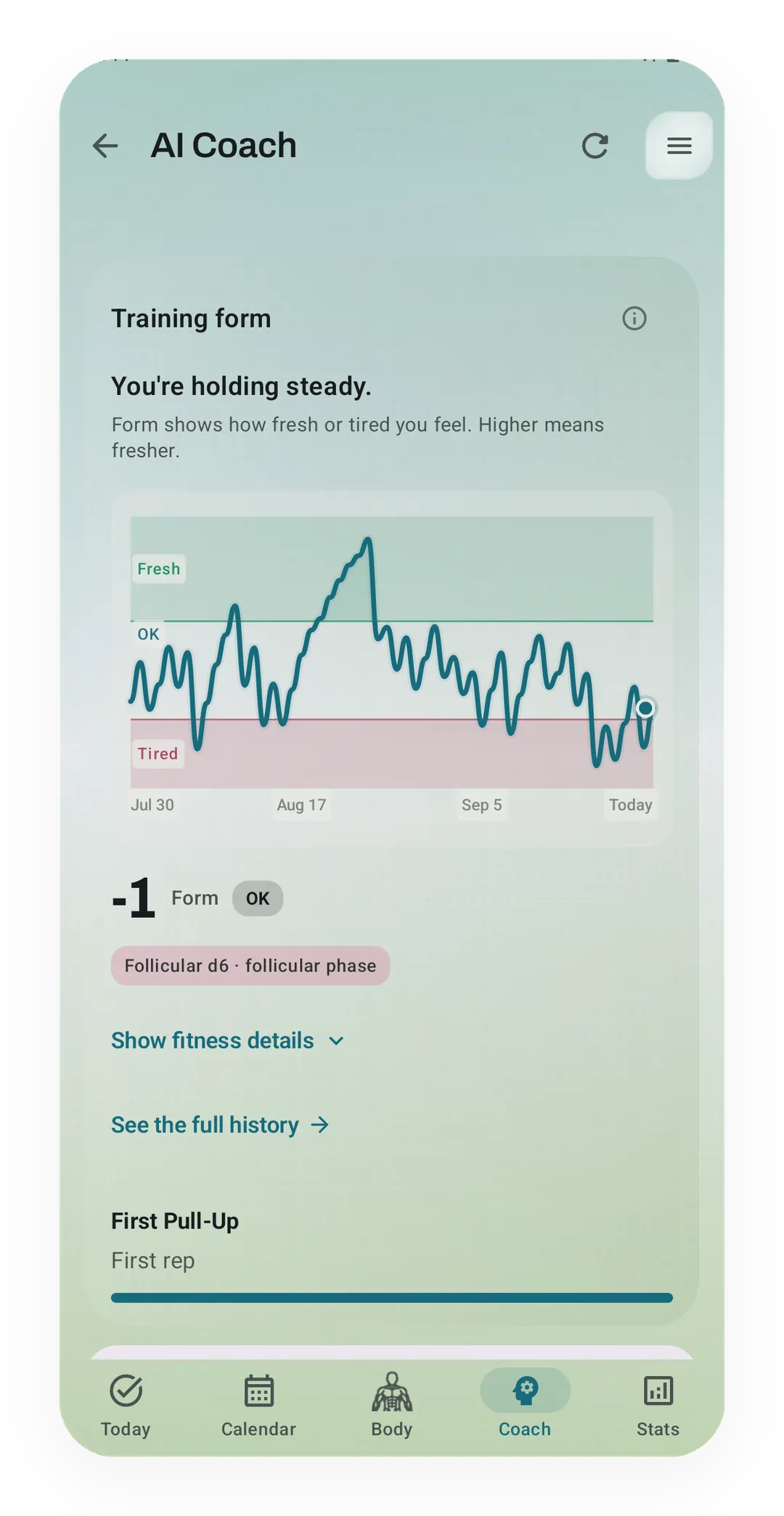
Real app capture, free tier. The Form curve on the Coach screen adds gym sessions and runs in the same training stress units, so it shows how much you trained. It cannot show whether a run slowed your lifting.
Quickstart
In the research, running does not kill gains for most people who lift. A 2022 review of 43 studies by Schumann and colleagues found that adding aerobic training to a lifting program left muscle growth and top strength about where lifting alone put them. Explosive strength, the kind behind a jump or a sprint, grew less, most of all when the run and the lift shared one session.
What is the interference effect?
The interference effect is the idea that endurance training holds back what lifting alone would build. Researchers call the mix of the two concurrent training, and a 1980 study by Hickson put the word interference in its title. Three groups trained for 10 weeks: one lifted, one did endurance work, and one did both. The group that did both improved its leg strength at the same rate as the lifters for the first 7 weeks, and then that rate “leveled off and declined during the 9th and 10th weeks.”
The dose matters when that study is quoted. The lifters trained 30 to 40 minutes a day, five days a week, and the endurance group trained 40 minutes a day, six days a week. The combined group did both plans in full, which is far more endurance work than three short runs a week.
Take a lifter who squats twice a week and wants to add three 30-minute runs. The rest of this page follows that week through the research.
Does running slow muscle growth?
Muscle growth held up in the largest review. Schumann and colleagues pooled 43 studies in 2022, and each one compared a group that lifted with a group that did the same lifting plus aerobic work. For muscle size, the gap between the groups was an effect size of -0.01, which is next to zero. The authors put it plainly: concurrent training “does not compromise muscle hypertrophy and maximal strength development.”
An older review, from Wilson and colleagues in 2012, pooled 21 studies with a wider rule, since it also took in studies that compared one kind of combined training with another. Its average effect on muscle growth was 1.23 for lifting alone and 0.85 for lifting plus endurance work, a gap the abstract does not call significant. The finding it does flag is about the kind of cardio, since lifting paired with running, but not cycling, “resulted in significant decrements in both hypertrophy and strength.”
One level down, at the single muscle fiber, the picture is less clean. Lundberg and colleagues pooled 15 studies in 2022 and found what they call “a small negative effect on fiber hypertrophy compared with strength training alone.” Its effect size of -0.23 sat right at the edge of statistical significance.
For the lifter in the example, the whole-muscle results suggest three runs a week are unlikely to cost much size. The fiber result is the reason to hold that view loosely.
Does running make you weaker?
Top strength held up in Schumann’s review, while explosive strength did not. Maximal strength, such as a one-rep max (1RM, the most weight you can lift once), differed by an effect size of -0.06, again close to zero. Explosive strength came out at -0.28, and that shortfall “was more pronounced when concurrent training was performed within the same session” than when the sessions were at least 3 hours apart. Wilson’s 2012 review points the same way for power, with an average effect of 0.91 for lifting alone and 0.55 for lifting plus endurance work, a gap it does report as significant.
How trained you are may change the answer. Petré and colleagues pooled 27 studies of lower-body 1RM in 2021 and sorted people by how trained they were. Trained people gained less squat and leg press strength with concurrent training, at an effect size of -0.35, while moderately trained and untrained people showed no clear shortfall. Among the trained, the shortfall sat in studies where both kinds of training happened in one session (-0.66), and it faded when they were done in different sessions (-0.10, not significant).
Sex may matter as well. Huiberts and colleagues pooled 59 studies with 1,346 people in 2024 and found that concurrent training blunted lower-body strength gains in men (-0.43) but not in women (0.08). Upper-body strength and power showed no difference between the sexes, and the data on muscle growth were too thin to compare.
The reviews do not line up perfectly on training status. Schumann’s review found no difference between untrained and active people, and “active” is a looser group than Petré’s trained lifters, so the two reviews are not asking quite the same question. For the example lifter, the trained, same-session result is the one to watch if the goal is a heavier squat after years of lifting.
Is running worse for gains than cycling?
Running versus cycling is the least settled part of the question, because the reviews point in different directions. The table sets out what each one reports.
| Review | Studies | What it found on running and cycling |
|---|---|---|
| Wilson and colleagues, 2012 | 21 | Lifting with running, but not cycling, cut muscle growth and strength. |
| Sabag and colleagues, 2018 | Not stated in the abstract | With interval training, a trend toward cycling, not running, costing lower-body strength, and it was not significant. |
| Schumann and colleagues, 2022 | 43 | No significant difference between cycling and running. |
| Lundberg and colleagues, 2022 | 15 | Running, but not cycling, cut the growth of type I (slow-twitch) fibers, which the authors call preliminary. |
Two of these lean against running and one leans against cycling, so the fair reading is that nobody knows yet. The Sabag review covered interval training only, where it found muscle growth and upper-body strength matched lifting alone.
Does the order of running and lifting matter?
Order matters for lower-body strength when both happen in one session. Eddens and colleagues pooled 10 studies in 2018 and found that lifting first, then doing endurance work, gave better lower-body strength than the reverse, by 6.91% on average. The order made no difference to leg muscle growth. Murlasits and colleagues found the same pattern that year, with a lower-body 1RM that was 3.96 kg higher on average when strength came first, while aerobic fitness did not depend on the order.
Time between the two is the other lever these reviews point at. Schumann’s review saw the explosive strength shortfall grow when both were done in one session rather than at least 3 hours apart, and Petré’s saw the shortfall in trained people mostly vanish in separate sessions.
For the example lifter, two setups line up with the smaller costs in this research. One puts the runs on days without squats, and the other puts a run after the squats with some hours in between. Neither is required, and the evidence says a lifter who ignores both is unlikely to give up much muscle growth.
Where does the research run out?
These reviews are strong on averages and thin on long stretches of mixed training.
- The reviews took in trials as short as 4 or 5 weeks, which is a small slice of a training life.
- Wilson’s review found that more frequent and longer endurance sessions went with smaller gains in muscle, strength and power, so three short runs and a marathon block are different questions.
- Huiberts and colleagues studied healthy adults aged 18 to 50, and they close by asking for “more studies on females and highly strength-trained and endurance-trained athletes.”
- A pooled effect describes the average person in these studies, and one person’s response can sit well above or below it.
These reviews measure muscle, strength and, in some, aerobic fitness. They say little about race times or how a run goes the day after squats, and that part shows up in your own log.
Track this in Kinoku
Kinoku logs your sets and your GPS runs in one history on your phone, with no account. The Form curve on the Coach screen scores both in the same training stress units. A gym session of 10 working sets of 5 at 80 kg, rated RPE 8 (rate of perceived exertion, 8 out of 10), scores about 64 points, and a 45-minute tempo run scores about 81. So a heavy leg week and a heavy run week add up on one line, and that base chart is free. Pro adds two 7-day forecast lines and a written read of the trend.
The limits are worth stating. Kinoku does not prevent the interference effect, and it does not plan your runs and lifts apart for you. The Form curve shows how much you trained, not whether a run slowed your lifting. The muscle map’s recovery view leaves runs out, so a long run does not show there as tired legs. Kinoku is also Android only.
If you are still deciding how to track both, the one app or two page sets the setups side by side, and the hybrid training apps roundup covers apps that build a plan for you. A sample week sits on the hybrid athlete training plan page, and the fitness and fatigue model page explains the math under the Form curve.
References
Common questions
Does running kill muscle gains?
Running does not kill muscle gains for most people who lift, going by a 2022 review of 43 studies by Schumann and colleagues. Adding aerobic training to a lifting program left muscle growth and top strength about where lifting alone put them. Explosive strength, the kind behind a jump or a sprint, grew less, most of all when the run and the lift shared one session.
What is the interference effect?
The interference effect is the idea that endurance training holds back what lifting alone would build. Hickson's 1980 study put the word in its title. In it, the group that did both gained leg strength at the lifters' rate for 7 weeks, and then that rate leveled off and fell. The combined group did a full five-day lifting plan plus 40 minutes of endurance work six days a week, far more than three short runs a week.
Do trained lifters lose more strength from running?
Trained lifters were the one group with a strength shortfall in a 2021 review of 27 studies by Petré and colleagues. Trained people gained less squat and leg press strength when they added endurance work, mostly when both happened in one session. Moderately trained and untrained people showed no clear shortfall, and a 2024 review by Huiberts and colleagues found blunted lower-body strength gains in men but not in women.
Is running worse for gains than cycling?
Running versus cycling is the least settled part of the question, because the reviews point in different directions. Wilson's 2012 review and Lundberg's 2022 review both leaned against running, while Sabag's 2018 review of interval training showed a trend against cycling that was not significant. Schumann's 2022 review found no significant difference, so the fair reading is that nobody knows yet.
Does the order of running and lifting matter?
Order matters for lower-body strength when the run and the lift happen in one session. A 2018 review of 10 studies by Eddens and colleagues found that lifting first gave better lower-body strength than the reverse, by 6.91% on average. The order made no difference to leg muscle growth. Murlasits and colleagues found a lower-body one-rep max 3.96 kg higher on average when strength came first.
Can Kinoku tell if running is hurting my lifting?
Kinoku cannot show whether a run slowed your lifting, but its Form curve shows how much you trained across both. The app logs sets and GPS runs in one history on your phone and scores both in the same training stress units. A heavy leg week and a heavy run week then add up on one line. The base chart is free, and Pro adds two 7-day forecast lines and a written read of the trend.
Track this in the app
Training Form curve (Coach screen)
The lead card on the Coach screen shows how fresh or tired you are right now. One Form line sits over three soft bands: Fresh, OK, and Tired, with a state pill beside it. Tap Show fitness details for the fitness and fatigue lines behind it. The base chart is free for all. Pro adds forecast lines and a note in plain words.
Core tracking works offline, with no mandatory account.
Related features
The lead card on the Coach screen shows how fresh or tired you are right now. One Form line sits over three soft bands: Fresh, OK, and Tired, with a state pill beside it. Tap Show fitness details for the fitness and fatigue lines behind it. The base chart is free for all. Pro adds forecast lines and a note in plain words.
Live pace, splits, a route map, and audio cues. Your run record is not uploaded to Kinoku; map tiles load when you view maps, and weather is a clear opt-in.
Every set, one tap. Track how hard each set felt, your rest timers, set types, and notes.