

Hybrid Athlete Training Plan: A Free Three-Day Week
A free three-day hybrid week with every set, rep and distance listed, where extra runs can sit, and how Kinoku logs the lifts and the runs together.
Kinoku in practice
Where this shows up in the app
 Open full-size image ↗
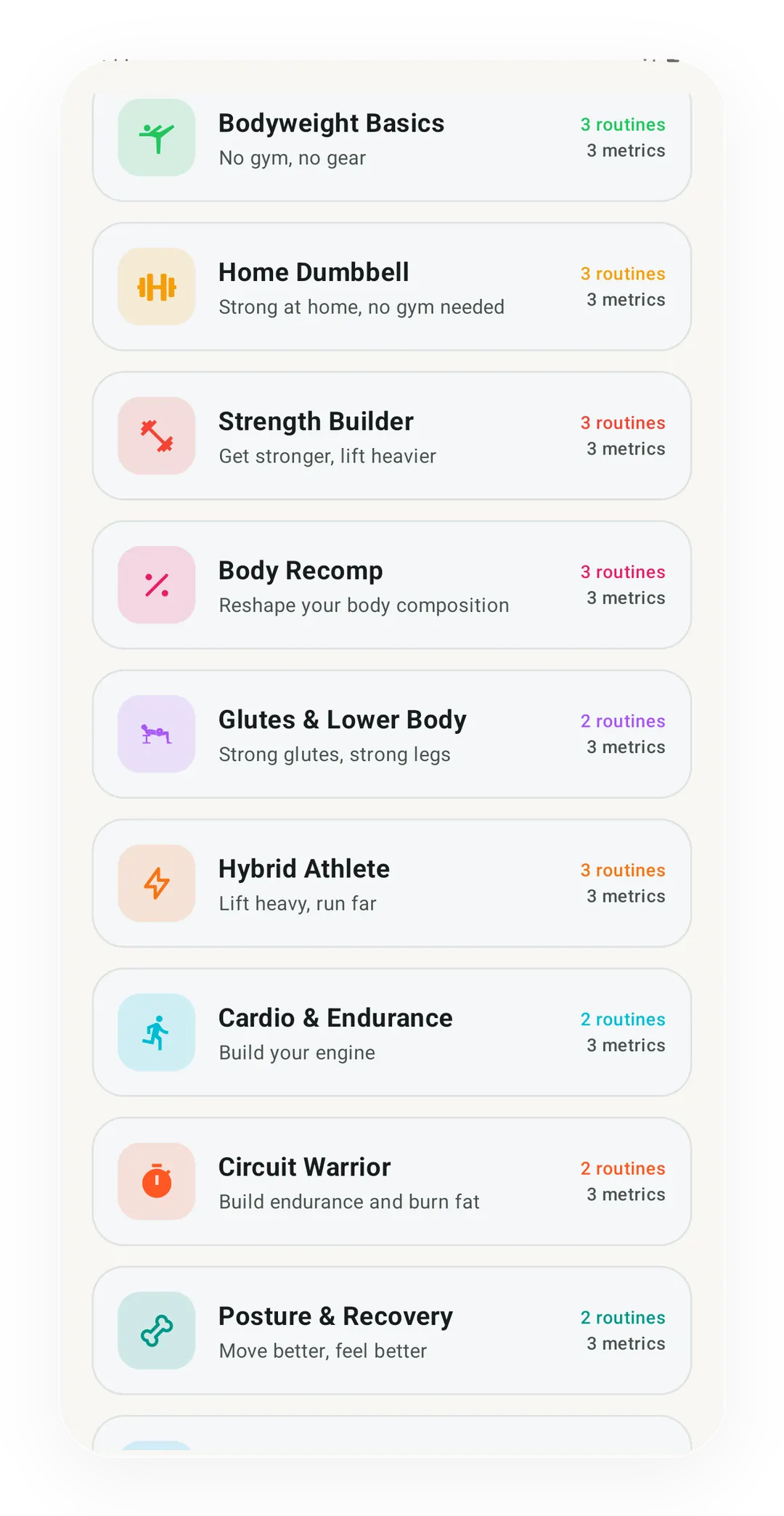
The pack in the gallery
App capture. Hybrid Athlete sits in the Starter Packs gallery with its three routines and three metrics, and the pack is free to apply.
 Open full-size image ↗
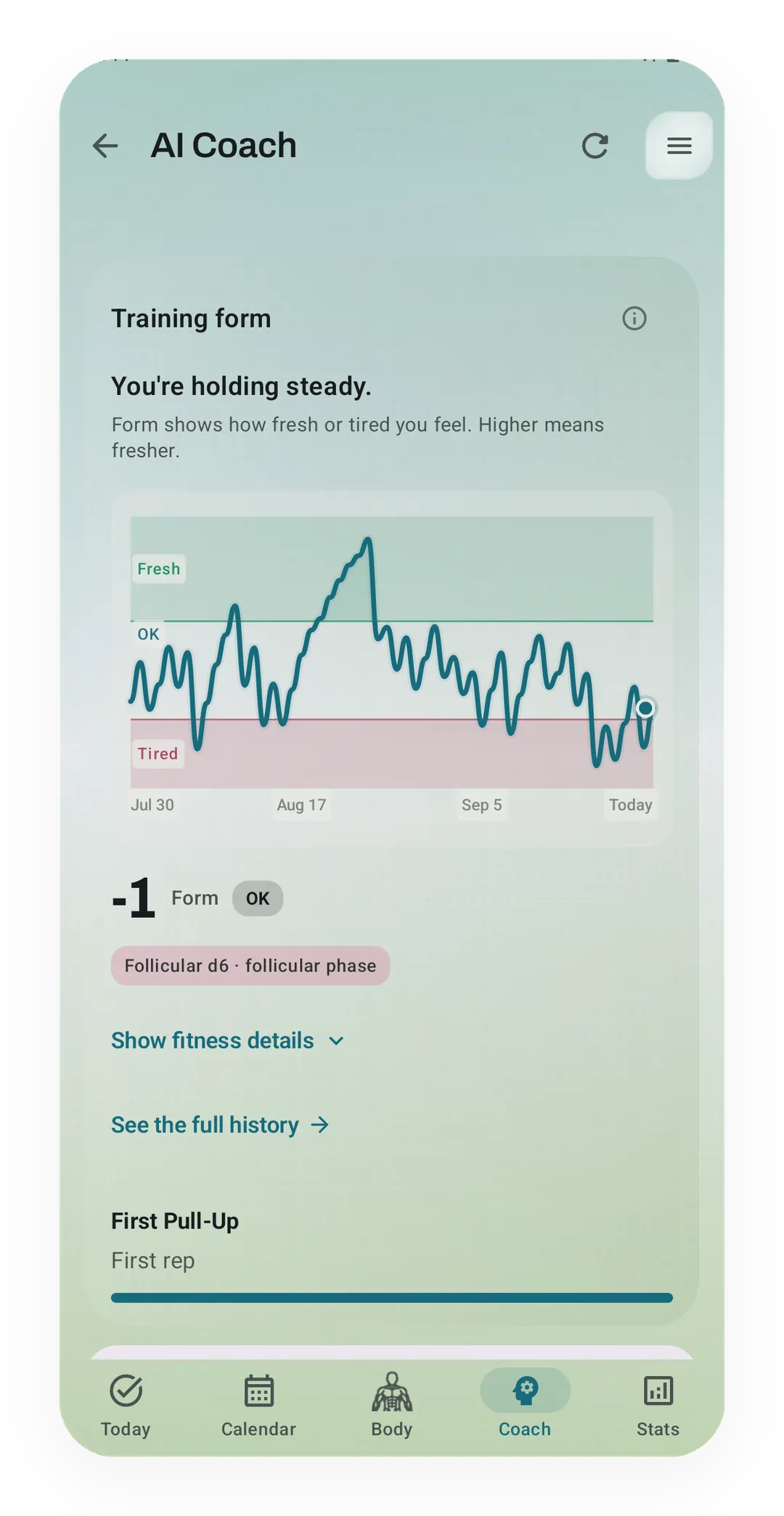
Where the week's load lands
Every finished session adds training stress points to the free Form curve on the Coach screen, whether it was lifting, the row or a GPS run. Today the curve reads -1, in the OK band.
Quickstart
A hybrid athlete training plan puts strength, running and conditioning into one week, so neither side gets dropped for the other. Below is a free three-day example, Kinoku’s Hybrid Athlete starter pack, with every set, rep and distance written out. After it come the open days for extra runs and how one app logs both halves of the week.
The week at a glance
The Hybrid Athlete pack is three sessions a week of about 30 minutes each: one for strength, one for running and rowing, and one for conditioning. When you apply it, Kinoku plans the next Monday, Wednesday and Friday, starting from tomorrow, and fills them in the order below.
| Day | Session |
|---|---|
| Monday | Strength & Carry |
| Tuesday | Open |
| Wednesday | Engine Builder |
| Thursday | Open |
| Friday | Hybrid Metcon |
| Saturday | Open |
| Sunday | Open |
That layout is what you get when you apply the pack on a weekend. Apply it on a Tuesday instead, and Strength & Carry lands on Wednesday, Engine Builder on Friday and Hybrid Metcon on the next Monday. Either way, the heavy lifting day and the run day sit two or three days apart.
Day 1: Strength & Carry
Strength & Carry covers the three big barbell lifts, then a loaded carry and a plank for the trunk.
| Exercise | Sets | Target |
|---|---|---|
| Squat (Barbell) | 4 | 6 reps |
| Bench Press (Barbell) | 4 | 6 reps |
| Deadlift (Barbell) | 3 | 5 reps |
| Farmer’s Walk | 3 | 40 seconds |
| Plank | 3 | 45 seconds |
Day 2: Engine Builder
Engine Builder opens with a run and a row, then moves on to a kettlebell, a wall ball and a box.
| Exercise | Sets | Target |
|---|---|---|
| Running | 1 | 3 km (just under 2 miles) in 20 minutes |
| Rowing Machine | 1 | 2 km (about 1.2 miles) in 10 minutes |
| Kettlebell Swing | 3 | 20 reps |
| Wall Ball | 3 | 15 reps |
| Box Jump | 3 | 10 reps |
Day 3: Hybrid Metcon
Hybrid Metcon, short for metabolic conditioning, is five moves done for reps or for time.
| Exercise | Sets | Target |
|---|---|---|
| Thruster | 3 | 12 reps |
| Kettlebell Swing | 3 | 15 reps |
| Burpees | 3 | 10 reps |
| Walking Lunges | 3 | 20 reps |
| Mountain Climbers | 3 | 30 seconds |
The pack sets reps, seconds and distances but no weights, so the first time through you choose the load. After that, starting a routine fills each set with what you did in your last session of it. The pack also turns on three daily metrics you can log, which are resting heart rate, heart rate recovery and how hard a session felt.
Where extra runs can sit
Extra runs fit on the four open days, and where they land next to the leg work is the part research has looked at. A 7-week study of 58 amateur rugby players compared strength and aerobic sessions done back to back, 6 hours apart and 24 hours apart. Bench press and half squat strength gains were smaller in the back-to-back group than with 6 or 24 hours between, and aerobic fitness rose most with a full day between. The authors wrote that “the interference on strength development depends on the recovery delay between the 2 sequences” [1].
A 2012 review of 21 studies by Wilson and colleagues found that “interference effects of endurance training are a factor of the modality, frequency, and duration of the endurance training selected” [2]. In that data, lifting alongside running came with smaller strength and muscle gains, and lifting alongside cycling did not.
Read together, those findings point to one approach, which is to leave a full day or more between Strength & Carry and an extra run. Every open day in the layout above already gives you that gap. More runs and longer runs carry more of the cost Wilson measured. Neither paper measured race times, and the rugby study lasted 7 weeks, so they say little about how fast your runs get over a season. The does running kill gains page goes further into that research.
How Kinoku records the week
Kinoku keeps all three sessions in your workout history as ordinary gym workouts. The run and the rowing machine on Engine Builder are entries you fill in with a distance and a time, not GPS tracks. A run you record with GPS is its own session, with a route map, pace and splits, and it lands in the same history on the phone with no account.
Each session you finish adds training stress points to the Form curve, the fitness and fatigue chart on the Coach screen. Sets with weight and reps score by load, reps and effort, while timed rows such as the plank and the typed-in run score by minutes and effort. A GPS run gets its own score on the same scale, so the week’s lifting and running add up on one line.
Take the Engine Builder run as the worked example. If you rate it a 7 out of 10 for effort, its 20 minutes add 28 points, because Kinoku multiplies minutes by effort and keeps a fifth of the result. The base chart is free, and Pro adds forecast lines and a note in plain words.
One edge to know is that the muscle map counts the run and the row only as a session. They add no volume there and do not mark a muscle as recently trained, while the map’s frequency view still counts Engine Builder as a session for the muscles they work. Running fatigue shows on the Form curve rather than as muscle volume, and the one app or two page works through the shared curve with numbers.
The program finder’s Hybrid athlete goal
The program finder, added to Kinoku in September 2026, asks about your days, gear, experience and goal, then explains its pick. Hybrid athlete is one of its three goals, and the app describes it as “A lifting week that leaves your legs fresh for runs and cardio.”
With that goal picked, the finder counts general fitness programs as a match and marks strength and muscle-size programs as aimed at a different goal. So general fitness programs rise above pure strength ones when your other answers are equal. The finder is free, and so is every program it suggests.
What this plan does not do
The pack is a fixed week, and it helps to know its edges before you start.
- It plans one week on the calendar and does not repeat it. After that, a Rotation Group can cycle the three routines in order for free, and a repeating calendar schedule is a Pro feature.
- It does not adapt. Nothing in the pack changes when you miss a session, and the plan does not move or rewrite itself.
- The pack itself has no rule for adding weight, since it ships without weights at all.
- The metcon day runs as ordinary sets. Circuit mode, with its round timer, is Pro, so the free pack imports Hybrid Metcon as a standard routine that you work through at your own pace.
- Nobody writes the next week for you from how this one went. Kinoku is a log with plans you choose, and it runs on Android only.
If you want a plan written and changed for you as you go, coached apps sell that. Edge describes “one coordinated hybrid fitness plan that flexes with your real life” [3], and Runna calls itself “a personal running coach in your pocket” [4]. The hybrid training apps page sets both beside Kinoku, with each claim quoted from the app’s own listing.
If your hybrid training is aimed at a Hyrox race, the Hyrox workout page sets out the eight runs and stations from the rulebook, with a five-day sample week built around them. The Hyrox simulation page covers full and half race rehearsals for a race block. Kinoku 1.6 adds a free Fitness Race Prep starter pack, with a station EMOM (every minute on the minute) and a timed day of runs and stations.
How to start it
The pack is free, with no account and no trial, and it takes four steps.
- Open the menu at the top right and tap Routines.
- Tap the Starter Packs icon at the top of the screen.
- Tap Hybrid Athlete to see its three routines.
- Tap Apply Pack.
Kinoku then creates the three routines, plans the week and opens your calendar. If your routine list is empty, a Browse Starter Packs button opens the same gallery. On a new install, picking strength training and runs as your focus also puts the pack first in Quick Start and on the Today screen. The same gallery holds the free Fitness Race Prep pack, which runs two of its three days on the free workout timers.
Track this in the app
Routines & Programs
Unlimited routines, Smart Sync, Starter Packs, and follow-along links are free, and so are Rotation Groups that cycle through several routines for you.
Core tracking works offline, with no mandatory account.
Related features
Unlimited routines, Smart Sync, Starter Packs, and follow-along links are free, and so are Rotation Groups that cycle through several routines for you.
Live pace, splits, a route map, and audio cues. Your run record is not uploaded to Kinoku; map tiles load when you view maps, and weather is a clear opt-in.
The lead card on the Coach screen shows how fresh or tired you are right now. One Form line sits over three soft bands: Fresh, OK, and Tired, with a state pill beside it. Tap Show fitness details for the fitness and fatigue lines behind it. The base chart is free for all. Pro adds forecast lines and a note in plain words.
Plan workouts on one calendar, with no limit on how many plans you keep or how far ahead you plan. Pro adds repeating schedules (weekly, custom days, or every few weeks), drag-to-move, bring-to-today, repeat-day, and day copy.
A 4-phase planning stack. The builder, all 25 templates, named programs with auto-progression, the custom model, and unlimited active programs are free. Pro adds volume targets, readiness tuning, and auto set changes.