
Hyrox Workout: The Race Format and How to Train for It
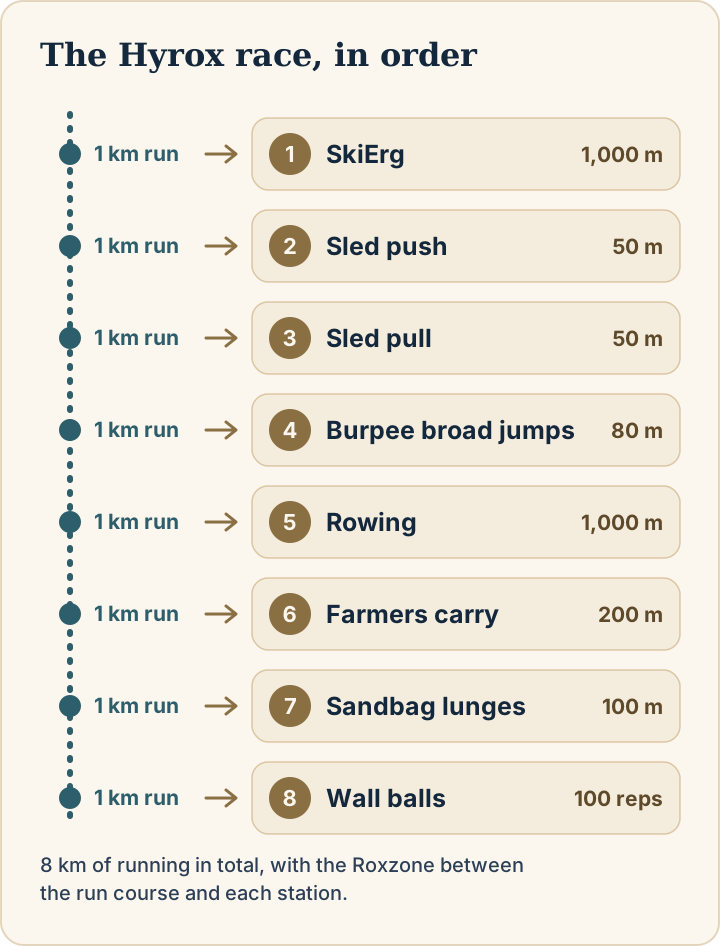
Hyrox is eight 1 km runs, each followed by a workout station. The stations, the weights by division, what decides a finish, and a sample training week.
A Hyrox block in Kinoku
These three clips come from the Kinoku Android app on the free plan.

Try it free on Android, with no account to make.
Quickstart
A Hyrox workout trains you for Hyrox, an indoor fitness race of eight 1 km runs, each followed by one workout station. The stations never change order, from a 1,000 m SkiErg to 100 wall balls. Below are the stations and weights from Hyrox’s own rulebook, what research says decides a finish time, and a sample week.
What is the Hyrox race format?
The Hyrox race format is a 1 km run, then one station, repeated eight times. Hyrox’s own race page puts it this way: “participants run 1km, followed by 1 functional workout station, repeated eight times” [1]. The Singles rulebook for the 26/27 season says the running “totals 8,000 meters, divided into eight run segments of approximately 1,000 meters each” [2]. Some venues split a segment into laps.
Between the run course and the stations sits the Roxzone, the area you pass through on the way in and out of each station. The rulebook counts the run course, the Roxzone and the stations as separate parts of the course, so the walk through the Roxzone adds to the 8 km of running [2].
Singles racers pick one of four divisions in the rulebook, which are Women, Men, Women Pro and Men Pro. The Pro divisions carry heavier weights on five of the eight stations. Doubles and relay teams race the same course, and in Doubles the pair runs together while “splitting each workout station as you choose” [1].
The eight Hyrox stations and their weights
The eight Hyrox stations come in this order in every race, each after a 1 km run. The weights below are from the 26/27 Singles rulebook, and the sled weights include the sled.
| Order | Station | Distance or reps | Women Open | Men Open and Women Pro | Men Pro |
|---|---|---|---|---|---|
| 1 | SkiErg | 1,000 m | Same for all | Same for all | Same for all |
| 2 | Sled push | 50 m (4 x 12.5 m) | 102 kg | 152 kg | 202 kg |
| 3 | Sled pull | 50 m (4 x 12.5 m) | 78 kg | 103 kg | 153 kg |
| 4 | Burpee broad jumps | 80 m | Body weight | Body weight | Body weight |
| 5 | Rowing | 1,000 m | Same for all | Same for all | Same for all |
| 6 | Farmers carry | 200 m | 2 x 16 kg | 2 x 24 kg | 2 x 32 kg |
| 7 | Sandbag lunges | 100 m | 10 kg | 20 kg | 30 kg |
| 8 | Wall balls | 100 reps | 4 kg | 6 kg | 9 kg |
The wall ball target sits at 2.70 m for women and 3.00 m for men, in both the open and the Pro divisions. Hyrox updates its rulebook each season, so the current one on hyrox.com is the place to check before a race.
What decides a Hyrox finish time?
Running decides more of a Hyrox finish than any single station, going by the studies published so far. In a 2025 study by Brandt and colleagues, 11 recreational racers did a simulated race. Their median finish was 86.5 minutes, and the runs took 51.2 minutes, “significantly longer than the exercise stations” [3].
The same study looked at who finished faster. A higher maximal oxygen uptake, more endurance training and lower body fat all went with a quicker time. The authors judged the race to have “moderate to low requirements in terms of maximum strength, coordination, and mobility” [3].
Two 2026 studies of faster racers point the same way. Rappelt and colleagues looked at seven seasons of public results and found that “overall performance is most strongly associated with running performance” [4]. Gutiérrez-Hellín and colleagues measured 24 men in the Pro division at one race, where running speed fell from the first run to the last. They concluded that “sustaining a higher relative intensity appears central to shorter total running time” [5].
These are early studies. One had 11 people in a simulated race, the other two looked only at fast racers, and none of them tested a training plan. They describe what separates finish times, which is a different question from how best to train.
A sample Hyrox training week
This sample week is our own suggestion, not a tested program. It leans on running because the studies above do, and it keeps two days for strength and the stations. It suits someone who already lifts and runs a little, with the race a couple of months away.
| Day | Session | What it holds |
|---|---|---|
| Monday | Strength and carries | Squat 4 x 6, Romanian deadlift 3 x 8, Sandbag Lunge 3 x 20 steps, Farmer’s Walk 3 x 40 seconds |
| Tuesday | Easy run | 30 to 45 minutes at a pace you can talk at |
| Wednesday | Rest | Rest, a walk or mobility work |
| Thursday | Run intervals | Six repeats of 1 km, with 2 minutes of walking between them |
| Friday | Rest | Rest |
| Saturday | Stations with runs | Four rounds of a 1 km run followed by one station, changing the station each round |
| Sunday | Long easy run | 45 to 60 minutes, easy |
Saturday is the closest thing to race day in the week. One way to fill its four rounds is a 500 m SkiErg, then 4 x 12.5 m of sled push, then 4 x 12.5 m of sled pull, then 30 wall balls. The next Saturday can cover the other four stations, so two weeks touch all eight.
A full or half simulation is a step up from the Saturday rounds, and the Hyrox simulation page sets out the formats coaches use and how to time one.
The weights in this week are yours to pick. Many people start below their race weight on the sled and the wall ball and build toward it. The does running kill gains page covers what the research says about putting runs and lifting in the same week. The hybrid athlete training plan has a lighter three-day week if five days is too many.
How to log Hyrox training in Kinoku
Kinoku logs Hyrox training as ordinary workouts and runs, on your phone, with no account. Every station has a built-in exercise among its more than 1,300, and each one logs the fields that fit it.
| Hyrox station | Kinoku exercise | What a set records |
|---|---|---|
| SkiErg | SkiErg Sprint | Distance and time, with a split per 500 m |
| Sled push | Sled Push (Conditioning) | Weight, distance and time |
| Sled pull | Sled Pull | Weight, distance and time |
| Burpee broad jumps | Burpee Broad Jump | Distance and time |
| Rowing | Rowing Machine | Distance and time, with a split per 500 m |
| Farmers carry | Farmer’s Walk | Weight and time |
| Sandbag lunges | Sandbag Lunge | Weight, reps and time |
| Wall balls | Wall Ball | Weight, reps and time |
| The 1 km runs | Running | Distance and time |
If a station logs a field you would rather change, a custom exercise is free and you pick its Log Type when you make it, for example Weight & Distance for the farmers carry. Custom exercises have no cap.
A Saturday stations day fits in one workout. Type each run in as a Running set with its distance and time, then log the station after it, so the whole session sits in your history as one workout. The session view groups sets by exercise, which puts the four runs together on one Running card above the stations. A run you record with GPS is its own session, with a route map, pace and splits, and it is free. If you start a GPS run while a gym workout is open, Kinoku asks before it goes on.
The Thursday intervals fit the free Interval Editor, which builds a run from steps with distance or time targets and repeat blocks. You save six repeats of 1 km with a walking rest once and run it each week.
Each session you finish adds points to the Form curve, the fitness and fatigue chart on the Coach screen. Sets with weight and reps, such as the wall balls, score by load, reps and effort. Sets with a time, such as the SkiErg and a typed-in run, score by minutes times effort, and a GPS run scores on the same scale. Take a 1 km run typed in at 5 minutes and rated 8 out of 10 for effort, which adds 8 points, because Kinoku multiplies minutes by effort and keeps a fifth. The base chart is free, and Pro adds forecast lines and a note in plain words.
The Wear OS app records workouts and runs from your watch and syncs them back to the phone, and it is free too. Circuit mode, which runs a session on a timer with rounds and rest phases, is part of Kinoku Pro.
What Kinoku 1.6 adds for Hyrox
Kinoku 1.6 adds free tools aimed at fitness races like Hyrox, and the workout timers page explains how the timers work. None of them needs Pro.
- Race-style timers. For Time counts up with an optional cap, EMOM (every minute on the minute) starts a station each minute, and AMRAP (as many rounds as possible) counts down. A Round done tap ticks off the round’s sets and saves a split, and the cues keep playing with the phone locked.
- A time on every loaded station. The sled push and sled pull log weight, distance and time, and wall balls and sandbag lunges log weight, reps and time. Sets you logged before keep every number.
- Best times. The exercise Graph tab keeps your fastest time at each effort you repeat, like a 50 m sled push at 152 kg, and a set that beats it shows New best in gold.
- A split per 500 m. Rowing machine and SkiErg sets show the split a rowing monitor shows, in any unit.
- The Fitness Race Prep pack. Three free routines: a station strength day, four rounds of runs and stations for time with a 40 minute cap, and a 16 minute station EMOM.
The Saturday rounds in the sample week fit the For Time timer, and a full or half simulation does too. The timer splits by round, a pass through the whole routine, so it gives one split per round and not one per station.
What Kinoku does not do for Hyrox
Kinoku is a log, and it helps to know where it stops before a race block starts.
- It has no Hyrox race template. The timer splits by round, not by run, station and Roxzone.
- It does not write or change a Hyrox plan for you. The sample week above is a page you read, not something the app sets up.
- The timers run on the phone, and the watch app has no timer of its own.
- A run recorded with GPS cannot share a workout with the stations, so a full simulation with GPS runs spans more than one session.
- Kinoku runs on Android only.
If you want a coached plan or race analytics, other apps sell that. The hybrid training apps page sets Kinoku beside the apps built around Hyrox, with each claim quoted from the app’s own listing. The one app or two page works through logging lifts and runs in one place.
Common questions
What is a Hyrox workout?
A Hyrox workout is training for Hyrox, an indoor fitness race where you run 1 km and then do one workout station, eight times over. The stations are the same everywhere and always in the same order, from the SkiErg to the wall balls. Training for it mixes running, strength and work at the stations, often with a run done right before a station.
What are the 8 Hyrox stations in order?
The first four Hyrox stations are the SkiErg for 1,000 m, the sled push for 50 m, the sled pull for 50 m and burpee broad jumps for 80 m. After them come rowing for 1,000 m, the farmers carry for 200 m, sandbag lunges for 100 m and 100 wall balls to finish. A 1 km run comes before each station, and the order is the same at every race.
How heavy is the Hyrox sled push?
The Hyrox sled push weighs 102 kg in the Women Open division, 152 kg for Men Open and Women Pro, and 202 kg for Men Pro. Those figures include the sled itself. The sled pull is 78 kg, 103 kg and 153 kg in the same three groups, per the Hyrox Singles rulebook for the 26/27 season.
How far do you run in a Hyrox race?
You run 8 km in a Hyrox race, split into eight runs of about 1 km each. The rulebook says the run totals 8,000 meters, and a venue can split a segment into laps. The Roxzone, the area that joins the run course to the stations, is a separate part of the course on top of that distance.
Is Hyrox more about running or strength?
Hyrox leans toward running in the research so far. In a 2025 study of 11 recreational racers, the runs took longer than the stations, and faster finishers had more endurance training behind them. A 2026 study of seven seasons of results found overall times most strongly tied to running. Both are small or early, and neither tested a training plan.
How many days a week do people train for Hyrox?
No study has set a number of training days for Hyrox. The sample week on this page uses five days, with two strength or station days and three runs, as one way to cover the race. It is an example, not a tested program, and a week with fewer days can still include a run, a lift and some time at the stations.
Is there a free Hyrox training app?
Kinoku is a free Android log where you can record Hyrox training, with built-in exercises for every station and free GPS runs. Version 1.6 added free For Time, EMOM and AMRAP timers, a time field on the sled and a free Fitness Race Prep pack. It writes no Hyrox plan for you, and apps that do are listed on our hybrid training apps page.
Can I log a Hyrox simulation in one Kinoku workout?
You can log a Hyrox simulation in one Kinoku workout when the runs are typed in as Running sets with a distance and a time. A run recorded with GPS is its own session, so a simulation with GPS runs ends up as more than one workout. The free For Time timer can run the whole simulation on one clock.
Track this in the app
Workout Logging
Every set, one tap. Track how hard each set felt, your rest timers, set types, and notes.
Core tracking works offline, with no mandatory account.
Related features
Every set, one tap. Track how hard each set felt, your rest timers, set types, and notes.
1,300+ built-in exercises with muscle data and unlimited custom moves are free. Pro adds custom form photos and assisted sorting.
Live pace, splits, a route map, and audio cues. Your run record is not uploaded to Kinoku; map tiles load when you view maps, and weather is a clear opt-in.
Build custom interval workouts step by step: warm-up, work, recovery, and repeats. Or copy a built-in one and tune it.
For Time, EMOM (every minute on the minute) and AMRAP (as many rounds as possible) timers that run the clock and save the score with your sets.
The lead card on the Coach screen shows how fresh or tired you are right now. One Form line sits over three soft bands: Fresh, OK, and Tired, with a state pill beside it. Tap Show fitness details for the fitness and fatigue lines behind it. The base chart is free for all. Pro adds forecast lines and a note in plain words.
Timer-driven circuits, rounds, rest phases, and safe session handling.