

Hyrox Simulation Workout: Full, Half and EMOM, and How to Time Them
A Hyrox simulation is a race rehearsal at home. The full, half and EMOM versions, when people run them, how to time one, and how to log it in Kinoku.
Kinoku in practice
Where this shows up in the app
 Open full-size image ↗
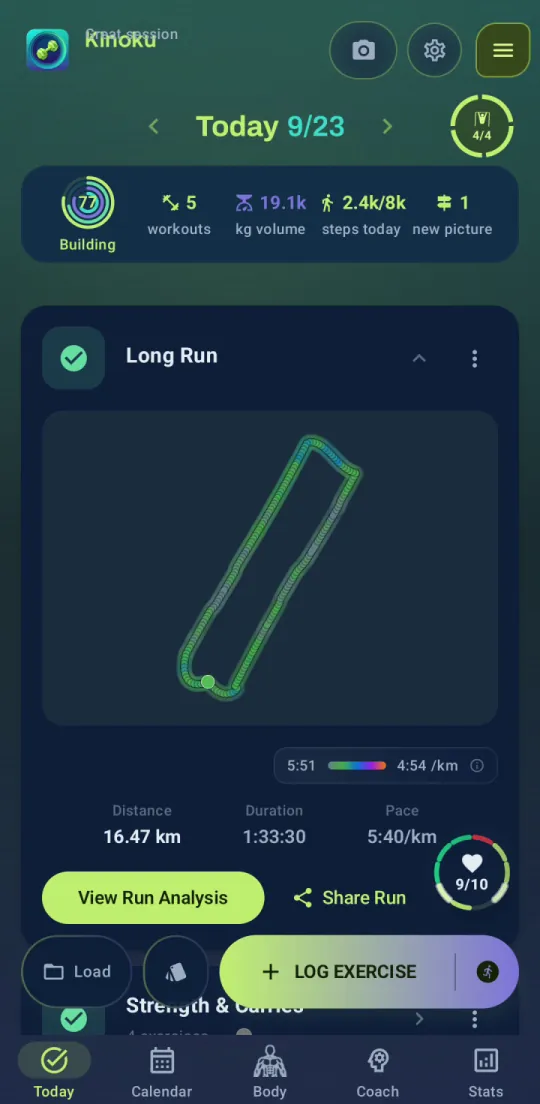
A GPS run in the app
On the free plan, a GPS run is its own session on Today. A simulation with GPS runs shows up as more than one workout, with the stations logged in another.
 Open full-size image ↗
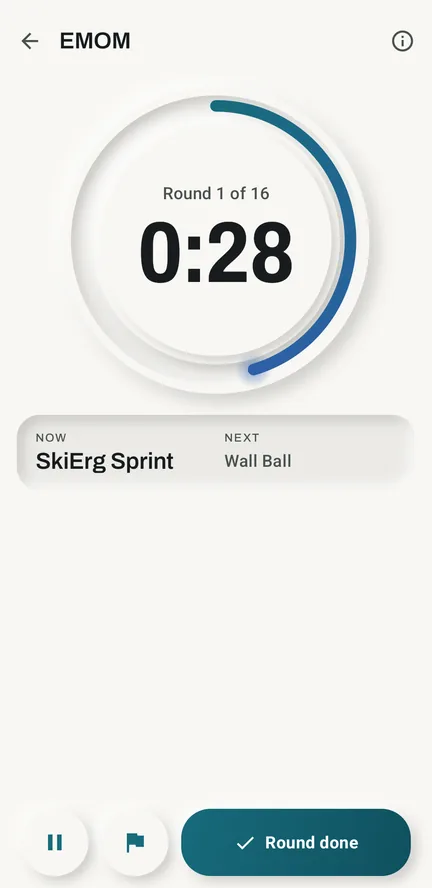
An EMOM on the timer
The free EMOM timer shows the round, the seconds left in the minute, and the station now and next. A Round done tap ticks off the station's set.
 Open full-size image ↗
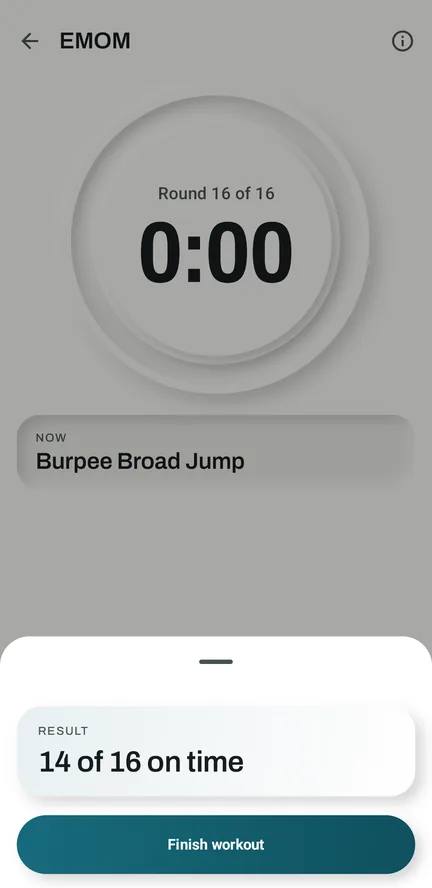
The score when it ends
When the last round ends, the result sheet shows how many rounds you finished on time, and it is free like the timer.
 Open full-size image ↗
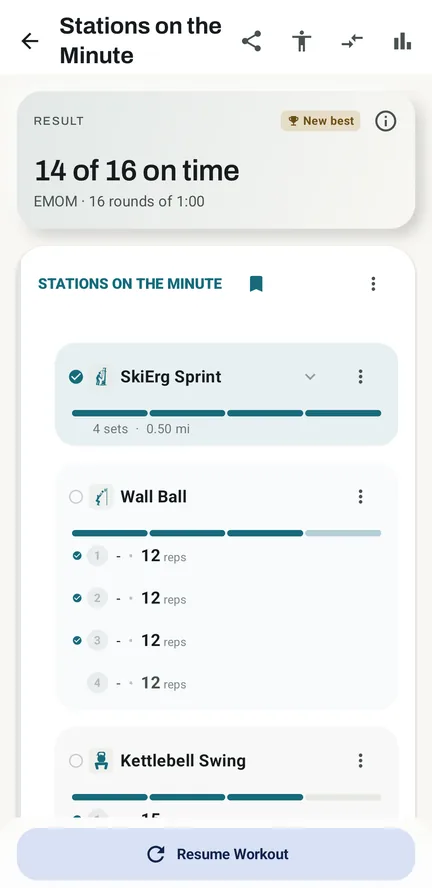
The whole session afterwards
The saved session keeps every station with its sets. Each Round done tap ticked off one set, and the two skipped rounds stay open, so Wall Ball and Kettlebell Swing each show 3 of 4 sets done.
Quickstart
A Hyrox simulation is a rehearsal of the race in your own gym, with runs and stations in race order and one clock running. People run the full version a few weeks out, and shorter half or EMOM (every minute on the minute) versions as regular checks. Below are the common formats, how to time one, and how Kinoku logs it.
What is a Hyrox simulation?
A Hyrox simulation is a practice race you set up yourself, so you meet the race’s demands before race day. The real race is eight runs of 1 km, each followed by one station, in a fixed order from the SkiErg to the wall balls [1]. GOWOD (a mobility and training app) calls a simulation “a race-day rehearsal that replicates the full competition format” [2].
A simulation answers questions a normal training day leaves open. It shows how your legs feel on a run straight after the sled, how long your transitions take, and which station costs you the most time. Built for Athletes puts the use plainly: “Keep note of your time and get working on your weaknesses to keep improving” [3].
Full, half and EMOM simulations compared
A Hyrox simulation comes in four common sizes, and the names are not used the same way by every coach. The table sets out the versions GOWOD lists [2] beside the half that Built for Athletes uses [3].
| Version | What it holds | When people use it |
|---|---|---|
| Full | 8 runs of 1 km and all 8 stations at race weight | About 3 to 4 weeks before the race [2] |
| Three-quarter | 6 runs and 6 stations | Mid block, when the full race is too much volume [2] |
| Half (GOWOD) | 4 runs of 1 km and 4 stations | Early in a block, or as a weekly benchmark [2] |
| Half (Built for Athletes) | 8 runs of 500 m and all 8 stations at half distance | A shorter test of the whole order [3] |
| EMOM style | Runs and stations on a set interval | When the full kit is not there [2] |
The Built for Athletes half keeps every station in race order at half the work. Its stations are a 500 m SkiErg, 25 m of sled push and of sled pull, 40 m of burpee broad jumps and a 500 m row. Then come a 100 m farmers carry, 50 m of sandbag lunges and 50 wall balls, with race weight on the loaded stations [3].
When people run a Hyrox simulation
People run a full Hyrox simulation once, a few weeks before the race, and shorter ones more often. GOWOD writes that “a full simulation done 3 to 4 weeks before race day is the most common approach”, and warns that one done too close to the race risks a tired start [2]. GOWOD suggests the half as a weekly benchmark, because it costs less to recover from.
These timings come from coaches, and no study has tested them. The research on Hyrox so far looks at what separates finish times, and running stands out in it, which the Hyrox workout page covers with its sources. A simulation is a good place to check your running under fatigue, since the runs come straight after the stations.
How to time a Hyrox simulation
A Hyrox simulation is usually timed as one clock that counts up from the start of the first run to the last wall ball. Most people compare that total from one simulation to the next. A split for each run and each station adds detail, which helps you find the station that costs the most.
Pacing matters more than the total on the first try. GOWOD’s rule of thumb is that “if your first run feels easy, you are probably pacing it correctly” [2], because going out too fast tells you little about your real race. A time cap helps on a long simulation, so a bad day ends at a set point and still gives you a score.
Take a half simulation in the GOWOD style as an example. Four rounds of a 1 km run and one station, with a 40 minute cap, give you one total time plus four round splits. A round that runs much slower than the others points to the station inside it.
An EMOM station workout
An EMOM workout starts a new piece of work at the top of each minute, and you rest for what is left of it. The format suits station practice when you have little time or no sled, and GOWOD lists an EMOM style next to the full and half simulations [2].
This 16 minute example is our own suggestion and not a tested program. The workout rotates four stations, one each minute, so each one comes up four times.
| Minute | Station |
|---|---|
| 1, 5, 9, 13 | SkiErg, 200 m |
| 2, 6, 10, 14 | Wall balls, 12 reps |
| 3, 7, 11, 15 | Kettlebell swings, 15 reps |
| 4, 8, 12, 16 | Burpee broad jumps, 20 m |
The score in an EMOM is how many minutes you finished on time. Work that spills past the minute means the load or the reps are too high for that day, which is useful to know before a race.
How to log a Hyrox simulation in Kinoku
Kinoku logs a Hyrox simulation as one workout, on Android, with no account. Each run goes in as a Running set with its distance and time, and each station as its own exercise after it. Every station has a built-in exercise, and the Hyrox workout page lists which fields each one records.
A run recorded with GPS is its own session with a route map, so a simulation with GPS runs spans more than one workout. The free Interval Editor suits the run repeats between simulations. Circuit mode, a countdown of work and rest phases, is part of Kinoku Pro.
The free timers in Kinoku 1.6
Kinoku 1.6 adds free tools built for this kind of session, and the workout timers page covers each mode in more detail.
- For Time, EMOM and AMRAP timers. For Time counts up with an optional cap of up to 180 minutes, EMOM runs 1 to 60 rounds, and AMRAP (as many rounds as possible) counts down a cap of up to 90 minutes. The cues keep playing with the phone locked.
- Round done. One tap ticks off the round’s sets and saves a split for that round. In an EMOM it marks the minute as on time.
- A result on the session. The score shows on the session and the recap, like “14 of 16 on time”, with a gold Best when you beat an earlier result at the same setup.
- A time on the sled. The sled push and sled pull log weight, distance and time, and wall balls and sandbag lunges log weight, reps and time.
- The Fitness Race Prep pack. Three free routines: a station strength day, four rounds of runs and stations for time with a 40 minute cap, and the 16 minute station EMOM above.
The timers split by round, where a round is one pass through the routine. So a full simulation with eight different stations gets one total time, and the four-round half above gets a split per round.
What Kinoku does not do for a simulation
Kinoku is a log with plain timers, so a few parts of a simulation stay with you.
- Kinoku does not split your time into run, station and Roxzone, the area between the run course and the stations.
- It does not build a simulation or a plan for you. The formats on this page are ones you set up as a routine.
- A run recorded with GPS cannot share a workout with the stations.
- The timers work on the phone only, with no timer in the watch app.
- Kinoku runs on Android only.
The hybrid training apps page sets Kinoku beside apps built around Hyrox, some with race analytics, with each claim quoted from the app’s own listing.
Common questions
What is a Hyrox simulation?
A Hyrox simulation is a rehearsal of the race done in your own gym, with runs and stations in race order. GOWOD (a mobility and training app) calls it "a race-day rehearsal that replicates the full competition format". A full one covers all eight runs and stations, and shorter versions cut the distance or the number of stations.
What is a half Hyrox simulation?
A half Hyrox simulation means two different workouts, depending on the coach. Built for Athletes keeps all eight stations and halves every distance, with 500 m runs. GOWOD's half is four 1 km runs and four stations. Both are shorter than the race, so both are easier to fit into a normal training week.
How long before a Hyrox race should I do a full simulation?
GOWOD writes that a full simulation done 3 to 4 weeks before race day is the most common approach, because one done too close to the race risks a tired start. That is coaching practice, and no study has tested the timing. A half simulation is lighter, which is why GOWOD suggests it as a weekly benchmark.
How do I time a Hyrox simulation?
Most people time a Hyrox simulation as one clock that counts up from the first run, with a note of each split if they can. Kinoku has a free For Time timer with an optional cap, and a Round done button that saves a split for each round. Without the timer, Kinoku logs each run and station with its own time.
Can Kinoku time a Hyrox simulation for free?
Yes. Since version 1.6, Kinoku has three free timers: For Time, EMOM (every minute on the minute) and AMRAP (as many rounds as possible). With the For Time timer, a whole simulation runs on one clock in the app. The timer splits by round, a pass through the whole routine, so a full simulation with eight different stations gets one total time, not a split per station. Circuit mode, the work and rest countdown, stays part of Kinoku Pro.
Track this in the app
Workout Logging
Every set, one tap. Track how hard each set felt, your rest timers, set types, and notes.
Core tracking works offline, with no mandatory account.
Related features
Every set, one tap. Track how hard each set felt, your rest timers, set types, and notes.
1,300+ built-in exercises with muscle data and unlimited custom moves are free. Pro adds custom form photos and assisted sorting.
Live pace, splits, a route map, and audio cues. Your run record is not uploaded to Kinoku; map tiles load when you view maps, and weather is a clear opt-in.
Build custom interval workouts step by step: warm-up, work, recovery, and repeats. Or copy a built-in one and tune it.
For Time, EMOM (every minute on the minute) and AMRAP (as many rounds as possible) timers that run the clock and save the score with your sets.
Timer-driven circuits, rounds, rest phases, and safe session handling.