
All-in-One Fitness Tracker Apps for Android (2026)
Which Android fitness apps keep gym sets, runs, steps and swims in one history? Ten apps compared from their own pages, by how much each one tracks.
Garmin Connect and Kinoku name all five activity types on their own pages, lifting, runs, steps, swims and other sports, and both describe logging sets with reps and weight: Garmin on its watches, Kinoku on the phone.
At a glance
| App | Best for | Better at | Main trade-off |
|---|---|---|---|
| Garmin Connect | Garmin watch owners who want runs, swims, lifting and steps in one place | Names the widest range of sports here, from kayaking to lifting | Its pages build it around a Garmin device |
| Kinoku | People who lift, run, swim and take classes and want one free history, no account | Sets with reps and weight beside GPS runs, steps, swims and classes | No food diary, and sleep and heart data come in from Health Connect |
| Google Health | Fitbit and Pixel Watch owners who want steps, runs and strength routines | A workout builder for strength, cardio and HIIT | Reps and weights sit under a Premium heading, and phone-only users see two tabs |
| Google Fit | Android users who want steps and phone-tracked runs in one journal | A journal that pulls in activity from other apps | Weightlifting is a manual entry, and Google is moving Fit users to Google Health |
| Huawei Health | Huawei watch or band owners who want over 100 sports, steps and swims | Records more than 100 sports, by its own page | Workouts started in the app expect a linked wearable |
| Samsung Health | Galaxy owners who want steps, runs and swims in one app | Counts steps with the phone's own sensor, no watch needed | A Samsung account comes first, and set logging is not described |
| Zepp | Amazfit owners who want steps, routes and strength logs, watch optional | A free core that works without a smartwatch | The listing carries a Contains ads label |
| Activ.run | Lifters who run and want sets and GPS runs with no account gate | Sets, reps and weight next to GPS runs | Its pages do not mention steps or swims |
| Map My Fitness | People who want 600-plus activity types with GPS, gym sessions included | The longest activity list here | Ads in the free app; fewer ads are a Premium feature |
| Strava | Runners and riders who want a feed, with lifts synced in from another app | Over 40 sport types and a social feed | Sets show up when another app or device sends them, and an account is required |
Publisher disclosure
Kinoku, made by Dreamsoft Works, writes and publishes this page, and Kinoku is one of the apps on it. Every fact about another app is quoted from a page that app's maker publishes, opened on October 4, 2026. We give no score. Where the list is ordered, the caption names the measure, and every label points at a quoted sentence.
Quickstart
Garmin Connect and Kinoku name all five activity types on their own pages: lifting, runs, steps, swims and other sports. Both describe logging each set with reps and weight, Garmin on its watches and Kinoku on the phone, so the tie stays alphabetical under the measure the table caption names.
Which fitness apps keep everything in one history?
An all-in-one fitness app holds every kind of training in a single history, so a squat session and a Sunday run sit on the same calendar. Most apps start from one side. Health apps such as Samsung Health or Garmin Connect begin with steps, sleep and GPS sessions, while gym logs begin with sets and reps. This page counts five activity types on each app’s own pages and then asks whether the app logs a set with its reps and weight.
- All five types. Garmin Connect and Kinoku. Both describe set-by-set lifting, Garmin on its watches and Kinoku on the phone.
- Four types. Google Health, Google Fit, Huawei Health, Samsung Health and Zepp. Google Health describes reps and weights under a Premium heading.
- Three types. Activ.run, Map My Fitness and Strava. Activ.run logs sets with reps and weight, and Strava shows them when another app sends them.
Breadth on a page is one question, and depth in the gym is another. A health app can name “strength training” as an activity without letting you record a single set, which is why the second key matters to anyone who lifts.
Side by side
The ticks below come from sentences each maker publishes, and “Not stated” marks what none of its pages we opened mention.
| App | Lifting | Runs | Steps | Swims | Other sports | Sets with reps and weight | Account |
|---|---|---|---|---|---|---|---|
| Garmin Connect | “lift weights” | Yes | Yes | Yes | Kayaking and more | On a Garmin watch | A free account |
| Kinoku | Yes | GPS runs | Yes | Yes | Classes, walks | Yes, free | None |
| Google Health | Strength routines | Phone or watch | Yes | Not stated | Bike, hike, high-intensity intervals | Under a Premium heading | Google account |
| Google Fit | Weightlifting, by hand | Phone or watch | Yes | Not stated | Soccer, skiing, spinning | Not stated | Google account |
| Huawei Health | Not counted | Yes | Yes | Yes | Over 100 sports | Not stated | Not stated |
| Samsung Health | Not stated | Yes | Phone sensor | Yes | Cycling, rowing | Not stated | Samsung account |
| Zepp | “strength logs” | GPS routes | Yes | Not stated | Cycling | Not stated | Not stated |
| Activ.run | Yes | GPS runs | Not stated | Not stated | Rides, by sync | Yes | No account gate |
| Map My Fitness | Strength training | GPS | Not stated | Not stated | 600-plus types | Not stated | Not stated |
| Strava | Shown when sent from another app | GPS | Not stated | Not stated | Over 40 types | From another app | Required |
Each app, in its own words
Garmin Connect
Best for: Garmin watch owners who want runs, swims, lifting and steps in one place.
Garmin Connect is the app that goes with Garmin’s watches.
- What it does well. Its homepage says “Whether you run, swim, kayak or lift weights… whatever you do, Garmin Connect can track it.” The listing calls it “your one-stop source for health and fitness data.”
- What its pages say about devices. “Garmin Connect is an extension of your Garmin device,” and the listing says you review your tracked activities once you pair a compatible Garmin device.
- Where it is the better pick. Anyone who already trains with a Garmin on the wrist.
- Where it differs. Its watch manual describes logging each set’s reps and weight on the watch, then sending the session to your Garmin Connect account, which it calls a free account you sign up for in the app. The pages we read do not describe entering sets in the phone app without a watch.
Kinoku
Best for: People who lift, run, swim and take classes and want one free history, no account.
Kinoku keeps gym sessions, runs, swims, classes and daily steps on one calendar, on an Android phone.
- What it does well. Each set carries its weight, reps, effort and set type, and a GPS run carries its splits, pace, climb and heart rate. Swims, classes such as yoga, pilates, spin and HIIT (high-intensity interval training), and the day’s steps land in the same history, and a gym session and a run both feed one Form curve of training load.
- What else comes in. Runs, walks, rides, hikes and swims that another app saved to Health Connect arrive as workouts, so a watch from another brand can still fill the history.
- Where it is the better pick. Your training spans the gym and the road, and you want one record of it with no sign-up.
- What Kinoku does not do: There is no food diary or food database, though a free custom metric can hold a daily number such as calories. Sleep and heart readings come from Health Connect rather than from Kinoku itself, and the app runs only on Android.
Google Health
Best for: Fitbit and Pixel Watch owners who want steps, runs and strength routines.
Google Health is the new name of the Fitbit app, as its listing says: “The Fitbit App is now Google Health”.
- What it does well. Its help page lets you track steps, distance and calories from the phone, and “use your phone to track a Walk, Bike, Hike, or Run” without a paired device. A custom workout builder designs “routines for any activity type, including strength training, HIIT yoga, and cardio.”
- What its pages say about plans. Logging “your reps, weights, and more” while you follow a workout sits under a heading marked Premium only. The listing says some features need a Google Health Premium subscription.
- Where it is the better pick. Fitbit and Pixel Watch owners who want guided routines next to their daily numbers.
- Where it differs. “If you do not have a connected Fitbit device or Pixel Watch, you will see a focused experience with the Today, and Health tabs.” A Google account is required.
Google Fit
Best for: Android users who want steps and phone-tracked runs in one journal.
Google Fit is Google’s original activity app for Android.
- What it does well. It uses “your Android phone’s sensors or Wear OS by Google smartwatch’s heart rate sensors to record your speed, pace, route, and more,” and its journal shows “your activity history across Fit and your integrated apps”.
- What its pages say about lifting. Its help centre lists weightlifting among the activities “that Fit doesn’t automatically track”, which you add by hand.
- Where it is the better pick. People who want steps and runs in one simple journal on any Android phone.
- Where it differs. Google’s blog says “We’ll invite Google Fit users to migrate their data into Google Health app later this year.” Fit also needs a Google account.
Huawei Health
Best for: Huawei watch or band owners who want over 100 sports, steps and swims.
Huawei Health is Huawei’s health app for Android and iOS phones.
- What it does well. Huawei’s page says it “records the activities of over 100 different sports, from beginner to advanced,” along with heart rate, sleep and steps. Its support page names running, cycling, swimming and rope jumping sessions.
- What its pages say about devices. For workouts started in the app, the support page asks you to make sure “your wearable device is linked with Huawei Health”.
- Where it is the better pick. People who already wear a Huawei device.
- Where it differs. Its page mentions “equipment training” without saying what that covers, so this page does not count lifting for it.
Samsung Health
Best for: Galaxy owners who want steps, runs and swims in one app.
Samsung Health is Samsung’s health app, and its product page says it also installs on other Android phones and iPhones.
- What it does well. The listing says you can “Record and manage your fitness activities, such as running, cycling, swimming, etc.”, and steps come from “the built-in acceleration sensor within your Samsung Galaxy device”. You can build a Routine Workout from more than 100 moves.
- What its pages say about limits. From version 6.15, “you must sign into your Samsung account to use Samsung Health,” and “Some contents are only available through an optional paid subscription.”
- Where it is the better pick. Galaxy owners who want one app for steps, runs and swims.
- Where it differs. No page we could open describes logging sets with reps and weight.
Zepp
Best for: Amazfit owners who want steps, routes and strength logs, watch optional.
Zepp is the official app for Amazfit watches.
- What it does well. Its listing says it captures “steps and calories burned, and advanced training data like pace, distance, speed, strength logs, and recovery insights.” Amazfit’s page says the app works “without requiring a smartwatch”.
- What its pages say about plans. “The core experience of the Zepp App is free.”
- Where it is the better pick. Amazfit owners, or anyone who wants a free start before buying a watch.
- Where it differs. The listing carries a Contains ads label, and its pages do not describe swims or sets with reps and weight.
Activ.run
Best for: Lifters who run and want sets and GPS runs with no account gate.
Activ.run is built for exactly two kinds of training, by its own description.
- What it does well. Its listing says “Activ.run is one app for your lifts and your runs”, and you “Log workouts with sets, reps, and weight in seconds”. Its homepage promises “No account gate, no onboarding wall”.
- What its pages say about other sports. It can “Bring your runs and rides together with your gym training” through syncing.
- Where it is the better pick. Lifters whose other sport is running and who want nothing more.
- Where it differs. Its pages do not mention steps or swims.
Map My Fitness
Best for: People who want 600-plus activity types with GPS, gym sessions included.
Map My Fitness is a GPS activity tracker with a long list of sports.
- What it does well. Its listing says you can “Log over 600+ activities including walking, running, cycling, gym workouts, strength training”, with “accurate GPS tracking and detailed performance stats”.
- What its pages say about plans. Its Premium list includes “Limited Ads”, and the listing carries a Contains ads label.
- Where it is the better pick. People who switch sports often and want one list for all of them.
- Where it differs. The pages we could read do not describe logging sets with reps and weight, or daily steps.
Strava
Best for: Runners and riders who want a feed, with lifts synced in from another app.
Strava records runs, rides and other GPS sports and shares them in a feed.
- What it does well. Its listing says “Record It All: Running, cycling, walking, hiking, yoga” plus “over 40 other sport types.”
- What its pages say about lifting. “Use your favorite device or strength app and your exercises, sets, reps, weights and a muscle map show up automatically.”
- Where it is the better pick. Athletes who want their feed to show the whole week, with lifting logged elsewhere.
- Where it differs. “To use the Services, you must sign up and create an account.”
How this list was checked
This list counts what each maker writes about its own app, on pages anyone can open.
- Every quote rechecked. We read the listings, help centres and product pages above on October 4, 2026, and a script confirmed each quote against its page.
- Not included. Polar Flow and Mi Fitness describe too little on the pages we opened to fill the table. Huawei Health’s Google Play page did not open from our location, so its row rests on Huawei’s own site. Hevy and Strong describe themselves as lifting logs, and the lifting and running roundup covers them.
- Ordered by the caption. No app paid to appear, and a tie on both keys stays alphabetical.
Frequently asked questions
Is there one app that tracks gym workouts, runs and steps?
Several apps here name all three on their own pages. Garmin Connect and Kinoku also name swims and other sports, and both describe logging each set with reps and weight. Garmin’s set logging runs on a Garmin watch, while Kinoku runs on the phone and takes a Wear OS watch if you have one.
Does Samsung Health track weightlifting?
Samsung’s pages describe running, cycling and swimming, steps counted by the phone’s own sensor, and routine workouts built from more than 100 moves. No page we could open describes logging sets with reps and weight, so this page does not claim it.
Does Garmin Connect track strength training?
Its homepage says it can track you whether you run, swim, kayak or lift weights. Its watch manual describes recording each set’s reps and weight during a strength session and sending it to your Garmin Connect account, so the app works as a home for what the watch records.
Does Google Fit track weightlifting?
Its help centre says you can add activities Fit does not track by itself, such as weightlifting, by hand. Sets and reps are not described. Google’s own blog says Fit users will be invited to move their data into the Google Health app.
Can Google Health log reps and weights?
Its help page describes logging reps and weights while you follow a workout, under a heading marked Premium only. The custom workout builder covers strength training, HIIT and cardio, and the page does not say which plan holds it.
Do I need a smartwatch for an all-in-one fitness app?
Some apps lean on one. Garmin calls its app an extension of your Garmin device, Huawei asks for a linked wearable when you start a workout in the app, and Google Health shows phone-only users two tabs. Zepp says it works without a smartwatch, Samsung counts steps with the phone, and Kinoku runs on the phone alone.
Which of these apps need an account?
Samsung Health needs a Samsung account, Google Health and Google Fit need a Google account, and Strava’s terms require sign-up. Garmin’s manual calls Garmin Connect a free account you sign up for in the app. Activ.run says it has no account gate, and Kinoku has no account at all. The other pages here do not say either way.
What is the difference between a health app and a training log?
A health app measures your day, such as steps, sleep and heart rate, and records GPS sessions, usually with a watch doing the work. A training log records what you lifted, set by set. An all-in-one app tries to be both, and the table shows which half each app’s pages describe.
Does Strava track gym workouts?
Its listing says your exercises, sets, reps and weights show up when another device or strength app sends them. It records running, cycling, walking, hiking, yoga and over 40 other sport types itself, and its terms require an account.
Can I bring my watch’s runs into a gym app?
Often, through Android’s Health Connect. Kinoku brings in runs, walks, rides, hikes and swims that another app saved there, and Activ.run’s listing says it brings runs and rides together with your gym training. The watch’s own app has to write the session to Health Connect first.
What does Kinoku not track?
Kinoku has no food diary or food database, though a free custom metric can hold a daily number such as calories. Sleep and heart readings come in from Health Connect, so they depend on a watch or another app that records them. It is Android only for now, and two phones keep separate records.
Related pages
- One app or two: What each setup can see, and how one curve scores both.
- Best apps for lifting and running in one app: The lifts-and-runs pair in detail, with Hevy, Strong and Strava.
- Free workout trackers with Health Connect: Which apps read and write Android’s health store.
- Which Android fitness app works without a smartwatch?: The phone-only version of this question, with steps, runs and lifts checked app by app.
- Best Google Fit alternatives: Apps for people leaving Google Fit.
- Kinoku vs Activ.run: Two apps built for lifts and runs.
- Kinoku vs Strava: A private log next to a social feed.
- Which Android app logs both swimming and lifting?: The swim and gym pair in detail, with Strand and MySwimPro beside Garmin and Samsung.
- Workout apps that track your menstrual cycle: For an all-in-one log that also holds your cycle, with Garmin, Google Health and Samsung Health beside Kinoku.
Which one fits you
- Choose Garmin Connect if you wear a Garmin and want everything it records in one app.
- Choose Kinoku if you want lifting sets, runs, steps, swims and classes in one free history on your phone, with no account.
- Choose Google Health if you own a Fitbit or Pixel Watch and want strength routines beside your steps and runs.
- Choose Google Fit if you want a simple journal of steps and phone-tracked runs, and you are ready to move to Google Health later.
- Choose Huawei Health if you wear a Huawei watch or band and want its 100-plus sports in one place.
- Choose Samsung Health if you own a Galaxy phone or watch and want steps, runs and swims together.
- Choose Zepp if you wear an Amazfit, or want a free watch-optional app with strength logs, and ads are fine.
- Choose Activ.run if lifts and runs are the whole story for you, and you want no account gate.
- Choose Map My Fitness if you want the longest list of activity types and do not mind ads.
- Choose Strava if the social feed matters most and another app logs your sets.
How this page is checked. Every fact about another app on this page comes from a page that app publishes, which we could open and quote on October 4, 2026. The sources, with the exact sentence each fact rests on, are listed just above. Every Kinoku fact is tied to the shipping app's code. The page carries no score; the caption above names the measure the list is ordered by. If a fact here has gone stale, the support page is the fastest way to tell us.
Kinoku in practice
Where this shows up in the app
 Open full-size image ↗
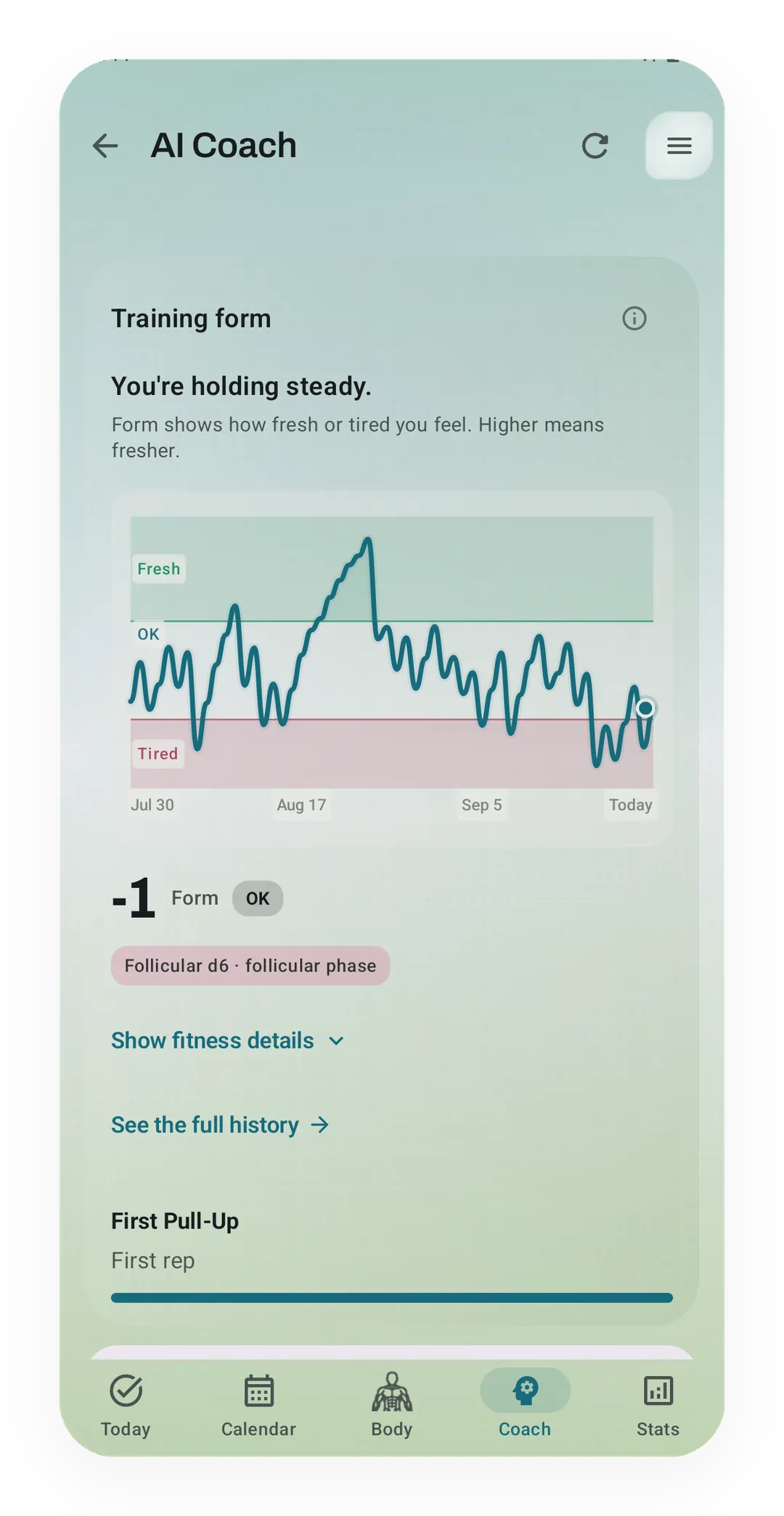
One curve for lifts and runs
Real app capture. Kinoku's Form curve scores every session, gym or road, in the same training stress units, so the week's load is one line.
One of the apps on this page
Kinoku is free to install
Core tracking works offline, with no account. An export from the app you use today can come along.
Android only for now, with an iPhone version in the works. Some depth is paid, and the pricing page says which parts.
Related features
Every set, one tap. Track how hard each set felt, your rest timers, set types, and notes.
Live pace, splits, a route map, and audio cues. Your run record is not uploaded to Kinoku; map tiles load when you view maps, and weather is a clear opt-in.
Daily steps, streaks, brisk minutes, and an hour-by-hour view of how you moved.
Pool and open water swims logged by stroke, distance and time, with swim achievements. Swim volume rolls into your weekly load and Kinoku score next to your lifts and runs.