

Activ.run Alternative: Kinoku vs Activ.run
Both log gym sets and GPS runs in one Android app with no account gate. Activ.run adds Garmin sync; Kinoku adds steps, classes, Wear OS and one fitness curve.
Activ.run fits a lifter who runs with a Garmin and wants the lightest one-app log; Kinoku fits one who wants steps, classes, Wear OS and one fitness curve for lifts and runs, with no account.
Publisher disclosure
Kinoku, made by Dreamsoft Works, writes and publishes this page. Every Activ.run product fact is quoted from a Activ.run page we opened on September 20, 2026. What we say about Activ.run's export file describes the layout Kinoku's importer reads. We say where Activ.run is the better pick, and we give no score.
Quickstart
Activ.run and Kinoku answer the same question, one app for the lifts and the runs, and neither puts an account between you and the first set. Activ.run keeps the scope tight, a gym log and a GPS run tracker with Garmin, Strava and FIT sync [4], with a free core [6]. Kinoku widens it to steps, swims and classes, adds a Wear OS app, and scores every session on one fitness curve. So pick Activ.run for the lightest log with a Garmin behind it, and pick Kinoku for one record of everything you do and one load curve for all of it.
What Activ.run does well
Activ.run’s listing opens with “one app for your lifts and your runs” that tracks “gym workouts and GPS runs in a single place” [1]. The gym side logs “sets, reps, and weight in seconds” [2], and the run side tracks “live pace, distance, and time” [3]. A Garmin watch syncs in, FIT files import, and a Strava account syncs activities [4], with Health Connect sync as well [5]. Its homepage promises “no account gate, no onboarding wall” [7] and lists CSV export [8]. Its own Hevy page is candid about scope, conceding that “Hevy and Strong have large, dedicated communities and years of polish focused entirely on lifting” [10].
Side by side
Every Activ.run cell is a quote from its listing or site. Where its pages do not state a feature, the cell reads “Not stated”.
| Activ.run | Kinoku | |
|---|---|---|
| Logs sets | Yes [2] | Yes, with effort, set type and a muscle map |
| GPS runs | Yes [3] | Yes, with splits, climb and heart rate |
| Steps, swims, classes | Not stated | Yes |
| One load curve for lifts and runs | Not stated | Yes, the Form curve |
| Account | No gate [7] | None |
| Offline | Not stated | Core tracking works offline |
| Watch | Garmin sync [4] | Wear OS app |
| Strava | Account sync [4] | Archive import, GPX routes |
| Health Connect | Yes [5] | Yes, read and write |
| Export | CSV [8] | CSV, full ZIP backup |
| Imports | FIT [4] | Hevy, Strong, FitNotes, JEFIT (a lifting app), Strava archive (GPX), minimal CSV; no FIT |
| Training plans | On the roadmap [9] | Free templates, a builder and a calendar |
| Price | Core free [6]; no price printed | Free; deeper analytics Pro |
| Platform | Android [1] | Android |
Where Kinoku differs
Kinoku keeps more of the week in one place. Steps count every day, while swims and classes log beside the lifts. A run and a gym session each earn training stress points on the same Form curve, so a readiness read on Thursday reflects Monday’s squats and Wednesday’s tempo run. The Wear OS app starts a workout or a run without the phone and syncs back when paired. The importer reads five other apps’ files, and the muscle map shows how often and how hard each muscle was trained by the lifting.
Where Activ.run is the better pick
- A Garmin or a Strava account feeds your runs. Activ.run syncs both live [4] and imports FIT files; Kinoku reads a Strava archive as an import, GPX routes only, and has no FIT decoder.
- You want the smallest possible app. Activ.run’s pages describe a gym log and a run tracker and little else, which is the point for some people. Kinoku carries programs, a calendar, a muscle map and analytics you may never open.
- Training plans are not your concern either way. Activ.run says its plans are “on the roadmap, not shipped” [9]; Kinoku has templates and a builder, but no coached plan.
Moving over
Activ.run lists CSV export on its homepage [8]. Kinoku’s importer reads a minimal CSV with date, exercise, weight and reps columns, and the import format page shows the exact layout. We have not tested an Activ.run export file, so the column names may need a rename before import. Runs recorded on a Garmin reach Kinoku only when a Strava archive holds them as GPX files; an archive of FIT files is not read.
What Kinoku does not do
Kinoku does not sync with Garmin Connect or a Strava account, does not run on iPhone, has no social feed, and does not sync between phones through a cloud. Readiness, zone training and the deeper run dashboard are Pro, and the pricing page lists every gate. This page carries no emulator test of Activ.run; every Activ.run fact rests on its listing and its site as opened on September 20, 2026.
Related pages
- Best apps for lifting and running in one app: the same question against Hevy, Strong and Strava.
- Best hybrid training apps for Android: the plan-led apps for runners who lift.
- One app or two: tracking lifts and runs together: why one load curve matters.
Which one fits you
- Choose Activ.run if you want a fast gym log plus GPS runs in one app, your runs already live on a Garmin or in Strava, and steps, classes and a shared load curve are not on your list.
- Choose Kinoku if you want lifts, runs, steps, swims and classes in one history on your phone, no account, a Wear OS app, and one fitness curve that scores a squat session and a run alike.
Frequently asked questions
Does Activ.run need an account?
Its homepage says there is no account gate and no onboarding wall, so you can start a run or a workout without signing up. Kinoku has no account at all, and no Kinoku server holds the record; Android's system backup may still copy eligible app data to your own Google Drive. Neither app's pages describe a cloud account for sync between phones.
Is Activ.run free?
Its listing says there is no subscription wall on the core features, and no in-app purchase flag showed on the listing on September 20, 2026. Its pages print no price, so this page prints none. Kinoku's free plan has no caps on workouts, runs, routines or history, and its deeper analytics are Pro.
Which one works offline?
Activ.run's pages do not say, so this page makes no claim. Kinoku's core tracking works offline: sets, GPS runs, steps and classes all record without a connection, and route map tiles load from the network into a cache the first time they are seen.
Which one has a watch app?
Activ.run's pages name Garmin sync and FIT import rather than a watch app of its own. Kinoku has a Wear OS app that starts workouts, logs sets and records GPS runs without the phone, and it does not sync with Garmin Connect.
Can I move my history between them?
Activ.run's homepage lists CSV export, and its listing names FIT import. Kinoku's importer reads Hevy, Strong, FitNotes, JEFIT and Strava files and a minimal CSV, so an Activ.run CSV with date, exercise, weight and reps columns can come in that way. We have not tested an Activ.run export file.
Which one tracks steps and classes?
Kinoku counts daily steps, logs swims, mobility and classes, and keeps them in the same history as lifts and runs. Activ.run's listing names bodyweight tracking and Health Connect sync, and does not mention steps or classes, so this page does not claim them.
Which one scores lifts and runs on one fitness curve?
Kinoku does. A gym session and a run each earn training stress points on one Form curve, so the readiness read reflects the whole week. Activ.run's pages describe volume, pace and zone trends, and do not describe a shared load curve, so the table says not stated.
What does Kinoku not do that Activ.run does?
Sync with Garmin Connect or a Strava account. Kinoku reads a Strava archive through its importer, which is a file, not a live sync, and it reads the GPX routes inside it; FIT files are not read. Kinoku is also Android only for now, with no social feed, and readiness, zone training and the deeper run dashboard are Pro.
How this page is checked. Every Activ.run product fact on this page comes from a Activ.run page we could open and quote on September 20, 2026. The sources, with the exact sentence each fact rests on, are listed just above. What we say about Activ.run's export file describes the layout Kinoku's importer reads. Every Kinoku fact is tied to the shipping app's code. If a fact here has gone stale, the support page is the fastest way to tell us.
Kinoku in practice
Where this shows up in the app
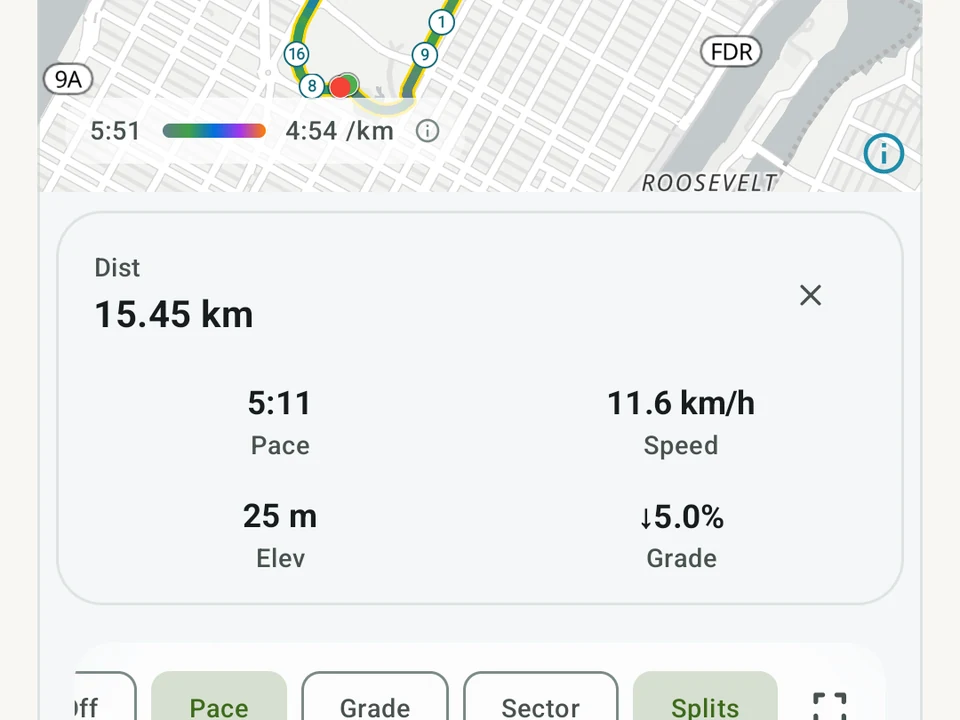 Open full-size image ↗
GPS runs in the same app as the lifts
Real app capture. A Kinoku run with its route, splits and pace, logged into the same history as the gym sessions.
Try the other side of the table
Kinoku is free to install
Core tracking works offline, with no account. Your export from Activ.run can come along.
Android only for now, with an iPhone version in the works. Some depth is paid, and the pricing page says which parts.
Related features
Live pace, splits, a route map, and audio cues. Your run record is not uploaded to Kinoku; map tiles load when you view maps, and weather is a clear opt-in.
Every set, one tap. Track how hard each set felt, your rest timers, set types, and notes.
Daily steps, streaks, brisk minutes, and an hour-by-hour view of how you moved.
The lead card on the Coach screen shows how fresh or tired you are right now. One Form line sits over three soft bands: Fresh, OK, and Tired, with a state pill beside it. Tap Show fitness details for the fitness and fatigue lines behind it. The base chart is free for all. Pro adds forecast lines and a note in plain words.