
What app tracks my workouts and my menstrual cycle together?
Seven Android apps, with the four that hold your workouts and your cycle in one app first. Kinoku leads because it needs no account. Each fact is quoted.
Kinoku, Garmin Connect, Google Health and Samsung Health track your workouts and your menstrual cycle together, and Kinoku is the one of those four with no account; Wild AI and FitrWoman give advice by phase.
At a glance
| App | Best for | Better at | Main trade-off |
|---|---|---|---|
| Kinoku | Lifters and runners who want their workouts and their menstrual cycle together, free and with no account | Gym sets, routines and GPS runs in one app with free cycle tracking, and phases on the training calendar | Android only for now, and links between training and phases need Pro and three logged cycles |
| Garmin Connect | Garmin watch owners who want cycle notes next to their activities | Cycle reports beside sleep, stress and activities recorded on a Garmin watch | Built around a compatible Garmin device and a Garmin sign-in |
| Google Health | Fitbit and Pixel Watch owners who want cycle, sleep and workouts in one app | Workout plans and a coach in the same app as menstrual cycle tracking | A Google account is required, and the coach needs Google Health Premium |
| Samsung Health | Galaxy owners who want cycle tracking inside their everyday health app | Cycle tracking through Natural Cycles beside steps, workouts and sleep | A Samsung account is required, and some phones are not supported |
| FitrWoman | Athletes who want to learn how their cycle may shape training and food | Phase-based reading, alerts at key times in the cycle, and a recipe library | Needs an account, and its listing names no workout log |
| Flo | People who mainly want a period tracker that can read activity from other apps | Over 70 symptoms to log, an Anonymous Mode, and activity read in from Health Connect | A period tracker first: its pages describe reading workouts in, not logging them |
| Wild AI | Athletes who want daily training and fuel advice tied to their cycle or life stage | Daily advice on training load and recovery, plus links to Garmin and Strava accounts | Its listing names no gym log, and its label lists data shared with third parties |
Publisher disclosure
Kinoku, made by Dreamsoft Works, writes and publishes this page, and Kinoku is one of the apps on it. Every fact about another app is quoted from a page that company publishes, opened on October 21, 2026. We give no score. Where the list is ordered, the caption names the measure, and every label points at a quoted sentence.
Quickstart
Kinoku, Garmin Connect, Google Health and Samsung Health keep your workouts and your menstrual cycle in one app, and Kinoku is the one of the four that needs no account. Wild AI and FitrWoman give advice by phase, and Flo reads activity in from other apps. The list follows that order, the caption names it, and we give no score.
Which apps track your workouts and your cycle together?
Four of the seven apps here keep your workouts and your cycle in the same app, going by their own pages. The other three turn your phase into advice or track your period while they read activity from elsewhere.
- Training apps with a cycle tracker inside: Kinoku, Garmin Connect, Google Health and Samsung Health. Kinoku needs no account and puts cycle phases on the same calendar as your gym sets and runs. Garmin’s listing shows trends for heart rate, steps, sleep and your cycle side by side. Google Health tracks “sleep, workouts, nutrition and menstrual cycles”, and Samsung Health runs cycle tracking with a partner. All three name a sign-in or an account on their own pages.
- Training advice built around the cycle: FitrWoman and Wild AI. FitrWoman says it helps you “train, compete and recover in sync with your menstrual cycle.” Wild AI’s listing opens with “Train, fuel and recover based on your female physiology.”
- A period tracker that reads your activity: Flo. Its privacy policy says the data it reads in from apps such as Health Connect “may include fitness activities”, while the app itself is built for periods, fertility and pregnancy.
Side by side
Every cell comes from the app’s own listing, policy or help pages, and “Not stated” means none of the pages we could open covers that point.
| App | Cycle tracking | Workouts | Advice by phase | Account | Where the data is kept | Paid layer |
|---|---|---|---|---|---|---|
| Kinoku | Periods, symptoms, estimates, phase calendar | Gym sets, routines, GPS runs | A short Coach message per phase, which you can switch off; no plan changes | None | A separate database on the phone | Pro links training to phases; tracking is free |
| Garmin Connect | Cycle trends and reports | Activities from a Garmin device | Educational content by phase | Sign-in in its setup steps | Not stated | Not stated |
| Google Health | Menstrual cycle tracking | Workouts and workout plans | Not stated | Google account required | Not stated | Premium for some features |
| Samsung Health | Through partner Natural Cycles | Running, cycling, swimming | Not stated | Samsung account required | Synced with your Samsung account | Optional paid content |
| FitrWoman | Period and daily symptoms | Not stated | Content and alerts by phase | Needed | Google Cloud, Europe-West region | Not stated |
| Flo | Period, ovulation, pregnancy | Reads fitness activities from Health Connect | Not stated | Anonymous Mode offered | Its own backup systems | Premium |
| Wild AI | Cycle, birth control, menopause stages | Supports your existing training; running plans | Daily recommendations | Not stated | Not stated | “In-app purchases” label |
Each app, in its own words
Kinoku
Best for: Lifters and runners who want their workouts and their menstrual cycle together, free and with no account.
Kinoku is a training app for Android with no account, so your workouts and your menstrual cycle sit together in one app. Cycle Tracking is a free part of it that you switch on when you want it.
- What it does well: You log periods, symptoms, your waking temperature and other signs of your fertile days, and Kinoku works out your next period and fertile window from the cycles you have logged. A mode for trying to conceive and a pregnancy mode are there if you want them. The Training Calendar draws a thin colored band for each phase under the days where you plan squats or runs. A ring marks a period Kinoku expects, so it never looks like one you logged.
- How it treats your phase: A settings card called “Where your cycle data shows up” lets you turn the phase off on the Coach screen, the calendar, your Kinoku Score and Readiness, one at a time. Kinoku never uses the phase to change your plan or those two scores, because the research on phase effects is mixed.
- What is Pro: Once three full cycles are logged, Pro lines up your sessions against your phases, so a run of heavy weeks in one phase reads as your own pattern. Pro can also read period entries from Health Connect, and that link only reads.
- Where the data goes: Cycle records and Cycle Tracking settings live in a database file of their own on the phone, and no Kinoku server holds them. Android’s automatic backup to your Google account does not copy that file. A backup ZIP you make yourself does carry it, and so does a phone-to-phone move you start. A custom metric you make lives in the main database, which Android’s backup can copy.
- What Kinoku does not do: The app is for Android phones, and there is no iPhone version yet. It writes no workout plan around your phase, reads no temperature from a watch or ring, and has no sync between two phones. It is a tracker rather than a medical tool, and a guess can drift when a cycle runs long or short. Official listing: Google Play.
Garmin Connect
Best for: Garmin watch owners who want cycle notes next to their activities.
Garmin Connect is the phone app for Garmin watches, and cycle tracking sits among its health stats.
- What it does well: Its listing shows trends for heart rate, steps, sleep, stress and your cycle in one place, and you can “Create customized workouts and courses”. Garmin’s 2019 blog post says you can link your cycle to changes in your sleep, stress and activities.
- What its pages say about phases: Garmin’s press release from the same year says users get reading on food and training for the phase they are in. Its blog adds that knowing your phase “can also help you understand what kind of training works best during that phase.”
- What its pages say about limits: You see your activities once you pair “another compatible Garmin device”, and the blog’s setup steps begin “Sign in to Garmin Connect on your smartphone or a desktop.” Garmin’s privacy page did not load as text for us, so this page says nothing about where Garmin stores data, beyond its Play label for no data shared.
- Where it is the better pick: Someone who already wears a Garmin and wants the cycle in the same app as runs, sleep and stress. Official listing: Google Play.
Google Health
Best for: Fitbit and Pixel Watch owners who want cycle, sleep and workouts in one app.
Google renamed the Fitbit app to Google Health, which folds cycle tracking into a broad health app.
- What it does well: You can track “sleep, workouts, nutrition and menstrual cycles” in one app. The listing talks about tracking your cycle “to understand how each phase affects your routine”, and it says “Google Health designs workout plans around your goals.”
- What its pages say about limits: Google’s help page says a Google account is required to use Google Health. The coach is “Available in certain countries with Google Health Premium”, and some other features need that subscription too.
- Where it is the better pick: A Fitbit or Pixel Watch owner who is happy with a Google account and wants plans, sleep and cycle in one place. Official listing: Google Play.
Samsung Health
Best for: Galaxy owners who want cycle tracking inside their everyday health app.
Samsung Health is Samsung’s own health app, and its cycle tracking comes from a partner.
- What it does well: The listing says cycle tracking, with help for symptoms and insights, comes “through your partner, Natural Cycles.” The same app records workouts “such as running, cycling, swimming, etc.”
- What its pages say about limits: Samsung’s support page says that from version 6.15 on, the app needs you to sign in to a Samsung account. The listing adds “Tablets and some mobile devices are not supported”, and some content needs an optional paid subscription.
- Where the data goes: Samsung’s support page says a new phone gets your data when you sync your Samsung Health profile to your Samsung account.
- Where it is the better pick: A Galaxy phone or watch owner who wants cycle tracking in the app they already use for steps and sleep. Official listing: Google Play.
FitrWoman
Best for: Athletes who want to learn how their cycle may shape training and food.
FitrWoman is a cycle app made by Orreco for female athletes, and most of its weight sits in reading and advice.
- What it does well: You log your period and your symptoms each day, and the app gives “personalized content based on your cycle status”. It sends alerts at key times in your cycle, and it has a library of snack and meal recipes.
- What its pages say about limits: The listing is candid that “there is no guarantee that our recommendations will work for you”. Its privacy policy says it asks for your name, email and date of birth “when you set up your account”.
- Where the data goes: The policy says “The Personal and Sensitive Data we collect is stored in Google Cloud’s Europe-West region.” Its Play label says no data is shared with third parties.
- Where it is the better pick: An athlete who wants to read about each phase and plan food around it, with training logged in another app. Official listing: Google Play.
Flo
Best for: People who mainly want a period tracker that can read activity from other apps.
Flo is a period, fertility and pregnancy tracker, and it treats workouts as data it reads in rather than logs.
- What it does well: The listing counts over 70 symptoms and moods you can log, plus tools for fertile days and pregnancy. Its privacy policy says data it reads in from apps such as Health Connect “may include fitness activities”, and Flo works on Wear OS 3 watches.
- What its pages say about limits: The listing says Flo gives no medical advice and “is not a method of birth control or conception aid.” It also says Flo is free to download with the core tools.
- Where the data goes: Anonymous Mode lets you use Flo “without linking your name, email, or personal identifiers.” The privacy policy says it may take 90 days to wipe “your personal data stored in our backup systems”.
- Where it is the better pick: Someone whose main need is a period and pregnancy tracker, and who is happy to log training in another app. Official listing: Google Play.
Wild AI
Best for: Athletes who want daily training and fuel advice tied to their cycle or life stage.
Wild AI gives a daily suggestion for training, food and recovery.
- What it does well: Its listing offers daily advice that adapts to your cycle, your birth control, or the years around menopause. It aims to tune how hard and how long you train and how you recover, and it has running plans that “can be cycle-synced.”
- What its pages say about limits: The listing frames the app as a layer on top of your plan: “Use the recommendations in Wild AI to support your existing training.” It names no gym set log, and it carries the In-app purchases label.
- Where the data goes: You can link Wild AI to your Oura, Fitbit, Garmin, Training Peaks and Strava accounts. Its Play label says the app may share personal info, app activity, and app info and performance with third parties.
- Where it is the better pick: A runner or athlete who already trains with Garmin or Strava and wants one daily suggestion that weighs the cycle. Official listing: Google Play.
Where does each app keep your cycle data?
Cycle data is about as personal as health data gets, so where it lives is worth checking before you pick. The answer differs a lot across these seven apps, and each one below comes from the app’s own pages.
- On a company server: FitrWoman stores data in Google Cloud’s Europe-West region. Flo’s policy refers to its own backup systems, and Samsung Health moves your profile through your Samsung account.
- Behind an account: Google Health needs a Google account, Samsung Health needs a Samsung account, and Garmin’s setup steps start with signing in. None of those three pages names a region where the data is stored.
- Shared beyond the app: Wild AI’s Play label says it may share some data types with third parties. FitrWoman and Garmin Connect carry the label for no data shared, and so does Kinoku.
- On the phone: Kinoku keeps cycle records in their own database file on the device. Android’s automatic backup does not copy that file, so your cycle history does not reach your Google account through that route.
That last line has a few edges worth knowing. A backup ZIP you save yourself does include the cycle file, because moving your data is your choice, and so does a phone-to-phone transfer you start. Kinoku also cannot change an Android backup that Google already made from an older version of the app. The privacy architecture page shows the file rules and the tests that hold them in place.
What can cycle-based training advice tell you?
Cycle-based advice can point you at patterns worth watching, while the research behind it is thinner than the marketing around it. A 2020 review by McNulty and colleagues, published in Sports Medicine, pooled 78 studies and found that performance might drop by a trivial amount early in the cycle. Its authors wrote: “Practically, the current evidence does not warrant general guidance on modulating exercise across the menstrual cycle.” They suggested a personal approach based on how each person responds.
The apps here handle that gap in different ways. FitrWoman’s listing says its advice rests on research and still carries no guarantee for you. Wild AI gives a daily suggestion for training, food and recovery, and Garmin frames its phase content as education.
Kinoku takes the most hands-off line. Its Coach screen can show a short message for each phase, which you can switch off, and with Pro it compares your own sessions across your own phases once three full cycles exist. It never moves a set or a score because of your phase, so any change to your plan stays your decision.
How this list was checked
We first read each cycle and workout claim about the six other apps on the maker’s own pages on October 12, 2026, and a script fetched every quoted sentence again on October 21, 2026.
- Other apps: Every line about FitrWoman, Wild AI, Garmin, Google, Samsung or Flo rests on a Play listing, a privacy policy, a help page, a blog post or a press release, and the sources list each one. We ran no phone test for this page, so a table cell is a quote or “Not stated”.
- Gaps: Wild AI’s website did not load for us on October 12, 2026, so its facts come from its Play listing alone. Garmin’s privacy page did not load as text, so this page makes no claim about where Garmin stores data.
- Kinoku: We checked each Kinoku claim against the app’s source code, down to the lines that decide what is Pro, and against the Cycle Tracking feature page.
- Order: Apps whose own pages say they keep your workouts and your cycle in one app come first. Inside that group, the app with no account comes first, and Garmin’s, Google’s and Samsung’s pages each name a sign-in or an account. Everything after that runs A to Z, and no app maker paid for a place on this list.
Frequently asked questions
What app tracks my workouts and my menstrual cycle together?
Kinoku, Garmin Connect, Google Health and Samsung Health each keep your workouts and your cycle in one app. Kinoku is the one of the four with no account, and it logs gym sets, routines and GPS runs with free cycle tracking inside. Wild AI and FitrWoman give training advice for each phase, while their listings describe no workout log of their own.
Which app adjusts my training to my menstrual cycle?
Wild AI comes closest. Its listing promises daily recommendations that adapt to your cycle, with advice on training intensity, length and recovery, plus running plans that can follow your cycle. FitrWoman offers content and alerts based on your phase. Kinoku never changes your plan by phase. Its Coach screen can show a short message for each phase, which you can switch off.
Is there a cycle tracking app that does not need an account?
Kinoku asks for no account at all, and its cycle tracking is free. Flo has an Anonymous Mode that unlinks your name and email from your data. Samsung Health, Google Health and FitrWoman each name an account on their own pages, and Garmin’s setup steps start with signing in. Wild AI’s pages that we could open do not say.
Where do these apps keep my cycle data?
FitrWoman’s policy says its data is stored in Google Cloud’s Europe-West region. Flo’s policy mentions its own backup systems, Samsung Health syncs your profile with your Samsung account, and Google Health needs a Google account. Garmin’s steps start with signing in. Kinoku keeps cycle records in a separate database on your phone, with no Kinoku server involved.
Does Android backup copy Kinoku’s cycle records to Google?
Android’s own backup to your Google account does not copy the file that holds Kinoku’s cycle records and settings. A backup ZIP you make yourself does carry it, and so does a phone-to-phone move you start. A custom metric you make lives in the main file, which Android’s backup can copy. Kinoku also cannot change an old backup that Google already holds.
Is Kinoku’s cycle tracking free?
Yes, the tracking itself is free. You can log periods, symptoms and your waking temperature, and see when your next period and fertile days may come. A mode for trying to conceive, a pregnancy mode and the phase band on the Training Calendar are free too. Pro adds two things: it reads period entries from Health Connect, and it lines up your training against your phases once three full cycles are logged.
Does cycle syncing your workouts improve results?
No app on this list proves that. A 2020 review of 78 studies by McNulty and colleagues found that performance might drop by a trivial amount early in the cycle, and it said the evidence does not support general rules. It suggested a personal approach instead. FitrWoman’s listing also says there is no guarantee its advice will work for you.
Can any of these apps be used as birth control?
Flo’s listing says plainly that it is not a method of birth control or a conception aid. Kinoku is not a medical device either, and its mode for trying to conceive opens with a notice saying it is not suitable for preventing pregnancy. The other pages we read make no birth control claim, so this page does not make one for them.
Which of these apps log gym sets as well as the cycle?
Kinoku logs sets, reps, weight and routines in the same app as its cycle tracker. Garmin Connect lets you create custom workouts, Google Health builds workout plans, and Samsung Health records running, cycling and swimming. Wild AI supports the training you already do, and Flo reads fitness activities in from Health Connect, but neither listing names a set-by-set gym log.
Can I bring my period history from another app into Kinoku?
With Pro, Kinoku can read period entries that another app has written to Health Connect. The link is read-only, so Kinoku never writes your period data back to Health Connect. On the free tier you type past periods in by hand, and you can edit the start and end of any period you have logged.
Which of these apps work with a Garmin watch?
Garmin Connect is Garmin’s own app, and its listing shows cycle trends next to the activities your watch records. Wild AI’s listing says it can sync with your Garmin, Strava, Oura, Fitbit and Training Peaks accounts. Kinoku has no direct Garmin link, and it reads workouts that other apps write to Health Connect instead.
What does Kinoku not do for cycle tracking?
Kinoku runs on Android today, and an iPhone version is in the works. It gives no phase-based workout plans, and it never uses your phase to change your Kinoku Score or Readiness. It reads no wearable temperature, so your waking temperature is typed by hand. It has no sync between two phones, and it is a tracker rather than a medical tool.
Related pages
- Cycle Tracking: What Kinoku logs, what it estimates, and which parts are Pro.
- Reproductive health privacy architecture: The separate database, the backup rules and the tests behind them.
- Training Calendar: Where the phase band sits next to your planned and logged sessions.
- Best privacy-focused fitness apps for Android: What each app’s own Play label says it collects and shares.
- Free workout trackers with Health Connect: What each app reads from and writes to Health Connect.
- Best Google Fit alternatives: Steps and workout apps for Google Fit users, Google Health among them.
Which one fits you
- Choose Kinoku if you want your workouts and your menstrual cycle together in one free Android app, with no account.
- Choose Garmin Connect if you already wear a Garmin watch and want cycle reports in the same place as your runs and sleep.
- Choose Google Health if you wear a Fitbit or a Pixel Watch, a Google account is fine, and you want workout plans next to your cycle.
- Choose Samsung Health if you use a Galaxy phone or watch and want cycle tracking in the health app it came with, with a Samsung account.
- Choose FitrWoman if you want reading, alerts and recipes for each phase of your cycle, and you log your training somewhere else.
- Choose Flo if you mostly want a period and pregnancy tracker, and seeing activity from your other apps is enough.
- Choose Wild AI if you want a daily suggestion for training and fuel based on your cycle, birth control or menopause stage, and you train with Garmin or Strava.
How this page is checked. Every fact about another app on this page comes from a page that app publishes, which we could open and quote on October 21, 2026. The sources, with the exact sentence each fact rests on, are listed just above. Every Kinoku fact is tied to the shipping app's code. The page carries no score; the caption above names the measure the list is ordered by. If a fact here has gone stale, the support page is the fastest way to tell us.
Kinoku in practice
Where this shows up in the app
 Open full-size image ↗
Where you are in your cycle
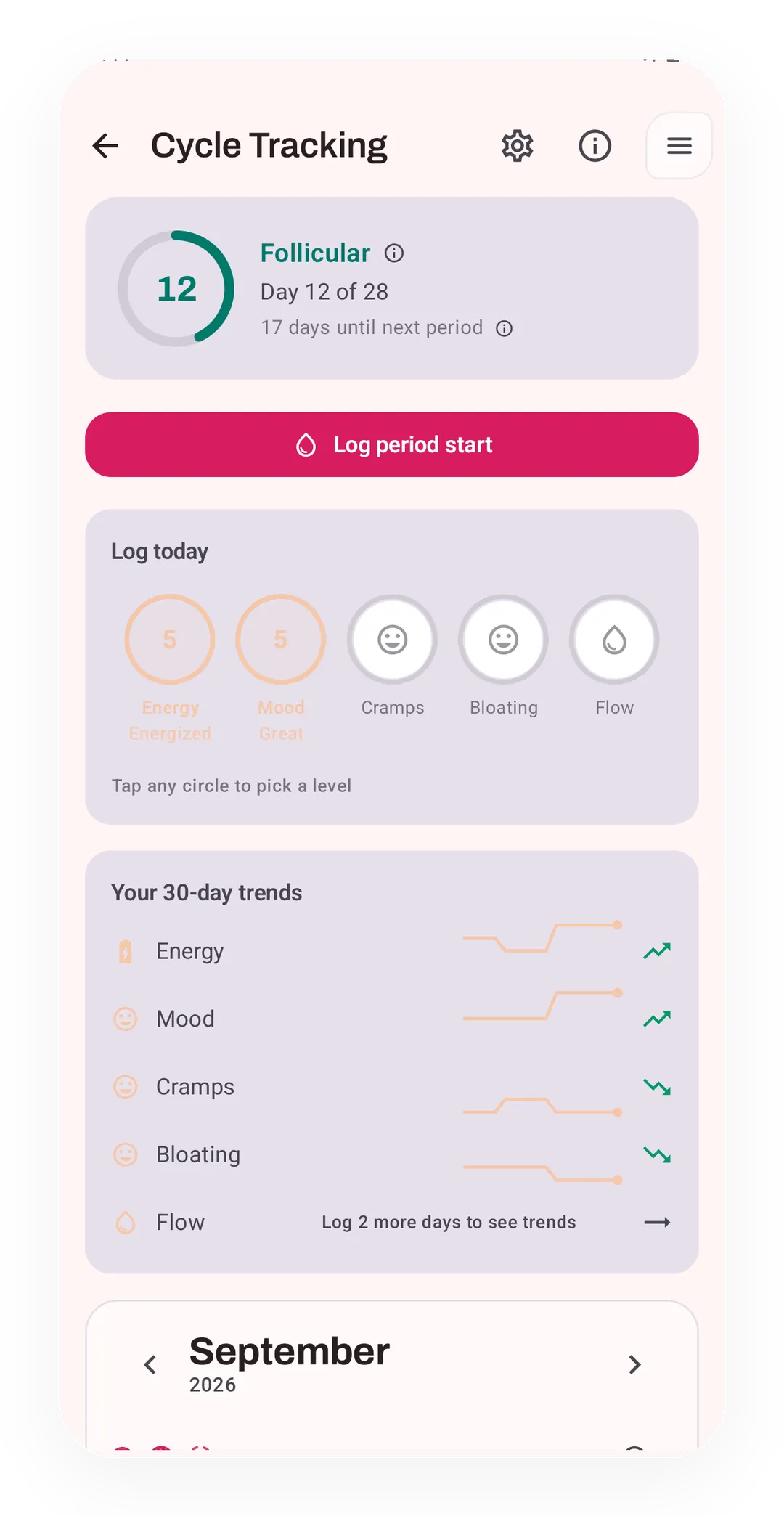
Real app capture, free tier. Kinoku's Cycle Tracking screen shows the follicular phase on day 12 of 28, with 17 days to the next period, and circles for logging today below.
One of the apps on this page
Kinoku is free to install
Core tracking works offline, with no account. An export from the app you use today can come along.
Android only for now, with an iPhone version in the works. Some depth is paid, and the pricing page says which parts.
Related features
Full cycle, fertility, and pregnancy tracking, with phase context and training links. Dedicated raw records and generated cycle state are excluded from future Android automatic cloud backup, standard exports, share cards, and Kinoku servers. Your Cycle Tracking configuration lives in that same excluded database, while user-created metrics remain eligible for Android system backup in your Google account. A manual ZIP or user-initiated device transfer can carry the dedicated database.
Plan workouts on one calendar, with no limit on how many plans you keep or how far ahead you plan. Pro adds repeating schedules (weekly, custom days, or every few weeks), drag-to-move, bring-to-today, repeat-day, and day copy.
Coaching screens that run on your phone and explain what changed in your training and why it matters.
Kinoku reads and writes Android Health Connect data without passing it to a cloud. Period flow import is a Pro feature and read-only. Kinoku never writes cycle data back to Health Connect.
Lossless backup, open CSV and JSON import, Strava import, and a scoped Export for AI handoff.