

FFMI Explained: How Much Muscle Do You Carry?
Fat-Free Mass Index rates lean mass for your height. What the adjusted version fixes, where the natural ceiling came from, and how wrong yours can be.
Kinoku in practice
Where this shows up in the app
 Open full-size image ↗
Body-composition context
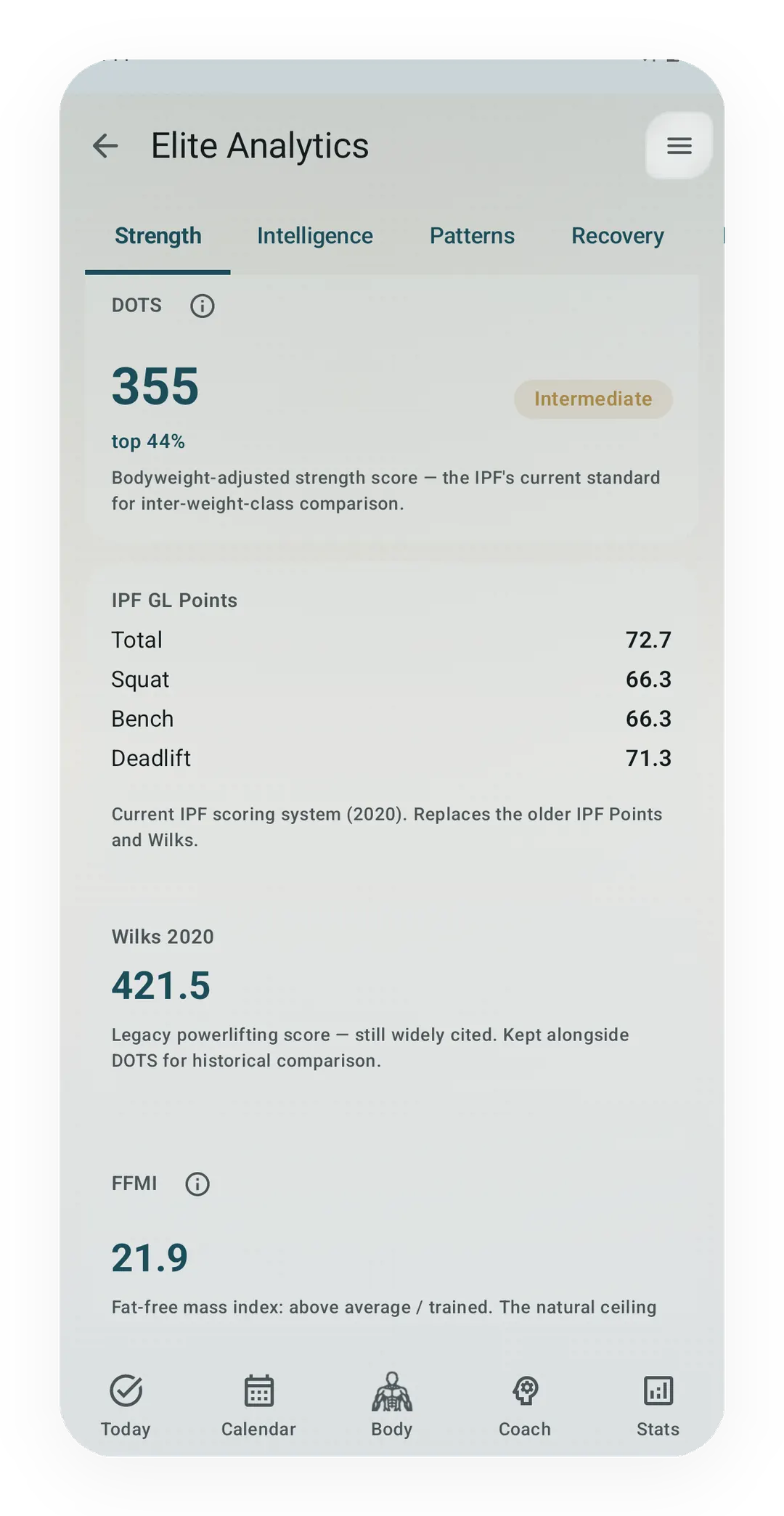
The Strength Scores surface places FFMI and related bodyweight context beside the inputs that drive them.
Quickstart
FFMI stands for Fat-Free Mass Index, and it estimates the lean mass you carry for your height. A tall lifter and a short one then land on one scale. The familiar 20-to-25 bands come mostly from male data. The bands are not validated as universal standards, and 25 is not a proven biological ceiling.
The catch is that FFMI depends entirely on your body-fat number. So if that number is a guess, your FFMI is a guess too.
Try it on the FFMI calculator, where nothing you type leaves your browser.
What it measures
BMI, or body mass index, has a well-known problem for lifters. It divides total weight by height squared, so muscle and fat count the same. A lean 95 kg lifter and a 95 kg couch potato of the same height then get the same BMI.
FFMI fixes that by throwing out the fat first:
fat_free_mass_kg = weight_kg × (1 − bodyFatPercent / 100)
FFMI = fat_free_mass_kg / (height_m)²
So it asks a different question than BMI. Not “how heavy are you for your height” but “how much lean mass do you carry for your height”.
The height adjustment
Plain FFMI still favours shorter people a little, because lean mass does not scale with height squared as neatly as the formula assumes.
The fix is a correction back to a reference height of 1.80 m:
adjusted_FFMI = FFMI + 6.1 × (1.80 − height_m)

# Kouri's published abstract prints 6.3; the paper body uses 6.1, and
# 6.1 is what nearly every calculator has used since. The two differ by
# at most 0.08 across normal heights.
If you are shorter than 1.80 m the correction adds points, and if you are taller it takes some away. This adjusted version is the one Kouri used, and it is the one the ceiling talk refers to. When someone quotes an FFMI number without saying which version, they usually mean this one.
How to read your number
Important limitation first: Kouri’s ceiling sample included only men, so the table below is a rough male-oriented guide. Do not read it as a validated scale for women, since the same cut-offs were never tested on them. In a larger general-population study, Schutz and colleagues reported different sex-specific numbers (median 18.9 for men and 15.4 for women aged 18–34).
| Adjusted FFMI | What it usually means |
|---|---|
| Under 18 | Low lean mass. Most untrained people sit here |
| 18 to 20 | Average |
| 20 to 22 | Above average. Typical of a lifter who trains steadily |
| 22 to 24 | Advanced. Years of consistent work |
| 24 to 25 | Near the upper edge of Kouri’s small nonuser sample |
| 25 to 26 | Above that sample edge; not proof of enhancement |
| Over 26 | Well above that sample edge; interpretation needs better body-composition data |
Where the “natural limit” number comes from
Kouri and colleagues published the key paper in 1995. They measured 157 male athletes: 83 who used anabolic steroids and 74 who did not. The 74 gave urine samples that came back clean, but they were a gym sample rather than a screened elite group. Their normalised FFMI topped out at 25.0.
That single number then travelled a long way. It shows up in forum arguments as a hard physical law, which is not what the paper said.
The paper’s own words for that result were “must be regarded as preliminary”. So 25 is where one small group happened to stop, not a wall built into human biology. It gets quoted as a wall constantly, including by people selling things.
The study has no female data, so it cannot establish a female ceiling. Schutz and colleagues’ larger general-population study found different sex-specific FFMI numbers. So the table above is male-oriented shorthand rather than a universal scale.
How wrong the number can be
Most FFMI pages skip this part, because your FFMI is only as good as your body-fat estimate. And the body-fat methods vary a lot:
- DEXA scan (an X-ray body scan): generally more repeatable, but still affected by device, protocol, hydration, and analysis choices
- Calipers: strongly dependent on the equation and the person taking the measurements
- Smart scale or hand-held device: sensitive to hydration and the manufacturer’s model
- Photo comparison or a guess: useful only as a broad visual estimate, not a measurement
A 5-point miss on body fat shifts a typical adult’s FFMI by more than a point. That is the whole width of a band in the table above.
So read your FFMI as a range. If your body fat might be 15% or might be 19%, run both and look at the spread. And if you are tracking change over time, keep using the same method. The trend is far more trustworthy than any single reading.
FFMI and strength are different questions
FFMI asks how much muscle you carry, while DOTS (a score of strength for your body weight) asks how strong you are. The two do not always agree.
A wiry lifter can post a high DOTS with a modest FFMI. A big, muscular person who has never trained for a meet can carry a high FFMI with a middling DOTS. Neither pairing is a contradiction, because they are measuring different things.
If you want both sides of the picture, read them together. The muscle you carry and what you can do with it are not the same fact.
Track this in Kinoku
The Strength Standards feature works out FFMI next to DOTS, IPF GL (the International Powerlifting Federation’s GoodLift score), and Wilks 2. The screen reads the body-fat number in your profile and rescores when you change it. Strength Standards sits inside Pro Analytics, which is a Pro feature.
Pairing it with Progress Photos gives you a second read that no formula can provide. The number and the mirror tell you different things.
The FFMI calculator here runs the same math without the app. Nothing is stored, and nothing is sent.
References
Track this in the app
Strength Standards
DOTS, IPF GoodLift, Wilks 2, and FFMI with offline percentile tables. Published tools widely used in strength sport.
Core tracking works offline, with no mandatory account.
Related features
DOTS, IPF GoodLift, Wilks 2, and FFMI with offline percentile tables. Published tools widely used in strength sport.
A Pro hub with five core tabs, plus a Cycle tab when cycle tracking is on. Its 20+ features include strength scores like DOTS, IPF GL, Wilks, and FFMI, the Banister Form Band, plateau alerts, ACWR, muscle balance, and cycle links.
Unlimited capture, pose matching, tags, and the gallery grid are free. Pro adds the Timeline and two-photo Compare tools. Kinoku does not upload photos to its servers; some files may enter Android system backup.