

Max Heart Rate by Age: Chart, Formulas and Target Zones
Max heart rate is about 208 minus 0.7 times your age. A chart for ages 20 to 70, three formulas side by side, and how to turn your max into target zones.
Kinoku in practice
Where this shows up in the app
 Open full-size image ↗
Zones per run, from pace
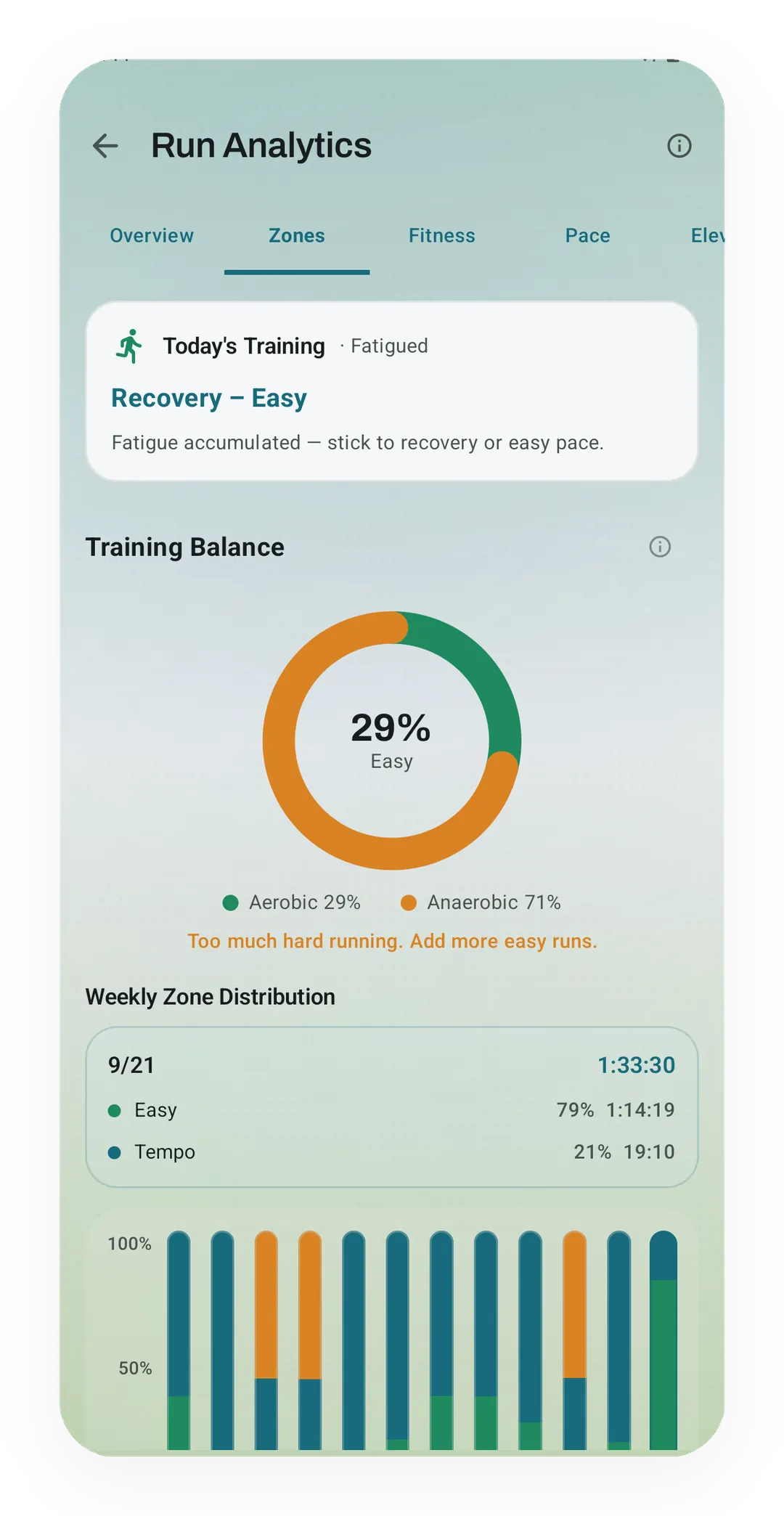
App capture with fictional runs. The Zones tab in Pro Run Analytics shows a week of 9/21 at 1:14:19 easy and 19:10 at tempo. These are pace zones, which Kinoku works out from your own runs, so they are a different method from the heart rate zones on this page.
Quickstart
Max heart rate by age is about 208 minus 0.7 times your age, from a 2001 study by Tanaka, Monahan and Seals. That gives 180 beats per minute (bpm) at 40 and 166 bpm at 60. Every formula gives an average for a group, and a single person’s max can land 10 or more beats away from that average.
The free max heart rate calculator does the sums for any age and lists your zones. This page explains where the numbers come from, how far to trust them, and how a target zone follows from a max.
Max heart rate by age chart
The chart below gives the estimated max heart rate in bpm from three common formulas, for ages 20 to 70. The Tanaka column is rounded down to a whole beat, which is how the Kinoku app rounds it, and the Gulati column is rounded to the nearest beat.
| Age | 220 minus age | Tanaka (Kinoku’s default) | Gulati (women) |
|---|---|---|---|
| 20 | 200 | 194 | 188 |
| 25 | 195 | 190 | 184 |
| 30 | 190 | 187 | 180 |
| 35 | 185 | 183 | 175 |
| 40 | 180 | 180 | 171 |
| 45 | 175 | 176 | 166 |
| 50 | 170 | 173 | 162 |
| 55 | 165 | 169 | 158 |
| 60 | 160 | 166 | 153 |
| 65 | 155 | 162 | 149 |
| 70 | 150 | 159 | 144 |
The old formula and Tanaka’s cross at 40. Younger than that, 220 minus age gives the higher number, and older than that it gives the lower one. By 70 the gap is 9 beats, which is the problem Tanaka’s team pointed to when they wrote that the older formula underestimates max heart rate in older adults.
The Gulati column sits lowest at every age, because it comes from a study of women only. The women in that study averaged 52 years old, so its rows at 20 and 25 stretch the formula well past most of the people it was built from.
How to calculate max heart rate
To work out Tanaka’s estimate, multiply your age by 0.7 and take that away from 208. Take a 45-year-old as the example. 0.7 times 45 is 31.5, and 208 minus 31.5 is 176.5, which Kinoku rounds down to 176 bpm.
Tanaka’s team reached that formula by pooling 351 earlier studies with 18,712 people in them. They then measured 514 healthy adults in their own lab and got 209 minus 0.7 times age, almost the same line. Neither sex nor how active people were made a difference to it.
The 220 minus age formula is older and much more widely printed. It is traced to a 1971 paper by Fox, Naughton and Haskell. A 2002 review by Robergs and Landwehr found that it came from looking over about 11 earlier sources, not from original research, and that later studies found large errors in it.
Gulati and colleagues looked at 5,437 women who took a maximal exercise stress test. Their peak heart rate followed 206 minus 0.88 times age, and the authors wrote that the usual formula, built mostly on men, gives women a max that is too high. Tanaka’s pooled data found no gap between men and women, so the two studies disagree. Each one is a fair summary of the people it measured.
Why your own max can differ from any formula
A max heart rate formula draws one line through a crowd of people, and most of them sit off the line. In their 2002 review, Robergs and Landwehr measured the typical miss at 7 to 11 bpm, and they noted that it can be larger than 11.
An error that size means a 45-year-old whose chart value is 176 can have a real max near 186, or near 166. Tanaka’s team found that age alone predicts max heart rate to a large extent, and the rest of the spread comes from the person. A formula has no way to see which side of the line you are on, which is why the chart is a starting point rather than an answer.
That matters most for training zones. If your real max is 10 beats above the chart, every zone worked out from the chart sits too low for you, and a run filed as easy may feel like a stroll.
How to find your measured max
A measured max is the highest heart rate you reach in a very hard effort, read from a heart rate monitor. One common source is the end of a hard race, such as a 5 km run with a sprint over the last few hundred meters. Your true max is at least as high as the highest real reading you have seen, so a hard race gives you a floor to work from.
Sensors can misread, so a single spike far above every other effort is worth doubting before you use it. Our post on whether you are really in zone 2 looks at heart rate drift and the errors a wrist sensor adds.
An all-out effort is hard on the heart by design. If you have a heart condition, take a medicine that slows your heart rate, or have had chest pain, dizziness or unusual breathlessness when you exercise, a talk with a doctor before any maximal test is the safer choice. A supervised exercise stress test, the kind used in Gulati’s study, measures your peak heart rate with medical staff in the room.
How to calculate target heart rate zones
Target heart rate zones come from your max in one of two ways. The simple way takes a share of your max, so 60 percent of a 173 bpm max is 104 bpm. The heart rate reserve way, often called the Karvonen method after a 1957 study by Martti Karvonen and colleagues, also uses your resting heart rate.
Your heart rate reserve is your max minus your resting heart rate. A target is your resting heart rate plus the share you want of that reserve. Resting heart rate is the pulse you count lying in bed just after you wake.
Take a 50-year-old with Tanaka’s max of 173 bpm and a resting heart rate of 60. The reserve is 113 beats. Here is zone 2, set at 60 to 70 percent, worked out both ways.
| Method | Sum | Zone 2 |
|---|---|---|
| Share of max | 0.6 x 173 to 0.7 x 173 | About 104 to 121 bpm |
| Share of reserve | 60 + 0.6 x 113 to 60 + 0.7 x 113 | About 128 to 139 bpm |
The same label, 60 to 70 percent, lands about 20 beats higher with the reserve method. That gap is one reason two apps can disagree about your zone 2 even when they agree on your max. Kinoku uses the reserve method, and below half your reserve it counts no zone at all.
Here are all five of Kinoku’s zones for that same runner, in whole beats the way the app sorts them. The app labels zone 5 VO2max, after VO2 max (the top rate at which your body can use oxygen), since that is the effort the zone sits near.
| Zone in Kinoku | Share of reserve | Age 50, max 173, resting 60 |
|---|---|---|
| 1, Recovery | 50 to 60% | 117 to 127 bpm |
| 2, Easy | 60 to 70% | 128 to 139 bpm |
| 3, Tempo | 70 to 80% | 140 to 150 bpm |
| 4, Threshold | 80 to 90% | 151 to 161 bpm |
| 5, VO2max | 90% and up | 162 bpm and up |
The VO2 max calculator estimates that rate from a timed run, with no heart rate needed.
Track this in Kinoku
Kinoku works out heart rate zones on your phone, from the max and resting heart rate it has for you. When you have not typed in a max, it uses Tanaka’s formula, rounded down, on the age from the date of birth in your profile. With no date of birth either, it works from an age of 35, which gives 183 bpm. With no resting heart rate, it uses 60.
You can enter a max and a resting heart rate of your own in the Performance thresholds part of Your Profile, and Kinoku then uses those in place of its defaults. That part is free on every plan. Recording a run with GPS is free too.
Time in each heart rate zone per run is part of Pro. It also needs the setting “Enrich runs with Health Connect heart rate”, under Settings, Run Tracking, Sensors & Privacy, which starts turned off. With both in place and Health Connect allowed to share heart rate, Kinoku reads the run’s heart rate after you finish. The run summary then shows the time you spent in each of the five zones above. A run without heart rate data can show pace zones in that card instead.
A few limits are worth knowing:
- Kinoku never raises your max on its own when a run goes past it. The number changes only when you edit it.
- The app has no built-in max heart rate test.
- The heart rate comes from whatever device saved it to Health Connect, so a wrist reading’s errors carry through.
- Kinoku runs on Android only.
Common questions
What is the max heart rate for my age?
Tanaka's formula puts the average max heart rate at 194 beats per minute at 20, 180 at 40 and 166 at 60. It works out as 208 minus 0.7 times your age. That is the middle of a spread, and a 2002 review found these formulas miss a typical person by 7 to 11 beats per minute, so the chart is a starting point for you.
How do you calculate your max heart rate?
To estimate your max heart rate, multiply your age by 0.7 and take the result away from 208, which is the formula from Tanaka, Monahan and Seals in 2001. At 45 that comes to 176.5, and Kinoku rounds it down to 176. A max you record yourself in a very hard effort is closer to the truth for you than any formula.
How do you calculate your target heart rate?
The heart rate reserve method takes your max minus your resting heart rate, multiplies that gap by the share you want, and adds your resting heart rate back. At 50, with a max of 173 and a resting heart rate of 60, zone 2 at 60 to 70 percent comes to about 128 to 139 beats per minute. A plain share of max gives a lower band, about 104 to 121.
Is 220 minus age accurate?
The 220 minus age formula is a rough guide that did not come from a study of its own. A 2002 history traced it to about 11 earlier sources, and Tanaka's 2001 study found it reads too low in older adults. At 70 it gives 150 beats per minute, while Tanaka's formula gives 159.
Do women have a lower max heart rate than men?
The research on women's max heart rate is split. Gulati's 2010 study of 5,437 women found that peak heart rate followed 206 minus 0.88 times age, which runs below the usual formula. Tanaka's 2001 study found no difference between men and women. Both describe group averages, so a measured max settles it for any one person.
Does getting fitter change your max heart rate?
Fitness did not move the age line in Tanaka's 2001 study, which found that how active people were made no difference to it. Training can lower your resting heart rate, though, and that widens your heart rate reserve, so your zones can shift even when your max stays put.
Is it safe to test your max heart rate?
An all-out effort puts real strain on the heart, so a talk with a doctor first is the safer choice for anyone with a heart condition, chest pain or dizziness during exercise, or a medicine that slows the heart. A supervised stress test, the kind used in Gulati's study, records your peak with medical staff on hand.
Can Kinoku use my own max heart rate?
Kinoku lets you enter a max and a resting heart rate of your own in the Performance thresholds part of Your Profile, and that works on the free plan. Without a max it uses Tanaka's formula on the age from your date of birth. Time in each heart rate zone per run is part of Pro and needs the Health Connect heart rate setting turned on.
Track this in the app
Zone Training
Pace zones, easy-versus-hard balance, and a training effect score built into your runs.
Core tracking works offline, with no mandatory account.
Related features
Pace zones, easy-versus-hard balance, and a training effect score built into your runs.
Live pace, splits, a route map, and audio cues. Your run record is not uploaded to Kinoku; map tiles load when you view maps, and weather is a clear opt-in.
Kinoku reads and writes Android Health Connect data without passing it to a cloud. Period flow import is a Pro feature and read-only. Kinoku never writes cycle data back to Health Connect.
Offline run breakdown with splits, a fitness score from your runs, a pacing score, best efforts, race forecasts, and a compare card that stacks each run against your similar past runs.