

Why does my bodyweight exercise volume look different?
Kinoku counts the body weight you lift on pull-ups, push-ups and dips, so 10 pull-ups at 75 kg add 750 kg of volume instead of a flat 10.
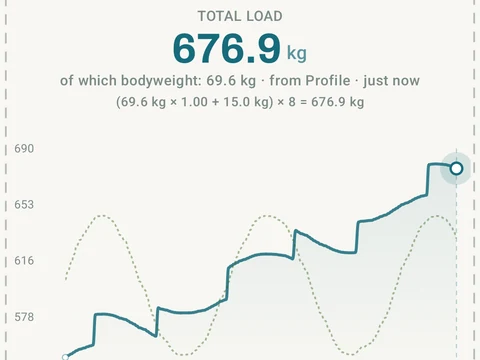
When Kinoku knows your body weight, a bodyweight set adds the load you lifted to your volume. Ten pull-ups at 75 kg add 750 kg, where an older set of the same pull-ups added a flat 10, one for each rep.
Not every move lifts your whole body, so each exercise carries its own share of body weight. A pull-up counts all of it, a dip about 98% and a push-up about 64%, because your feet hold up part of you on the floor. That keeps a push-up from looking as heavy as a pull-up when you compare them. Any belt or vest weight goes on top at its full weight.
Sets you logged before Kinoku had your body weight keep the old count, so your past weeks do not change. Only sets you complete while your body weight is known use the new math.
In the app
Bodyweight Total Load
Pull-ups, push-ups, and dips get real per-rep load from body-movement math, not just reps times one. The load math, snapshots, and Total Load chart are free; Pro scales the volume charts in Stats Analysis to your body weight.